
Mindfulness Coaching: What It Is, Evidence and Costs
Mindfulness coaching combines a regular mindfulness practice, such as short meditations, breath awareness or mindful pauses during the day, with coaching on how to use it in your actual life: at work, in relationships, around sleep or a goal you keep stalling on. A mindfulness coach teaches the practice, helps you keep it going and links it to changes you want. Mindfulness programs have moderate evidence for easing anxiety, depression and pain. It is not a treatment for mental illness, and for a small number of people meditation can stir up difficult experiences, which is worth knowing before you start.
Meditation apps have made the basics easy to try. Keeping a practice going, and using it in the moments that count, is the harder part. A coach adds the two things an app cannot: someone who notices when the practice slips, and help bringing it into the moments that matter. This guide covers what mindfulness coaching involves, how it differs from a meditation class or an MBSR course, what the research shows (including side effects), what it costs and how to choose a good coach.
Mindfulness coach, meditation teacher, MBSR course or therapist?
| Option | What you get | Best for |
|---|---|---|
| Mindfulness coach | One-to-one practice plus coaching on goals and daily life | People who want a personal practice tied to a specific change |
| Meditation teacher or class | Instruction in a tradition or technique, usually in a group | Learning to meditate, community, lower cost |
| MBSR course | Mindfulness-based stress reduction, a structured group program led by a trained teacher | A tested curriculum with a clear beginning and end |
| Meditation app | Guided recordings and reminders | Trying it out cheaply |
| Therapist | Treatment for anxiety, depression or trauma, sometimes including mindfulness-based methods | Anyone with a mental health condition |
If your main concern is everyday stress, our guide to stress management coaching covers the broader approach, and somatic coaching covers body-based work that often sits close to mindfulness.
Who mindfulness coaching suits
It tends to suit people who are basically well and want a steadier way through busy or tense days: managers who snap in meetings and regret it, parents running on four hours of sleep, people who lie awake replaying conversations, anyone who has tried an app and wants a human to keep them honest. It also suits people with a specific goal, such as eating more slowly, drinking less or handling a difficult relationship, who want awareness to be part of the change.
It is a weaker fit if you want a quick fix, if you are in acute distress, or if sitting still with your thoughts reliably makes things worse. In those cases, start with the box further down.
A three-minute practice to try first
Before paying anyone, try this once a day for a week. It shows you whether the basic idea suits you.
- Stop and notice (one minute). Sit or stand still. Ask: what am I thinking, what am I feeling, what do I notice in my body? Name it without fixing it.
- Narrow to the breath (one minute). Feel the breath where it is clearest, at the nose, chest or belly. When your mind wanders, which it will, bring it back without scolding yourself.
- Widen out (one minute). Let your attention spread to your whole body and the room, then carry on with your day.
If a week of this feels useful but hard to keep up, that is exactly the gap a coach fills. If it makes you feel distressed rather than calmer, read the safety section below before going further.
What happens in mindfulness coaching
A first session usually covers why you are here, what you have tried (an app, a retreat, a class), how your days run and where you most want to feel different: the commute, the 3pm crash, conversations with a teenager, falling asleep. Many coaches teach a short practice in that first session so you leave with something to do.
After that, sessions tend to have two halves:
- Practice. A guided practice together, five to twenty minutes, and a conversation about what you noticed.
- Application. Taking it into real life: the "pause before reply" for difficult emails, a mindful walk between meetings, noticing the first sign of irritation before it becomes a fight.
Between sessions you build a daily habit. A coach will usually start small, five minutes a day, rather than an hour, because the habit matters more than the length.

Daily check-ins work well with mindfulness because they are a small act of noticing in themselves. A morning intention and an evening reflection take a minute.

Over weeks, progress is less about minutes logged and more about what changes: sleep, reactivity, how you handle a hard day. A coach helps you track that, and the journey view in a coaching app makes the bigger arc visible.

What the research shows, including the part people skip
Mindfulness has a large research literature, of mixed quality. Here is a fair summary.
- Moderate evidence for anxiety, depression and pain. A review of 47 randomized trials with 3,515 participants found moderate evidence that mindfulness meditation programs improve anxiety, depression and pain, and low evidence for stress and quality of life. The effects were small to moderate, and there was no evidence the programs were better than active treatments such as medication or exercise (Goyal and colleagues, 2014).
- Much of the field is still preliminary. The US National Center for Complementary and Integrative Health notes that much of the research is preliminary or not scientifically rigorous, results vary by condition, and meditation should not replace conventional care (NCCIH, effectiveness and safety).
- Coaching plus mindfulness has some support. In an eight-week study of 45 adults, combining mindfulness training with coaching led to significantly greater goal attainment than health education seminars, whichever came first (Spence, Cavanagh and Grant, 2008). It was small and exploratory.
Side effects are real, if uncommon
Meditation is usually considered low-risk, but few studies have looked carefully at harms. A 2020 systematic review of 83 studies with 6,703 participants found that about 8 percent of people reported an adverse effect, most often anxiety, depression or cognitive problems. Rates were about 4 percent in experimental studies and much higher in observational ones, and adverse effects also occurred in people with no history of mental illness (Farias and colleagues, 2020). This is not a reason to avoid mindfulness. It is a reason to choose a coach who asks about your history, starts gently and knows when to pause.
See a licensed professional when...
- You have a history of trauma or PTSD and practice brings up flashbacks, panic or a feeling of being unreal or disconnected. Stop, and talk with a trauma-informed therapist.
- You have had psychosis or bipolar disorder. Talk with your psychiatrist before starting intensive practice or long silent retreats.
- You are living with depression or an anxiety disorder. Mindfulness may help alongside treatment, but it should not replace it.
- Practice is making you feel consistently worse, not better.
- You have thoughts of harming yourself. In the US, call or text 988 to reach the 988 Suicide and Crisis Lifeline.
What mindfulness coaching costs
Coachful's 2026 Coaching Business Report, which compiles published research and practitioner reports for the second quarter of 2026, has no mindfulness-specific rate. Mindfulness coaching is usually sold as health and wellness coaching, where the benchmarks are:
| Format | Typical price |
|---|---|
| One session | $75 to $200 |
| Four-week reset, four sessions | $400 to $800 |
| Three-month program, eight to ten sessions | $900 to $2,000 |
| Ongoing monthly coaching | $300 to $700 a month |
| App-based program with a weekly coach check-in | $17 to $149 a month |
US dollars, Q2 2026. Hourly band from PayScale and practitioner reports; packages from practitioner reports. See coachingrates.com. Practitioner figures are estimates.
Group courses such as MBSR, or a local meditation class, are another route; compare their total price with a coaching package. If you are deciding whether one-to-one coaching is worth the extra, think about whether your problem is learning the practice (a class may be enough) or keeping it going and using it in your life (where a coach helps most). Our guide to whether a life coach is worth it has a quick way to decide.
How to choose a mindfulness coach
Training worth asking about
- MBSR teacher certification. Brown University's Mindfulness Center and School of Professional Studies offer a Certificate in MBSR Teaching. Teachers can become qualified in about a year and fully certified in two or more; the program expects at least two years of daily practice and requires four silent retreats (Brown Mindfulness Center).
- Meditation teacher training in a recognized tradition, with years of personal practice. Ask how long they have practiced and who trained them.
- Coaching credentials. The ICF's ACC, PCC and MCC show coaching training and hours (ICF), and the NBC-HWC from the National Board for Health and Wellness Coaching shows health coaching training and a board exam (NBHWC).
- Trauma-sensitive training. Given the side-effect research, ask how they adapt practice for people with trauma histories.
Questions to ask
- How long have you practiced, and how were you trained to teach?
- How do you adapt practices for someone with anxiety or a trauma history?
- How much of a session is practice and how much is coaching?
- What do you do if a practice makes a client feel worse?
- How will we know it is helping?
Red flags
- Claims that mindfulness cures anxiety, depression or illness.
- Pressure to stop medication or therapy.
- Pushing long or intensive practice from the start.
- Dismissing difficult experiences in meditation as "just resistance".
- Expensive add-ons such as retreats or products presented as essential.

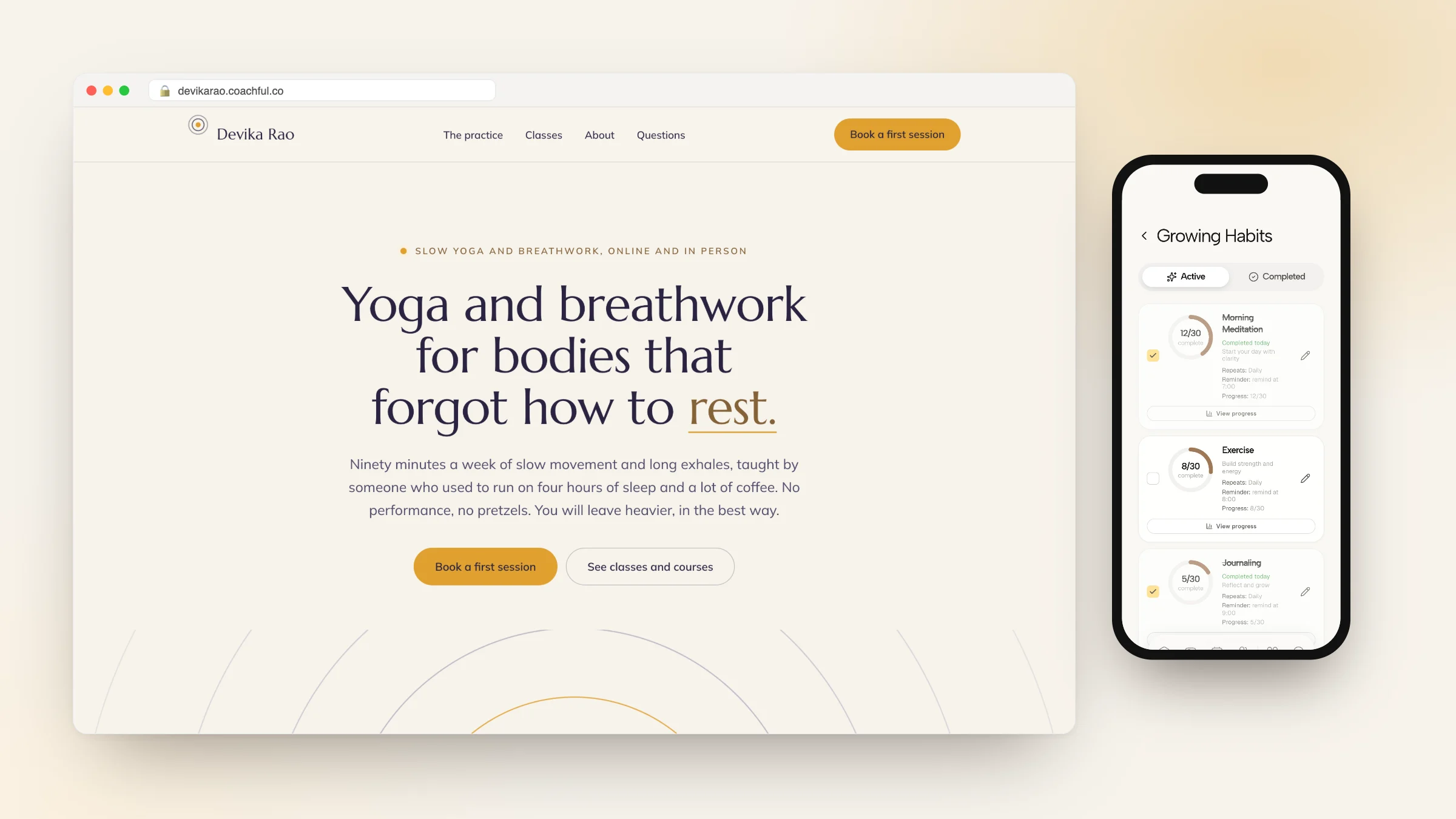
The sample template above, with a fictional somatic and mindfulness coach, shows a clear, calm pitch: who the coaching is for (professionals running on empty) and what the work involves (breath, posture and attention).

Some coaches combine mindfulness with yoga or breathwork, as the fictional teacher in this second template does. If you have injuries or health conditions, ask about their training for adapting movement.
Find a mindfulness coach on Coachful
Coachful's Find a Coach directory is public, and you can browse it without an account. Search "mindfulness", "meditation" or "breathwork" to find coaches whose headline or bio mentions them, or browse the Spirituality, Health and Fitness and Mindset categories. The Find My Coach quiz asks about your goals, your preferred style and your monthly budget and returns a shortlist.
Profiles show each coach's background, credentials and method where they have added them, any programs and prices, and a way to book a discovery call or send a message. Ask the questions above, and notice whether the coach asks about your history before suggesting practices.

Are you a mindfulness coach?
Coachful's pages for health and wellness coaches and mindset coaches show the habits, check-ins and client app this work runs on, and what is health and wellness coaching covers scope. The team will build your website or program for you at no extra cost through the free white-glove service.
Frequently asked questions
What does a mindfulness coach do?
A mindfulness coach teaches a regular practice, such as short meditations or mindful pauses, helps you keep it going and applies it to specific goals and situations in your life. Sessions often combine a guided practice with coaching on what you noticed and what to change.
Is mindfulness coaching worth it?
It can be if you want a personal practice tied to real changes and have struggled to keep one going alone. Research shows moderate benefits of mindfulness programs for anxiety, depression and pain. If you mainly want to learn to meditate, a class or course may be enough.
How much does a mindfulness coach cost?
There is no mindfulness-specific figure. As health and wellness coaching, it typically costs $75 to $200 a session or $900 to $2,000 for a three-month program, according to Coachful's 2026 Coaching Business Report. A group course or class is worth pricing as an alternative.
Can mindfulness have side effects?
Sometimes. A 2020 review of 83 studies found about 8 percent of people reported an adverse effect, most often anxiety or low mood, including some with no history of mental illness. Start gently, and stop and get help if practice makes you feel consistently worse.
What is the difference between mindfulness coaching and MBSR?
Mindfulness-based stress reduction is a structured group program with a set curriculum, led by a trained teacher. Mindfulness coaching is one-to-one and tailored to your goals. Some coaches are also MBSR-trained teachers.
Can a mindfulness coach help with anxiety?
For everyday stress and mild worry, mindfulness practice can help. For an anxiety disorder, see a clinician first; mindfulness may help alongside treatment, and some therapists use mindfulness-based methods themselves.












