Somatic Coaching: What It Is, What Works and How to Start
Somatic coaching is coaching that treats the body as part of the conversation. Instead of working only with what a client thinks and says, the coach helps them notice sensation, breath, posture and movement, then uses what they notice to make a decision or practice a new way of acting. It is coaching, not therapy: the aim is better action and steadier presence in everyday life, not treating trauma or illness.
This guide covers where somatic coaching came from, the ideas underneath it, what the research does and does not support, a step-by-step session with a sample dialogue and 11 questions, who it suits, the scope lines that matter most, and the training routes. If you run your practice on Coachful, our team will build the check-in, worksheet or program described below in your account for free.
Where somatic coaching comes from
The word "somatics" was coined by Thomas Hanna, a philosophy professor and movement theorist, to describe the body as experienced from the inside rather than observed from the outside. It became an umbrella for methods such as the Feldenkrais Method, the Alexander Technique and Laban Movement Analysis, which share the idea that awareness of sensation and movement can change habits.
Somatic coaching as a named practice is most closely tied to Richard Strozzi-Heckler, an aikido teacher with a 6th-degree black belt and a PhD, who founded the Strozzi Institute in 1985. His books The Anatomy of Change (1984), The Leadership Dojo (2007) and The Art of Somatic Coaching (2014) set out the core claim: people act from their "shape", the habitual way they hold themselves under pressure, and lasting change needs practice in the body as well as insight.
A separate lineage often gets mixed up with it. Somatic Experiencing, developed by Peter Levine and described in Waking the Tiger (1997), is a body-oriented trauma therapy. Many coaches borrow its language ("tracking", "titration", "resourcing"), but it was designed as a clinical method. That difference matters for scope, and we come back to it below.
| Approach | Main aim | Who usually delivers it | Typical client |
|---|---|---|---|
| Somatic coaching | Steadier action, presence and follow-through on goals | Coaches with body-based training | Leaders, professionals, people in transition |
| Somatic Experiencing | Resolve post-traumatic stress symptoms | Therapists and helping professionals trained in SE | People with trauma symptoms |
| Bodywork (massage, structural integration) | Physical tension, mobility, comfort | Licensed or certified bodyworkers | Anyone with physical complaints |
| Mindfulness training | Attention and acceptance of present experience | Mindfulness teachers, clinicians, coaches | General population, stress reduction |
The core ideas behind somatic coaching
- The body keeps the habit. A client may understand perfectly that they over-apologize in meetings and still do it. Somatic coaches assume the pattern is partly a physical reflex: shoulders rise, breath shortens, eyes drop, and the apology follows.
- Sensation is information. Noticing inner signals such as heartbeat, breath and muscle tension (what researchers call interoception) gives the client earlier warning that the old pattern is starting.
- Small shifts, repeated. The work is rarely dramatic. It is a longer exhale, feet on the floor, a softer jaw, practiced often enough that it becomes available under pressure.
- Centering before acting. Many somatic coaches teach a short centering practice the client uses before a hard conversation, a decision or a request.
- Commitments live in the body. Saying "no" or making a clear request is rehearsed as a physical act, not only planned as words.
What the research says about somatic coaching
The honest summary: there are almost no controlled trials of somatic coaching as a named method. Most of the support comes from adjacent research on breathing, posture and body-based therapy, and that evidence is mixed in quality. Here is what we found when we read the studies.
| Claim | What the research shows | Strength |
|---|---|---|
| Slow breathing calms the nervous system | A 2018 systematic review of 15 studies found slow breathing (under 10 breaths a minute) increased heart rate variability and was linked to more relaxation and less anxiety and anger in healthy adults. | Moderate, small studies |
| Posture changes how you feel | A 2022 meta-analysis of 73 studies found the effect came mostly from avoiding slumped, contracted postures (g = 0.45 versus neutral). Expansive "power" postures added almost nothing over neutral (g = 0.06). | Moderate |
| Body-based work helps trauma symptoms | A 2021 scoping review of Somatic Experiencing found preliminary positive effects across 16 studies, with mixed study quality and a call for unbiased trials. This is therapy research, not coaching research. | Preliminary |
| Coaching in general works | A meta-analysis of workplace coaching found positive effects on performance, well-being, coping and goal-directed self-regulation (g = 0.43 to 0.74). It did not isolate somatic methods. | Good for coaching overall |
Two practical lessons follow. First, a gentle breathing practice and getting out of a collapsed posture both have reasonable support, so they are sensible defaults. Second, be careful with bigger claims. "Release trauma stored in your hips" or "change your hormones with a two-minute pose" go beyond what the evidence supports, and they are the kind of promise that gets coaches into trouble.

How to run a somatic coaching session, step by step
This structure works online or in person for a 50-minute session. It assumes you have already contracted for body-based work in your agreement.
- Re-confirm consent. "We'll include some noticing of your body today. You can skip anything, keep your eyes open, and stop at any point. Is that okay?" Ask every session, not just once.
- Arrive. Two minutes of orienting: feet on the floor, weight in the chair, looking around the room. Do not instruct deep breathing straight away; some clients find it activating.
- Name the topic. Agree the outcome for the session the way you would in any coaching conversation.
- Locate it. Ask what the client notices in their body as they talk about the topic. Accept "nothing" as an answer.
- Track with curiosity, in small doses. Size, temperature, movement, intensity from 0 to 10. If intensity climbs past what the client wants, move attention to a part of the body that feels neutral.
- Experiment with one small shift. A longer exhale, uncrossing the arms, lifting the gaze. Ask what changes. Keep the experiment tiny.
- Rehearse the action. Have the client say the request or the boundary out loud from the steadier position.
- Design the practice. One short practice tied to a real trigger, such as two minutes of centering before the weekly meeting.
- Close and record. Ask what they want to remember, in their words, and write it down.
A short sample dialogue
Maya is a team lead who dreads giving feedback. This is an illustrative exchange, not a transcript.
Coach: When you picture opening that feedback conversation with Sam, what do you notice in your body?
Maya: My chest gets tight. And I'm already smiling, which is weird.
Coach: Tight chest, and a smile. On a scale of 0 to 10, how strong is the tightness right now?
Maya: Maybe a six.
Coach: Would you be willing to try something small? Let your exhale be a little longer than your inhale, three times, and notice what happens.
Maya: It drops. Maybe a four. My shoulders came down.
Coach: From here, with your shoulders down, try your first sentence to Sam out loud.
Maya: "Sam, I want to talk about the last two deadlines." That sounded different. Less like an apology.
Coach: What would help you find this before Thursday's meeting?
Maya: Doing the breathing in the corridor before I walk in.
11 somatic coaching questions
- What do you notice in your body as you say that?
- Where is it strongest? If it had a size or shape, what would it be?
- What happens to your breathing when you picture walking into that room?
- From 0 to 10, how intense is it right now?
- Where in your body feels neutral or okay at the moment?
- What small change in how you're sitting feels a little steadier?
- When you have handled this well before, how were you standing?
- What do you notice when you let the exhale be longer?
- Would you like to keep going, slow down, or stop here?
- What would your body need in the two minutes before that conversation?
- What do you want to remember from today, in your own words?
Question 9 is the one coaches skip. Asking it out loud keeps the client in charge of the pace, which is the whole point. For the listening skills underneath these questions, see our guide to the levels of listening.

Who somatic coaching suits, and who it doesn't
It tends to suit people whose stress is obvious in their body but who explain it away; leaders and professionals who understand their pattern and still repeat it; people preparing for public speaking, negotiations or hard conversations; and clients who have done a lot of talking-based work and feel stuck in their heads.
It is a poor fit, or needs a referral first, for clients with active post-traumatic stress, frequent dissociation or panic attacks; eating disorders or severe body image distress; unexplained pain or physical symptoms that need medical assessment; and anyone who doesn't want body-focused work. A client who says "I'd rather just talk" has given you a complete answer.
Scope cautions: trauma, touch and medical symptoms
Body-based work brings up strong reactions faster than talking does. That is part of its value and the main reason to keep firm lines.
- Trauma. You can work in a trauma-aware way without working on trauma. If a client starts reliving an event, stop the exercise, help them orient to the room, and talk about support. Our guide to trauma informed coaching covers the referral conversation, and what to do when a client cries covers the moment itself.
- Touch. Some in-person somatic coaches use touch. If you do, get explicit consent each time, offer a no-touch alternative, and check that your training and your insurance cover it. Our life coach insurance checklist lists the questions to ask an insurer.
- Medical symptoms. Chest pain, dizziness, numbness or persistent pain are for a doctor. Do not interpret them as emotion.
- Claims. Describe what you do ("we work with breath, posture and attention to help you act more steadily") rather than what you cannot show ("release stored trauma").
Somatic coaching training routes
There is no single regulator for somatic coaching, so look at hours, supervised practice and whether a program is accredited by the International Coaching Federation. Two examples we checked on the programs' own sites in October 2026:
- Strozzi Institute, Somatic Coach Certification. 14 months, including 16 days in person, with 150+ contact hours. The institute lists it as ICF-accredited at the PCC level, with cohorts of up to 28 people.
- Somatic Experiencing International, SE Practitioner training. Spread over about two and a half to three years in roughly eight multi-day modules, with personal sessions required. It is a trauma-resolution training aimed at helping professionals; completing it does not turn coaching into therapy.
Whatever you choose, keep an accurate log of your coaching hours. Our guide to ICF coaching hours explains what counts.
How to run somatic coaching inside Coachful
Somatic work lives or dies on practice between sessions, which is where most coaching tools are weakest. This is how coaches set it up in Coachful, all included in your membership.
A body check-in worksheet with sliders
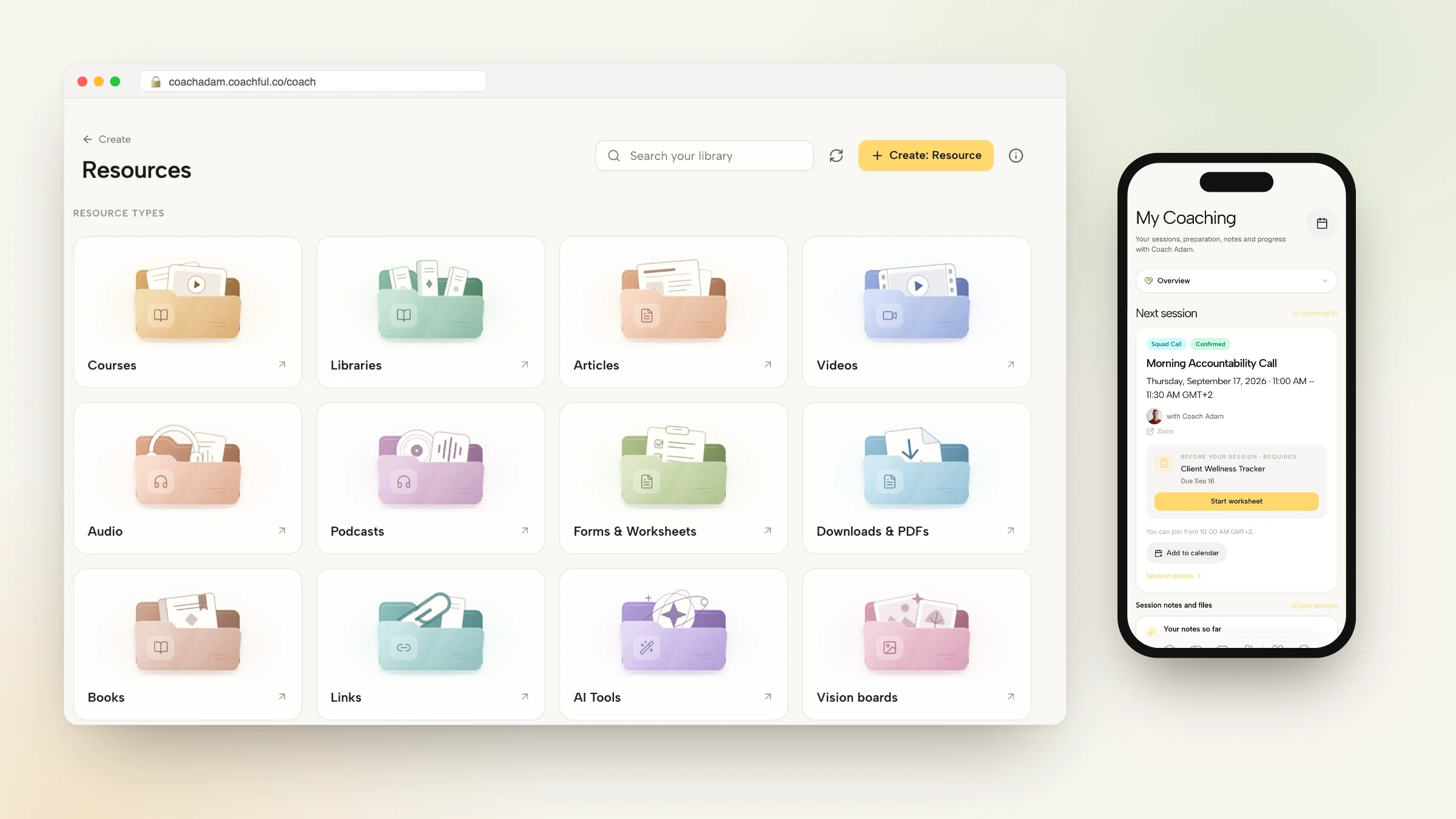
Build a short form in Create > Resources > Forms & Worksheets with slider questions: "How settled does your body feel?" from Tense to Settled, "Where do you notice tension?" as a short answer, and "Energy" from Drained to Energized. Attach it to your session type as prep, and it appears on the client's session card under Before your session. Our forms and questionnaires page shows the question types.
A daily practice flow with a breathing screen
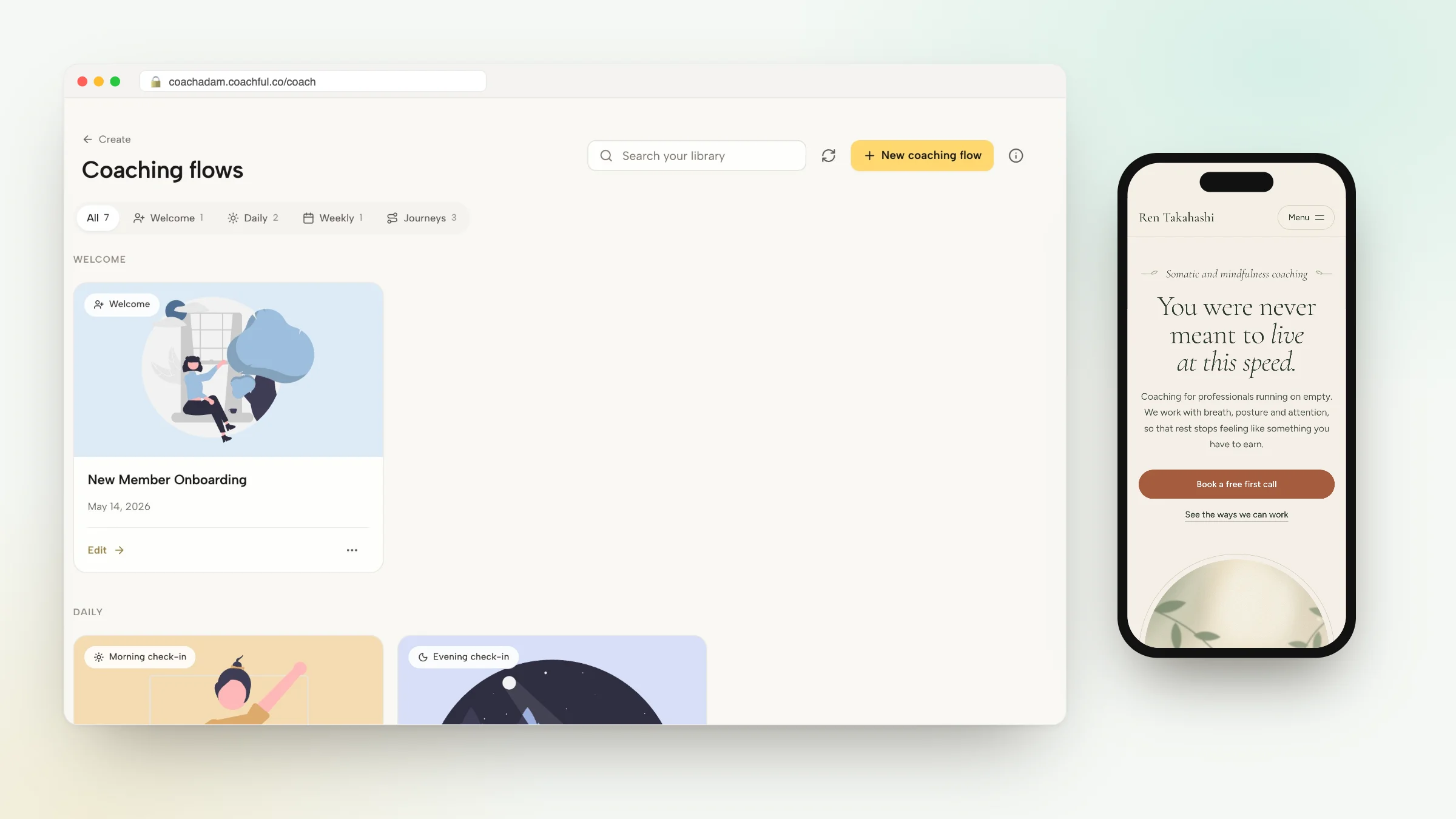
In Create > Coaching flows, a daily check-in can include a Breathing step (a guided breathing exercise), a Mood Scale and a Journal Page, which only the client can read. Tools > Explore also has an editable Breathing pause practice you can adapt instead of starting from scratch.

The practice as a habit
Add the agreed practice ("two minutes of centering before the team meeting") as a habit with a reminder. The client ticks it off and sees their progress ring, and you see whether the practice is happening before you build on it.

Session notes that keep the thread
Your shared notes build into Your notes so far on the client's My Coaching page, while private notes stay yours. Recording the client's own words for what changed ("my shoulders came down") gives them something concrete to return to.

Spotting patterns across clients
The Clients overview shows check-in rates, average mood and reflections across your practice, with a Check in on list for clients who report feeling low or stuck. It is a prompt to reach out, not a diagnosis.

A website that says what you actually do
Coachful's designed homepage templates include one written for somatic and mindfulness coaching. Recent requests to our team included a somatic coach leaving Kajabi: the homepage and About page were rebuilt from the old theme, testimonials that had been images became real text, and the contact form now feeds Coachful. Pages for health coaches and life coaches show the rest of the setup.

Have the Coachful team build it for you
If you would rather not build the check-in, worksheet or program yourself, Coachful's white-glove service is free on every plan. Go to Create > We'll build it for you, choose what you want (a form or worksheet, a coaching flow, a program, a website), describe it, and attach any material you already use. The team replies by email, usually within about 24 hours, and builds it inside your account so you can edit it afterwards. Nothing gets invented: no credentials, testimonials or prices you haven't given. The team does not record your audio or video practices for you. Read what the free white-glove service includes.

Related reading: mindfulness coaching, emotional intelligence coaching and 25 coaching techniques that work in real sessions.
Frequently asked questions
What is somatic coaching in simple terms?
It is coaching that pays attention to the body as well as thoughts. The coach helps you notice sensations, breath and posture during a real situation, try small physical shifts, and practice acting from a steadier state. The goal is better everyday action, such as a clear request or a calmer presentation, rather than therapy.
Is somatic coaching the same as somatic therapy?
No. Somatic therapies such as Somatic Experiencing are clinical methods for trauma symptoms, delivered by trained therapists and helping professionals. Somatic coaching works with healthy, functioning clients on goals and performance. A coach who notices trauma symptoms should pause the body work and refer.
Is there scientific evidence for somatic coaching?
Not much for somatic coaching itself. Adjacent research is more useful: a review of 15 studies supports slow breathing for relaxation, and a meta-analysis of 73 studies found that avoiding slumped postures improves mood while "power poses" add little. Coaching overall has decent meta-analytic support.
Can somatic coaching be done online?
Yes. Breath, posture, sensation tracking and centering all work on video. Ask the client to sit so you can see their upper body, check consent each session, and keep exercises short. Touch-based methods are the main thing that needs to be in person.
How do I become a somatic coach?
Train in coaching fundamentals first, then add a body-based program. The Strozzi Institute's Somatic Coach Certification runs 14 months with 150+ contact hours and is listed as ICF-accredited at the PCC level. Check insurance if your work includes touch.
What questions does a somatic coach ask?
Mostly noticing questions: "What do you notice in your body as you say that?", "Where is it strongest?", "From 0 to 10, how intense is it?" and "What small change feels steadier?" The most important one is "Would you like to keep going, slow down or stop here?"
Will Coachful build a somatic check-in or program for me?
Yes. The white-glove service is free on every Coachful plan. Ask from Create > We'll build it for you and the team will build a body check-in worksheet, a daily practice flow or a full program in your account, usually within about 24 hours, ready for you to edit.