Emotional Intelligence Coaching: Models, Evidence, Steps
Emotional intelligence coaching helps clients get better at noticing, understanding and managing emotions, their own and other people's, so they handle pressure, conflict and relationships more skillfully. Most of it is practical: naming feelings precisely, catching the moment between trigger and reaction, reading what others need, and rehearsing a better response. Research suggests these skills can be trained, with moderate effects, although what "emotional intelligence" actually measures depends heavily on which model and test you use.
This guide covers where emotional intelligence came from, the three competing models and why the difference matters, what the evidence does and does not support, a session with sample dialogue and 12 questions, assessments, who it suits, the cautions, and training routes. If you coach on Coachful, our team will build the check-ins and program in this guide in your account for free.
Where emotional intelligence coaching came from
Psychologists Peter Salovey and John Mayer coined the scientific concept in a 1990 paper in Imagination, Cognition and Personality, defining emotional intelligence as the capacity to reason about emotions and use emotional information to guide thinking. Salovey has since described it as his most underappreciated work.
The idea reached a wide audience through psychologist and science journalist Daniel Goleman's book Emotional Intelligence (1995), which broadened the idea into a set of workplace competencies. Goleman, Richard Boyatzis and Annie McKee's Primal Leadership (2002) took it into leadership development, and Boyatzis's intentional change theory, set out for coaches in Helping People Change (2019, with Melvin Smith and Ellen Van Oosten), became one of the main coaching frameworks built on it. Reuven Bar-On's model and his EQ-i questionnaire added a third strand.
Three models of emotional intelligence, and why it matters which one
| Model | What it says EI is | Typical measure | What to watch for |
|---|---|---|---|
| Ability model (Mayer and Salovey) | A set of skills: perceiving, using, understanding and managing emotions | Performance tests with right and wrong answers, such as the MSCEIT | Narrow, but the most distinct from personality |
| Trait model | How you see your own emotional tendencies | Self-report questionnaires | Overlaps a lot with personality traits |
| Mixed or competency models (Goleman, Boyatzis, Bar-On) | A broad set of competencies such as self-awareness, self-management, empathy and teamwork | Self-report and 360 questionnaires, such as the EQ-i 2.0 or ESCI | Broad and practical, and the hardest to separate from general effectiveness |
This matters because research findings differ by model, and researchers still argue about the definition. A coach should be clear with clients about which kind of EI they are working on and what a score does and does not mean.
What the research says about emotional intelligence coaching
Can emotional intelligence be developed?
- Meta-analysis. A 2018 multilevel meta-analysis of 24 studies (28 samples of healthy adults) found a significant, moderate improvement from before to after EI training, which held at follow-up. The model used and the length of training affected results.
- A randomized trial with a one-year follow-up. In a Belgian study, 132 adults were randomized to a 15-hour group program on five emotional competencies plus four weeks of email follow-up, or to a control group. The trained group improved emotional competence and also showed lower cortisol, better well-being and better relationships, confirmed by peer reports and lasting at least a year.
- Health care workers. A 2024 meta-analysis of 17 studies found every included study showed EI gains, but warned that methodological weaknesses may have inflated the effects.
Does emotional intelligence matter at work?
Partly, and it depends on the measure. A 2016 meta-analysis by Miao, Humphrey and Qian found self-report and mixed EI were clearly linked to job satisfaction (around .32 and .39), while ability EI barely was (.08). Critics such as John Antonakis, in a published 2009 debate with Neal Ashkanasy and Marie Dasborough in The Leadership Quarterly, have argued that much of the leadership claim for EI rests on weak measurement. Our reading: emotional skills are worth coaching, but claims that "EQ matters more than IQ" go well past the evidence.
What about coaching specifically?
Intentional change theory suggests coaching should start with the client's ideal self before working on gaps. A 2023 brain-imaging study from Boyatzis's group found that coaching conversations about the ideal self and about the real self engaged conflicting patterns of attention, which the authors argue supports sequencing the ideal self first. It is a lab study with young adults, not an outcome trial, so treat it as a promising idea.

How to run an emotional intelligence coaching session
- Pick one real interaction. A recent meeting, argument or decision, not "my EQ" in general.
- Name the emotion precisely. "Frustrated" or "embarrassed" is more useful than "bad". Offer a short list if the client struggles.
- Find the trigger and the impulse. What exactly set it off, and what did they feel the urge to do?
- Check the body. Where did they notice it? Body signals are often the earliest warning.
- Read the other person. What might they have been feeling or needing? What's the evidence?
- Choose a response. What would they do if they were at their best in that moment?
- Rehearse it. Say the opening line out loud.
- Agree a practice. Usually a daily emotion log or a pause routine before a known trigger.
A short sample dialogue
Jon is a new engineering manager. Illustrative, not a transcript.
Coach: Take me to the moment in the stand-up when it went wrong.
Jon: Priya said the release would slip again, and I snapped at her in front of everyone.
Coach: Just before you snapped, what were you feeling?
Jon: Angry. Actually, no. Embarrassed. My director was on the call.
Coach: Embarrassed. Where did you notice it?
Jon: Face went hot. Jaw tight.
Coach: And what do you think Priya was feeling when she said it?
Jon: Probably nervous. She was telling me early, which is what I asked for.
Coach: At your best, what would you have said?
Jon: "Thanks for flagging it early. Let's take it offline right after this."
Coach: What would help you notice the hot face next time, before the words come out?
Jon: If I feel my jaw tighten, I take one breath and ask a question first.
12 emotional intelligence coaching questions
- What exactly were you feeling, in one or two precise words?
- What was underneath that feeling?
- Where did you notice it in your body?
- What set it off, specifically?
- What did you feel the urge to do?
- What did you actually do, and what happened next?
- What might the other person have been feeling or needing?
- How do you know? What's the evidence?
- At your best, how would you have responded?
- What early signal could warn you next time?
- Who handles moments like this well, and what do they do?
- What will you practice this week?
These pair well with the listening skills in our levels of listening guide and the questions in communication skills in coaching.
Using EI assessments in coaching
An assessment gives the conversation a starting point, and it can also mislead. Three habits help:
- Know what you're using. An ability test, a self-report questionnaire and a 360 measure different things. Tell the client which one and why.
- Get certified where required. Publishers of instruments such as the EQ-i 2.0 require certification to administer and debrief them.
- Treat scores as hypotheses. Ask "Does this fit your experience? Where doesn't it?" before building a plan on a number.
You can also skip formal instruments entirely and work from real situations and feedback, which is cheaper and often more useful. For a broader look at assessment tools, see our guide to the best coaching assessment tools.
Who emotional intelligence coaching suits, and who it doesn't
It suits new and senior leaders, people whose reactions under pressure are costing them relationships or credibility, client-facing professionals, couples and parents working on communication (within coaching scope), and teams with recurring conflict.
It suits less well clients who need treatment for anger, anxiety or mood problems; situations where the real problem is a toxic workplace rather than the client's skills; and clients sent by an employer who don't want to be there. In that last case, contract carefully about what is shared.
Cautions for EI coaches
- A score isn't a verdict. Low EI scores are not a personality defect, and high scores don't excuse poor behavior.
- Emotion regulation is not suppression. The goal is choosing a response, not hiding feelings. Coaching people to swallow legitimate anger can do harm.
- Know when it's clinical. Frequent rage, panic, numbness or persistent low mood need a licensed professional. Our guide to trauma informed coaching covers referral.
- Be careful with sponsors. If a company pays for EI coaching after a complaint, agree in writing what you report and what stays confidential.
Emotional intelligence coaching training routes
We checked these on the providers' own sites in October 2026:
- EQ-i 2.0 and EQ 360 certification (MHS). Delivered by MHS's authorized training partners, with a digital badge for certified EQ-i 2.0 users. MHS states that the training is approved for ICF Core Competency and Resource Development credits.
- Case Western Reserve University, Weatherhead Executive Education. Its catalog includes a course called Building Leadership Capability through the Power of Intentional Change, the theory behind Boyatzis's coaching approach.
An assessment certification lets you use a tool; it does not make you a coach. Pair it with accredited coach training and, if you want a credential, the ICF credentials.
Running emotional intelligence coaching inside Coachful
EI grows through repeated noticing in real life, so most of the work happens between sessions. This is how coaches set that up in Coachful, all included in your membership.
A daily emotion check-in
Tools > Explore includes an editable Emotional check-in (calm, hope, connection, confidence, energy and focus). In Create > Coaching flows, an evening check-in can combine an Evening Mood or Mood Scale step with a short question ("What was your strongest feeling today, and what triggered it?") and a Journal Page only the client can read.

A scored self-assessment you design
The form editor lets you group questions into categories with weights, so you can build your own self-assessment (for example, self-awareness, self-management, social awareness and relationships) and repeat it at the start and end of an engagement. Label it honestly as a reflection tool, not a validated test.
Trends across clients
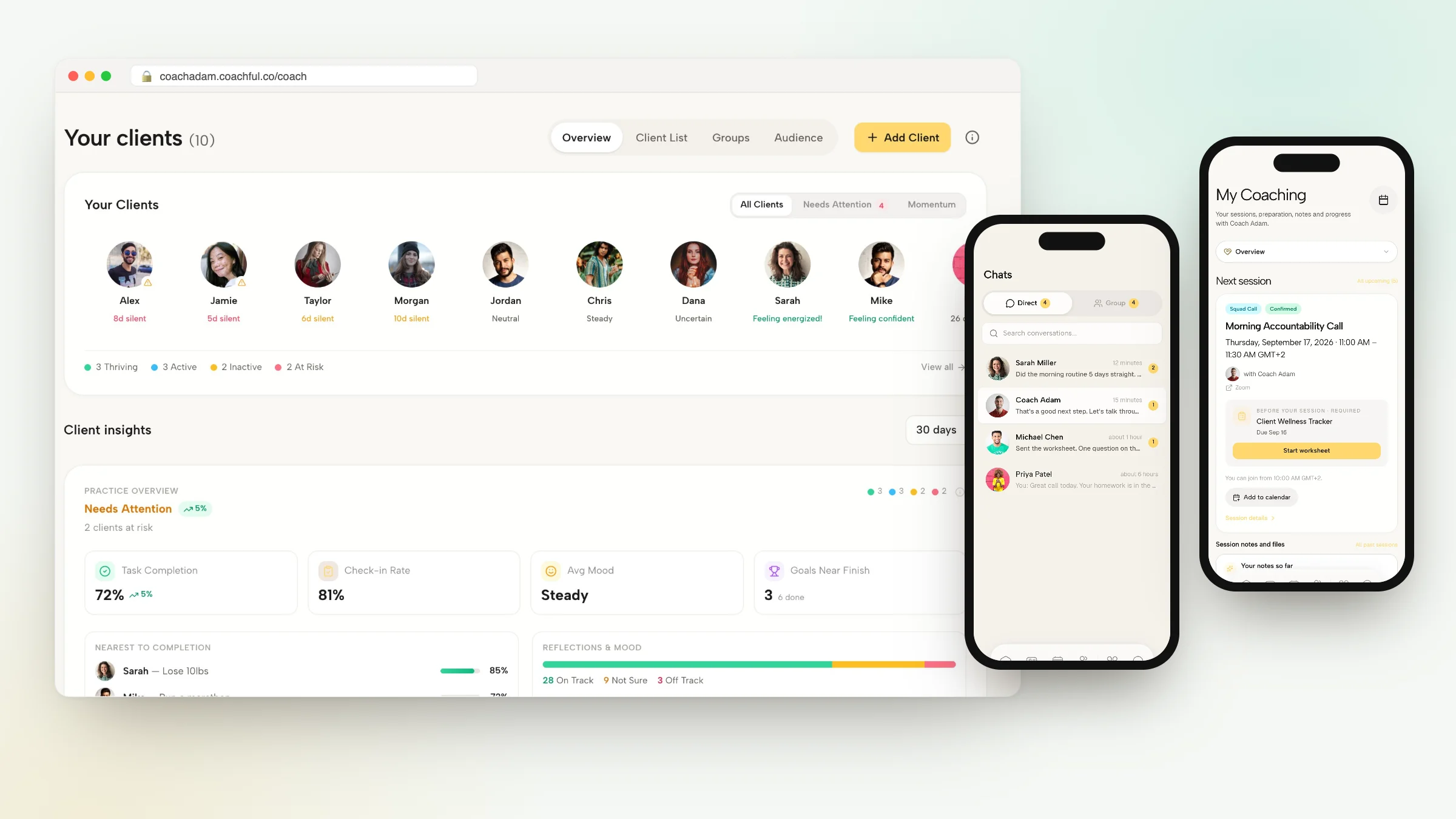
The Clients overview shows check-in rates, average mood and mood trends over 30 days. For a leadership cohort, it's a quick way to see who is under strain before the next group call.

The practice as a goal
Save the agreed practice ("one breath and a question before responding in stand-ups") as a goal with milestones, and use the weekly reflection to review what happened.

Before each session
Attach a short prep worksheet to the session type ("Which interaction do you want to work on?") so the client arrives with a real example. It shows on their session card under Before your session.

Prepare with Brain
Brain's Prepare for a client shortcut brings together the client's recent check-ins and progress, which helps you spot emotional patterns across weeks.

Let our team build your EI coaching program
Coachful's white-glove service is free on every plan. From Create > We'll build it for you, ask the team to build an emotion check-in, a self-assessment, a leadership cohort program or a website. Send what you already use, and the team replies by email, usually within about 24 hours, then builds it in your account. Nothing gets invented: no fake credentials or results. Read what the free white-glove service includes, and see our pages for executive coaches and relationship coaches.

Related approaches: somatic coaching for the body side of emotion, and cognitive behavioral coaching for the thinking side.
Frequently asked questions
What is emotional intelligence coaching?
It is coaching focused on recognizing, understanding and managing emotions in yourself and others. Sessions work through real interactions: naming the feeling precisely, finding the trigger, reading the other person, choosing a better response and practicing it between sessions.
Can emotional intelligence really be improved?
The evidence says yes, moderately. A meta-analysis of 24 studies found moderate gains that held at follow-up, and a randomized trial of 132 adults found improvements in emotional competence, well-being and relationships lasting at least a year after a 15-hour program.
What are the four domains of emotional intelligence?
In Goleman and Boyatzis's competency model they are self-awareness, self-management, social awareness and relationship management. The Mayer and Salovey ability model instead describes four branches: perceiving, using, understanding and managing emotions.
Which emotional intelligence assessment should a coach use?
It depends on your goal. Ability tests such as the MSCEIT measure skills with right and wrong answers; self-report tools such as the EQ-i 2.0 capture how clients see themselves; 360 tools add others' views. Most require certification. Many coaches work without one and use real situations instead.
Is emotional intelligence more important than IQ?
That popular claim goes beyond the evidence. Research links some EI measures to job satisfaction and commitment, but results vary a lot by measure, and critics argue many leadership claims rest on weak methods. Emotional skills are worth developing without overselling them.
How is EI coaching different from therapy?
EI coaching builds everyday emotional skills in people who are functioning well. Therapy treats conditions such as anxiety, depression or anger disorders. If a client's emotions are overwhelming their daily life, a coach should refer them to a licensed professional.
Can Coachful build my emotional intelligence program for free?
Yes. The white-glove service is free on every Coachful plan. Ask from Create > We'll build it for you and the team will build an emotion check-in, a self-assessment or a full program in your account, usually within about 24 hours.