
How to Find a Life Coach: 7 Steps, Questions and Costs
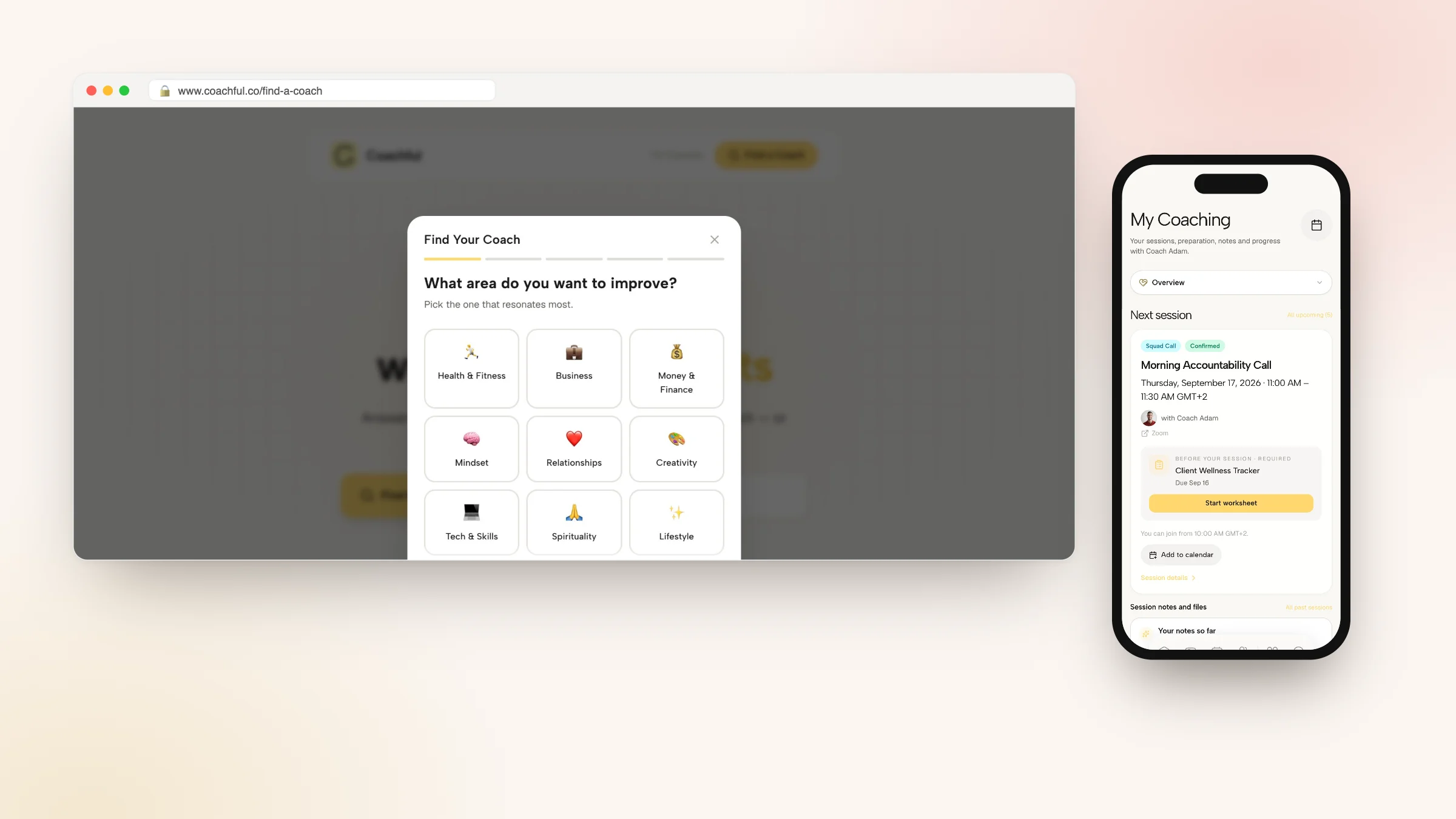
How to find a life coach, in short: name the specific change you want, decide on a budget and format, shortlist three to five coaches who specialize in that kind of change, check their training and reviews, book discovery calls with two or three of them, and choose the one you trust most, with a written agreement. Directories such as Coachful's Find a Coach and the ICF's Credentialed Coach Finder make the shortlist easier. The fit between you and the coach matters more than almost anything else.
The search feels harder than it is because "life coach" covers so much: career moves, confidence, relationships, habits, purpose, the vague sense that you are not where you meant to be. This guide turns it into a process you can finish in a week or two: a step-by-step plan, where to look, what to ask on a discovery call, the red flags, what it costs and what a good first month feels like.
How to find a life coach in seven steps
1. Name the change you want
Write one or two sentences about what you want to be different in three to six months. "Leave teaching for instructional design by summer" is something a coach can work with. "Feel better about life" is a starting point, not a brief. If you are stuck here, Coachful's Wheel of Life assessment scores eight areas of your life in a few minutes and shows where the gaps are, and the SMART goal worksheet turns a wish into a goal.
2. Check that coaching is the right tool
Coaching is for people who are reasonably steady and want to act. If your main struggle is your mental health, start with a therapist (see the box below). If you need someone to tell you exactly what to do from experience, a mentor or consultant may fit better. Our "Am I ready for a coach?" quiz is a quick self-check, and what life coaches do explains the job in detail.
3. Pick a kind of coach
Most good life coaches specialize. A coach who mainly works with career changers, new parents, people after divorce or first-time managers will be faster on that problem than a generalist. Our list of types of life coaching helps you name the specialty you need.
4. Set a budget and format
Decide what you can spend over three months without strain, whether you want one-to-one or group coaching, and whether video is fine (for most people it is; see are online coaches worth it). The cost section below gives typical ranges.
5. Build a shortlist of three to five
Use a directory, ask people you trust for referrals, and check whether your employer offers coaching. For each coach, read their profile or website, the kinds of clients they work with, their training and any reviews you can verify somewhere they do not control.
6. Book two or three discovery calls
Many coaches offer a short first call to see whether you are a fit. Use it to ask the questions below and to notice how you feel talking to them.
7. Choose, and get it in writing
Pick the coach you trust and who challenged you a little on the call. Before paying, get the number of sessions, price, schedule, cancellation and refund terms and confidentiality in writing. The ICF's Code of Ethics expects coaches to agree roles, responsibilities, confidentiality and financial arrangements with clients up front (ICF Code of Ethics).
Where to look for a life coach
| Where | Good for | Watch out for |
|---|---|---|
| Coachful's Find a Coach | Browsing by category or topic, comparing programs, a matching quiz, booking a discovery call from the profile | Read each coach's own description of their training |
| ICF Credentialed Coach Finder | Filtering for ICF-credentialed coaches by credential, coaching theme, language, rate and location | Lists only coaches who hold an ICF credential |
| Personal referrals | Someone you trust has seen the coach work | Your friend's goal may be different from yours |
| Your employer | Coaching benefits, learning budgets, leadership programs | Employer-paid coaching often focuses on work goals |
| Social media | Getting a feel for how a coach thinks | A large following is not evidence of skill |
The ICF's Credentialed Coach Finder is free to use. It filters by credential level, coaching themes, methods, rate (including pro bono), client type, industry, language and location, and once your search narrows to 75 coaches or fewer you can send an anonymous request for proposals (ICF guide for individuals).
What credentials mean for a life coach
Life coaching is unregulated in most places, so anyone can use the title. Credentials are voluntary. The best known come from the International Coaching Federation (ICF), and each requires coach training, logged coaching hours, ten hours of mentor coaching and an exam.
| ICF credential | Coach training | Coaching experience | Clients |
|---|---|---|---|
| ACC (Associate Certified Coach) | 60+ hours | 100+ hours, 75 paid | 8+ |
| PCC (Professional Certified Coach) | 125+ hours | 500+ hours, 450 paid | 25+ |
| MCC (Master Certified Coach) | 200+ hours | 2,500+ hours, 2,250 paid | 35+ |
Source: ICF experience requirements, October 2026.
A credential tells you a coach has been trained and supervised. It does not tell you whether they are good with your kind of problem. In consumer coaching, experience with clients like you, a clear method and the feel of the discovery call often matter as much. If a coach claims an ICF credential, you can check it on the ICF's site.
Life coach or therapist? See a licensed professional when...
- Low mood, anxiety, panic or worry is affecting your sleep, work or relationships most days.
- You are dealing with trauma, an eating disorder, an addiction or grief that is not easing.
- You have thoughts of harming yourself. In the US, call or text 988 to reach the 988 Suicide and Crisis Lifeline; elsewhere, call your local emergency number.
The ICF's own guidance describes coaching as future-focused and therapy as the place to heal, and notes a coach may step back if therapy is more appropriate. Coaching can come later, or alongside treatment if your clinician agrees. Our guide to life coach vs therapist covers the difference in depth.
Questions to ask on a discovery call
- Who do you usually work with? Listen for people like you, with goals like yours.
- How would you approach my goal? A good coach will sketch a process without promising an outcome.
- What happens between sessions? Prep, check-ins, messaging, worksheets. Most of the change happens here.
- How will we know it is working? Look for a concrete answer, such as a review at week six against goals you set together.
- What training do you have, and do you have supervision or a mentor?
- What do you do if a client needs therapy instead? A clear answer is a good sign.
- What are the terms? Sessions, price, payment plan, cancellations, refunds and confidentiality.
Then notice the call itself. Did you talk more than the coach? Did they ask at least one question that made you think? Did you feel pressured? Research on coaching relationships suggests this instinct deserves weight: a meta-analysis of 27 samples covering 3,563 coaching processes found the quality of the working relationship between coach and client was consistently linked to clients' results (Graßmann, Schölmerich and Schermuly, 2020). That is a correlation rather than proof, but it is a strong and consistent one.

Red flags when choosing a life coach
- Guaranteed results. The US Federal Trade Commission warns that no one can guarantee you will make lots of money with little to no risk, and flags "proven system" claims and pressure to act now as warning signs in coaching offers (FTC consumer alert). The same logic applies to life coaching promises.
- Pressure on the call. A discount that expires before you hang up is designed to stop you thinking.
- Testimonials you cannot check. The FTC notes testimonials might not be true or typical.
- Blurred lines with therapy. Offering to treat anxiety, depression or trauma.
- Vague training. "Certified" with no named program or body.
- No written agreement, or everything handled in direct messages.
What a life coach costs
Coachful's 2026 Coaching Business Report, which compiles published research and practitioner reports for the second quarter of 2026, gives these life coaching benchmarks:
| What you buy | Typical price | Source |
|---|---|---|
| One session, typical coach | $75 to $200 | PayScale and practitioner reports |
| Newer coach | $50 to $100 an hour | Practitioner estimate |
| Experienced coach | $100 to $200 an hour | Practitioner estimate |
| Top of the niche | $200 to $500 an hour | Practitioner estimate |
| Three months, eight sessions | $1,200 to $2,500 | Practitioner reports and verified published rates |
| Six months, 12 to 16 sessions | $2,500 to $5,000 | Practitioner reports |
| Group coaching | $100 to $300 a month | Practitioner reports |
US dollars, Q2 2026. When Coachful collected the session rates 18 life coaches publish, they ranged from $50 to $980, with most between $100 and $250; a small sample, so read it as spread. Details on coachingrates.com.
For a deeper look at prices by niche, see how much life coaches charge, and for whether it is worth it in your case, is a life coach worth it. If cost rules a coach out for now, what ChatGPT can and cannot do as a life coach is an honest look at the alternative.
What a good first month with a life coach feels like
The early research on life coaching is encouraging: a randomized trial of a ten-week group program found gains in goal striving, well-being and hope (Green, Oades and Grant, 2006), and a second trial found clients of professional coaches showed more goal commitment and progress than peer-coached clients (Spence and Grant, 2007). Both were small. In practice, you can usually tell within three or four sessions whether it is working:
- You leave each session with one or two actions you chose.
- Something happens between sessions: prep before the call, a check-in during the week, notes you can find later.
- The coach remembers what you said last time and holds you to it, kindly.
- You feel challenged at least once a session, not only encouraged.

Many coaches give clients an app for the between-session part. In Coachful's client app, the My Coaching page shows the next session, prep that is due and a short list of what to do next.

Goals and habits sit there too, so progress is something you can see rather than something you have to remember.


And there is usually a message thread for the week's wins and wobbles. Agree reply times at the start.

Find a life coach on Coachful
Coachful's Find a Coach directory is public, so you can browse without creating an account. Search a topic, such as "career change", "confidence" or "burnout", and it matches coaches whose headline or bio mentions it, or browse by category, including Mindset, Lifestyle and Relationships. You can switch between browsing coaches and browsing their programs.
If you are not sure what to search for, the Find My Coach quiz asks five short questions: the area you want to improve, where you are right now, your email, your preferred coaching style and your monthly budget. It then suggests coaches. Profiles show what each coach has added about their background, credentials and method, their programs and prices, and either a calendar to book a discovery call or a form to send a message.

Are you a life coach?
Every question on this page is one your prospective clients ask before they book. Our guide on how to become a life coach covers training and first clients, and Coachful's page for life coaches shows the platform. If your website does not answer these questions yet, the team will build it for you at no extra cost through the free white-glove service.

Frequently asked questions
How do I find a good life coach?
Start with the specific change you want, then shortlist three to five coaches who specialize in it, using a directory such as Coachful's Find a Coach or the ICF's Credentialed Coach Finder, plus referrals. Check training and verifiable reviews, book two or three discovery calls and choose the coach you trust, with a written agreement.
How much does a life coach cost?
Most life coaches charge $75 to $200 a session, and three-month packages of eight sessions typically cost $1,200 to $2,500, according to Coachful's 2026 Coaching Business Report. Group coaching usually runs $100 to $300 a month.
Should my life coach be certified?
Certification is not legally required in most places, but it shows training and supervised practice. ICF credentials require 60 to 200 or more hours of training and 100 to 2,500 or more hours of coaching. Experience with your kind of goal and a good discovery call matter as much.
What questions should I ask a life coach before hiring them?
Ask who they usually work with, how they would approach your goal, what happens between sessions, how you will both know it is working, what training they have, what they do if a client needs therapy, and what the terms are for sessions, price, cancellations and refunds.
Is it better to find a life coach locally or online?
For most people, online is fine and widens your choice to coaches who specialize in exactly your situation. Video works well for conversation-based coaching; see are online coaches worth it. Choose in-person if being in the same room matters to you.
How long should I work with a life coach?
Most packages run about three months, long enough to see a change in behavior. A focused decision might need two or three sessions; a bigger transition often takes six months. Agree a review point at the start.
Can I try a life coach before committing?
Most coaches offer a short discovery call before you pay anything, and some sell a single session or a four-week starter package. Use that to judge the fit before buying a longer program.












