Are Online Coaches Worth It? How to Tell Before You Pay
Are online coaches worth it? For most people, yes, when three things line up: you have a specific change you want in the next three to six months, the coach has a clear method and gives you work between calls, and the price fits that commitment without strain. Research finds coaching works about as well online as face to face. The coach matters far more than the screen.
That is the short answer. The longer one depends on what you want help with, how much you can spend and how to tell a good online coach from a confident one with a ring light. This guide covers all three, with real 2026 price ranges, the research in plain English and the red flags worth checking before you pay anything.
What the research says about online coaching
Coaching has been studied more than most people expect, mostly in workplaces. The results are steady enough to lean on, with a few honest caveats.
- Coaching works, on average. A meta-analysis by Theeboom, Beersma and van Vianen found positive effects on performance and skills, well-being, coping, work attitudes and goal-directed self-regulation, with effect sizes from moderate to large.
- Online works about as well as in person. A 2016 meta-analysis of workplace coaching by Jones, Woods and Guillaume found no difference in effect between face-to-face coaching and coaching that blended face-to-face sessions with e-coaching.
- The strongest studies still show an effect. De Haan and Nilsson pooled only randomized controlled trials of workplace and executive coaching, 37 studies in all, and reported a moderate overall effect (published in 2023 in Academy of Management Learning and Education). They also flagged signs of publication bias, which is what you would expect in any young field.
- The relationship carries a lot of the weight. A meta-analysis of 27 samples and 3,563 coaching processes found a consistent link between the quality of the client and coach working relationship and the results clients got.
Two caveats. Most of this research is workplace coaching, often paid for by an employer, and many outcomes are self-reported. Nobody has run a large trial on the coach you found on Instagram last Tuesday. What the evidence does tell you is where to look: at the coach's method, at the relationship you build in the first few sessions, and at whether you do the work between them. Delivery over video is not the weak point.

How much online coaching costs in 2026
Most online coaches sell packages rather than single hours, and the price depends heavily on the kind of coaching. These ranges come from Coachful's 2026 Coaching Business Report, which compiles published research and practitioner reports for the second quarter of 2026. It does not survey coaches itself, so each row names where its numbers come from.
| Type of coaching | Typical hourly rate | A common package | Where the numbers come from |
|---|---|---|---|
| Life coaching | $75 to $200 | 3 months, 8 sessions: $1,200 to $2,500 | PayScale and practitioner reports; package from practitioner reports and a verified sample of 18 coaches' published rates |
| Health and wellness | $75 to $200 | 3 months, 8 to 10 sessions: $900 to $2,000 | PayScale and practitioner reports |
| App-based coaching with a coach check-in | Not sold by the hour | $17 to $149 a month | Practitioner reports |
| Career coaching | $100 to $250 | Single session: $99 to $280. Four-session job search sprint: $500 to $1,000 | PayScale and practitioner reports; single session from 35 published rates on one career coaching marketplace |
| Business coaching | $150 to $400 | 90 days, 8 to 10 sessions: $3,000 to $6,000 | ICF Global Coaching Study 2025 and PayScale; package from practitioner reports |
| Executive coaching | $200 to $500 | 3 months, 6 sessions: $3,000 to $8,000 | ICF Global Coaching Study 2025 and PayScale; package from practitioner reports |
| Group life coaching | Shared between members | $100 to $300 a month per person | Practitioner reports |
US dollars, Q2 2026, from Coachful's 2026 Coaching Business Report. Practitioner reports are estimates rather than measured study findings. The ICF Global Coaching Study 2025 is the main primary study behind the professional averages.
One gap worth naming: our data has no reliable figure for online personal training or fitness coaching, which is a large part of what people mean by "online coach". If that is what you are weighing, compare what you get per week (programming, form checks, check-ins, message access) rather than the monthly sticker. Our breakdown of app-only versus live-call fitness coaching shows how those formats differ.
For life coaching specifically, how much life coaches charge goes deeper by niche and experience, and what executive coaching costs covers the employer-paid end of the market.
Is online coaching worth it for you? A quick test
Price only tells you half of it. The other half is whether coaching is the right tool for where you are. Run through these honestly.
| If this sounds like you | Coaching is likely | Why |
|---|---|---|
| You know roughly what you want to change and keep stalling on doing it | Worth it | Coaching is strongest at turning intent into steady action, which is what goal attainment studies measure. |
| You are facing a decision with real stakes (a career move, a business pivot, a hard conversation) | Worth it | A good coach slows the decision down and makes you test it against what you actually value. |
| You want information or a plan, and you are happy to follow it alone | Maybe not | A course, a book or a single paid session may get you there for far less. |
| You cannot give it an hour or two a week outside the calls | Wait | The calls are the smaller part. Without the between-session work, you are paying for conversation. |
| You are dealing with depression, trauma, an eating disorder or thoughts of self-harm | See a licensed clinician first | Coaching is not treatment. Good coaches will tell you this and refer you. |
If you land in the first two rows, the question becomes which coach, not whether. Weighing life coaching in particular? We cover that case in is a life coach worth it, and if you have been leaning on a chatbot instead, what ChatGPT can and can't do as a life coach. If you land in the last row and you are in crisis right now in the US, call or text 988 to reach the 988 Suicide and Crisis Lifeline. Outside the US, contact your local emergency number.
What good online coaching looks like between calls
The fair worry about online coaching is that it shrinks to a video call every two weeks and a lot of good intentions in between. The coaches who get results online fix that with structure. Here is what you should expect to see by week two.
- A clear next session with something to prepare. A short prep form or worksheet before each call means you arrive having thought, and the hour goes on the hard part.
- Notes you can find later. You should be able to see what was agreed last time without scrolling a chat thread.
- A small number of actions for this week. Three is plenty. Ten is a sign the coach is guessing.
- A way to reach the coach, with stated limits. Message access is valuable when the response time and scope are agreed up front.

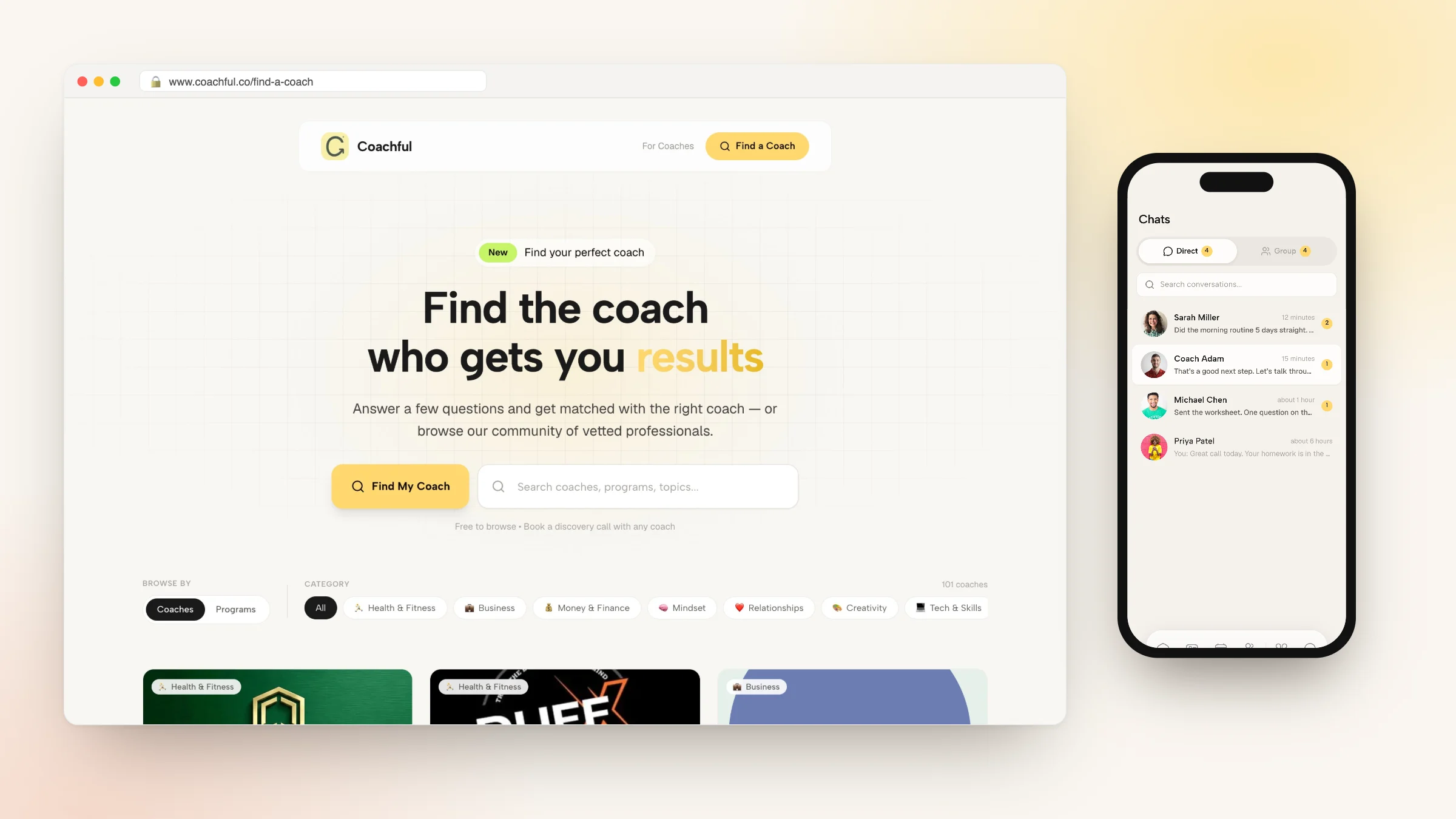
In Coachful's client app, that structure sits on the My Coaching page: the next session, any required prep, and a "What to do next" list pulled from sessions, journeys and programs. Your coach sets it up; you open it on a phone or a laptop.

The quieter feature that matters most is the message thread. A coach who replies to "I skipped the walk again, what now?" on a Wednesday is doing more for your goal than another call would.

Habits and programs fill the rest of the week. If your goal involves daily practice, ask whether the coach tracks it with you or leaves it to your memory.

Red flags to check before you pay an online coach
Coaching is unregulated in most countries, so anyone can use the title. That is not a reason to avoid it, only a reason to ask questions a regulated profession would answer for you.
- Guaranteed outcomes. "Six figures in 90 days" or "lose 30 pounds guaranteed" is a sales line, not a method. Ask what happens if you do the work and it does not happen.
- Pressure to decide on the call. A discount that expires before you hang up is designed to stop you thinking. A good coach is fine with you sleeping on it.
- No written agreement. You should get the sessions, price, cancellation terms, refund terms and confidentiality in writing before you pay.
- Vague credentials. "Certified" by whom? If a coach claims an ICF credential, the ICF will confirm whether a person currently holds one. Training matters less than results in consumer coaching, but a coach who cannot explain theirs is a coach who will not explain other things either.
- Blurred lines with therapy. The ICF Code of Ethics expects coaches to keep the difference between coaching and therapy clear and to refer clients on when needed. Ask what the coach does if a client discloses something clinical.
- Testimonials you cannot check. Screenshots of anonymous messages prove nothing. Ask to speak to a past client, or look for reviews in a place the coach does not control.
- Everything happens in DMs. Booking, paying and coaching through Instagram messages leaves you with no record of what you agreed or paid for.
How to choose an online coach in five steps
- Write down the one outcome. "Change careers into product management by June" is coachable. "Feel better about life" needs narrowing first, and a good coach will help with that on the first call.
- Shortlist three coaches who work on that outcome. Coachful's Find a Coach directory needs no account or card to browse, lets you filter by category or search by topic, and has a short quiz that matches you to coaches. You can browse programs as well as people, and book a discovery call or send a message straight from a profile.
- Book discovery calls with two or three of them. Ask how they would work with you, what a typical week looks like, how you will measure progress and what happens if it is not working by week six.
- Judge the conversation, not the pitch. Did they ask more than they told? Did you leave with one useful thought? Given what the research says about the working relationship, how the call felt is real evidence.
- Start with the shortest sensible commitment. A three-month package is the usual sweet spot: long enough for change, short enough to leave if it is wrong.
For a sense of what the first session itself should cover, see how a first coaching session is structured. It is written for coaches, which makes it a handy checklist for clients.

Online coaching versus in-person coaching
For individual coaching, the evidence above gives you no reason to pay more for in person. Online widens your choice from the coaches in your city to the coaches who specialize in your exact problem, and it removes the commute that quietly kills consistency.
In-person still wins in a few places: hands-on physical training where form matters and video is awkward, team or workshop work where the room is part of the method, and people who simply focus better face to face. If you are unsure, ask the coach for a mix, such as an in-person kickoff and online sessions after.
Group coaching online is the budget option with a real upside: other people working on the same thing. Look for a group with a small, active community rather than a large, silent one.

If you are a coach reading this
The buyers above are asking exactly these questions, so your website and booking flow need to answer them before the discovery call. Coachful's team will build your coaching website, funnel or program inside your account, free on every plan, usually within about 24 hours. See how the free white-glove build works, or how the client app gives clients the between-session structure described here.
Frequently asked questions
Is online coaching worth the money?
It is worth the money when you have a specific goal, the time to work on it between sessions and a coach with a clear method. Meta-analyses of coaching find positive effects on goals, skills and well-being, and a 2016 review found no difference between face-to-face and blended online coaching. It is a poor buy when you want information you could get from a book or course.
How much does an online coach cost per month?
It depends on the type. A three-month life coaching package typically runs $1,200 to $2,500, which works out at roughly $400 to $830 a month. Health and wellness programs run $900 to $2,000 for three months, app-based coaching with a coach check-in runs $17 to $149 a month, and group life coaching runs $100 to $300 a month per person.
Are online coaches legit, or is it mostly a scam?
Most online coaches are legitimate, but the title is unregulated, so quality varies widely. Check for a written agreement before payment, a clear method, outcomes described without guarantees, and testimonials you can verify. If a coach claims an ICF credential, the International Coaching Federation will confirm whether they currently hold one.
Is online coaching as effective as in-person coaching?
For individual coaching, the research says yes. A meta-analysis of workplace coaching studies by Jones, Woods and Guillaume found no difference in effect between face-to-face and blended face-to-face and online formats. What predicts results more reliably is the quality of the working relationship between you and the coach.
How long should I work with an online coach before I see results?
Most coaches sell three-month packages because that is long enough to see behavior change and short enough to commit to. You should notice clearer priorities and steadier action within the first four to six weeks. If nothing has moved by then, raise it with the coach and agree on what will change.
What should I ask an online coach on a discovery call?
Ask how they would work on your specific goal, what a normal week looks like between sessions, how progress is measured, what their response time is on messages, what happens if you need therapy rather than coaching, and what the refund and cancellation terms are. Their answers matter less than whether they ask you good questions back.
Where can I find a good online coach?
Referrals from people you trust are the best start. Coachful's Find a Coach directory needs no account or card to browse: you can filter by category, search by topic, take a short matching quiz, look at coaches' programs and book a discovery call or send a message directly from a coach's profile.