Price App-Only and Live-Call Tiers for Online Fitness Coaching

Most of your online clients pay one monthly price and train from the app. A couple pay more because they also get video calls where you watch their lifts and fix their form. It works, sort of. But you are not sure the gap between the two prices is right, the calls keep running long, and app-only clients have started asking for "just a quick call" about their squat. Raise the price and you might lose the people who are paying more. Leave it and the calls slowly eat your evenings.
That is the setup one online trainer described on Reddit: monthly recurring payments for most clients, and "2 clients that pay [more] as they also get 2 zoom calls a month going over form."
The short answer: define each tier by its service level, not by "more coaching." Write down exactly what app-only includes: the program, how often you review check-ins and how fast you reply. Write down exactly what the live tier adds: how many form-review calls, how long, how they are booked and what happens to unused ones. Then price the live tier from the time those calls really take, including prep and notes, plus a premium for personal attention. Clients can only choose well between tiers they can tell apart, and you can only protect your time with limits that are written down.
Coachful details were checked on 3 October 2026.
App-only vs live form review: what each fitness coaching tier is for
| App-only | Live form review | |
|---|---|---|
| Best for | Clients who train confidently and need structure and accountability | Clients learning lifts, coming back from a break, or stuck on technique |
| Includes | Program, check-in review, messages within set hours | Everything in app-only, plus scheduled calls to review form |
| Your time per client | Mostly reviewing check-ins and adjusting the plan | Check-ins plus calls, prep and follow-up notes |
| Main risk | Feels impersonal, so clients drift | Underpriced calls that grow longer and more frequent |

Define the service level before you set the price
Write these down for each tier, put them on your sales page and repeat them at onboarding:
- Program updates: how often the plan changes, for example every few weeks or after each check-in.
- Check-in review: which day you review, and what clients get back (a written comment, a plan tweak).
- Messaging: the hours you reply and how quickly. "Within one working day" is a promise you can keep; "anytime" is not.
- Form feedback on app-only: decide whether clients can send a short clip for written feedback, and how many per month. If it is not included, say so.
- Live calls on the higher tier: how many per month, how long, and how far ahead they are booked.
- Unused calls: whether they expire at the end of the month or roll over once. Unlimited rollover quietly turns into a backlog.
- Rescheduling: how much notice a client must give before a call counts as used.
With this written down, "can we jump on a quick call?" from an app-only client has a friendly answer: "That's part of the live tier. Want me to switch you over for a month while we work on your deadlift?"

Price the live-call tier from your time, then add the premium
The mistake is pricing calls by gut feel. Work out what they cost you first. A hypothetical example: two 30-minute calls a month, each with 15 minutes of prep and notes, is 90 minutes. If your time is worth $60 an hour to you, those calls cost you $90 of time every month, before any premium for one-to-one attention. If the gap between your tiers is smaller than that, every upgrade makes your week busier and your hourly rate lower.
So build the live tier price in three parts:
- The app-only price, because the client still gets everything in that tier.
- The time cost of the calls, including prep and follow-up, at the hourly rate you need.
- A premium for personal attention, because live correction is worth more to the client than the minutes it takes.
Then check capacity: count how many live-tier clients fit into the hours you are willing to spend on calls each week. When that number is close, the price is probably too low. Our guide to structuring coaching packages without underpricing covers the same logic for three tiers.
Mark Coles talks through how to set prices for online fitness coaching, useful context for setting your app-only base price. Source: YouTube.
Keep the app-only tier from feeling like "less coaching"
App-only clients leave when they feel nobody is watching. The fix is not more calls; it is visible attention:
- Reply to every check-in with one specific comment about their week, not "great job."
- Give them daily habits and progress they can see, so the app shows momentum between check-ins.
- Adjust the plan when the data says so, and tell them why.
- Offer a community space or group Q&A for questions that do not need a private call.

For more ways to keep clients engaged without adding calls, see keeping coaching clients engaged between sessions.
Moving fitness clients between tiers
- Suggest an upgrade when technique is the bottleneck: a new lift, a plateau, coming back from injury with clearance, or repeated form questions in check-ins.
- Make downgrading easy: once the technique is solid, moving back to app-only keeps the client rather than losing them.
- Offer a month on the live tier as a defined block, not an open-ended commitment.
- Raising prices for existing live-tier clients? Give notice and explain what is included. See raising coaching rates without losing trust.

Mistakes that make fitness coaching tiers backfire
- A live tier priced only slightly above app-only. Every upgrade costs you time you are not paid for.
- No call limit. "Calls as needed" grows until it fills your week.
- Vague app-only promises. If "support" is undefined, every client defines it for you.
- Calls with no prep. Ask for a short clip or the lift numbers beforehand so the call is spent correcting, not catching up.
- Hiding the live tier. If app-only clients do not know it exists, they ask for free calls instead.
Running both tiers in Coachful
- Two offers, one place: sell each tier as its own monthly subscription, with one-time payments, payment plans and coupons available too, at a 0% platform fee (Stripe or Razorpay processing still applies).
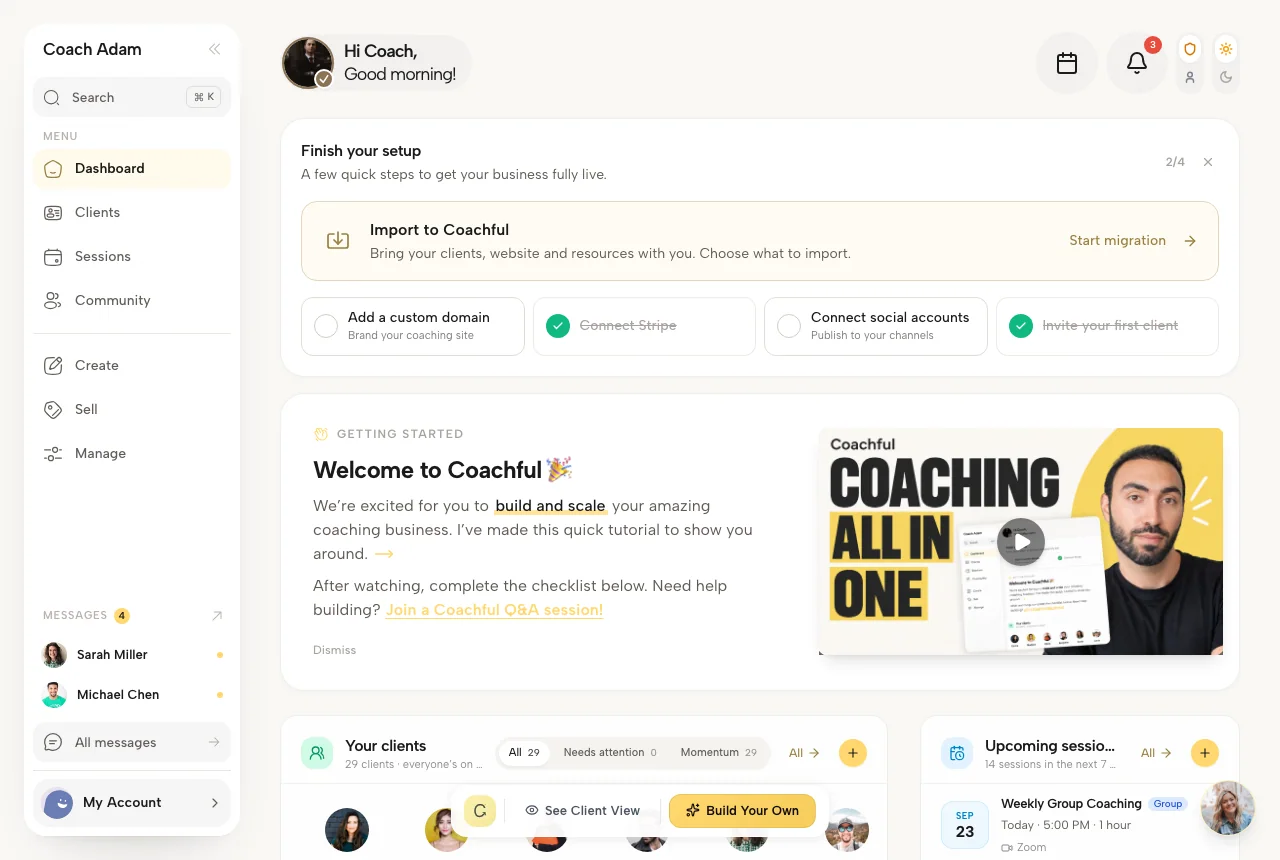
- App-only delivery: programs with weekly goals and daily tasks, daily habits with check-ins and streaks, progress tracking, and community, in a client app on iOS and Android that shows your branding.
- Live tier calls: booking pages and session credits let you cap how many calls a client can book, and calls run on built-in video, so you do not need a separate video subscription for form reviews.

If your coaching relies on a specialised exercise library or detailed workout logging, compare how each platform handles that in our fitness coaching software comparison and on the HubFit alternative page. For setting up the recurring billing itself, see recurring coaching sessions with automatic billing. Coachful has a 7-day free trial, card required, no charge during the trial, cancel in one click.
Frequently asked questions
How much more should a live form-review tier cost than app-only?
At least the time cost of the calls, including prep and notes, at your hourly rate, plus a premium for personal attention. Work out the minutes per client per month first; if the price gap does not cover them, upgrades make you busier without paying you more.
Should app-only online fitness clients get any calls?
Only if you decide in advance and write it down, for example one onboarding call. Otherwise keep app-only to the program, check-in reviews and messages within set hours, and point clients who want live help to the higher tier.
How many form-review calls a month should the higher tier include?
Enough to make visible progress on technique and few enough that you can serve every live-tier client in the hours you set aside. Pick a number, a call length and a booking window, and decide what happens to unused calls.
Should unused form-review calls roll over?
Usually they should expire at the end of the month or roll over once at most. Open-ended rollover builds a backlog of calls you owe, often at the busiest time of year.
Can video form checks replace live calls?
For many clients, short clips with written feedback work well and take less of your time. You can include a set number in app-only or the live tier, and keep live calls for clients who need real-time correction.
Do I need a separate Zoom subscription for form-review calls?
Not on Coachful. Calls run on built-in video included in the subscription. If you prefer, Coachful can also create Zoom, Google Meet or Teams links automatically.