
How to Create an Online Fitness Coaching Program People Keep
Anyone can email a PDF of workouts. An online fitness coaching program is what happens around the workouts: the starting assessment, the adjustments when a knee complains, the check-in that notices someone skipped Thursday three weeks running, the habits that make training possible in a life with kids and a commute. Clients pay for that layer, and it is the part most programs under-build.
This guide shows how to design an online fitness coaching program for a specific client and constraint, with a complete nine-week sample for parents training at home, programming rules that survive remote delivery, check-ins and form feedback, habits, pricing tiers, delivery in an app and the mistakes to avoid. Coachful's team can build the program for you for free on any Coachful plan: send your training blocks and notes through a short form and the weeks, workouts, habits and check-ins are set up in your account.
Workout plan versus coaching program
| Part | Workout plan | Online fitness coaching program |
|---|---|---|
| Start | Day 1, workout A | Intake, movement check, baseline tests, goal in the client's words |
| Training | Fixed sets and reps | Progressions, substitutions, effort targets, planned deloads |
| Feedback | None | Weekly check-in, form review, adjustments |
| Habits | Not covered | Steps, protein, sleep, a plan for missed sessions |
| End | Runs out | Retest, review, next phase |
Every row on the right is something you design once and deliver many times. That is what makes the program scale beyond your 1:1 hours.
Pick the client and the constraint
Fitness programs fail when they are written for "anyone who wants to get fit". Write for one person with one set of limits:
- Equipment. Full gym, a pair of adjustable dumbbells, bodyweight only, a hotel room on Tuesdays.
- Time. Three 40-minute sessions is a very different program from five 75-minute sessions.
- History. Brand new, returning after years off, training around an old injury.
- Goal. Strength, a first race, moving without pain, a body composition change.
The constraint becomes your marketing. "Strength training for parents with a garage and forty minutes" will find its people faster than "transform your body".
Sample: a nine-week online fitness coaching program
The program is "Garage Strong", for parents in their forties training at home three times a week with adjustable dumbbells, a bench and a mat. The promise: "In nine weeks you are measurably stronger on four basic lifts, you train three times a week without negotiating with yourself, and you have a plan for weeks when it all goes sideways."
| Week | Block | Training focus | Habit added | Check-in metric |
|---|---|---|---|---|
| 1 | Onboarding | Movement check and baseline tests: goblet squat reps, push-up reps, dumbbell row, plank time | Lay out kit the night before | Sessions done, baseline numbers |
| 2 | Foundation | Three full-body sessions, moderate effort, learning technique | A daily walk of any length | Effort per session from 1 to 10 |
| 3 | Foundation | Add a set or a few reps to each main lift | Protein at two meals | Form video of the squat |
| 4 | Foundation | Heaviest week of the block | Bedtime within a 30-minute window | Energy and soreness |
| 5 | Deload and retest | Lighter week, retest two baseline lifts | None new | Retest numbers |
| 6 | Build | Split routine: two strength days, one conditioning circuit | Keep all habits | Sessions done, effort |
| 7 | Build | Progress loads, introduce single-leg work | A plan for one missed session | Form video of the split squat |
| 8 | Build | Heaviest week of the program | Keep all habits | Energy, soreness, sleep |
| 9 | Retest and next phase | Full retest, review, choose next goal | Pick the habits to keep | Final numbers against week one |
The deload in week five does double duty: bodies recover, and the retest gives clients an early win to tell their partner about, which matters more for retention than most coaches expect.

The onboarding week, step by step
Week one sets the tone for the whole program, so script it:
- Intake form before anything else. Training history, injuries and anything a doctor has told them to avoid, the days and times they can realistically train, and a photo of their equipment. That photo saves a week of "I don't have a bench" messages.
- A 30-minute video call. Watch them squat, hinge, push and pull with light weight or none. You are looking for what to modify, not grading them.
- Baseline tests with written instructions. Same tests, same order, same rest, so the week-five and week-nine retests compare like with like.
- Expectations in writing. Which day the check-in is due, how quickly you reply, how to reach you if something hurts, and what happens if they miss a week.
Clients who finish a tidy onboarding week tend to treat the rest of the program as something real, because it already feels organized.
Programming rules that hold up online
You will not be there to spot, cue or swap an exercise in the moment. Write the program so it adjusts without you:
- Effort targets, not only weights. "Three sets of eight, leaving two reps in the tank" works at any strength level.
- A substitution for every exercise. Bench taken by the laundry? Floor press. Knee grumpy? Box squat to a higher target.
- Clear progression rules. "When you hit the top of the rep range on all sets, add weight next session."
- Planned easy weeks. Every fourth or fifth week, drop the load. Clients who never deload get hurt or bored.
- A minimum session. A twenty-minute version for chaotic days, so the streak survives.
Weekly check-ins and form feedback
The check-in is the coaching. Keep it the same each week so trends show up:
- Sessions completed this week, out of three.
- Average effort, from 1 to 10.
- Energy, sleep and soreness, each on a short scale.
- Anything that hurt (not muscle soreness, actual discomfort)?
- One win, one thing to change.
Ask for one short form video a week of the main lift, filmed side-on, and reply with one cue rather than five. If a client reports pain that is more than ordinary soreness, recommend they see a qualified medical professional before continuing that movement.
Habits beyond the workouts
Three forty-minute sessions add up to two hours a week. The other 166 decide whether clients feel any different. Add one habit at a time, tracked as done or not done each day.

Daily steps, protein at meals and a consistent bedtime cover most of what busy clients need. Our guide to creating a health coaching program goes deeper on stacking habits if your program leans toward lifestyle change.
Pricing tiers for online fitness coaching
Online fitness coaching usually sells in tiers, separated by how much live contact the client gets:
- App only: the program, workout logging, weekly written check-in replies.
- App plus a monthly call: everything above, with a 30-minute review each month.
- Premium: weekly calls or form reviews within a set window, plus nutrition support.
Price per month or per program block, and make the lower tier good enough that clients do not feel punished for choosing it. Our guide to pricing app-only and live-call tiers walks through the trade-offs in detail.

Delivering the program in an app
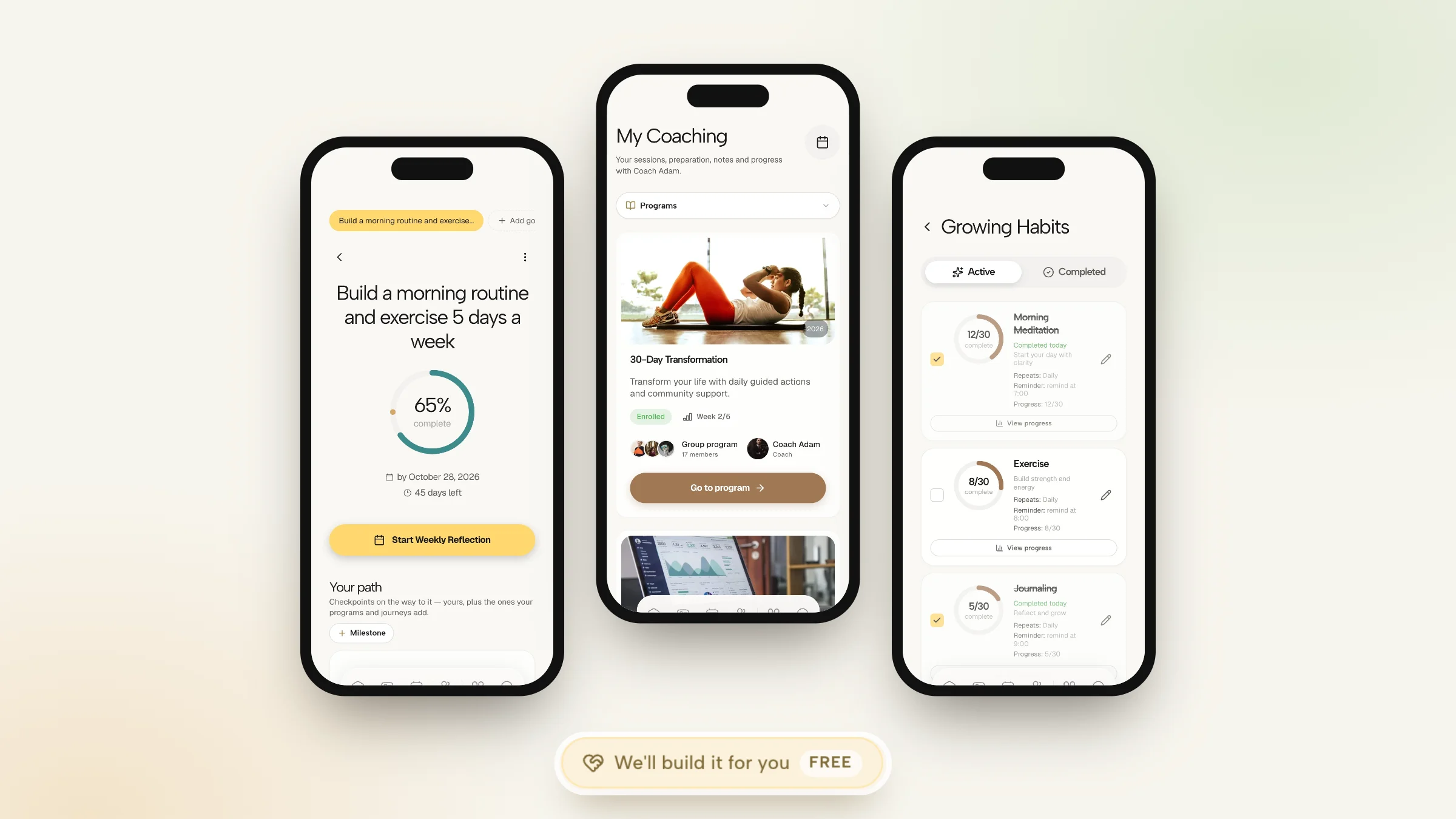
Fitness clients open the program in the gym, between sets, with sweaty hands. It has to live on their phone. In Coachful, the client app on iPhone and Android shows the current week, the day's practices and habits, and the Fitness & Nutrition power-up adds a workout builder with an exercise library (supersets, circuits, AMRAP, EMOM and intervals), client workout logging with set history, nutrition targets, meal plans, recipes, food lookup and private progress photos and measurements. You switch it on for the clients who need structured workout logging. Ready-to-film templates such as Strong After 40, Your First 5K and Strong Foundations, and course templates like The Home Workout Blueprint and Mobility in 15 Minutes a Day, can give you a head start. The page for fitness coaches covers the setup, and our roundup of fitness coaching software compares the alternatives.

Mistakes in online fitness programs
- Programming for the coach, not the client. Your favorite six-day split is not a busy parent's program.
- No baseline. Without week-one numbers, clients cannot see progress, and progress is what renews.
- Five cues per form video. Pick the one that fixes the most. Clients can only think about one thing under load.
- Ignoring missed sessions. A missed Thursday is information. Three in a row is a conversation.
- A program that just stops. End every block with a retest and a clear next phase, so clients have a reason to stay.
Let Coachful's team build your fitness program
If you have the training blocks in your head or a spreadsheet, Coachful's team will build the program in your account for free, on any plan. The app labels it FREE and Complimentary gift.
Start from the Create page (the first chip reads We'll build it for you · FREE) or from the Want us to build your program? card at the bottom of your Programs list, which opens the form with Program selected.

Describe the program ("a nine-week home strength program, three sessions a week, with a deload in week five, one habit a week and a weekly check-in"), who it is for and what it should achieve. Add up to eight links and up to ten files: your training spreadsheet, exercise notes, a check-in you already use or an audio recording explaining your approach. Video files are not accepted, so keep your exercise demos for later. The last box covers deadlines and anything to avoid.
The team replies by email with next steps, usually within around 24 hours. That is the typical turnaround, not a guaranteed deadline. Everything is built inside your own account, so you can tweak loads, swap exercises and adjust habits in the normal editors afterwards.
A few things the service does not do: the team does not record exercise demos or any video or audio, write medical or injury advice, run sessions, design logos or manage ads. And nothing is invented, including credentials, transformations, testimonials or prices. Anything missing is left for you to add. The guide to the free white-glove service lists what else the team can build, from the sales page to the email sequence.
Write the first week before anything else. If the onboarding and baseline week is right, clients trust the other eight.
Frequently asked questions
How do I create an online fitness coaching program?
Choose one client and constraint (equipment, time, history, goal), start with an intake and baseline tests, write training blocks with effort targets, substitutions and planned deloads, add a weekly check-in and form review, layer in one habit at a time, and end with a retest and a next phase.
How long should an online fitness coaching program be?
Many coaches work in blocks of four to six weeks and sell programs of eight to twelve weeks, so there is room for a deload and a retest. Ongoing clients then move from block to block on a monthly plan.
What should a weekly fitness check-in include?
Sessions completed, average effort, energy, sleep and soreness on short scales, any pain beyond normal soreness, and one win plus one thing to change. Ask for one short form video of the main lift each week.
How do online fitness coaches price their programs?
Usually in tiers by live contact: app-only with written check-in replies, app plus a monthly call, and a premium tier with weekly calls or faster form reviews. Prices are set per month or per block. Make the lowest tier genuinely useful.
Can Coachful build my online fitness coaching program for free?
Yes. The build is free on any Coachful plan. Choose Program in the request form, describe the blocks and audience, and attach your spreadsheet, notes or a voice memo. The team replies by email, usually within around 24 hours. You record any exercise demo videos yourself.
Do I need an app to run online fitness coaching?
You need somewhere clients can see the day's workout, log what they did and check in, ideally on their phone. A dedicated coaching app keeps that in one place instead of spreadsheets, messages and email.












