How to Find a Health Coach: Credentials, Costs and Fit

How to find a health coach, in short: decide which habit you want help changing, check whether your employer, health plan or clinic already offers coaching, then shortlist coaches who specialize in your goal through the NBHWC's directory of board-certified coaches, referrals and directories such as Coachful's Find a Coach. Ask about their training and scope on a short discovery call, and if your goal involves a medical condition, tell your doctor and choose a coach who is happy to work alongside your care team.
"Health coach" covers a wide range of people: board-certified coaches who work in clinics, wellness coaches in workplace programs, people with a short online certificate, and specialists in sleep, menopause, gut health or weight. All can help in the right situation. This guide explains which kind fits your goal, the help you may already have access to, what credentials mean, where to look, what it costs and the red flags.
Which health coach fits your goal?
| Your goal | Who to look for | Also involve |
|---|---|---|
| Eat better, move more, sleep better, in general | A health and wellness coach | Nobody else, unless something changes |
| Prediabetes or a high risk of type 2 diabetes | A lifestyle coach in a CDC-recognized National Diabetes Prevention Program | Your doctor, who can confirm prediabetes |
| Weight, with a condition your doctor treats | A health coach with clinical experience | Your doctor, and a registered dietitian for a medical diet |
| A specific stage, such as menopause or postpartum | A specialist coach in that stage | Your clinician for symptoms and treatment |
| Stress and burnout | A wellness or burnout coach | A therapist if anxiety or low mood is constant |
| Strength and fitness | A fitness coach or certified personal trainer | Your doctor if you have an injury or a heart condition |
The difference between a health coach and a wellness coach is fuzzy in practice; wellness coach vs health coach explains where people draw the line, and what health and wellness coaching is covers how it works.
Check the help you may already have
Before you pay a private coach, look at three places:
- Your employer. Workplace wellness programs and employee assistance programs sometimes include health coaching. Ask HR or check your benefits portal.
- Your health plan or clinic. Some health systems and practices have coaches on staff. Coaching delivered under a clinician's supervision is the main way health coaching gets billed to insurance; our guide to whether a health coach can bill insurance explains the codes and what changed in 2026.
- The National Diabetes Prevention Program. If you have prediabetes, the CDC's lifestyle change program runs for a year, meeting about once a week for the first six months and once or twice a month after that, led by a Lifestyle Coach "specially trained to lead the program". The CDC says some employers and insurance carriers cover the cost (CDC). You can search for one near you or online with the CDC's Find a Program tool.
How to find a health coach in five steps
1. Write the change in one sentence
"Walk 30 minutes, five days a week, by the end of March" or "Stop the 3pm sugar crash without cutting out lunch". A coach can work with that. "Get healthy" is a starting point for the first call.
2. Decide on format
One-to-one sessions by video work well for most people. Group programs cost less and add company. App-based coaching with a weekly check-in from a real coach is the cheapest option and suits simple goals.
3. Build a shortlist of three
Look for a specialty that matches your goal and life stage. Sources are below.
4. Check training and scope
Ask where they trained, whether they are board certified, and what they refer to a doctor, dietitian or therapist. Our list of questions to ask a health coach has the full set.
5. Book a discovery call and agree terms in writing
Number of sessions, what happens between them, price, cancellations and how your health information is stored.
Where to look for a health coach
| Where | Good for | Watch out for |
|---|---|---|
| NBHWC's Find a Health Coach directory | Board-certified coaches (NBC-HWC) | It lists only coaches who hold the credential |
| Your doctor or clinic | Coaches who already work with clinicians | Availability varies by practice |
| Employer and health plan programs | Coaching you may not pay for directly | Program coaches may have limited time per person |
| Coachful's Find a Coach | Browsing coaches and their programs by topic, then booking a call | Read each coach's own account of their training |
| Referrals | Someone you trust saw the coach work | Their goal may differ from yours |
The National Board for Health and Wellness Coaching links its directory from its home page (NBHWC). Board certification is the credential most clinics and employers in the US recognize.
What health coach credentials mean
Health coaching is not a licensed profession in most places, so anyone can use the title. The main credential in the US is the National Board Certified Health and Wellness Coach (NBC-HWC). According to the NBHWC, to sit the board exam a coach must:
- complete an NBHWC-approved training program;
- hold an associate's degree or higher in any subject, or have 4,000 hours of work experience in any field;
- log 50 coaching sessions that meet NBHWC's requirements, after passing a skills assessment in their training program;
- pass the Health and Wellness Coach Certifying Examination, offered in set windows each year (NBHWC).
Many good coaches have other training: an ICF credential, a background in nursing, physical therapy or fitness, or a specialist certificate. Ask what their training covered and how many people they have coached with goals like yours. Our guide to health coach certification compares the programs.
See a licensed professional when...
- You need a diagnosis, a medication change or treatment for a condition. That is your doctor's job, and a coach should never suggest stopping or changing medication.
- You need a medical diet for a condition such as kidney disease or diabetes. A registered dietitian provides medical nutrition therapy.
- You have a history of an eating disorder, or food and weight cause you distress. Start with a clinician who treats eating disorders.
- Low mood or anxiety is constant, or you have thoughts of harming yourself. In the US, call or text 988 to reach the 988 Suicide and Crisis Lifeline.
A good health coach works alongside these professionals and will ask about your health history before you start.
What a health coach costs
Coachful's 2026 Coaching Business Report, which compiles PayScale and practitioner reports for the second quarter of 2026, gives these health and wellness coaching benchmarks:
| What you buy | Typical price | Source |
|---|---|---|
| Per hour, typical range | $75 to $200 | PayScale and practitioner reports |
| Newer coach | $50 to $100 an hour | Practitioner estimate |
| Experienced coach | $100 to $200 an hour | Practitioner estimate |
| Four-week reset: four sessions with a habit tracker | $400 to $800 | Practitioner reports |
| Three-month program: eight to ten sessions with weekly check-ins | $900 to $2,000 | Practitioner reports |
| Ongoing monthly: two to four sessions plus messaging | $300 to $700 a month | Practitioner reports |
| App-based coaching with a weekly coach check-in | $17 to $149 a month | Practitioner reports |
US dollars, Q2 2026. Practitioner figures are estimates. Details on coachingrates.com.
Most private health coaching is paid out of pocket. Whether you can use a health savings account or flexible spending account depends on IRS rules and your plan, so check with your plan administrator before assuming you can. More on prices in how much a health coach charges, and on value in is a health coach worth it.
Red flags when choosing a health coach
- Promises to cure, reverse or treat a disease. That is outside a coach's scope.
- Selling supplements or products they profit from as part of the plan, without saying so.
- Dramatic before-and-after testimonials. The FTC says testimonials reporting results "more dramatic than users can generally expect are likely to be deceptive" unless the typical result is clearly disclosed (FTC).
- No health-history questions before the first session.
- One plan for everyone, handed over in the first call.
- Advice to ignore your doctor. Walk away.
What good health coaching feels like
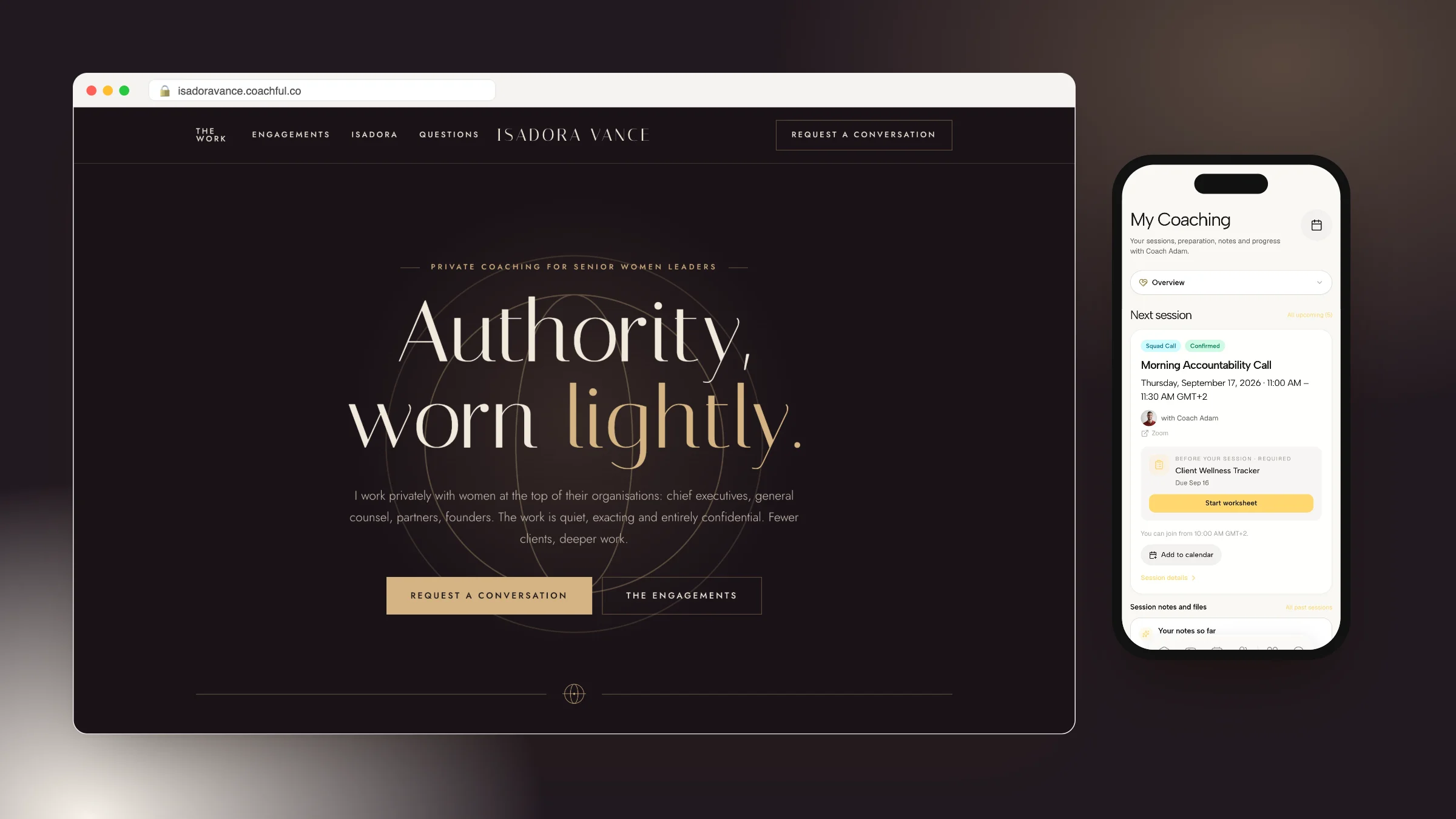
Health coaching is mostly about the days between sessions. Expect to leave each call with one or two small, specific actions, and a way to track them. Many coaches use an app where daily habits come with reminders and visible progress.

On a phone, ticking a habit off takes a few seconds, which is the point.

Bigger goals get a date and a weekly reflection, so you and the coach can see whether the small actions add up.

A short check-in before each call means the session starts with what actually happened that week.

And there is usually a way to send a quick message when something goes well or badly. Agree reply times at the start.

Find a health coach on Coachful
Coachful's Find a Coach directory is public, so you can browse without creating an account. Search a topic, such as "sleep", "menopause", "gut health" or "weight", to find coaches whose headline or bio mentions it, or browse the Health and Fitness and Lifestyle categories. You can switch between browsing coaches and browsing their programs, which helps if you want a fixed four-week or three-month program.
The Find My Coach quiz asks what you want to improve, where you are right now, your email, your preferred coaching style and your monthly budget, then suggests coaches.

Each profile shows what the coach has added about their training and approach, their programs and prices, and either a calendar to book a discovery call or a form to send a message.

Are you a health coach?
Every question on this page is one your future clients are asking. Our guides on how to become a health coach and how to get clients as a health coach cover training and clients, and Coachful's page for health coaches shows the platform. If your website does not answer these questions yet, the team will build it for you through the free white-glove service.

Frequently asked questions
How do I find a good health coach?
Write down the habit you want to change, check whether your employer, plan or clinic offers coaching, then shortlist three coaches who specialize in your goal through the NBHWC directory, referrals or a coach directory. Ask about training and scope on a discovery call and get the terms in writing.
How much does a health coach cost?
Most health coaches charge $75 to $200 an hour, and a three-month program of eight to ten sessions typically costs $900 to $2,000, according to Coachful's 2026 Coaching Business Report. App-based coaching with a weekly coach check-in runs $17 to $149 a month.
What is a board-certified health coach?
A coach who holds the NBC-HWC credential from the National Board for Health and Wellness Coaching. It requires an approved training program, an associate's degree or 4,000 hours of work experience, 50 logged coaching sessions and a passing score on the board exam.
Does insurance cover a health coach?
Usually not for private coaching. The routes that exist run through clinics and programs: coaching under a clinician's supervision, or the CDC's Diabetes Prevention Program, which some employers and insurers cover. Ask your plan, and see our guide on whether health coaches can bill insurance.
Should I see a health coach or a dietitian?
See a registered dietitian if you need a medical diet for a condition. A health coach helps you build and keep habits, often after a dietitian or doctor has set the plan. Many people use both.
Can I find a health coach online?
Yes. Most health coaching works well by video, and online widens your choice to specialists in your exact situation. Directories such as NBHWC's and Coachful's Find a Coach let you search by topic and book a call.
How long should I work with a health coach?
Three months is a common length, long enough for a new habit to settle. A four-week reset suits a single change; ongoing monthly coaching suits people who want accountability over a longer period.