
Can a Health Coach Bill Insurance? CPT Codes and Medicare
Not on your own, in most cases. Can a health coach bill insurance? A self-employed health coach can't bill Medicare directly and rarely gets paid by private insurers, because health coaching isn't a provider type with its own billing rights. The working routes run through a licensed practitioner who bills for coaching delivered under their supervision, and in July 2026 CMS proposed paying nationally for the health coaching codes 0591T to 0593T on exactly that basis. As of October 17, 2026, that proposal is not final.
So the honest version for a coach building a practice today: insurance billing is a route you can join through a clinic, a health system or a community organization, not a button you switch on in a private practice. The rest of this guide explains the codes, what CMS proposed, the arrangements that work, what to tell self-pay clients about HSAs and FSAs, and what to avoid. Coachful runs the self-pay side of a health coaching practice, and our team will build your health coaching website for free on every plan.
Can a health coach bill insurance? The quick answer by situation
| Your situation | Can it be billed? | How it works |
|---|---|---|
| Independent health coach, Medicare client | Not by you | Only a billing practitioner can bill. If CMS finalizes its 2027 proposal, a practitioner could bill 0591T to 0593T for your work under supervision. |
| Independent coach, private insurance | Rarely | Payment for these Category III codes is each payer's decision. Check the payer's written policy before telling a client anything. |
| Coach employed by or contracted to a medical practice | Possibly, by the practice | The practice bills eligible services you deliver as auxiliary personnel, under its rules and its records. |
| Coach at a community-based organization | Possibly, through a partner practice | The 2027 proposal allows general supervision for coaches employed by community organizations that meet the training standards. |
| Lifestyle coach in the Diabetes Prevention Program | Yes, by the supplier | An organization enrolled as an MDPP supplier bills Medicare for the program. |
| Licensed professional who also coaches | Your licensed service only | You bill what your license covers. The coaching itself still isn't billable on its own. |
| Self-pay client who wants to use an HSA or FSA | That's the client's account decision | Eligibility depends on IRS rules and the plan, not on your invoice. |
What the health coaching CPT codes are
Three Category III CPT codes describe health and well-being coaching. Category III codes are temporary tracking codes for emerging services, and having a code is different from being paid for it. The National Board for Health and Wellness Coaching notes that the codes became active in 2020.
| Code | Description | Proposed 2027 work RVU |
|---|---|---|
| 0591T | Health and well-being coaching face-to-face; individual, initial assessment (60 to 90 minutes) | 1.00 |
| 0592T | Individual follow-up session, at least 30 minutes | 0.70 |
| 0593T | Group (2 or more individuals), at least 30 minutes, billed once per beneficiary in the group | 0.23 |
Descriptions and proposed values from the CY 2027 Physician Fee Schedule proposed rule.
Until now, Medicare left the pricing of these codes to its regional contractors. CMS added the services to the Medicare Telehealth Services List in the CY 2024 final rule, which allowed them by video, but a code on a list still needs a payer willing to price it and a provider eligible to bill it.

What CMS proposed for 2027
In the CY 2027 Physician Fee Schedule proposed rule, displayed on July 14, 2026 and published on July 16, CMS proposed "conditions of payment and valuation" for 0591T, 0592T and 0593T and national payment for all three (CMS-1848-P). The details that matter to a coach:
- Who bills: the billing practitioner, such as a physician. The coach furnishes the service as auxiliary personnel under the practitioner's direct supervision.
- What the coach needs: appropriate certification, which CMS says includes, but is not limited to, the National Board for Health and Wellness Coaching national standards, the National Commission for Health Education Credentialing's eligibility for Certified Health Education Specialists, or the American Holistic Nurses Credentialing standards for Certified Nurse Coaches. Training from evidence-based programs funded under the Older Americans Act would also count.
- Community organizations: coaches employed by community-based organizations may work under general supervision, if they meet the same training and certification standards.
- Frequency: no preset limits, "as long as they are reasonable and necessary."
- Definition: CMS proposed adopting the CPT description of coaching as a patient-centered approach in which patients determine their goals and self-monitor behaviors "within the context of an interpersonal relationship with a coach."
CMS also asked whether it should create new G-codes instead of pricing the Category III codes, so the final mechanism could change. The comment period closed on September 14, 2026. At the time of writing CMS had not published a final rule, and the proposal would apply from 2027 only if it is finalized. NBHWC's summary of the proposal is on its site, and the full text is in the Federal Register.
What "auxiliary personnel" and supervision mean for you
Medicare's incident-to rules define auxiliary personnel as anyone acting under a physician's or other practitioner's supervision, "regardless of whether the individual is an employee, leased employee, or independent contractor" (42 CFR 410.26). So a contract arrangement with a practice is possible in principle, not only a salaried job.
Two supervision levels appear in the proposal:
- Direct supervision: the practitioner must be available. The regulation allows "virtual presence" through real-time audio and video, excluding audio-only, for many services.
- General supervision: the service runs under the practitioner's overall direction and control, but they don't need to be present.
What this means in practice: the practice decides whether to bill, owns the clinical record, carries the compliance risk and sets the documentation standard. Your coaching notes would live in its systems, not yours. If you are approached about this kind of arrangement, ask who bills, which codes, what supervision looks like day to day, how you are paid (per session, salary or contract) and what happens to your own private clients. Get the answers in a written agreement reviewed by someone who knows health care billing.

Routes that work today
Here is where insurer or program money reaches health coaches now, and what each takes.
- Work inside a clinic or health system. NBHWC's 2025 survey of board-certified coaches found 22 percent work primarily in health care, 41 percent in private practice, 10 percent in for-profit digital health and 7 percent in corporate wellness, and 58 percent described themselves as self-employed (NBHWC, 2025). Health-care roles are where any billing happens. If you are still choosing a training route, our guide on how to become a health coach explains which credentials clinics ask for.
- Join a Diabetes Prevention Program. The Medicare Diabetes Prevention Program is covered under Part B as a preventive service, with 16 weekly core sessions and monthly maintenance sessions, delivered by organizations enrolled as MDPP suppliers (CMS). Coaches lead the sessions; the supplier bills.
- Partner with a community organization. The 2027 proposal names community care hubs, area agencies on aging and similar non-profits as employers of health coaches who could work under general supervision.
- Sell to employers. Corporate wellness budgets pay coaches directly, with no claims and no codes. This is often the fastest institutional money for a private-practice coach.
- Use the license you already hold. A registered dietitian, nurse or other licensed professional bills the services their license covers, under that license. Keep that work and your coaching clearly separate in your records and your agreements.
What to tell self-pay clients about HSAs and FSAs
Clients will ask whether they can pay with their health savings account or FSA card. Don't promise yes. These accounts pay for medical care as the tax code defines it, and the IRS says nutrition counseling and weight-loss programs qualify "only if" they treat "a specific disease diagnosed by a physician," while general wellness doesn't (IRS FAQ). The decision belongs to the client and their plan administrator.
What you can do: give a clear itemized invoice with your name, the dates, the service and the amount, and say plainly in your agreement that you make no claim about tax or account eligibility. Our sibling guide on whether coaching is covered by insurance explains the client's side, and is coaching tax deductible covers the tax questions.

Mistakes that can cost you your reputation
- Putting a diagnosis code on a receipt. A coach doesn't diagnose. A "superbill" with a diagnosis you didn't make, or a code you aren't eligible to bill, can put both you and the client in trouble.
- Billing a code as if you were the provider. Under the proposal the billing practitioner bills. An independent coach submitting 0592T in their own name is not what CMS described.
- Telling clients "insurance will probably cover it". Say what you know: you are paid directly, and the client can ask their insurer or plan administrator.
- Ignoring privacy rules once claims are involved. CMS says providers who submit HIPAA transactions, like claims, electronically are covered entities (CMS). If you work under a practice, follow its systems for anything clinical.
- Drifting into treatment. Coaching supports behavior change. Meal plans for a medical condition, medication advice and clinical assessment belong to licensed professionals. Our guide to health coach certification covers scope of practice.
Pricing a self-pay health coaching practice
Most health coaches are paid by the client or an employer, so the price you set matters more than any code. Coachful's 2026 Coaching Business Report puts health and wellness coaching at $75 to $200 an hour (PayScale and practitioner reports), with three-month programs of eight to ten sessions at $900 to $2,000 and ongoing monthly coaching at $300 to $700, both practitioner estimates (coachingrates.com). NBHWC's 2025 survey found private-practice board-certified coaches charging a median of $100 an hour, with most rates between $75 and $150.
Packages that bundle sessions, weekly check-ins and habit tracking are easier to sell than single hours, and they give an employer something concrete to buy. Our guide to how much a health coach charges has worked examples, and how to get clients as a health coach covers filling the practice, including employer deals.

How Coachful runs the self-pay side
Coachful is built for the part of a health coaching practice that clients or employers pay for directly. Be clear about the boundary: Coachful doesn't submit insurance claims, doesn't produce superbills and is not HIPAA-certified. If you deliver billed services inside a medical practice, use that practice's records and billing systems for that work.
For your own clients, a Coachful membership includes:
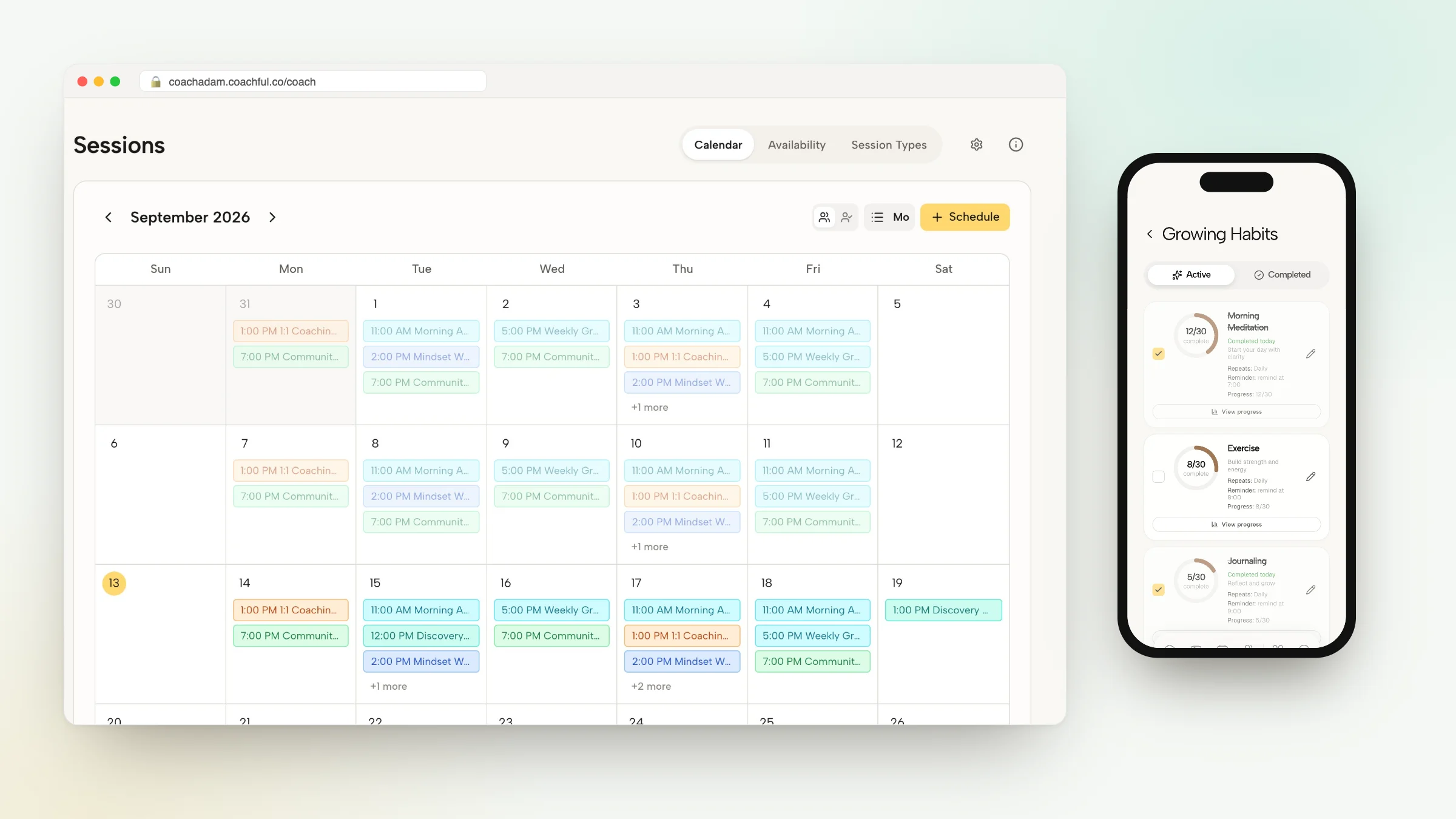
- Programs with habits and check-ins. Multi-week programs with weekly goals, daily tasks, habits and morning and evening check-ins in the client app on iPhone and Android.
- Forms and agreements. Intake and check-in forms, and coaching agreements sent for e-signature before the first session and stored on the client record.
- Payments and invoices. One-time payments, subscriptions and payment plans through your own Stripe or Razorpay account with a 0% Coachful platform fee, and an invoice for every transaction.
- Client overview. Who is following through and who has gone quiet, from task completion, check-ins and mood.
See the full setup on the Coachful page for health coaches.


The free build, if you want your site done for you
Our team builds websites, funnels, offer pages and programs inside your Coachful account for free on every plan. Open Website and click Fill in a form on the "Want us to build it for you?" card, or pick We'll build it for you · FREE under Create. Say which pages you want, what they should do and where visitors should go next, and attach up to 10 files and 8 reference links. The team replies by email with next steps, usually within about 24 hours, though that isn't a guaranteed deadline. Nothing gets invented: no credentials, testimonials or prices you don't have. It doesn't include logo design, filming your videos or running ads. See what the free build covers.

Frequently asked questions
Can a health coach bill Medicare?
Not directly. Health coaches aren't a provider type that bills Medicare in their own name. CMS's 2027 proposal would let a billing practitioner bill 0591T to 0593T for coaching delivered by a certified coach under supervision, but it was not final as of October 17, 2026.
Do health coaches take insurance?
Most don't. NBHWC's 2025 survey found most board-certified coaches in private practice or self-employed, paid by clients or employers. Coaches working inside clinics may deliver services the practice bills, under the practice's name and rules.
What are the CPT codes for health coaching?
0591T for an individual initial assessment of 60 to 90 minutes, 0592T for an individual follow-up of at least 30 minutes, and 0593T for group coaching of at least 30 minutes. They are Category III codes, so payment depends on the payer.
Do I need NBC-HWC certification to bill for health coaching?
Under the 2027 proposal, auxiliary personnel would need appropriate certification, which CMS says includes the NBHWC national standards, CHES eligibility from NCHEC, or the AHNCC standards for Certified Nurse Coaches, among others. Private payers set their own rules.
Can clients pay a health coach with an HSA or FSA?
Only if the expense counts as medical care under IRS rules, which for nutrition counseling and weight-loss programs means treating a specific disease diagnosed by a physician. The client should ask their plan administrator. Don't promise eligibility on your website or invoice.
Does Coachful handle insurance billing or superbills?
No. Coachful runs the self-pay side: programs, habits, check-ins, booking, agreements, payments and an invoice for every transaction. It doesn't submit claims or create superbills and isn't HIPAA-certified, so billed clinical work belongs in the practice's own systems.
Will Coachful build my health coaching website for free?
Yes. Coachful's team builds websites, funnels, offer pages and programs for free on every plan, inside your account. Fill in the form from the Website page or from Create, and the team replies by email, usually within about 24 hours. Coachful itself is a paid membership with a free trial.












