
How to Get Clients as a Health Coach: Channels and Scripts
How to get clients as a health coach, in short: health coaches who fill a practice usually lean on one of three channels. Clinicians refer patients who need help changing habits, employers and community groups book talks and group programs, and a narrow, searchable specialty brings people in through a small free resource and a consult. Pick one as your main channel for 90 days, give it a one-page referral sheet, a 20-minute consult and a clear three-month offer, then track where every client came from.
Health coaching has a particular problem that general marketing advice ignores. The people who need you most are often already talking to a doctor, a physical therapist or an HR benefits team, and those gatekeepers want to know exactly what you do and what you don't. This guide covers the channels that work for health coaches, with scripts you can copy, a referral one-pager, a 30-day plan and the setup that keeps it running. If you are still training, start with how to become a health coach; for the general client system behind all coaching niches, see how to get more clients as a coach. Every Coachful plan also includes a free build of your website or funnel by our team, covered at the end.
The channels that bring health coaches clients
| Channel | Best for | Speed | What it needs |
|---|---|---|---|
| Clinician referrals | Steady one-to-one clients with clear goals | Slow to start, then reliable | A specialty, clear scope, a referral sheet; board certification helps |
| Employers and workplace wellness | Group programs and workshops | Slow sales cycle | A talk, a six-week group offer, an invoice the company can pay |
| Community talks | First clients in your area | Weeks | A 45-minute talk and a sign-up sheet |
| Content on one problem | Online clients beyond your area | Months, then compounding | A specialty people search for and a small free resource |
| Partnerships | Trainers, dietitians, yoga studios, pharmacies | Weeks | A clear handoff in both directions |
| Your own network | The first three to five clients | Days | A one-sentence description of who you help |
Pick one main channel and one supporting channel. Running all six at half strength is the most common reason a health coaching practice stays at two clients.
Start with a specialty someone can refer to
"I help people live healthier lives" gives a doctor nothing to act on. "I help women in perimenopause rebuild sleep and energy over 12 weeks, alongside their doctor's care" does. The test is whether a clinician could say your sentence to a patient in ten seconds.
Good health coaching specialties tend to sit next to a common clinical conversation: prediabetes and blood sugar habits, weight with a chronic condition, perimenopause and menopause, gut health, sleep, recovery after a cardiac event, burnout, postpartum return to movement. Pick one where you have training or lived experience, and write your scope into the same sentence. Our list of coaching niches helps if you are still choosing, and menopause coaching shows what a specialty looks like from the client's side.

Channel 1: clinician referrals
Primary care doctors, OB-GYNs, physical therapists, chiropractors, dietitians and therapists all see patients who know what they should do and are not doing it. Many would happily send those patients somewhere, provided the coach is safe, specific and easy to refer to.
Build a one-page referral sheet. Keep it to one side of paper:
- Who you help, in your one sentence.
- What you do: habit change, accountability, weekly check-ins, a 12-week program.
- What you do not do: diagnose, prescribe, change medication or give medical diets. You refer back for anything clinical.
- Your training and any credential, such as NBC-HWC.
- How to refer: a short link to book a consult, and your phone number.
- How you communicate back: with the client's written permission, a short progress note at the end of the program.
Then ask for a ten-minute conversation. Start with practices you already have a connection to, such as your own doctor or a physical therapist you know:
"Hi Dr. Patel, I'm a health coach in Eastside. I work with women in perimenopause on sleep, movement and energy over 12 weeks, and I refer anything clinical straight back to their doctor. Some of your patients may want help sticking to the changes you recommend. Could I drop off a one-page summary, or take ten minutes to explain how a referral would work?"
Close the loop. The coach who sends a three-line progress note, with permission, is the one who gets the next referral. If you ever work inside a clinic's program, follow the clinic's own systems for patient records. Coachful is not HIPAA-certified, so it suits private clients who come to you directly.
A clinician relationship can also become a billing route, where a practice bills for coaching you deliver under its supervision. That is a different arrangement with its own rules; our guide on whether a health coach can bill insurance explains it.
Channel 2: employers and workplace wellness
HR and benefits teams buy talks, challenges and group programs, usually for a whole team at once. The sales cycle is slow, but one contract can fill a quarter.
- Offer one talk first. A 45-minute lunch-and-learn on a single problem: "Beating the 3pm crash" or "Sleep for shift workers".
- End with a six-week group option employees can join, paid by the company or by the employee.
- Send a one-page proposal with the outline, group size, dates and price, and offer to invoice the company.
"Hi Jo, I run a 45-minute session on energy and the afternoon slump for office teams: what's going on, three changes that take under ten minutes, and a simple week-one plan. Would it be useful for your wellbeing calendar this spring? I can share the outline and a couple of dates."
Our guide to pitching an employer-paid coaching pilot covers the proposal, and coaching workshop ideas has talk formats.

Channel 3: community talks
Libraries, gyms, yoga studios, community centers, pharmacies, churches and parent groups all run events and look for speakers. These rooms are full of people who already care about their health. The talk outline that converts best is simple:
- Ten minutes on why the problem happens, in plain language.
- Twenty minutes on three changes they can make this week.
- Five minutes of one person's story, with permission.
- Five minutes on what working together looks like, and a sign-up sheet for your free guide and a consult.
Collect emails on paper or a QR code that opens your guide page. The follow-up emails do most of the converting.
Channel 4: content on one searchable problem
People type health questions into search bars and AI tools every day: "why am I tired at 3pm", "how to sleep through the night in perimenopause", "what to eat with prediabetes". A coach who answers one family of those questions well, week after week, builds an audience that books.
Two rules keep health content honest. The FTC says health claims "require substantiation in the form of competent and reliable scientific evidence", and testimonials showing results "more dramatic than users can generally expect are likely to be deceptive" without a clear statement of typical results (FTC). So teach habits and explain research, and never promise a medical outcome.
Every post should point to one small free resource, such as a seven-day meal plan, a sleep reset checklist or a short quiz. Our guide to creating a lead magnet has examples, and a five-day challenge works well for habit-based coaching.

The offer that turns interest into clients
Whatever the channel, the path is the same: free resource, three follow-up emails, a 20-minute consult, then a program. Single sessions rarely change habits, so lead with a defined program. Coachful's 2026 Coaching Business Report puts a typical three-month health coaching program of eight to ten sessions with weekly check-ins at $900 to $2,000, a four-week reset at $400 to $800 and ongoing monthly coaching at $300 to $700, based on practitioner reports. See how much a health coach charges for the full ranges and how to create a health coaching program for the structure.

On the consult, ask about health history and current care before anything else. It protects the client, it shows clinicians you are safe to refer to, and it tells you quickly whether you are the right coach. The coaching sales script covers the rest of the conversation.

Scripts you can copy
To your network:
"I've started coaching women in perimenopause who want their sleep and energy back. It's a 12-week program alongside whatever their doctor recommends. If you know anyone who'd find that useful, I'd be grateful for an introduction, and I'm happy to send a short free sleep guide they can try first."
After a workshop:
"Thanks for coming on Tuesday. Here's the week-one plan I promised. If you'd like help making it stick, I have a few consult slots next week. It's 20 minutes, and we'll work out whether my program is a fit. Book here: [link]."
Asking a client for a referral, at the moment of progress:
"You've slept through five nights this week, which you couldn't do in March. Is there anyone in your life going through what you were? If so, I can send you a short note to forward."
A 30-day plan to get health coaching clients
| Days | Focus | Done when |
|---|---|---|
| 1 to 3 | Write your one-sentence specialty and scope. Draft the referral sheet. | A clinician could repeat your sentence |
| 4 to 7 | Build the free resource, its page and three follow-up emails. Set up a 20-minute consult with health-history questions on the booking form. | A friend can sign up and book on their phone |
| 8 to 12 | Send 20 personal messages to your network. Contact five clinicians or practices you have a link to. | Five conversations booked or held |
| 13 to 18 | Book one community talk and pitch one employer. | A date in the diary |
| 19 to 24 | Publish four pieces of content on your one problem, each pointing to the resource. | Four posts live |
| 25 to 30 | Count leads, consults and clients by source. Send thank-you notes to anyone who referred. | You know which channel to double |

Running it on Coachful
Coachful keeps the whole path in one place:
- Funnels for your guide, a short quiz or a five-day challenge, with templates for lead magnets, events and discovery calls. See funnel software for coaches.
- Booking with availability rules, intake questions on the booking form and email reminders, plus SMS and WhatsApp reminders once messaging is turned on. See booking software.
- Email sequences with delays and triggers for the follow-ups, and Leads with the source on every record.
- Programs with daily habits, goals and morning and evening check-ins, so clients see progress between sessions. The Fitness and Nutrition power-up adds nutrition targets, meal plans, recipes and food lookup if food is part of your work.
- Find a Coach, Coachful's public directory, where you can list your profile in the Health and Fitness category with your headline, bio and a button to book a call, and see profile views, clicks and quiz matches. Listing is included in your membership.
Our page for health coaches shows the full setup.

Have the website and funnel built for you
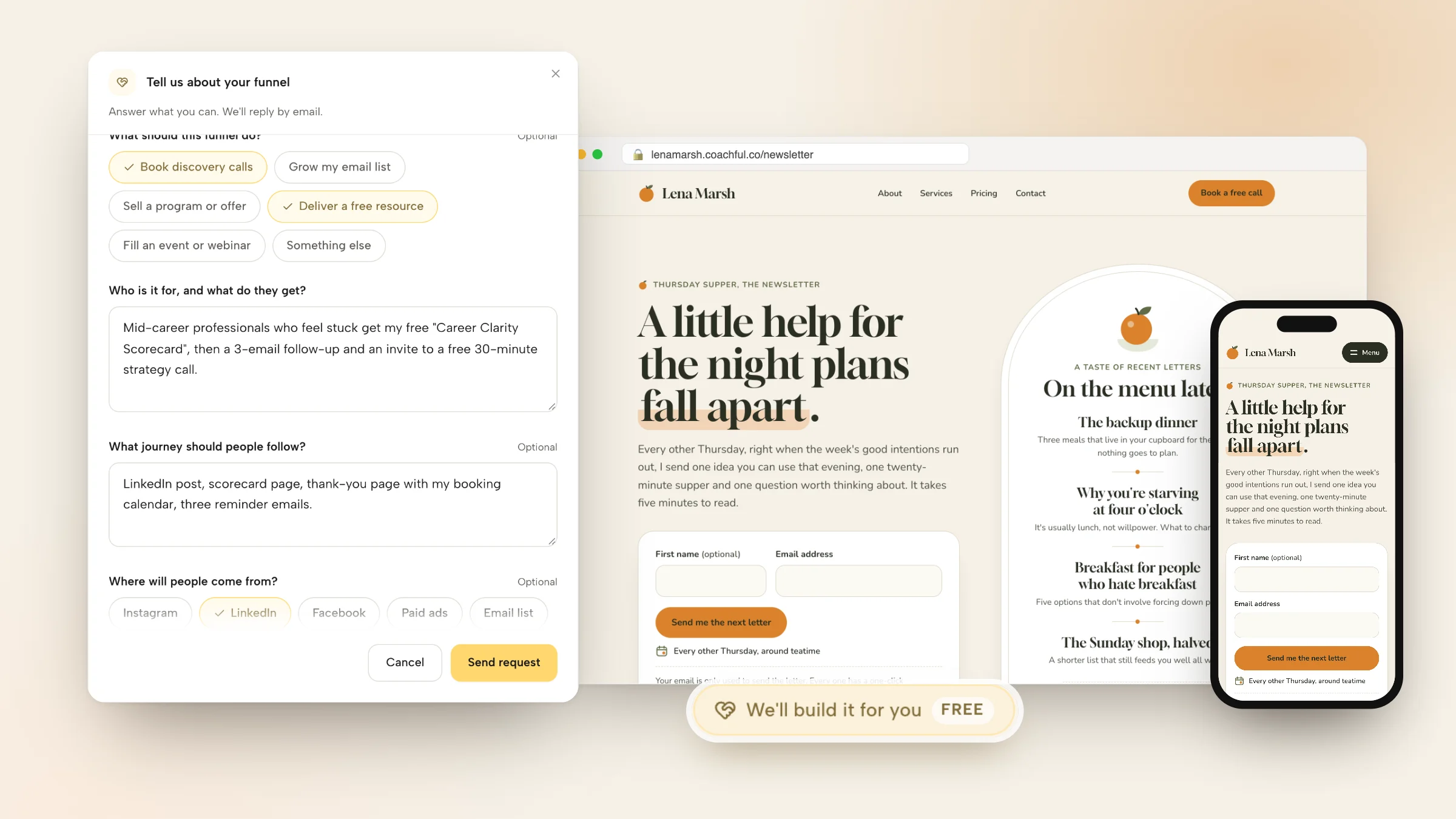
Every Coachful plan includes a free white-glove build. From Create, choose "We'll build it for you", pick website or funnel, and answer a short form: which pages you want, what they should do, what visitors should do next, and where your traffic comes from. You can add up to eight reference links and ten files, such as your logo, photos or the PDF of your guide. The Coachful team replies by email, usually within about 24 hours, and builds it inside your account so you can edit everything afterwards. Nothing gets invented: no fake credentials, testimonials or prices. Recent requests include a five-page site for a menopause and midlife coach with every button leading to a free 20-minute consultation. Our guide to a health coach website covers the pages.

Mistakes that slow down a health coaching practice
- Asking clinicians for referrals before you can state your scope. They will not risk a patient on a vague offer.
- Promising outcomes you cannot control, such as weight lost or a lab result. It invites complaints and breaks FTC rules on health claims.
- Selling single sessions. Habits take weeks; sell the program.
- No follow-up after talks. Most sign-ups book after the second or third email, rarely on the night itself.
- Not recording the source. Without it, you cannot tell which channel to keep.
More in mistakes new health coaches make.
Frequently asked questions
How do health coaches get clients?
Mostly through clinician referrals, employer and community workshops, content on one specific problem, partnerships with trainers and dietitians, and their own network. Pick one main channel, give it a referral sheet, a free resource and a 20-minute consult, and track where every client came from.
How do I get referrals from doctors as a health coach?
Choose a specialty that sits next to a common clinical conversation, write a one-page referral sheet that states what you do and do not do, and ask practices you know for ten minutes. With client permission, send a short progress note at the end. Board certification makes the conversation easier.
How do I get my first health coaching client?
Send personal messages to 20 people who know you, describing exactly who you help, and offer a free guide plus a 20-minute consult. Book one community talk in the same month. Your first clients usually come from people who already trust you.
Do I need to be certified to get health coaching clients?
Not legally in most places. Private clients care more about your specialty and results. Clinics, employers and digital health companies often ask for NBC-HWC board certification, so it matters more if those are your channels.
How much should a new health coach charge?
Coachful's 2026 Coaching Business Report puts newer health coaches at $50 to $100 an hour and three-month programs at $900 to $2,000. Price a defined program rather than single sessions, and raise your rate once you have results to show.
Can Coachful build my health coaching website for free?
Yes. Every Coachful plan includes a free white-glove build. Describe the website or funnel in a short form, attach your logo, photos and guide, and the team builds it in your account, usually within about 24 hours. You can edit everything afterwards.
Is health coaching on social media worth it?
It can be, if you pick one platform, one specific problem and one free resource to point to. Expect months, not weeks. Pair it with a faster channel such as referrals or community talks while it builds.












