
5-Day Challenge Funnel for Coaches: The Day-by-Day Build
A five-day challenge works because it lets people try your coaching before they buy it. For five days they do one small thing a day with your guidance and a group around them, and by Friday they've felt a change and met you properly. A challenge funnel is everything around those five days: the signup page, the welcome, the daily lessons and emails, the group, the invitation on the last day and the follow-up after.
This guide lays out a complete challenge funnel day by day, with copy for each piece, using a fictional meditation coach who runs a free "Quiet Mornings" challenge as the example.
A shortcut if you want one: Coachful's team builds challenge funnels for free on every Coachful plan, from the signup page to the daily structure and emails. You'll find how to request it near the end.
When a challenge funnel is the right choice
A challenge is more work than a checklist, so it's worth checking it fits first. It suits you if:
- your coaching involves daily practice (habits, movement, meditation, writing, money tracking),
- people need to feel a result before they believe it's possible,
- you're comfortable showing up live for a few days,
- you have a paid program that naturally continues what the challenge starts.
If most of those are true, read on. If not, a simpler lead magnet or a single webinar funnel may be a better first step.
The whole challenge funnel, day by day
| When | What participants get | Email subject |
|---|---|---|
| Signup week | Signup page, welcome email, group invite | You're in: Quiet Mornings starts Monday |
| Sunday | "Get ready" email with a two-minute setup task | Tomorrow, 7am: set this up tonight |
| Day 1 | Lesson: why mornings feel rushed; task: three breaths before your phone | Day 1: before you touch your phone |
| Day 2 | Lesson: a five-minute sit; task: sit once, any time before 9am | Day 2: five minutes, no app needed |
| Day 3 | Lesson: what to do with a busy mind; task: name three thoughts and let them go | Day 3: the day most people want to quit |
| Day 4 | Lesson: attaching it to a habit you already have; task: pick your anchor | Day 4: make it automatic |
| Day 5 | Live session: review the week, the invitation to the program | Day 5: live at 7pm, and what's next |
| Days 6 to 8 | Replay, answers to questions, enrollment closes | The replay, and doors close Thursday |
The challenge itself is short. The structure around it is what turns participants into clients.
The signup page
Keep the promise small and specific. Five days can't change someone's life, but it can change their mornings.
- Headline: Five calmer mornings, starting Monday.
- Subheadline: A free five-day challenge for busy people who've tried meditation apps and given up. Ten minutes a day, a small group to do it with, and a live session on Friday.
- What happens each day: list the five days, one line each.
- Who it's for: "You start your day on your phone and feel behind before breakfast."
- Host: two sentences and a photo.
- Dates: the start date, and when the live session is.
- Button: Join the free challenge
Run challenges on fixed dates. "Starts Monday" gives people a reason to sign up now and a group to start with. An always-open challenge loses both.

The group: where the challenge actually happens
The daily lessons matter less than the group. People show up for each other. Set it up so it feels lived-in on day one:
- A pinned welcome post: "Introduce yourself: your name, where you're joining from, and what your mornings look like right now."
- A daily post: the day's task and a question. "Day 2: did you sit? Where? How long did it feel?"
- Replies from you: every comment on day one, as many as you can after that.
- Celebration posts: share wins (with permission) as they come in.
A dedicated community space inside the program beats a social media group, because nobody gets distracted by their feed halfway through a reply.
The daily email, in one template
Each day gets the same short structure, so people know what to expect:
- One line on today's idea.
- Today's task, in one sentence, with how long it takes.
- A link to the lesson (video, audio or written).
- The question for the group, and a link to post the answer.
- A reminder of the live session on Friday.
Day 3 deserves a special note. That's when most people fall off, so the email should say so: "If yesterday didn't happen, today is still Day 3. Nobody's counting." Permission to restart keeps more people in than any motivational quote.

Day 5: the invitation
The live session on the last day is where the challenge becomes a sale, so plan it as carefully as the lessons. A simple 45-minute shape:
- Ten minutes of wins. Read out comments from the group and invite people to share live.
- Fifteen minutes of teaching. What made this week work, and why most people stop after a week.
- A short guided sit together. End the teaching with the practice itself.
- The invitation. "If you want to keep going with support, the eight-week Quiet Mornings program starts on the 15th. Here's what it includes, who it's for and how to join."
- Questions. Answer honestly, including "who shouldn't join".
The program should be the obvious next step: same practice, more depth, longer, with you. If the challenge is about mornings and the program is about sleep, the jump feels odd.
After the challenge: three emails, then stop
- Next morning. Subject: "The replay, and a thank-you". The replay, a recap of what the program includes, the link.
- Two days later. Subject: "Your questions from Friday". Answer the three most common questions in plain words.
- On the last day of enrollment. Subject: "Doors close tonight". Short, honest, final. Only if there's a real close.
Then stop selling. Participants who didn't buy stay on your list and hear about the next challenge.
Worked example: the "Quiet Mornings" challenge
Take a fictional meditation coach, Mei, who teaches calm, practical morning practice to people who think they're "bad at meditating".
- Traffic: Instagram reels of a one-minute breathing practice for two weeks, an email to her list, and a mention on a friend's podcast.
- Signup: a free challenge on fixed dates, with an account so the five days and the group live in one place.
- Daily: one short audio lesson, one task, one group question, one email.
- Day 5: a live session from her living room with the invitation to her eight-week program.
- After: replay, questions and a final email, then the next challenge date announced a month later.
Our earlier piece on running a five-day coaching challenge that turns into paying clients goes deeper on hosting the challenge itself; this guide focuses on the funnel around it.
Numbers to track
- Signups from each traffic source.
- Day 1 starts: people who did the first task. Low means the welcome and "get ready" emails need work.
- Day 5 attendance: people at the live session. This is your real audience for the offer.
- Enrollments: as a share of Day 5 attendees, not of signups.
Challenge funnel mistakes
- Tasks that take an hour. Ten minutes a day is plenty.
- No group, or a group the host never visits.
- Teaching everything in five days, so the program has nothing left to add.
- Forgetting the invitation, or making it three times a day.
- Running it once. The second challenge is always better, and the first one's participants tell their friends.

Running a challenge in Coachful
In Coachful, a challenge is a short program set to free, with a signup funnel in front of it. That keeps the daily lessons, the group and the paid program in the same account.
- Template: New Funnel includes a Free 5-day challenge template. It writes an energetic signup page with the five days laid out, a short FAQ and a closing call to action. Participants create a free account and the challenge is added straight away.
- The days: build the five days as a program with a lesson and a task each day, so participants can tick off progress.
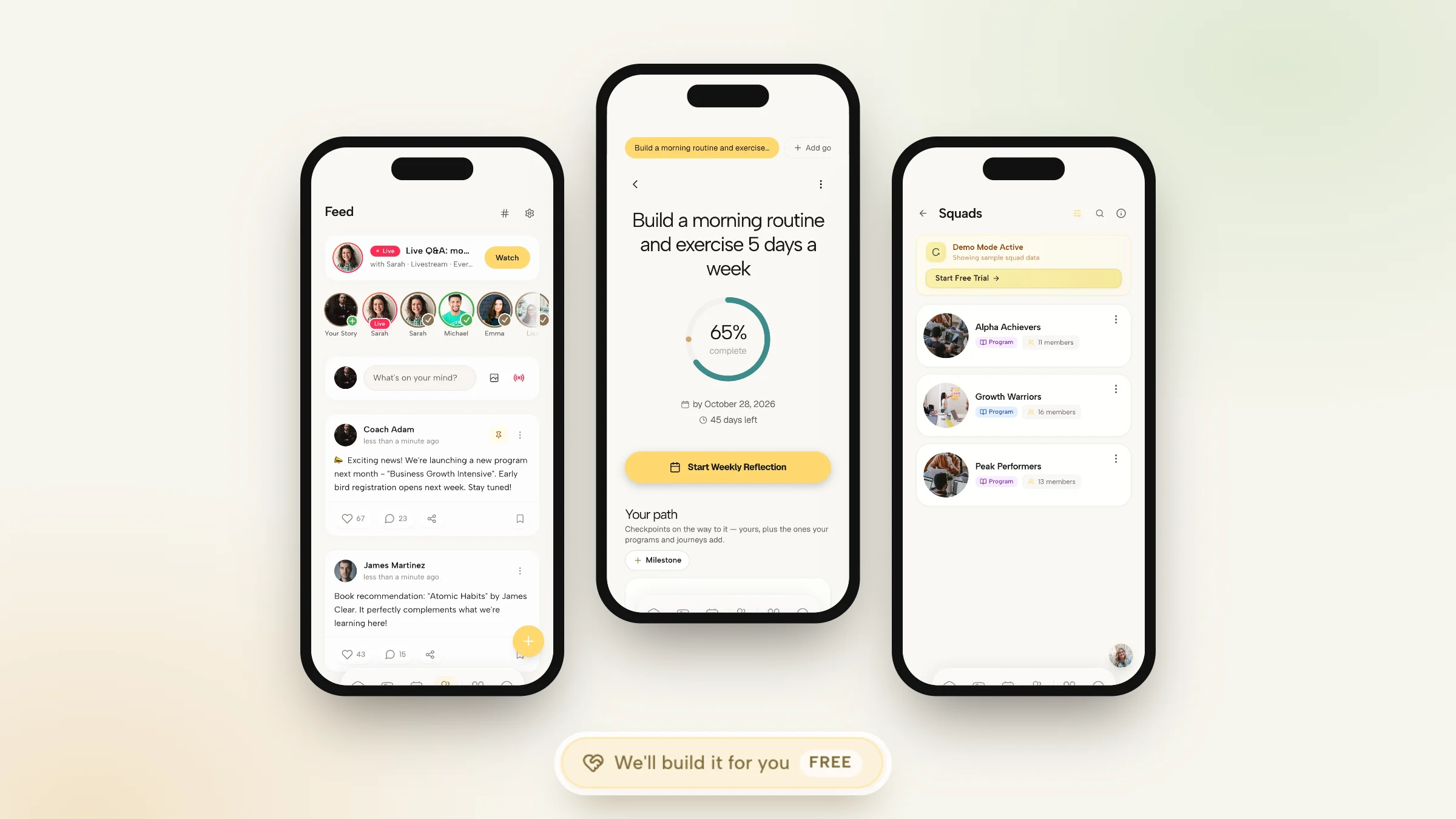
- The group: a program can have its own community feed and chat, and you can go live there for the Day 5 session.
- Emails: schedule broadcasts to everyone in the program, or run a sequence that starts on enrollment.
- Leads: every participant becomes a lead with the funnel as the source, so you can follow up after the challenge.

Let our team build your challenge funnel for free
A challenge has a lot of moving parts. On every Coachful plan, the Coachful team will build it for you at no extra cost, shown in the app as a complimentary gift.
How to ask. Open Funnels and press Fill in a form on the "Want us to build it for you?" card. Choose "Fill an event or webinar" or "Grow my email list" as the goal. If you want the five days built as a program too, open Create, choose "We'll build it for you" and pick "Program".
What to send. The challenge topic, who it's for and what they'll get each day; the dates; the paid program it leads to; and where people will come from. Add your notes or an outline of the five days, your photos and logo, and links to challenges you like. The form takes up to eight links and ten files, including audio, but not video files.
What happens next. The team replies by email with next steps, usually within about 24 hours, though that isn't a promised deadline. Everything is built in your own account, so you can edit the days, pages and emails afterwards. You record your own audio or video lessons; the team sets up the structure and writes the material around them.
A recent build like this. For a real-estate and money coach, the team built a free nine-day bootcamp course with its own signup funnel and emails, leading into a year-long cohort program with an application form.
What it doesn't include. The team won't host your live session, manage your community or run ads. Nothing is invented: no made-up participant numbers, testimonials or credentials. See the full list on the free white-glove service page.

If the program after the challenge isn't built yet, our guide to creating a group coaching program covers it. Mei's kind of practice, meditation and mindfulness, has its own overview: Coachful for spiritual coaches.
Frequently asked questions
What is a challenge funnel?
A challenge funnel is a signup page, a short free challenge (usually five days) with daily lessons and a group, and an invitation to a paid program on the last day, followed by a few emails. It lets people experience your coaching before they buy.
How long should a coaching challenge be?
Five days is the most common length because it fits a working week and is short enough to finish. Three days works for simpler topics. Longer challenges lose more people midway and delay the invitation.
Should my challenge be free or paid?
Free challenges attract more people and work well for building a list. Paid challenges, even at a low price, attract fewer but more committed participants who are more likely to finish and buy the next step.
Where should I host my challenge group?
Somewhere participants can focus. A community space attached to the challenge program keeps lessons, tasks and conversation together without social media distractions, and makes it easy to move buyers into the paid program.
Can Coachful build my challenge funnel for free?
Yes. On every Coachful plan, the team builds the signup funnel, the challenge structure and the emails at no extra cost. Open Funnels and press Fill in a form, or use "We'll build it for you" on Create. The team replies by email, usually within about 24 hours.
When should I pitch during a five-day challenge?
Mostly on Day 5, during a live session, after the group has shared their wins. You can mention earlier that something is coming, but keep the first four days focused on helping people get the result.












