
Menopause Coaching: What It Covers, Costs and Where It Stops
Menopause coaching is practical support for the years around menopause: a coach helps you work out what is affecting your sleep, energy, mood, work and relationships, build routines that ease the load, and walk into medical appointments with a clear record of what is happening. A menopause coach does not diagnose, test hormones or prescribe. Treatment decisions, including hormone therapy, belong to you and a clinician. Small trials link health coaching to fewer menopausal symptoms, and psychological approaches such as CBT reduce how much hot flashes bother people.
Plenty of women reach their mid-forties expecting hot flashes and nothing else, then find themselves awake at 3am, foggy in meetings and snapping at people they love. The medical side matters and comes first. What a coach adds is the weekly work of living with it: the sleep plan, the conversation with your manager, the strength training you keep meaning to start. This guide covers what menopause coaching is, where a doctor takes over, what sessions involve, what the research found, typical costs and how to pick a coach who stays in their lane.
Perimenopause, menopause and after: where a coach fits
Menopause is a single point in time: the US National Institute on Aging defines it as 12 months without a period. Most women begin the transition, called perimenopause, between ages 45 and 55, it can last several years, and the average age of menopause in the United States is 52 (NIA, What Is Menopause?). NIA lists hot flashes, night sweats, trouble sleeping, joint and muscle discomfort, pain during sex, moodiness and irritability, forgetfulness and difficulty concentrating among the symptoms, and notes that some women have few or none.
| Stage | What is going on | Where coaching can help |
|---|---|---|
| Perimenopause | Hormone levels shift, periods change, symptoms often start | Tracking symptoms, protecting sleep, adjusting exercise and eating, preparing questions for your doctor |
| Menopause | Confirmed after a full year without a period or spotting | Sticking with the routines that work, workplace conversations, rethinking what the next decade looks like |
| Postmenopause | The years after; some symptoms ease, others can continue | Strength, bone and heart-friendly habits your clinician recommends, energy, purpose and identity |
What a menopause coach actually works on
A good menopause coach starts with your week, not a protocol. The work usually lands on a few areas:
- Sleep. A wind-down routine, a cooler bedroom, a plan for the 3am wake-up, and a sleep log you can show your doctor.
- Hot flash patterns. Noting when they hit and what came before, so you can test changes such as layers, alcohol, spicy food or a warm room at work.
- Movement. Getting back to regular exercise, often with strength work added, at a level your body and clinician are happy with.
- Eating. Regular meals and realistic changes, without the crash diets that tend to show up in midlife marketing. A registered dietitian handles medical nutrition.
- Work. Planning how, or whether, to raise symptoms with a manager, and practical adjustments such as a desk fan or a later first meeting after a bad night.
- Appointments. Writing down symptoms, dates and questions so a ten-minute appointment covers what matters.
- The bigger picture. Midlife often stacks menopause on top of teenagers, ageing parents and a career peak. Some women use coaching to decide what they want from the next stretch of life.
If weight is the main goal, our guide to weight loss coaching covers that path, and stress management coaching covers the load that so often comes with this stage.
See a licensed professional when...
- Your bleeding changes in the ways NIA says to check with a doctor: periods very close together, heavy bleeding, bleeding or spotting after sex or between periods, periods lasting more than a week, or any bleeding or spotting after a year without a period.
- You want to discuss hormone therapy or other medicines for symptoms. The benefits and risks depend on your health history, so that conversation belongs with a doctor or nurse practitioner, not a coach.
- Low mood, anxiety or irritability is affecting your relationships or work most days, or you are not sure whether it is menopause or something else.
- Symptoms are new, severe or unusual for you, such as chest pain, a racing heart or sudden changes in your health. Get them checked rather than coached.
- You have thoughts of harming yourself. In the US, call or text 988 to reach the 988 Suicide and Crisis Lifeline. In a life-threatening situation, call 911.
Menopause coach, menopause doctor or therapist?
| Who | What they do | Licensed? |
|---|---|---|
| Menopause coach | Habits, routines, planning, accountability and support between appointments | No. The title is unregulated |
| Primary care doctor, gynecologist or nurse practitioner | Assessment, tests, hormone therapy and other prescriptions, follow-up | Yes |
| Clinician certified by The Menopause Society | A health professional who has passed the society's practitioner competency exam; the society's site lists practitioners | Yes, through their own profession |
| Psychologist or therapist | Therapy for mood and anxiety, and structured CBT for menopausal symptoms | Yes |
| Registered dietitian | Medical nutrition therapy, for example alongside diabetes or high cholesterol | Many states require a license (BLS) |
Most women who use a coach also see a clinician. The sensible order is medical assessment first, then coaching for the day-to-day work, with your permission for the two to talk if that helps.
What happens in menopause coaching sessions
The first session is mostly listening. Expect questions about your cycle and symptoms, what a bad day looks like, sleep, work, what your doctor has said, what you have tried and what you want to feel different in three months. Many coaches send a short form before the first call so the time goes on the hard part.
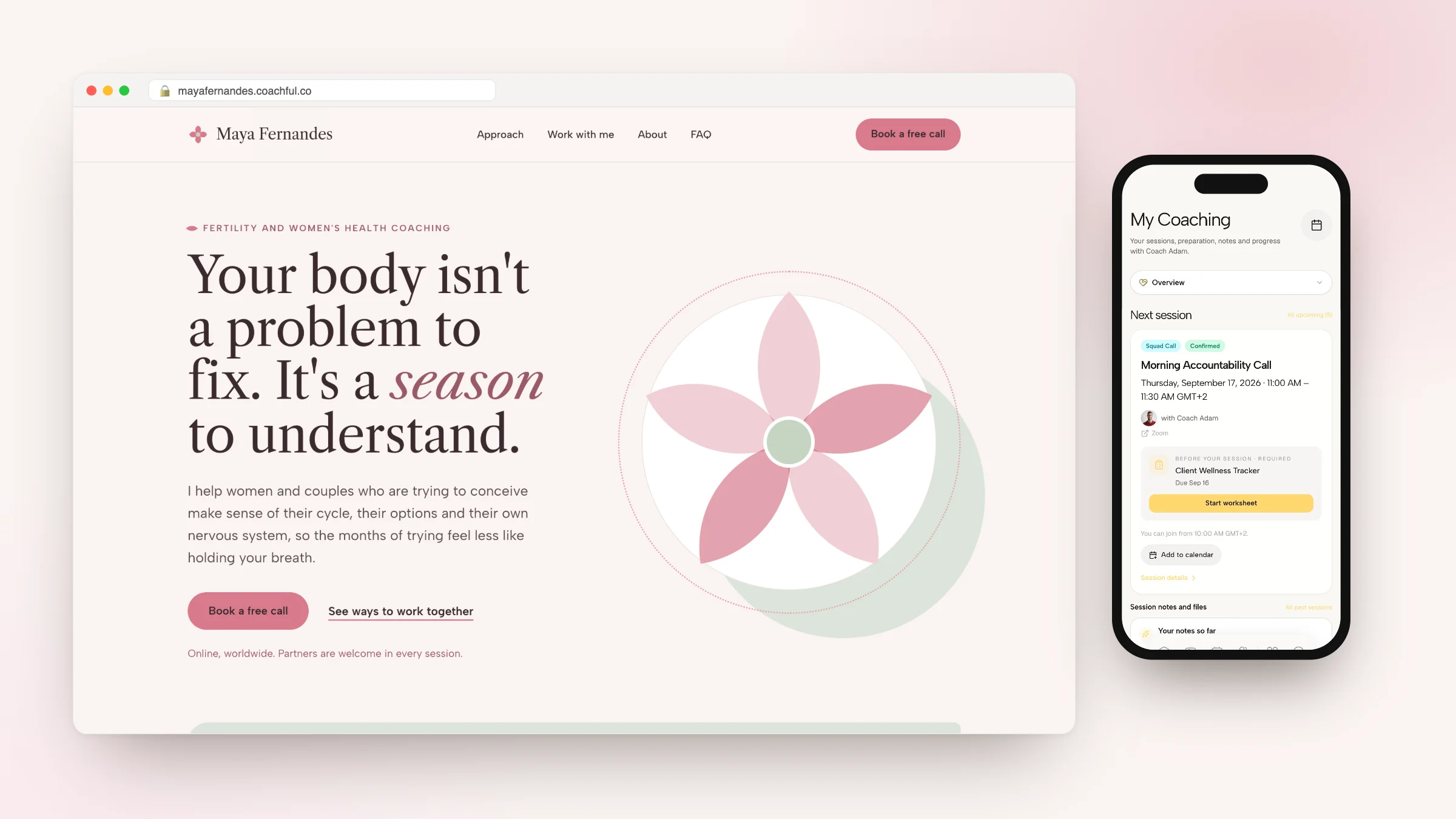
In Coachful's client app, for example, that prep shows up on your coaching page as something to finish before the session, next to the date and the video link.

After that, sessions are usually every week or two for 30 to 60 minutes. A typical rhythm: review what the symptom and sleep logs showed, pick one change to test, plan around the obvious obstacle ("what happens on the nights you wake at 3am?"), and agree what you will track before next time.
Small daily habits do a lot of the work, and seeing them in one place makes it easier to keep going on the weeks when you feel flat.

A dated goal keeps the work concrete. "Strength training twice a week until the end of the quarter" is something you can check. "Feel like myself again" is a starting point for a conversation, not a plan.

Many coaches also allow short messages between sessions. Agree at the start how fast they reply and what messages are for, so a rough night does not turn into a long wait for an answer.

What the research says about menopause coaching
The research on menopause coaching under that name is small. A few studies are worth knowing:
- A randomized trial of health coaching. Shokri-Ghadikolaei and colleagues (2022) assigned 94 women aged 45 to 55 to five coaching sessions, held every two weeks by a midwifery coach, or to a control group. Four months later the coached group had lower menopausal symptom scores, fewer depression symptoms and better quality of life. Coaching did not change how much they exercised (PubMed). It was one trial at one university.
- Psychological approaches reduce how much hot flashes bother people. A meta-analysis of 12 randomized trials found that CBT, behavior-based therapy and mindfulness reduced hot flash bother in the short and medium term and menopausal symptoms in the short term (van Driel and colleagues, 2018). These were therapy programs, not coaching, but many coaches borrow the same skills.
- Work is part of the picture. In a Mayo Clinic survey of 4,440 employed women aged 45 to 60, 13.4 percent reported at least one adverse work outcome from menopause symptoms and 10.8 percent had missed work in the previous year. The authors estimated $1.8 billion a year in lost work time in the US (Faubion and colleagues, 2023).
- Workplace programs look promising but are under-studied. A 2023 systematic review found only five studies of workplace menopause interventions. Self-help CBT and a health promotion program that included work-life coaching improved symptoms, mostly in small, selected groups (Rodrigo and colleagues, 2023).
Read together: coaching is a reasonable support for the habits and decisions around menopause, with early evidence behind it. It is not a treatment for symptoms that need medical care.
What menopause coaching costs
Coachful's 2026 Coaching Business Report, which compiles published research and practitioner reports for the second quarter of 2026, has no menopause-specific rate. Menopause coaching is usually sold as health and wellness coaching, so those are the closest benchmarks:
| Format | What it usually includes | Typical price |
|---|---|---|
| One session | A single 60-minute session | $75 to $200 |
| Four-week reset | Four sessions, a habit tracker and a food and movement plan | $400 to $800 |
| Three-month program | Eight to ten sessions, weekly check-ins and resources | $900 to $2,000 |
| Ongoing monthly | Two to four sessions a month plus messaging | $300 to $700 a month |
US dollars, Q2 2026. Hourly band from PayScale and practitioner reports; packages from practitioner reports, which are estimates. See coachingrates.com.
The same report rates women's health as a growing, low-saturation niche, also a practitioner estimate. In practice that means fewer specialists to choose from, so it is worth asking a general health coach how much menopause work they have done. Three practical points:
- Ask your employer. The report notes that nearly six in ten coaching clients worldwide are sponsored by an employer, so check what your benefits include.
- Start with a short block. A four-week reset or a three-month program with a review point is a sensible first commitment.
- Budget for the clinician first. Coaching is an add-on to medical care, not a replacement for it. For more on whether paying a coach makes sense, see is a life coach worth it.
How to choose a menopause coach
Credentials and backgrounds worth recognizing
- NBC-HWC. National Board Certified Health and Wellness Coaches complete an approved training program, log coaching sessions and pass a board exam (NBHWC). Our guide to health and wellness coaching explains what that training covers.
- ICF credentials. The ACC, PCC and MCC show general coaching training and logged hours (ICF credentialing).
- A clinical background. Some menopause coaches are nurses, midwives, dietitians or physical therapists. Ask which role they are playing with you, because coaching and clinical care have different rules.
- Menopause-specific training. Ask what it was, who ran it and how many hours it involved. A weekend course is not the same as a clinical certification.
Questions to ask on a discovery call
- How many of your clients are in perimenopause or menopause, and what do they usually want help with?
- How do you work with my doctor, and when do you tell a client to see one?
- What happens between sessions: tracking, check-ins, messages?
- What would we focus on in the first month, given what I have told you?
- How will we know by week six that this is working?
Red flags
- Selling supplements, testing kits or "hormone balancing" packages the coach profits from.
- Telling you to start, stop or change hormone therapy or any medication.
- Interpreting lab results or saliva tests for you.
- Promising that symptoms will disappear, or guaranteeing weight loss.
- Pressure to prepay a long package on the first call.
Find a menopause coach on Coachful
Coachful runs a public directory at Find a Coach, and you can browse it without an account. Search "menopause", "perimenopause" or "midlife" to find coaches whose headline or bio mentions them, or start from the Health and Fitness and Lifestyle categories. You can switch between browsing coaches and browsing their programs.
The Find My Coach quiz asks what you want to improve, where you are right now, your preferred coaching style (including a gentle, supportive option) and your monthly budget, then suggests a shortlist.

Each profile shows what the coach has added about their background, credentials and method, any programs with prices, and either a calendar to book a discovery call or a form to send a message. Use the questions above on the call.

Are you a menopause or midlife coach?
Our guide on how to become a health coach covers training and scope, and health coach certification compares the credentials. Coachful's page for health coaches shows the habits, check-ins and goals your clients would use. One recent request through our free white-glove service came from a menopause and midlife health coach starting with no site, logo or prices; the team built a five-page site in sage and cream with every button leading to a free 20-minute consultation.

Frequently asked questions
What does a menopause coach do?
A menopause coach helps you manage the day-to-day side of perimenopause and menopause: sleep, movement, eating, stress, work and relationships. They help you track symptoms, test small changes and prepare for medical appointments. They do not diagnose, order tests or advise on hormone therapy.
Is menopause coaching worth it?
It can be if you have seen a clinician and want structure for the habits and decisions that follow. A 2022 randomized trial found five health coaching sessions reduced menopausal symptom scores and depression symptoms, and psychological programs reduce hot flash bother. The evidence is still small.
How much does a menopause coach cost?
There is no menopause-specific figure. Health and wellness coaching typically runs $75 to $200 a session, $400 to $800 for a four-week reset or $900 to $2,000 for a three-month program, according to Coachful's 2026 Coaching Business Report.
Can a menopause coach help with hormone therapy decisions?
A coach can help you write down your questions and think through what matters to you, but the decision belongs to you and a doctor or nurse practitioner who knows your health history. A coach who recommends starting or stopping hormones is working outside their scope.
What is the difference between a menopause coach and a menopause specialist?
A menopause specialist is a licensed clinician, such as a gynecologist or a practitioner certified by The Menopause Society, who can assess and treat symptoms. A menopause coach works on habits and planning and is not a medical provider.
Can menopause coaching help with work?
Yes, that is a common focus. In a Mayo Clinic survey, about one in ten employed women aged 45 to 60 had missed work because of menopause symptoms. A coach can help you plan a conversation with your manager and practical changes to your workday.
Is online menopause coaching as good as in person?
For conversation-based coaching, video works well for most people and lets you choose a specialist anywhere. See are online coaches worth it for the trade-offs.












