
How to Become a Health Coach: Training, NBHWC and Clients
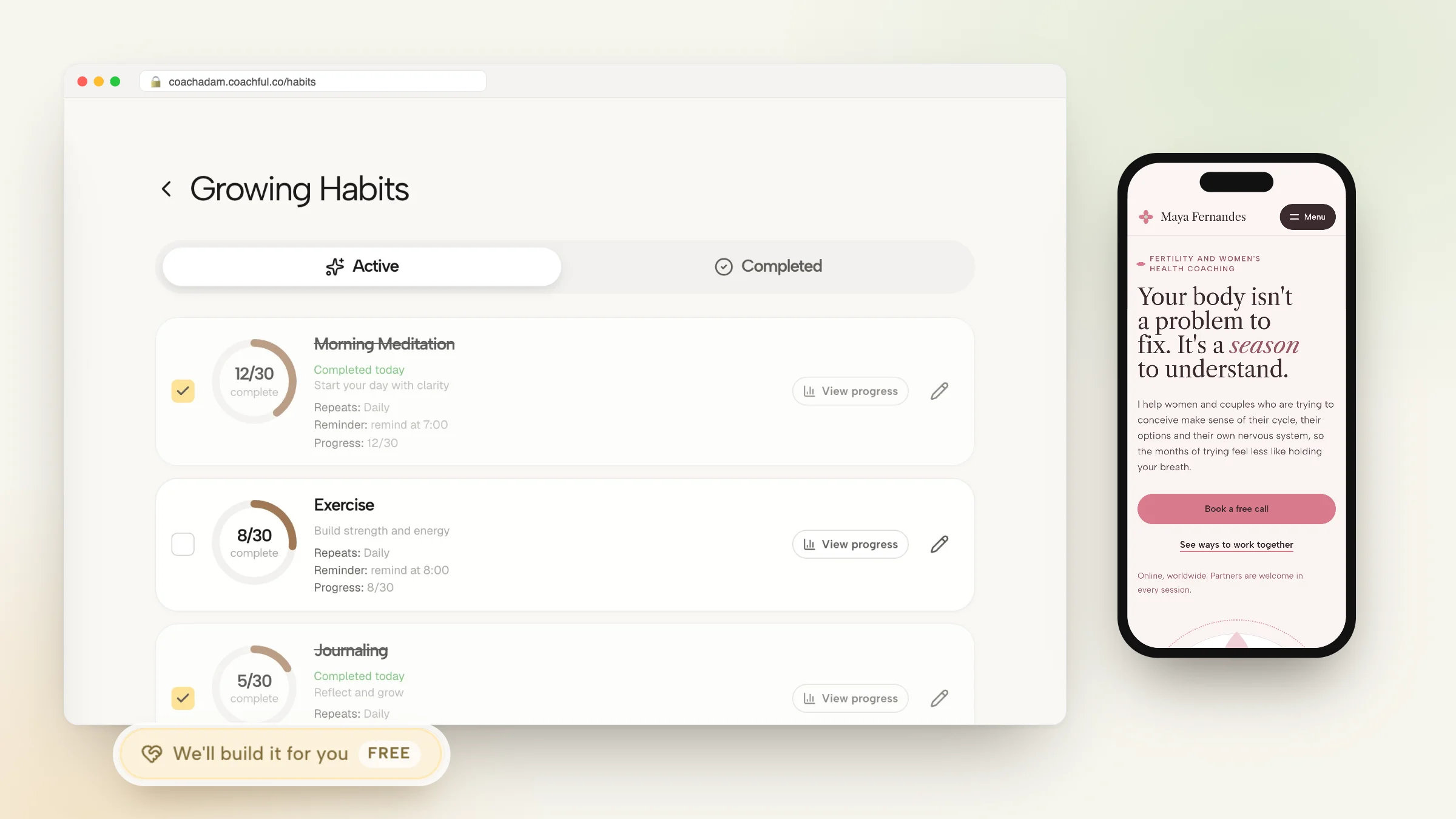
To become a health coach, you complete a health coach training program, practice coaching real clients, choose a specialty, and set up a practice that stays inside a health coach's scope. You don't need a license to work as a health coach in most places. In the US, the most recognized credential is board certification from the National Board for Health & Wellness Coaching (NBHWC), which asks for an NBHWC-approved training program, 50 logged coaching sessions, an associate degree or 4,000 hours of work experience, and a board exam.
That's how to become a health coach in one paragraph. This guide fills in the rest: what health coaches do and are not allowed to do, how board certification works, what the work pays, the steps in order, and how to set up a practice clients trust. When you reach the setup stage, Coachful's team will build your health coaching website and program page for free on every plan.
What a health coach does, and where the line is
A health coach helps people change the habits behind their health: eating, movement, sleep, stress, and sticking to a plan their doctor already gave them. The work is behavior change. The coach helps the client set realistic goals, notice what gets in the way, design small experiments and keep going when motivation dips. It sits alongside medical care, not instead of it.
| Role | What they do | Licensed? |
|---|---|---|
| Health coach | Supports behavior change, habits and follow-through on goals | Not licensed; board certification is voluntary |
| Registered dietitian | Assesses nutrition needs and provides medical nutrition therapy | Licensed or certified in many US states |
| Nutritionist | Advises on nutrition; the title's rules vary by state and country | Varies by location |
| Personal trainer | Designs and coaches exercise programs | Usually certified, not licensed |
| Doctor, nurse or therapist | Diagnoses and treats conditions | Licensed |
The scope rule is simple to say and important to follow: health coaches don't diagnose, prescribe or treat. In some US states, writing individualized meal plans or giving nutrition advice for a medical condition is limited to licensed dietitians or nutritionists, so check the law where you and your clients live. Coach the habits; leave the clinical decisions to clinicians. Our explainer on what health and wellness coaching is goes further into the boundaries.
What health coaches earn
Health coaching is a crowded field, and it's worth knowing the numbers before you invest in training. Coachful's 2026 Coaching Business Report puts health and wellness coaches at $75 to $200 an hour (PayScale and practitioner reports) and $52,000 to $77,000 a year (PayScale, ZipRecruiter and Glassdoor). It describes the niche as "the most crowded end of the profession, and the one competing hardest against apps and subscriptions," rating saturation as very high.
Two findings in the same report point to where the opportunity is. App-based programs with a weekly coach check-in already sell for $17 to $149 a month, so a general "healthy habits" offer is competing with software. And women's health is flagged as underserved and growing, with low saturation. Specialists do better than generalists. Our breakdown of what health coaches charge covers rates, programs and monthly pricing in detail.
Step 1: Decide whether you want board certification
You can work as a health coach without any credential. Board certification makes sense if you want to work with clinics, employers or digital health companies, which often ask for it, or if you want a rigorous, structured training. In the US, the NBHWC credential is the one most of those organizations recognize. Its exam is developed and run together with the National Board of Medical Examiners.
These are NBHWC's core eligibility requirements as it publishes them. They change, so check NBHWC's current rules before you enroll anywhere:
| Requirement | What it involves |
|---|---|
| Approved training | Complete a health and wellness coach training program approved by NBHWC, including its practical skills assessment |
| Coaching sessions | Log 50 health and wellness coaching sessions that meet NBHWC's coaching log rules, after passing the program's skills assessment |
| Education or experience | An associate degree or higher in any field, or 4,000 hours of work experience in any field |
| The exam | Pass the board certification exam to earn the NBC-HWC credential |
The education requirement surprises people: the degree can be in any subject, and work experience in any field can replace it. You don't need a background in health care to qualify. Outside the US, look for the coaching or health body your future employers name; many health coaches also hold an ICF coaching credential for the coaching skill itself, which our ICF credential comparison explains.
Step 2: Choose a health coach training program
Whether or not you plan to sit the board exam, choose a program that teaches you to coach, not just to know about nutrition. Look for:
- NBHWC approval, if you want board certification. NBHWC publishes its list of approved programs.
- Observed practice. Real coaching sessions with feedback from a trainer, not only lectures and quizzes.
- Behavior-change methods, such as motivational interviewing, goal setting and relapse planning.
- Scope of practice teaching, including when and how to refer to a clinician.
- Total cost and time. Add tuition, exam fees and the hours you'll spend practicing. Compare totals, not module prices.
Be careful with very short "certification" courses that promise you can call yourself a certified health coach after a weekend. A certificate of completion from a school is not the same as board certification; our explainer on certificates of completion sets out the difference.
Step 3: Log your coaching sessions
Start practicing as soon as your program allows, with friends of friends, colleagues or a small group of volunteers who agree to honest feedback. Keep a log of every session from the start: date, client, length and focus. If you're working toward NBHWC eligibility, follow its coaching log rules closely, because only qualifying sessions count.
Practice clients also become your first testimonials and referrals, so treat them like paying clients: a short agreement, a clear number of sessions and a proper close at the end.

Step 4: Pick a specialty
"Health coach" is a crowded label, and generalists end up competing with apps on price. A specialty gives people a reason to choose you. Good health coaching specialties are specific about the person and the change:
- Women navigating perimenopause and menopause.
- Adults recently told they have prediabetes who want to change how they eat.
- Professionals recovering from burnout who need sleep and energy back first.
- People with gut symptoms who have seen a doctor and want help with the daily habits.
- Couples trying to conceive who want support with stress and routines.
The best specialty is usually one you have lived or worked in. It shortens the explanation and makes your marketing sound like you. Test it with a few conversations before you print anything; our guide to validating a coaching niche with a paid pilot shows how.

Step 5: Get the legal basics right
- A clear scope statement in your agreement and on your website: what you do, what you don't, and that you work alongside the client's medical care.
- Professional liability insurance, which most health coaches carry.
- A business structure and tax setup that fits where you live.
- Privacy. You'll handle sensitive health information. Say how you store it. If you work with US health care organizations, ask whether HIPAA applies to your arrangement, and choose your tools accordingly.
- A referral list of doctors, dietitians and therapists you can point clients to.
Avoid medical claims in your marketing: no "cure", "reverse" or "treat". Describe habits, support and accountability. Our coaching agreement template is a good starting point for the scope and referral clauses.
Step 6: Design your first health coaching program
Behavior change takes weeks, so sell a program rather than single sessions. Two shapes work well to start, with typical prices from Coachful's 2026 report (practitioner reports):
- A four-week reset: four 60-minute sessions with a habit tracker and a simple food and movement plan, typically $400 to $800. A good first purchase.
- A three-month program: eight to ten sessions with weekly check-ins and resources, typically $900 to $2,000. Long enough for habits to stick.
Plan what happens between sessions as carefully as the sessions themselves: a short daily habit, a weekly check-in, a simple worksheet before each call. That's the part an app can only partly copy. Our step-by-step guide to creating a health coaching program covers week-by-week structure, and these health coaching templates give you ready-made forms and trackers.

Step 7: Set up your health coaching practice
You need a website that explains your specialty, a way to book a first call, a way to take payment, a signed agreement and somewhere for the work between sessions to happen. In Coachful, all of that sits in one account and is included in your membership:
- A website from 30 designed templates, including wellness designs, on your own domain, with booking and checkout on the page.
- Programs with weekly goals, daily tasks, habits and morning, evening and weekly check-ins you design, delivered in a client app on iPhone and Android.
- The Fitness & Nutrition power-up for nutrition targets up to calories and macros, meal plans, recipes, food lookup, and private progress photos and measurements.
- Payments through your own Stripe or Razorpay account with a 0% Coachful platform fee, including payment plans and subscriptions.
- Agreements sent for e-signature before the first session.
Two honest limits: Coachful is not HIPAA-certified (it is GDPR-ready with full data export), and it doesn't sync with wearables or Apple Health. If your practice depends on either, plan around it. More on the Coachful page for health coaches, and on the site itself in our guide to a health coach website. If you are comparing tools, our roundups of scheduling software for health coaches and software for nutrition coaches cover the options.

Let Coachful's team build your website for free
Most new health coaches lose months to the website. Coachful's team builds it for free on every plan: the website, a program or sales page, a free-guide funnel and the emails behind it, inside your own account. Coachful itself is a paid subscription, and you can start with a free trial.
In Coachful, open Website and click Fill in a form on the "Want us to build it for you?" card, or choose We'll build it for you · FREE under Create. Tell the team which pages you want, what they should do and what visitors should do next. Add up to 8 links and up to 10 files, such as a photo, a logo, a program outline or the PDF of your free guide.

The sample request above comes from a gut-health coach: a calm homepage, a Work With Me page for a three-month package and a page for a free seven-day meal guide, with visitors getting the guide first. The team replies by email with next steps, usually within about 24 hours, which is typical rather than guaranteed.
A recent build for a menopause and midlife health coach who had no site, logo or prices produced five pages (home, about, coaching, free consultation and contact) in sage and cream, with every button leading to a free 20-minute consultation. Prices were left for the coach to decide. Nothing gets invented: no credentials, testimonials or health claims you haven't made. The team doesn't design logos, record videos or run ads. Here's everything the free build covers.
Step 8: Find your first health coaching clients
- Start with people who know you. A short, specific message to your network about who you help and what changes for them.
- Build relationships with clinicians. Doctors, physical therapists and dietitians often want somewhere to send patients who need help with habits. Bring a one-page description of your program and your scope.
- Run a free workshop. A 45-minute talk at a library, a gym or a workplace on one specific topic, with an invitation to a free call at the end.
- Offer a useful free guide. A seven-day meal plan template or a sleep reset checklist, delivered by email, with a short follow-up sequence.
- Approach employers later. Workplace wellness work pays differently and moves slowly, and board certification helps.

How long does it take to become a health coach?
| Stage | Typical timing |
|---|---|
| Research programs and choose a specialty | A few weeks |
| Complete a health coach training program | Several months, depending on the program and your pace |
| Log 50 coaching sessions for NBHWC eligibility | A few months if you coach a handful of people each week |
| Sit the board exam | At one of NBHWC's scheduled exam windows |
| Set up your practice and launch a first program | A few weekends, or less with the free build |
These are typical patterns, not measured figures. You can start coaching paying clients before you're board certified; certification is a credential, not a license.
Frequently asked questions
Do you need a certification to be a health coach?
No. In most places there's no legal requirement, so you can practice without one. Board certification through NBHWC is voluntary but widely recognized in the US, and clinics, employers and digital health companies often ask for it.
How do you become a certified health coach?
For US board certification, complete an NBHWC-approved training program, log 50 qualifying coaching sessions after passing the program's skills assessment, meet the education or experience requirement (an associate degree or 4,000 hours of work experience, in any field) and pass the board exam.
Can I become a health coach without a degree?
Yes. You can practice without any degree, and NBHWC accepts 4,000 hours of work experience in any field in place of an associate degree for board certification. Check NBHWC's current rules before you apply.
Can health coaches give meal plans?
It depends on where you work. In some US states, individualized meal plans and nutrition advice for medical conditions are limited to licensed dietitians or nutritionists. Health coaches can usually support general healthy eating habits and help clients follow a plan from their clinician. Check your state's law.
How much do health coaches make?
Coachful's 2026 Coaching Business Report puts health and wellness coaches at $52,000 to $77,000 a year, from PayScale, ZipRecruiter and Glassdoor, with session rates of $75 to $200. Specialists, such as women's health coaches, tend to do better than generalists in this crowded niche.
What is the difference between a health coach and a nutritionist?
A health coach supports behavior change and follow-through; a nutritionist or dietitian advises on what to eat, and a registered dietitian can provide medical nutrition therapy. Many health coaches work alongside dietitians and refer clients to them.
Can I be a health coach part time?
Yes, and many start that way, coaching a few clients in the evenings while they train and log sessions. A short program, such as a four-week reset, fits around a job more easily than open-ended coaching.
Will Coachful build my health coaching website for free?
Yes. Coachful's team builds health coaching websites, program pages and free-guide funnels for free on every plan. Fill in the form from Create or the Website page and the team replies with next steps, usually within about 24 hours. Coachful is a paid subscription; the build costs nothing extra.












