
How Much Does a Health Coach Charge? 2026 Rates and Programs
How much does a health coach charge? In 2026, most health and wellness coaches charge $75 to $200 for a one-hour session, a three-month program typically costs $900 to $2,000, and ongoing monthly coaching runs $300 to $700 a month. Those ranges come from Coachful's 2026 Coaching Business Report, which compiles PayScale salary data and practitioner reports for the second quarter of 2026.
Health coaching has a pricing problem that other coaching niches don't. Your client can download an app with daily lessons and a weekly check-in from a coach for $17 to $149 a month, according to the same report. So the question isn't only "what do health coaches charge" but "what am I offering that an app can't, and how do I price it". This guide covers the numbers by experience and format, the pricing models that hold up against apps, how to set your own rate and how to present it. And if you'd like the program page and checkout built for you, Coachful's team does that for free on every plan.
One honest caveat before the numbers: no large public study measures what health coaches charge per session, and the report has no directly collected sample of published health coach rates. Each range below names its source, and several are practitioner estimates.
How much do health coaches charge per session?
The working band for health and wellness coaching is $75 to $200 an hour, from PayScale data and practitioner reports compiled in the 2026 report. That's the same band as life coaching and below career, business and executive coaching.
| Stage | Typical hourly rate | What usually explains it |
|---|---|---|
| Newer health coach | $50 to $100 | A recent certification, a broad focus such as "healthy habits", sessions sold one at a time |
| Experienced health coach | $100 to $200 | A specific focus (gut health, menopause, blood sugar), a repeatable program, referrals |
| Top of the niche | $200 to $400 | A narrow specialty, a visible body of work, referrals from clinicians or employers |
Health and wellness hourly band from PayScale and practitioner reports; stage bands are practitioner estimates, not study findings. Compiled in Coachful's 2026 Coaching Business Report for Q2 2026. US dollars, before tax and costs.
The profession-wide average was $234 an hour in 2025, according to the ICF Global Coaching Study 2025 and PayScale as compiled in the report. That figure includes executive and corporate coaching paid by employers, so it overstates what most health coaches can charge individuals.
What health coaching programs cost
Behavior change takes weeks, so most health coaches sell programs or monthly coaching rather than single sessions. The report observes four common shapes:
| Format | Sessions and length | What's usually included | Typical price | Per session |
|---|---|---|---|---|
| 4-week reset | 4 sessions of 60 minutes over 4 weeks | A habit tracker and a food and movement plan | $400 to $800 | $100 to $200 |
| 3-month program | 8 to 10 sessions of 60 minutes over 3 months | Weekly check-ins and resources | $900 to $2,000 | $90 to $250 |
| Ongoing monthly | 2 to 4 sessions of 60 minutes a month | Messaging between sessions | $300 to $700 a month | $75 to $350 |
| App-based with a coach | Daily lessons, ongoing | A psychology-based app and a weekly coach check-in | $17 to $149 a month | Not session-based |
Formats and price ranges observed in the market, from Coachful's 2026 Coaching Business Report (practitioner reports), Q2 2026. The per-session column is our arithmetic: price divided by sessions, ignoring check-ins and messaging.
The four-week reset and the three-month program are the formats most independent health coaches sell. The reset is a good entry point because it's short enough to say yes to; the three-month program is where habits have time to stick. Monthly coaching works best after a program, for clients who want to keep the accountability going.

Why health coaching prices sit where they do
The report describes health and wellness as "the most crowded end of the profession, and the one competing hardest against apps and subscriptions." It rates the niche as medium on income, very high on saturation and low to medium on difficulty to enter (ICF Global Coaching Study 2025 and practitioner reports, as compiled in the report). Annual earnings come in at $52,000 to $77,000, from PayScale, ZipRecruiter and Glassdoor.
Three things follow from that:
- "Health coach" alone doesn't set a price. In a crowded field, a general offer gets compared with the cheapest option, which is often an app. A specific offer ("blood sugar coaching for women after a prediabetes diagnosis") gets compared with the cost of the problem.
- The human part is what you charge for. Apps do reminders and lessons well. A coach notices patterns, adjusts the plan when life gets in the way and knows when to refer someone to their doctor. Your price should be built around those.
- Some specialties are less crowded. The report flags women's health as underserved and growing, with low saturation. Fertility, perimenopause and menopause coaching are examples of where a focused health coach can stand out.
Our explainer on what health and wellness coaching is covers what the work includes and where it stops.
Program, monthly or app plus coach: choosing a pricing model
| Model | Example structure | Good for | Watch out for |
|---|---|---|---|
| Short reset | 4 weekly sessions, a habit tracker and a simple plan, $600 | A first purchase and a clear starting point | Clients who stop at week four; offer the next step in week three |
| Three-month program | 8 sessions, weekly check-ins, messaging, $1,500 or three payments of $525 | Your core offer, long enough for habits to form | The mid-program dip; plan a check-in call around week six |
| Monthly coaching | 2 sessions a month plus messaging, $450 a month, three-month minimum | Clients continuing after a program | Every month is a decision to stay; show progress monthly |
| Group program | 8 to 12 people, 6 weekly group calls and a community, $400 per person | A lower price point and more clients per hour | Needs enough sign-ups to start on a date |
| Membership | A monthly group call, resources and community, from $47 a month | Keeping past clients close at a low price | Low revenue per person; works best alongside one-to-one work |
Example structures are illustrations set inside the ranges above, not market rates. The membership floor reflects the report's $47 to $197 a month range for memberships and communities across coaching.
A group program is worth a closer look for health coaches. The report puts cohort-based group programs at $500 to $3,000 per person across coaching, for 8 to 20 participants. A group of ten people learning to cook for steady energy together is good for them and changes your hourly arithmetic completely.

What changes a health coach's price
- Specialty. Gut health, autoimmune support, perimenopause, fertility and blood sugar all support higher prices than "wellness" because the client can name the problem.
- Credentials. In the US, the National Board for Health & Wellness Coaching (NBHWC) offers board certification, with an exam developed with the National Board of Medical Examiners. The 2026 report doesn't measure how much it adds to rates, but it helps with clinics and employers, who often ask for it. Our guide to becoming a health coach covers the requirements.
- Clinical relationships. Referrals from doctors, dietitians or physical therapists bring clients who are ready to commit.
- What you're allowed to sell. Health coaches don't diagnose or treat, and in some US states individualized nutrition plans are limited to licensed dietitians or nutritionists. Price the coaching (habits, accountability, behavior change), not a medical service you can't legally provide.
- Who pays. Employer wellness programs and clinics pay differently from individuals. Across coaching, nearly six in ten clients are employer-sponsored, according to the ICF Global Coaching Study 2025 as cited in the report.
How should a health coach set their price?
Work from your income target and your capacity, then check the result against the ranges. This example uses figures inside the published ranges; they're illustrations, not market data.
- Pick a yearly target before tax and costs. Say $60,000.
- Choose your core offer. A three-month program at $1,500. That's 40 programs a year, or just over three new clients a month.
- Add a continuation. If a third of those clients stay on monthly coaching at $450 for three months, that's about $18,000 more, so you could reach the target with fewer programs, or with the same number and room for a slower month.
- Count the hours. Forty programs of eight sessions is 320 sessions, plus weekly check-ins and messaging. Spread over 46 working weeks, that's around seven sessions a week plus check-in time. Sustainable for most coaches.
- Compare with the alternative. At $100 a single session, $60,000 needs 600 sessions a year, about thirteen a week, every week. That's the main argument for selling programs.
Then add your costs: software, insurance, continuing education, payment processing and tax. Our coaching business startup budget lists them. When you raise prices later, do it for new clients first; this guide to raising package prices walks through it.

How to present a health coaching price
- Lead with the change and the length. "Twelve weeks to steady energy and meals you can actually keep, with eight sessions and weekly check-ins" gives the price something to be measured against.
- Show the monthly equivalent next to the total. "$1,500, or three payments of $525" reads very differently from "$1,500" alone, especially next to an app's monthly price.
- Name what an app can't do. "I review your week with you and change the plan when life gets in the way" is the line that justifies the difference.
- Avoid medical claims. No "cure", "reverse" or "treat". Describe habits and support, and say you work alongside the client's doctor.
- Put the terms in writing. Cancellations, rescheduling and refunds belong in the agreement the client signs before session one.
Whether to show prices on your website at all is a real choice; this piece weighs it. And if you work with clients who have chronic conditions, our guide on when a health coach needs a second app covers the tracking side.
Selling health coaching programs in Coachful
In Coachful, a program is sold as an offer: one-time, a payment plan or a monthly subscription, with an agreement for e-signature and a booking step behind it. The client pays at checkout and lands in a multi-week program with the work you've designed for each week.
- Habits and check-ins with daily tasks, habit streaks, and morning, evening and weekly check-in flows you design, so the work between sessions is visible.
- Forms such as a recurring wellness tracker for energy, mindset and recovery, with answers saved to the client record.
- The Fitness & Nutrition power-up for nutrition targets up to calories and macros, meal plans, recipes, food lookup, and private progress photos and measurements.
- Group programs that create a cohort group with a feed, group chat and group calls when clients enroll.
- Payments to your own Stripe or Razorpay account, with a 0% Coachful platform fee.

Two limits to know. Coachful is not HIPAA-certified, though it is GDPR-ready with full data export, and it doesn't sync with wearables or Apple Health. If your practice needs either, plan for it. More on the Coachful page for health coaches, and on the software choice in our comparison of health coaching software.

Have your health coaching program page built for free
Coachful's team builds program and sales pages, websites, funnels and email sequences for free on every plan, inside your own account. Coachful itself is a paid subscription, and you can start with a free trial.
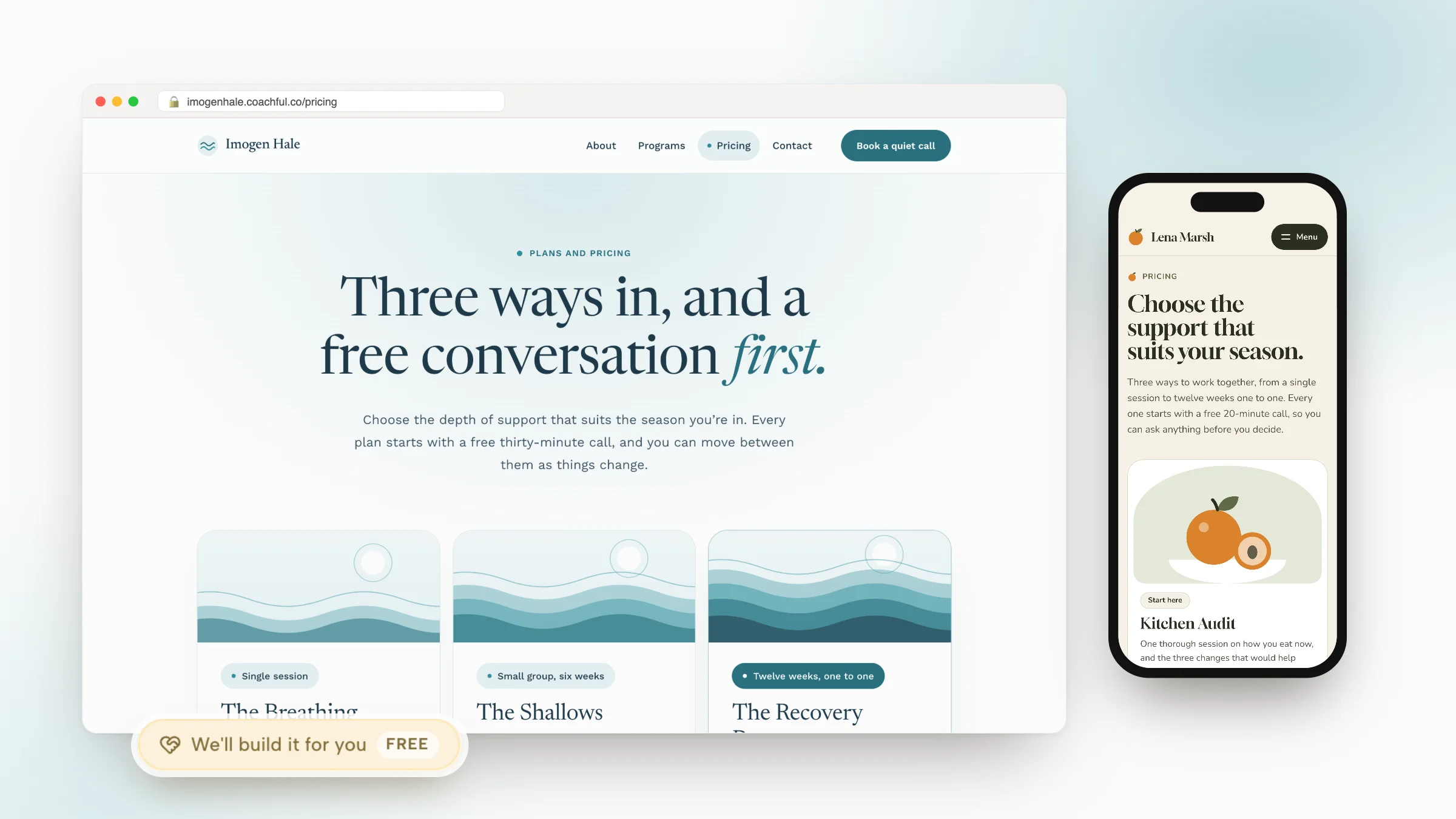
Open Website and click Fill in a form on the "Want us to build it for you?" card, or choose We'll build it for you · FREE under Create. Say which pages you need, what they should do and what visitors should do next, and attach up to 10 files and 8 links.

The sample above is a gut-health coach asking for a calm homepage, a Work With Me page for a three-month package and a page for a free seven-day meal guide, with visitors getting the guide first and then joining the program or booking a call. The team replies by email with next steps, usually within about 24 hours; that's typical, not guaranteed.
A recent build for a menopause and midlife health coach who started with no site, logo or prices produced five pages (home, about, coaching, free consultation and contact) in sage and cream, with every button leading to a free 20-minute consultation. A psychologist-turned-coach working on emotional eating got a new homepage with three clear paths: book a call, join the free community or enroll in the program. Prices the coach hadn't set were left for them to fill in; the team doesn't invent prices, testimonials or credentials. See everything the free build covers.
Frequently asked questions
How much does a health coach cost per session?
Most health and wellness coaches charge $75 to $200 for a one-hour session in 2026, based on PayScale data and practitioner reports compiled in Coachful's 2026 Coaching Business Report. Practitioner estimates put newer coaches at $50 to $100 and specialists at the top of the niche at $200 to $400.
How much does a health coach cost per month?
Ongoing monthly health coaching with two to four sessions and messaging typically costs $300 to $700 a month. A three-month program of eight to ten sessions typically costs $900 to $2,000, or roughly $300 to $670 a month if paid over three months.
Is a health coach worth it compared with a health app?
App-based programs with a weekly coach check-in cost $17 to $149 a month, according to the 2026 report, and suit people who mainly need structure and reminders. A health coach is worth more when you need someone to spot patterns, adjust the plan to your real life and keep you accountable week to week.
How much should a new health coach charge?
Practitioner estimates put newer health coaches at $50 to $100 an hour, but start from your own numbers. A $60,000 target at $100 a session needs about thirteen sessions a week all year; the same target from a $1,500 three-month program needs about 40 clients a year, which is why most new health coaches sell programs.
Does insurance cover health coaching?
Usually not for independent coaches, so most clients pay themselves. Some employers and clinics fund health coaching as part of wellness or care programs. Check the rules in your country and state before making any claims about coverage on your website.
Do certified health coaches charge more?
The 2026 report doesn't measure the rate difference for health coaching credentials. Board certification through NBHWC tends to matter most to clinics, employers and other organizations that hire coaches, while individual clients often weigh results, specialty and fit more heavily.
Can Coachful build my health coaching program page for me?
Yes, for free on every plan. Send the form from Create or the Website page with your offer, your free guide if you have one and any copy or photos, and the team replies with next steps, usually within about 24 hours. The pages are built in your account, so you can edit them later.
How much do health coaches make a year?
The 2026 report puts health and wellness coaches at $52,000 to $77,000 a year, from PayScale, ZipRecruiter and Glassdoor. Those aggregators lean toward employed roles, so independent coaches can earn well below or above that band. Compare other niches in what career coaches charge and what life coaches charge.












