
Is Coaching Tax Deductible? Business, Life and Career Rules
It depends on what the coaching is for and who pays. Is coaching tax deductible in the US? Business coaching for a business you already run is generally deductible as an ordinary and necessary business expense, so the answer to "is business coaching tax deductible?" is usually yes. Personal life coaching is a personal expense and isn't. Most employees can no longer deduct work coaching they pay for themselves, and coaching bought before your business opens may count as a start-up cost.
This guide walks through each case with the IRS publication behind it, the records that hold up, and what coaches can tell clients who ask. It covers US federal rules only, it isn't individual tax advice, and state rules and other countries differ. If a lot of money is involved, check your situation with a tax professional.
Is coaching tax deductible? The quick answer
| Situation | Generally deductible? | Why |
|---|---|---|
| Business coaching for a business you already run | Yes | An ordinary and necessary business expense (Pub 334) |
| Coaching that improves skills in your current self-employed work | Yes | Education that maintains or improves skills in your present work (Pub 970) |
| Coaching bought before your business starts | Possibly, as a start-up cost | You can elect to deduct up to $5,000 of start-up costs, then amortize the rest (Pub 583) |
| Coach training to move into coaching from another career | Generally no, as education | Education that qualifies you for a new trade isn't deductible work-related education (Pub 970) |
| Executive or leadership coaching your employer pays for | Yes, for the employer | A business expense for the company; often tax-free to you as a working condition benefit (Pub 15-B) |
| Work coaching you pay for yourself as an employee | Generally no | Most unreimbursed employee expenses can't be deducted (Pub 529) |
| Personal life coaching | No | Personal, living and family expenses aren't deductible (Pub 334, Pub 529) |
| Health or wellness coaching | Rarely, as a medical expense | Only medical care counts, and only above 7.5 percent of AGI (Pub 502) |
The test the IRS applies
For a business, the rule is short. IRS Publication 334 says that "to be deductible, a business expense must be both ordinary and necessary," where "an ordinary expense is one that is common and accepted in your field of business" and "a necessary expense is one that is helpful and appropriate for your business" (IRS Publication 334). It doesn't have to be indispensable.
The same publication adds the rule that trips up coaching most often: "If you have an expense that is partly for business and partly personal, separate the personal part from the business part. The personal part is generally not deductible." Coaching often spans both. A business coach who also helps you with boundaries at home, or a "life and business" package, may need splitting.
The IRS also stopped publishing its old business-expenses guide: it says it has "discontinued Publication 535, Business Expenses," and points most small-business topics to Publication 334 instead (IRS). If an article quotes Pub 535 as current, it is out of date.

Business coaching for a business you already run
If you are self-employed, run an LLC or own a company, coaching aimed at that business is usually the clearest case. Examples that typically pass the ordinary-and-necessary test:
- a business coach helping you set prices, build an offer or plan the year;
- a sales coach working on your discovery calls;
- a leadership coach for a founder managing a team;
- a marketing or content coach for your business's channels.
Self-employed people report it on Schedule C with their other business expenses. Because it reduces business profit, it can also reduce self-employment tax, which in the US is 15.3 percent for Social Security and Medicare on net earnings (IRS).
Where it gets harder: coaching that is mostly about your personal life, a coaching retreat that is mostly a holiday, or an expensive program with no clear connection to your actual business. The more the coaching looks like personal development, the more you should expect to defend the business purpose, or split it.
Coaching before your business opens
Coaching you buy while preparing to launch, before you take your first client or sale, is usually a start-up cost rather than an ordinary expense. IRS Publication 583 says start-up costs "are the expenses you incur before you actually begin business operations" and "may include costs for advertising, travel, surveys, and training" (IRS Publication 583).
You can elect to deduct up to $5,000 of start-up costs in the year the business begins. That $5,000 is reduced by the amount your start-up costs exceed $50,000, and any remaining costs must be amortized, with the details in the instructions for Form 4562. If you never start the business, the treatment is different, so ask a tax professional.
Training and certification, including for coaches
Coaching programs and coach training often count as education, which has its own test. Publication 970 says self-employed people can deduct "qualifying work-related education," meaning education that is required by law or that "maintains or improves skills needed in your present work." It isn't qualifying if it "is needed to meet the minimum educational requirements of your present trade or business" or "is part of a program of study that will qualify you for a new trade or business" (IRS Publication 970).
For coaches, that splits two common situations:
- An established coach taking an advanced certificate, mentor coaching or a specialist course is usually improving skills in their present work. Self-employed coaches report qualifying education on Schedule C.
- Someone in another career taking a first coaching certification to become a coach is usually qualifying for a new trade, which isn't deductible as work-related education, even if they keep their current job. Whether any of it counts as a start-up cost once the coaching business begins is a question for a tax professional.
Publication 970 gives an analogy worth knowing: a psychiatrist who trains at a psychoanalytic institute isn't qualifying for a new profession, so that training counts. A therapist adding coaching skills may be in a similar position; a new career is different.

If you are an employee
Two different things happen depending on who pays.
Your employer pays. The company deducts it as a business expense. For you, it can be tax-free. IRS Publication 15-B describes working condition benefits as property and services an employer provides "so that the employee can perform their job," excludable to the extent the cost would have been deductible to the employee as a business expense (IRS Publication 15-B). Executive and leadership coaching tied to your current role often fits that description, but your employer's payroll team decides how it is reported. Some employers also run an educational assistance program, which can exclude up to $5,250 of qualifying education a year; whether a coaching program qualifies is the employer's call under the plan's rules.
Publication 334 also lists "outplacement services" among the business expenses an employer can deduct, which is how career transition coaching is often funded during layoffs.
You pay yourself. Generally there is no deduction. Publication 529 says "you can no longer claim any miscellaneous itemized deductions," including unreimbursed employee expenses, unless you are in a few categories such as Armed Forces reservists, qualified performing artists, fee-basis government officials or employees with impairment-related work expenses (IRS Publication 529). In practice, that usually rules out deducting career coaching you pay for yourself as an employee, whether you are trying to move up or move on; if the coaching relates to self-employment income you also have, ask a tax professional. The better move is often to ask your employer to pay or reimburse you under its expense policy.
Personal life coaching and health coaching
Life coaching for personal goals is a personal expense. Publication 334 lists "personal, living, and family expenses" among things you can't deduct, and Publication 529 says the same. Feeling more confident at work doesn't turn personal coaching into a business expense if the coaching is about your life generally.
Health coaching is a separate question: whether it counts as a medical expense. Medical expenses are "the costs of diagnosis, cure, mitigation, treatment, or prevention of disease," and they exclude expenses "merely beneficial to general health" (IRS Publication 502). The IRS's FAQ says nutrition counseling and weight-loss programs count only when they treat "a specific disease diagnosed by a physician," and therapy for a diagnosed mental illness counts while marital counseling doesn't (IRS FAQ). Even qualifying medical expenses are deductible only on Schedule A, and only the amount above 7.5 percent of your adjusted gross income. Our guide to whether life coaching is covered by insurance covers HSAs and FSAs, which use the same definition.
Records that make a coaching deduction hold up
If you deduct coaching, keep enough to show what it was, when and why it served the business:
- The invoice, with the coach's name, dates, amount and a description of the service. "Business strategy coaching, Q3" is better than "coaching package."
- The agreement, which usually states the goals and scope of the work.
- Proof of payment, such as a card or bank statement.
- A short note of the business purpose, written at the time, if the connection isn't obvious.
Publication 970 says you must keep records as proof of any deduction and should generally keep them for 3 years from the date you file the return. Our guide to the financial setup after your first payment covers accounts and bookkeeping, and bookkeeping tools for coaches compares the software.

For coaches: what to tell clients who ask
Clients often ask "can I write this off?" before they buy. A safe, useful answer has three parts: what your coaching covers, that you'll provide itemized invoices, and that deductibility depends on their situation, so they should check with their tax professional. Don't promise a deduction in sales copy, and don't relabel personal coaching as business coaching to make the sale easier.
A few practical habits help:
- Name the service plainly on your offers and invoices: "business coaching," "career coaching," "leadership coaching" or "life coaching."
- Offer company invoicing for clients whose employer pays. Employer-sponsored work is common: in the 2023 ICF Global Coaching Study, coaches said on average 57 percent of their clients were sponsored (ICF, 2023). Our guide to how coaches get paid covers employer billing.
- Write the scope into your agreement, so the business purpose is documented from the start.
- Track your own deductible costs too: software, insurance, training and mentor coaching. Our guide to life coach salary shows how they come out of revenue before take-home pay.

How Coachful helps with the paperwork
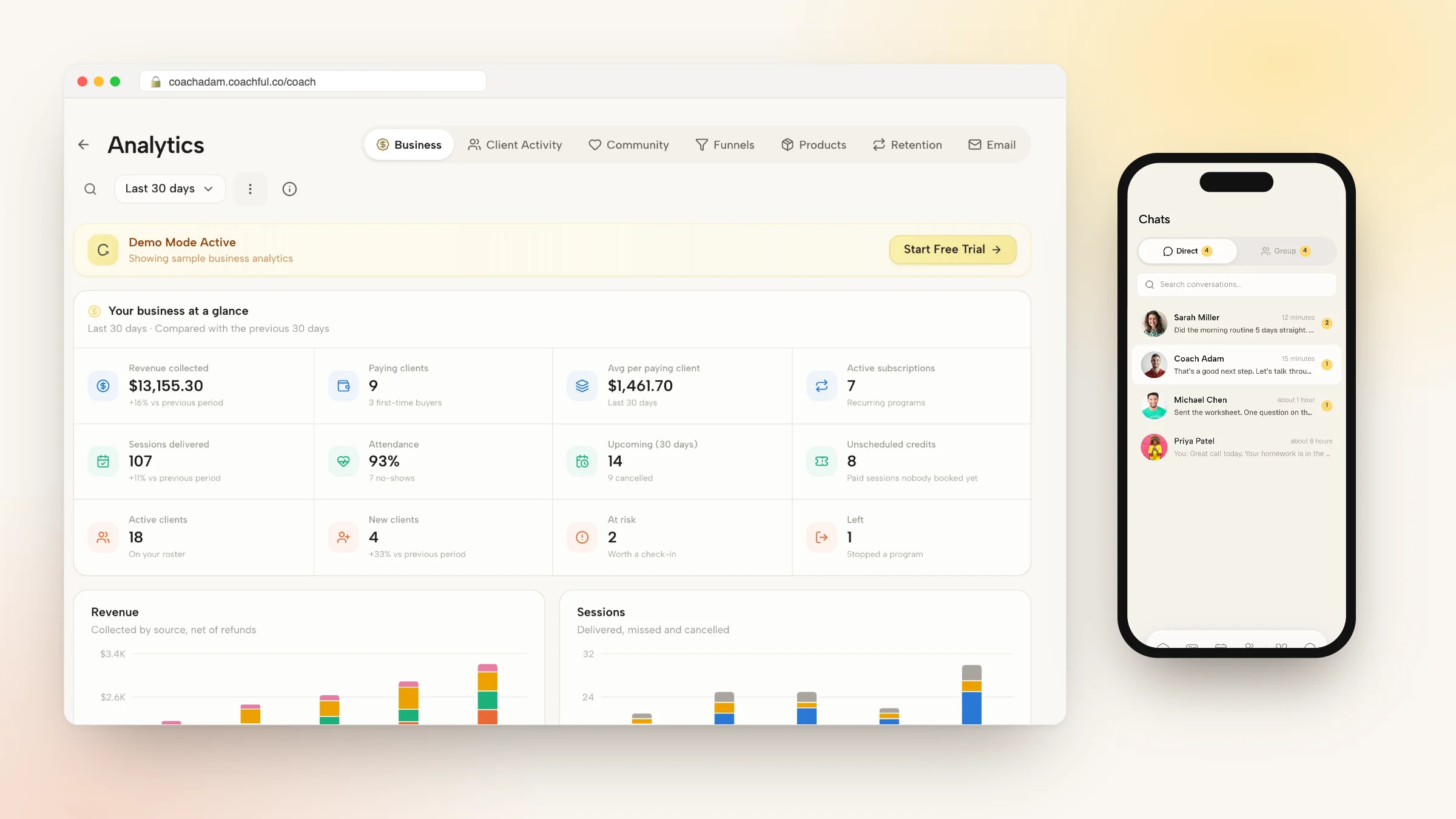
Coachful issues an invoice for every transaction and lets you raise manual invoices from your product catalog, so each payment has a document a client can file. Payments go to your own Stripe or Razorpay account with a 0% Coachful platform fee, as one-time payments, subscriptions or payment plans (how payments work). Agreements are sent for e-signature before the first session and stored on the client record, and Analytics shows revenue collected and paying clients for the period you choose, which makes setting money aside for tax a monthly habit. If you are a business coach, the Coachful page for business coaches shows the full setup.
Coachful doesn't file taxes or give tax advice. It keeps the records your accountant will ask for in one place.

Want your coaching website built for you?
Our team builds websites, funnels, offer pages and programs inside your Coachful account for free on every plan. Open Website and click Fill in a form on the "Want us to build it for you?" card, or choose We'll build it for you · FREE under Create. Describe the pages you want and what visitors should do next, and add up to 10 files and 8 links. The team replies by email, usually within about 24 hours, though that isn't guaranteed. Nothing is invented on your behalf, and logo design, video recording and ad management aren't included. Read what the free build covers.


Frequently asked questions
Is business coaching tax deductible?
Usually, if it's for a business you already run. The IRS lets businesses deduct ordinary and necessary expenses, and coaching on pricing, sales, leadership or strategy typically qualifies. If part of the coaching is personal, only the business part is deductible.
Is life coaching tax deductible?
Generally no. Life coaching for personal goals is a personal, living or family expense, which the IRS doesn't allow as a deduction. It also isn't a medical expense, because coaching for general well-being isn't treatment of a disease.
Is executive coaching tax deductible?
For the employer that pays for it, yes, as a business expense, and it is often tax-free to the executive as a working condition benefit. If an employee pays for it personally, there is generally no deduction, because most unreimbursed employee expenses can't be claimed.
Can I deduct a coaching certification?
If you are already a self-employed coach and the course improves your skills, it is usually deductible on Schedule C. If the certification qualifies you for a new trade, such as becoming a coach from another career, it generally isn't deductible as work-related education.
Is a business coach a tax write-off for an LLC?
Usually yes, when the coaching serves the LLC's business. A single-member LLC typically reports it on Schedule C with other business expenses. Keep the invoice, the agreement and proof of payment.
Can I deduct career coaching while I'm looking for a job?
Generally no, if you are an employee paying for it yourself. Under current IRS guidance, unreimbursed employee expenses can't be claimed except by a few categories of workers, such as Armed Forces reservists. If your employer pays for outplacement or career transition coaching, the employer can deduct that cost.
Can I deduct coaching I paid for before I launched my business?
Possibly, as a start-up cost. IRS Publication 583 lists training among start-up costs and lets you elect to deduct up to $5,000 in the year the business begins, reduced once start-up costs pass $50,000, with the rest amortized.
Will Coachful build my coaching website for free?
Yes. Coachful's team builds websites, funnels, offer pages and programs for free on every plan, inside your own account. Fill in the form from Website or Create, and the team replies by email, usually within about 24 hours. Coachful itself is a paid membership with a free trial.












