
How Do Coaches Get Paid? Payment Models, Fees and Taxes
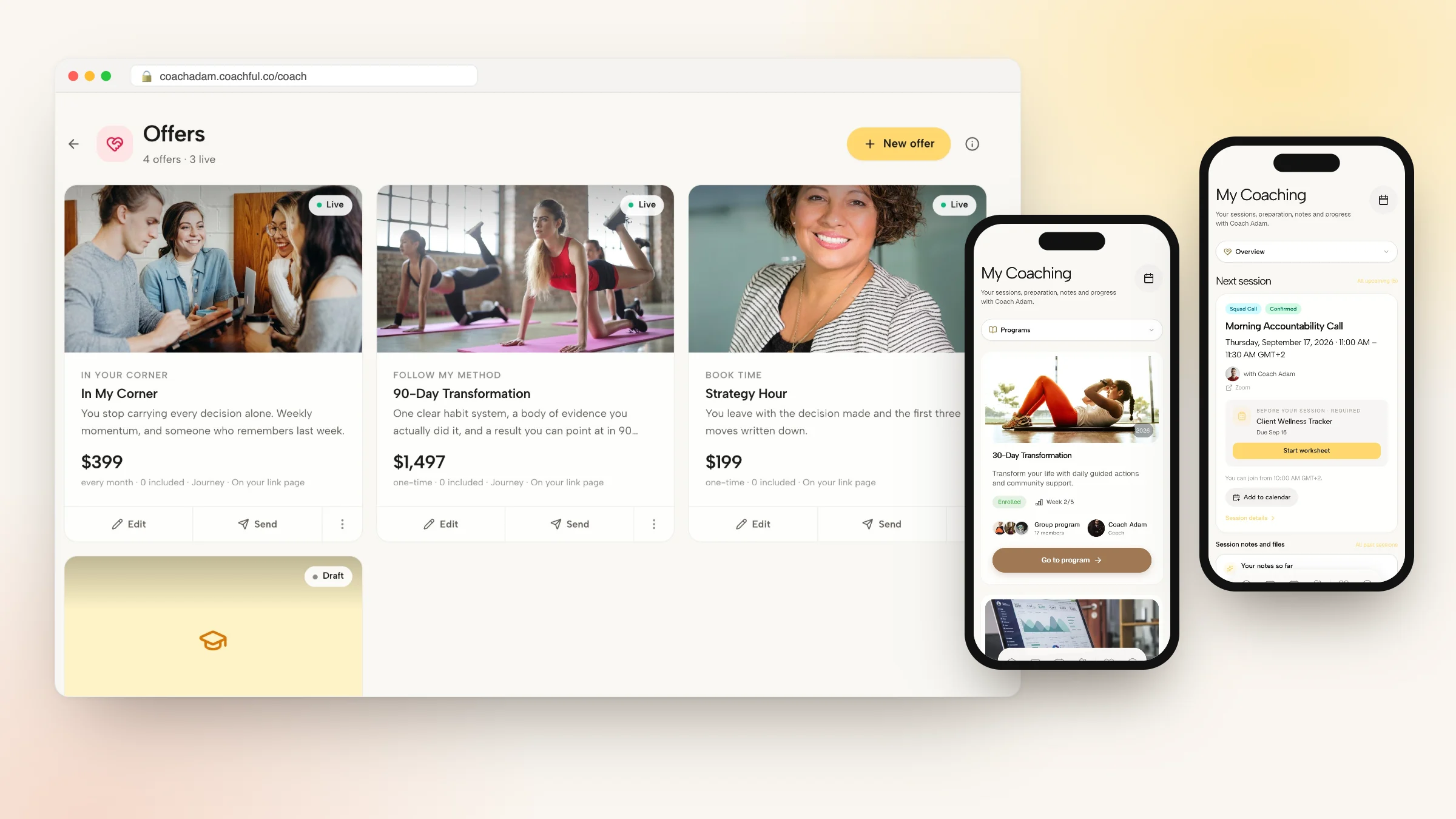
How do coaches get paid? Most self-employed coaches are paid directly by their clients, usually by card through a payment processor such as Stripe, for a package or program, a monthly subscription or retainer, a payment plan, or single sessions; when a company pays, the coach sends the employer an invoice. Coaches employed by companies, schools or coaching providers earn a salary or are paid per session, and sports coaches are mostly paid by schools and clubs.
The details matter more than they look. The model you choose decides how predictable your income is, how often clients drop off, and how much admin you do chasing payments. This guide covers the main payment models with typical prices, how money actually moves from a client's card to your bank account, how employer billing works, getting paid up front, international clients, the US tax basics and how Coachful handles payments.
How coaches get paid: the quick answer by type of coach
| Type of coach | Who pays | How |
|---|---|---|
| Self-employed life, health, career or business coach | The client | Card or bank payment for packages, subscriptions, payment plans or sessions |
| Executive or leadership coach | Usually the employer | An invoice per engagement or per month, often with a purchase order |
| Coach working through a coaching company | The company | A salary, or a contractor fee per session or per client |
| Coach inside an organization | The employer | A salary, as part of HR or learning and development |
| Sports coach | A school, college, club or team | A salary or stipend; part-time work is common |
For sports coaches, the BLS reports a median of $47,320 a year for coaches and scouts in May 2025, with about 64% working in educational services and part-time work common (BLS). The rest of this guide is about the coaches people hire for life, health, career, business and leadership work.
The main coaching payment models
| Model | How it works | Best for | Watch out for |
|---|---|---|---|
| Single session | The client pays per session, usually when booking | Urgent, one-off needs such as an interview next week | Unpredictable income; clients drift away |
| Package or program | One price for a set number of sessions or a fixed-length program, paid up front | Most coaching with a defined outcome | Clients who never book their remaining sessions |
| Monthly subscription or retainer | A recurring charge for ongoing coaching or access | Ongoing support, business and executive retainers | Needs a clear cancellation policy |
| Payment plan | A program price split into installments, sometimes with a deposit | Higher-priced programs | Failed payments partway through |
| Group program or membership | Many clients pay a lower price for shared coaching | Common problems and budget-conscious clients | Needs enough members to be worth running |
| Employer invoice | The company pays for an employee's coaching on agreed terms | Executive, leadership and career transition work | Longer payment terms and procurement steps |
| Digital products | Courses, workbooks and recordings sold alongside coaching | Income that does not depend on your hours | Rarely replaces coaching income on its own |
Most coaching practices mix two or three. A common shape is a defined program as the main offer, a monthly option for clients who finish and want to continue, and a single paid session as a low-risk first step.

What each model typically costs clients
Coachful's 2026 Coaching Business Report, which compiles the ICF's 2025 Global Coaching Study, PayScale and practitioner reports for the second quarter of 2026, gives these examples by model:
| Model and niche | Example | Typical price |
|---|---|---|
| Single session, career | One 50-minute session with intake prep | $99 to $280 |
| Short package, life | Four 60-minute sessions over four weeks | $400 to $600 |
| Program, life | Eight sessions over three months | $1,200 to $2,500 |
| Program, health and wellness | Eight to ten sessions over three months, with weekly check-ins | $900 to $2,000 |
| Monthly, health and wellness | Two to four sessions a month plus messaging | $300 to $700 a month |
| Retainer, business | Two to four sessions a month and on-call access | $1,500 to $4,000 a month |
| Contract, executive | Twelve sessions over six months, with an assessment | $8,000 to $20,000 |
| Group, life | Group calls and community | $100 to $300 a month |
| Membership or community | Recurring access | $47 to $197 a month |
US dollars, Q2 2026. Practitioner figures are estimates. Rates by niche on coachingrates.com.
For setting your own prices, see how much life coaches charge, coaching package tiers and the package pricing calculator. Whether the income adds up to a living is the subject of do life coaches make money.

How the money gets from the client to you
For most coaches, a payment works like this:
- The client pays at checkout on your booking page, offer page or invoice, by card or a wallet such as Apple Pay or Google Pay.
- A payment processor handles the charge. Stripe is the most common for coaches. The processor takes its processing fee, which depends on the country and payment method, so check its current pricing.
- Your coaching platform may add a fee. Some platforms take a percentage of every payment on top of processing. Check this before you choose one, because on a full practice it adds up.
- The money settles to your account and pays out to your bank on the processor's payout schedule.
"Stripe Connect" is the setup where a platform connects to your own Stripe account. The payments are yours: they settle in your Stripe account, and you can see them in your own Stripe dashboard. That is different from platforms that collect payments into their own account and pay you later. Our roundup of payment platforms for coaches compares the options.


When a company pays: employer invoices
Employer-paid coaching is common. The ICF's 2025 study, as summarized in Coachful's 2026 Coaching Business Report, finds that nearly six in ten coaching clients worldwide are employer-sponsored. Getting paid by a company looks different from a client paying by card:
- Agree who is invoiced in the coaching agreement, along with what the company receives in return, such as progress summaries.
- Ask about purchase orders and supplier setup before the first session. Larger companies often need you registered as a supplier first.
- Set payment terms on the invoice, with a due date, and decide whether you invoice the whole engagement, by month or in installments.
- Record bank transfers against the invoice so you know what is still outstanding.
Our guide to billing company-funded coaching covers the setup, and pitching an employer-paid pilot covers the sale.

Getting paid up front, and what happens when you are not
Most coaches take payment before the work starts: at booking for sessions, at purchase for programs, and at the start of each period for subscriptions. It protects your calendar and removes the awkward chase. Put these in your coaching agreement:
- When payment is due, and what happens to sessions if it is late.
- Your cancellation and rescheduling window, and whether a late cancellation uses a session.
- Your refund policy, including partway through a program.
- What happens to a payment plan if the client stops.
The ICF's Code of Ethics asks coaches to agree financial arrangements with clients and sponsors before coaching begins (ICF Code of Ethics, standard 1.1). For the hard cases, see what to do when a client does not pay, a client who wants a refund halfway through and automating prepayment.

International clients and currencies
Coaching by video means clients in other countries, and they will want to pay in their own currency. Two approaches work: charge in your own currency and let the client's bank convert, or set a separate, rounded price in each currency you sell in. The second looks more professional and avoids awkward amounts. Tax rules can also change when you sell across borders. Our guide to charging international coaching clients covers both.
Taxes when you get paid as a coach (US basics)
Tax rules vary by country, state and situation, so treat this as orientation and check with a tax professional. For US coaches who are self-employed:
- Self-employment tax. If your net earnings from self-employment are $400 or more, you pay self-employment tax and file Schedule SE. The IRS states the rate as 15.3%, covering Social Security and Medicare (IRS).
- Estimated taxes. The IRS notes that self-employed people may have to pay estimated taxes quarterly, since no employer withholds tax for you.
- Form 1099-K. If clients pay you by card, you will get a Form 1099-K "no matter how many payments you got or how much they were for". For payment apps and online marketplaces, the threshold is payments totaling over $20,000 in more than 200 transactions (IRS).
- Sales tax. Whether coaching or digital products are taxable depends on the state and what you sell. Ask your tax professional before you assume either way.
For the money setup around all of this, see coaching business financial setup and bookkeeping tools for coaches. Whether your clients can deduct coaching is covered in is coaching tax deductible.
Which payment model should you use?
A short checklist:
- Does your coaching have a clear outcome and timeline? Sell a program, with a payment plan for higher prices.
- Do clients need ongoing support after the outcome? Add a monthly option for when they finish.
- Is the need urgent and specific? A paid single session is a good first step.
- Is a company paying? Invoice the engagement on agreed terms.
- Do many clients share the same problem? Run a group program at a lower price.
- Are you chasing payments every week? Move to prepayment and automatic billing.
For the full case for programs over sessions, see how to sell coaching packages online, and for higher-priced offers, high-ticket coaching payment plans.
How coaches get paid on Coachful
Coachful payments run through your own Stripe account, connected with Stripe Connect, or through Razorpay. Funds settle to your account, and Coachful charges a 0% platform fee, so you keep everything after Stripe or Razorpay processing. What you can sell and how:
- One-time prices, subscriptions and payment plans, including weekly, monthly or yearly subscriptions and installment plans with an optional deposit.
- Apple Pay and Google Pay at checkout, coupons, order bumps and refunds.
- Offers and bundles that combine programs, sessions, community access and resources at one price, with included calls turned into session credits the client books.
- Invoices for every transaction, plus manual invoices from your product catalog with due dates, partial and offline payments recorded, and installment schedules.
- Sponsors: add an employer to a client's profile so invoices and agreements go to them while the coaching stays with the client.
- Separate prices per currency, set by you rather than converted, and tax settings for invoices and checkout.
- Every payment recorded on the client's record, with revenue, subscriptions and unbooked session credits in analytics.
Coachful does not process payments itself; Stripe or Razorpay does. See coaching payment software and coaching packages for the details. If you would rather have your offer page and checkout set up for you, every plan includes a free white-glove build by the Coachful team.


Frequently asked questions
How do life coaches get paid?
Most life coaches are self-employed and paid directly by clients, usually by card through a processor such as Stripe. The most common models are three-month programs, monthly packages, payment plans for higher prices, and single sessions as a first step.
Do coaches get paid before or after sessions?
Usually before. Most coaches take payment at booking for single sessions, at purchase for programs and at the start of each billing period for subscriptions. Some executive engagements are invoiced monthly or in installments to the employer.
How do coaches take payments online?
Through a checkout on their booking page, offer page or invoice, connected to a payment processor such as Stripe. Clients pay by card or a wallet such as Apple Pay, and the money settles to the coach's account after processing fees.
Should a coach charge per session or per month?
Programs or monthly packages usually work better than per-session pricing, because they match how change happens and make income more predictable. Per-session pricing suits urgent, one-off needs and makes a good first step.
How do executive coaches get paid?
Usually by the employer, through an invoice for the engagement or by month, often with a purchase order. Coachful's 2026 Coaching Business Report puts a six-month executive contract with 12 sessions at $8,000 to $20,000.
Does Coachful take a percentage of coaching payments?
No. Coachful charges a 0% platform fee on payments. Clients pay through your own Stripe or Razorpay account, and you keep everything after the processor's fees.
Do coaches have to pay self-employment tax?
In the US, self-employed coaches with net earnings of $400 or more pay self-employment tax, which the IRS states as 15.3%, and may need to pay estimated taxes quarterly. Check with a tax professional for your situation.












