
Do Life Coaches Make Money? What the Income Data Shows
Yes, but most make a modest amount and a minority make a good living. Do life coaches make money? Nine in ten coach practitioners in the ICF's 2023 study had active clients, and average coaching revenue was $52,800 a year globally and $67,800 in North America. Yet 53 percent of coaches reported less than $30,000 a year from coaching. Life coaches who earn well tend to sell packages to a specific audience, keep clients longer and add a second income stream, such as groups or employer contracts.
This guide is about the mechanics: where the money comes from, why so many coaches earn less than they expect, what a target income takes in clients and packages, and the signs that a practice is on track. For salary bands by experience, region and credential, see our separate life coach salary guide.
Do life coaches make money? The quick answer
| Question | Short answer | Source |
|---|---|---|
| Do most coaches earn something? | Yes: 91% of coach practitioners had active clients in 2022 | ICF 2023 |
| Do most earn a full living? | No: 53% reported under $30,000 a year from coaching | ICF 2023 |
| What is average coaching revenue? | $52,800 a year globally, $67,800 in North America | ICF 2023 |
| What do life coaches charge? | Typically $75 to $200 a session | PayScale and practitioner reports |
| Can a life coach make six figures? | Some do; it usually takes packages, a niche and a second income stream | Coachful's 2026 report |
| How long until it pays? | A first client in 1 to 3 months with active outreach; consistent $10,000-plus months in 12 to 36 months | Practitioner estimates |
ICF figures from the 2023 ICF Global Coaching Study executive summary, which covers all coaching niches. Other figures from Coachful's 2026 Coaching Business Report on coachingrates.com.
Where coaching revenue differs by region
Where your clients live changes the numbers a lot. The ICF's 2023 study broke average annual revenue from coaching down by region, for all types of coaching:
| Region | Coach practitioners | Average annual revenue from coaching | Average fee per one-hour session |
|---|---|---|---|
| North America | 34,200 | $67,800 | $272 |
| Oceania | 3,700 | $58,800 | $259 |
| Western Europe | 30,800 | $52,400 | $277 |
| Asia | 8,600 | $33,900 | $226 |
| Middle East and Africa | 4,900 | $29,600 | $165 |
| Latin America and the Caribbean | 16,900 | $22,900 | $114 |
| Eastern Europe | 10,000 | $18,700 | $138 |
| Global | 109,200 | $52,800 | $244 |
ICF 2023 Global Coaching Study, 2022 figures, US dollars. Most coaching now happens on video, so a coach in a lower-fee region who serves clients elsewhere can price against their clients' market.
These averages include executive and leadership coaches, who earn more. In the same study, 67 percent of coaches said business coaching (leadership, executive, organizational or small business) was their main area, and coaches who mainly served executives reported the highest fees and income. Life coaching sits toward the lower end of the spread.

Why so many coaches earn less than they expect
The session fee is not the income. ICF's 2023 figures show it clearly: average annual revenue of $52,800 against an average of 11.9 hours a week working as a coach works out to about $85 of revenue per coaching hour, which is the "average hourly revenue recovered" ICF reports, far below the $244 average fee per session. Not every coaching hour is a full-price paid hour.
Five things usually explain the gap:
- Too few paying hours. The average coach had 12.2 active clients. Many coach part time alongside other work, which the BLS notes is common: "few coaches work exclusively as coaches" (BLS).
- Unpaid hours that look like coaching. Free discovery calls, "quick" check-ins and practice clients fill the calendar without filling the bank account.
- Selling single sessions. A client who buys one hour at a time can stop any week. Packages hold commitment and price better.
- A broad niche. Coachful's report calls life coaching "the easiest niche to enter and the hardest to monetise, because the outcome is the least measurable."
- Constant replacement. If every client leaves when the package ends, all your effort goes on finding new ones. The report estimates that coaches earning above $120,000 take about 55 percent of revenue from existing and returning clients, while those below $80,000 take about 70 percent from new clients, figures drawn from practitioner estimates and ICF data.

Where life coaches' money actually comes from
Most coaches who make a good living don't rely on one-to-one hours alone. In the ICF's 2023 study, 93 percent of coach practitioners offered services beyond coaching, most often consulting (59 percent), training (58 percent) and facilitation (55 percent). Coachful's 2026 report estimates that 94 percent of coaches earning above $100,000 sell something beyond one-to-one hourly coaching, a practitioner estimate rather than a measured figure.
| Income stream | Typical price | Notes |
|---|---|---|
| Four-week starter, four sessions | $400 to $600 | A low-risk first step for new clients |
| Three-month package, eight sessions | $1,200 to $2,500 | The backbone of most life coaching practices |
| Six-month package, 12 to 16 sessions | $2,500 to $5,000 | Deeper work; renewals come from here |
| VIP intensive day | $750 to $2,000 | One day plus follow-up |
| Group coaching | $100 to $300 a month per person | One call, many clients |
| Online course | $297 to $2,000 | Low-touch, sells while you coach |
| Membership or community | $47 to $197 a month | Recurring, needs steady engagement |
| Corporate or B2B retainer | $3,000 to $10,000 a month | Organization-level contracts |
Package shapes and prices observed in the market, from Coachful's 2026 Coaching Business Report (practitioner reports and verified samples). For more on the payment mechanics, see our sibling guide on how coaches get paid, and for worked offers, 12 life coaching package examples.

What a target income takes
Here is the arithmetic for three revenue targets, using a three-month, eight-session package at $1,800, which sits inside the market range above. Each "place" is one client slot you keep filled all year, so one place sells four packages a year.
| Yearly revenue target | Packages a year | Client places to keep filled | Reality check |
|---|---|---|---|
| $50,000 | 28 | 7 | Doable part time once referrals start |
| $75,000 | 42 | 11 | A full one-to-one book |
| $100,000, one-to-one only | 56 | 14 | At the top of the 10 to 15 active clients practitioners describe as sustainable |
| $100,000, mixed | 40, plus a group and a course | 10, plus 12 group members | 10 places ($72,000) + a group of 12 at $200 a month for 10 months ($24,000) + a $297 course sold 15 times ($4,455) |
Illustrative sums, not measured incomes. They assume every place stays filled; at 75 percent fill, you need about a third more places. The mixed row shows why higher earners add a group: it adds revenue without adding a dozen more one-to-one hours.
Then take out costs. In the US, self-employed people pay 15.3 percent self-employment tax for Social Security and Medicare on net earnings, on top of income tax (IRS), plus card processing fees, software, insurance and training. Our guide to setting a coaching revenue target works backward from the take-home pay you need, and our coaching revenue calculator does the sum for your own prices.

Signs your practice is on track
Coachful's report gives practitioner benchmarks that are useful as checkpoints, not promises:
- First paying client: one to three months with active outreach.
- First $5,000 month: three to six months.
- Consistent $10,000-plus months: 12 to 36 months.
- An established, stable business: four to six years.
- Discovery call close rate: 40 to 70 percent for warm referrals, 14 to 18 percent from paid search.
- Renewals: 35 to 50 percent of standard three-to-six-month one-to-one packages renew.
If you are two years in and still well below these, the fix is usually one of three things: a narrower niche, a package instead of single sessions, or a referral habit. Our guides to getting life coaching clients and mistakes new life coaches make go through each.

How Coachful helps a coaching practice make money
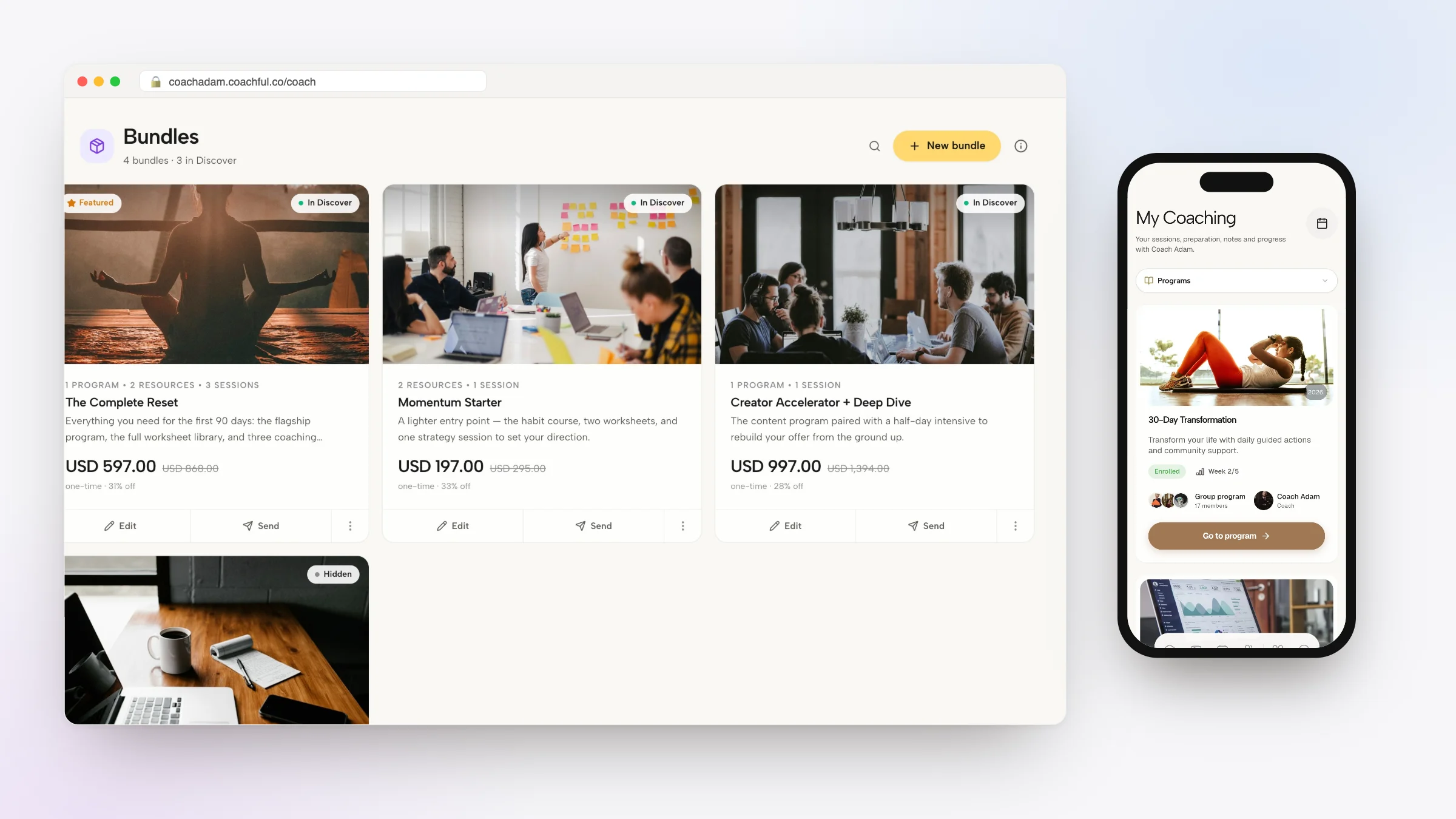
A Coachful membership includes the pieces that turn sessions into revenue in one place. Offers can be single sessions, fixed programs, monthly retainers or payment plans, paid through your own Stripe or Razorpay account with a 0% Coachful platform fee. Group programs create a cohort with a community feed and group calls automatically, so adding a group stream doesn't mean adding another tool. Leads and follow-ups sit next to clients, and Analytics shows revenue collected, paying clients, average revenue per paying client and active subscriptions, with a Retention tab for the renewals that higher earners rely on. The Coachful page for life coaches shows the full setup.
Setup doesn't have to eat the months when income is thinnest. Our team builds your website, funnel, offer page or program inside your account for free on every plan. Choose We'll build it for you · FREE under Create, or click Fill in a form on the "Want us to build it for you?" card on Website or Funnels. Say what you want built, attach up to 10 files and 8 links, and the team replies by email with next steps, usually within about 24 hours, which isn't guaranteed. The team never invents credentials, testimonials or prices, and doesn't design logos, record videos or run ads. See what the free build includes.


Frequently asked questions
Do life coaches make good money?
A minority do. The ICF's 2023 study found average coaching revenue of $52,800 a year globally, but 53 percent of coaches earned under $30,000. Those who earn well usually serve a specific audience, sell packages rather than hours and keep clients for more than one engagement.
How much do life coaches make a year?
Salary data compiled in Coachful's 2026 report puts life coaches at $47,000 to $72,000 a year, from PayScale, ZipRecruiter and Glassdoor, which skew toward employed coaches. Self-employed income varies far more, from a few thousand dollars to six figures.
Can you make six figures as a life coach?
Yes, but it usually takes more than one-to-one hours. Reaching $100,000 on a $1,800 three-month package alone means keeping 14 client places filled all year. Most six-figure coaches add groups, courses or employer contracts.
Is it hard to make money as a life coach?
Harder than in most niches. Coachful's 2026 report rates life coaching as the easiest niche to enter and the hardest to monetize, because outcomes are hard to measure. A specific audience and a clear result make it much easier to sell.
How many clients does a life coach need to make a living?
At $1,800 per three-month package, $50,000 a year takes about seven client places kept full and $75,000 about eleven. The ICF found coach practitioners averaged 12.2 active clients in 2022.
Do most life coaches fail?
There is no reliable failure-rate data. What the data shows is that over half of coaches earn under $30,000 a year from coaching, and many coach part time. That points to a slow build rather than a quick income, which is worth planning for.
How do life coaches get paid?
Most take payment directly from clients, usually as packages, monthly retainers or payment plans, and some are paid by employers. On Coachful, payments go to the coach's own Stripe or Razorpay account with a 0% platform fee.
Will Coachful build my coaching website for free?
Yes. Coachful's team builds websites, funnels, offer pages and programs for free on every plan, inside your account. Fill in the form from Create, Website or Funnels, and the team replies by email, usually within about 24 hours. Coachful itself is a paid membership with a free trial.












