How to Find an Executive Coach: Sources, Vetting and Cost

How to find an executive coach, in short: decide what should be visibly different in six to twelve months and who is paying, then build a shortlist of three to five coaches from your company's approved coach pool, peer referrals, the ICF's Credentialed Coach Finder and directories such as Coachful's Find a Coach. Check that each has coached leaders at your level, run chemistry calls with at least three, and sign a three-way agreement with your sponsor before the first session.
Executive coaching is a bigger purchase than most coaching, and the buying process is different. There is often a sponsor (your manager, the board, HR) who funds it and wants to know it worked, which raises questions about confidentiality that a private client never has to think about. This guide covers where executives and HR teams actually find coaches, the credentials and experience that matter at senior level, a scorecard for chemistry calls, what to put in the contract, typical costs and the warning signs. If you are still deciding whether you need one, start with what executive coaching is and the signs you need an executive coach.
How to find an executive coach: the quick answer by situation
| Your situation | Where to start | What to check first |
|---|---|---|
| Your company is paying | HR or learning and development. Many organizations keep a panel of approved coaches. | What your sponsor will hear, and who owns the goals |
| You are paying yourself | Peer referrals, the ICF Credentialed Coach Finder, directories | Experience with leaders at your level, and the full engagement price |
| Newly promoted or a first-time executive | Coaches who specialize in transitions and the first 90 days | A structured plan for the first three months |
| Founder or CEO | Referrals from other founders, board members and investors | Whether they have worked with boards, and how they handle conflicts of interest |
| HR sourcing coaches for several leaders | Coaching firms and leadership development providers, plus independent coaches | Matching process, reporting, and how impact is measured |
Step 1: Write down what should be different, and who needs to see it
Executive coaching works best with goals other people can observe. "Be more strategic" is a theme. "Spend two of every five working days on next year's plan rather than this week's escalations, as noticed by my team and my CEO" is a goal. Write one or two of these before you contact anyone, plus the names of the people whose view matters: your manager, peers, direct reports or the board.
That list does two jobs. It tells a coach whether they are a fit, and it becomes the basis for the stakeholder input most executive coaches gather at the start and end of an engagement. If you cannot name what would change, a coach can help you work it out, but expect the first few sessions to go there.
Step 2: Settle who pays, and what that changes
Coachful's 2026 Coaching Business Report, drawing on the ICF's 2025 Global Coaching Study, notes that nearly six in ten coaching clients worldwide are employer-sponsored. At executive level the share is usually higher. That matters because the sponsor becomes a party to the agreement.
The ICF's Code of Ethics asks coaches to "co-create a coaching agreement regarding roles, responsibilities, confidentiality, financial arrangements" with clients and sponsors before coaching starts, and to have a clear agreement about what information is exchanged and how (ICF Code of Ethics, standards 1.1 and 2.2). In practice that means you should know, before session one, exactly what your sponsor will receive: usually the goals, attendance and a summary at the midpoint and end, and not the content of your conversations.
If you are paying yourself, the questions are simpler: total cost, payment schedule, and what happens if you need to pause during a busy quarter.
Where to look for an executive coach
| Source | Good for | Watch out for |
|---|---|---|
| Your company's coach panel | Coaches already vetted, contracted and briefed on your culture | A small panel may not include someone with your exact challenge |
| Coaching firms and leadership development providers | Matching, consistent quality and reporting across many leaders | You may meet the coach only after the firm has chosen a shortlist |
| Peer referrals | Someone at your level has seen the coach work | Their challenge may not be yours |
| ICF Credentialed Coach Finder | Filtering by credential, coaching themes, methods and rate | Lists only ICF-credentialed coaches |
| Business school and executive education networks | Coaches who already work with senior programs | Availability can be limited |
| Coachful's Find a Coach | Browsing coaches and their programs, then booking a discovery call from the profile | Read each coach's own account of their training and experience |
Two of these deserve a note. The ICF's Credentialed Coach Finder is free to use and filters by credential type, coaching themes, coach methods and rate, and you can send an anonymous request for proposals to the coaches you shortlist (ICF guide for individuals). Large providers set their own bar: the Center for Creative Leadership says fewer than 3% of its coach applicants are accepted, with a minimum of five years as a full-time coach, an advanced degree, a coaching credential and at least 200 hours of training (CCL, 2025). That is one firm's standard, but it is a useful benchmark for what "senior" means.
Credentials and experience that matter at executive level
Executive coaching is unregulated, so the title proves nothing on its own. These are the signals worth checking:
| ICF credential | Coaching experience required | Clients |
|---|---|---|
| ACC | 100+ hours, 75 paid | 8+ |
| PCC | 500+ hours, 450 paid | 25+ |
| MCC | 2,500+ hours, 2,250 paid | 35+ |
Source: ICF experience requirements, October 2026.
- A credential at PCC or above is common among coaches who work with senior leaders, though not required. In Europe, EMCC accreditation plays the same role.
- Leadership experience of their own, or long experience coaching leaders in organizations like yours. Ask which; both can work.
- Assessment qualifications. If a coach proposes a 360 or a psychometric, ask whether they are certified to administer and interpret it.
- Supervision. Coaches who work with executives often have a supervisor or mentor coach. It is a good sign that someone is checking their work.
For a comparison of the training routes coaches take, see executive coaching certification.
How to run the chemistry calls
The ICF recommends meeting at least three coaches and asking each for two references, and notes that "Qualifications are important, but chemistry is what makes a coaching relationship really work" (ICF). A chemistry call is usually 20 to 30 minutes and costs nothing. Use the same questions with every coach so you can compare; our list of 15 questions to ask an executive coach covers them in detail. Then score each call straight afterwards:
| Criterion | What a strong answer sounds like | Score 1 to 5 |
|---|---|---|
| Relevant experience | Names leaders in roles like yours and what changed, without naming them | |
| Engagement design | A clear arc: intake, stakeholder input, a development plan, a midpoint review, a close | |
| Confidentiality | Says exactly what the sponsor will hear, before you ask | |
| Measurement | Proposes how you will both know it worked, such as a short stakeholder survey at the start and end | |
| Challenge | Asked at least one question that made you think on the call | |
| Fit | You would be comfortable telling this person about a mistake |
Measurement is the row most leaders skip. The Center for Creative Leadership advises buyers to ask whether a provider measures impact "through pre- and postcoaching data such as participant self-reporting, 360s, pulse surveys, and stakeholder interviews" (CCL, 2025). A coach who has a plan for this is easier to defend to a sponsor at renewal time.
Put the engagement in writing
Corporate engagements in Coachful's 2026 Coaching Business Report typically run six to twelve months. Before you start, the agreement should cover:
- Goals, in the observable form from step 1, signed off by you and your sponsor.
- Structure: number and length of sessions, any stakeholder interviews or 360, and support between sessions.
- Confidentiality: what the sponsor receives, when, and in what form.
- Measurement: what will be checked at the midpoint and the end.
- Fees and billing: the total, who is invoiced, and the payment schedule.
- Rescheduling, pauses and exit: the ICF expects coaches to respect every party's right to end the relationship under the agreement's terms.
Our guide to stakeholder alignment meetings shows how the three-way conversation usually runs.
What an executive coach costs
Coachful's 2026 Coaching Business Report, which compiles the ICF's 2025 Global Coaching Study, PayScale and practitioner reports for the second quarter of 2026, gives these executive coaching benchmarks:
| What you buy | Typical price | Source |
|---|---|---|
| Per hour, typical range | $200 to $500 | ICF 2025, PayScale |
| Newer executive coach | $150 to $250 an hour | ICF 2025 and practitioner estimates |
| Experienced | $250 to $500 an hour | ICF 2025 and practitioner estimates |
| Top of the field | $500 to $1,500 an hour | ICF 2025 and practitioner estimates |
| Leadership sprint: six sessions over three months | $3,000 to $8,000 | Practitioner reports |
| Six-month contract: 12 sessions plus assessment | $8,000 to $20,000 | Practitioner reports |
| Corporate engagement, per executive | $10,000 to $50,000 | ICF 2025 |
US dollars, Q2 2026. Details on coachingrates.com.
More detail is in executive coaching rates and how much executive coaching costs. Whether the price is justified in your case is the subject of is executive coaching worth it.
Red flags when hiring an executive coach
- Promises of a promotion or a specific outcome. A coach can work on what you control. Nobody controls a board.
- No conversation about the sponsor. If your company is paying and the coach never asks about your manager or HR, the confidentiality terms will be improvised later.
- Coaching your boss, or a direct competitor, without saying so. The ICF Code expects coaches to discuss and manage conflicts of interest with all parties.
- An assessment-heavy package from someone who cannot say what each tool is for or whether they are qualified to use it.
- Pressure to sign on the call, or a discount that expires before you can speak to HR.
What a good engagement looks like between sessions
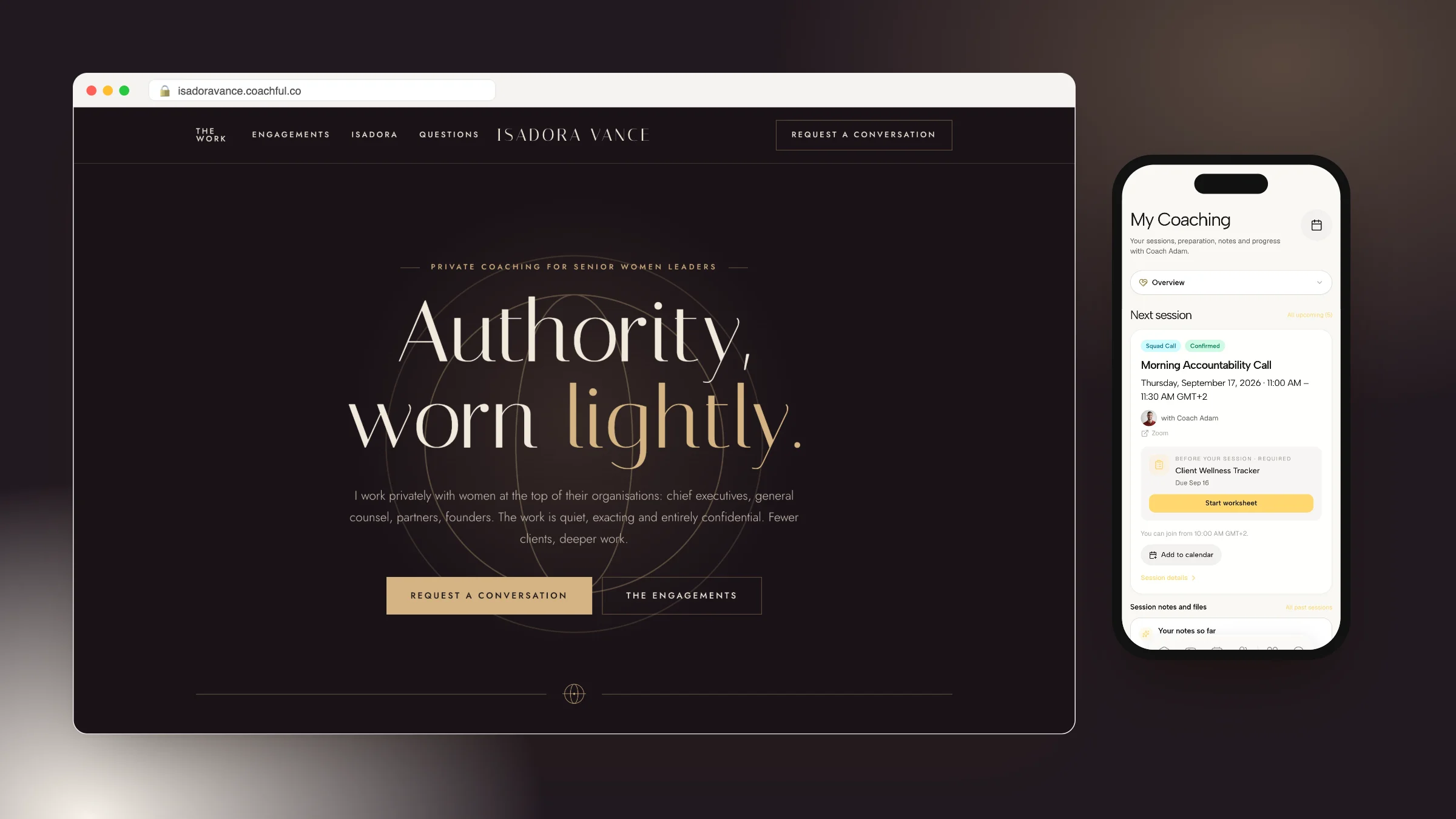
At senior level, most of the change happens between meetings: the difficult conversation you planned, the delegation you tried, the feedback you asked for. Good coaches make that visible. Many give clients a shared space with the next session, the prep that is due and notes from the last call.

Goals with dates keep the engagement honest, especially when a sponsor will ask about progress at the midpoint.

Some coaches lay the engagement out as a path, so you can see where you are in a six-month arc.

And there is usually a way to send a quick message before a big meeting. Agree in the contract what that channel is for and how fast replies come.

Find an executive coach on Coachful
Coachful's Find a Coach directory is public, so you can browse without an account. Search "executive", "leadership" or "first-time manager" to find coaches whose headline or bio mentions them, or browse the Business and Mindset categories. You can switch between coaches and their programs, which helps if you want a fixed engagement rather than open-ended sessions.
The Find My Coach quiz asks five short questions, covering the area you want to improve, where you are now, your email, your preferred coaching style and your monthly budget, and then suggests coaches.

Profiles show what each coach has added about their background, credentials and approach, their programs and prices, and either a calendar to book a discovery call or a form to send a message. Use the call as your chemistry call, with the scorecard above.

Are you an executive coach?
Every question in this guide is one a sponsor or a leader asks before signing. Our guide on how to become an executive coach covers training and first engagements, and how to find executive coaching clients covers the corporate sales side. Coachful's page for executive coaches shows the platform, including an Executive Coaching power-up with stakeholder feedback rounds. If your website does not yet answer a sponsor's questions, the team will build it for you through the free white-glove service.

Frequently asked questions
How do I find a good executive coach?
Write down what should be visibly different in six to twelve months, then shortlist three to five coaches from your company's coach pool, peer referrals, the ICF's Credentialed Coach Finder or a directory. Check experience with leaders at your level, run at least three chemistry calls with the same questions, and agree a written three-way contract.
How much does an executive coach cost?
Coachful's 2026 Coaching Business Report puts typical executive coaching at $200 to $500 an hour, a six-month contract with 12 sessions at $8,000 to $20,000, and corporate engagements at $10,000 to $50,000 per executive, based on the ICF's 2025 study and practitioner reports.
Will my company pay for an executive coach?
Often, yes. Nearly six in ten coaching clients worldwide are employer-sponsored, according to the ICF's 2025 study. Ask HR or learning and development whether there is a coaching budget or an approved panel, and bring a written goal and a proposed coach or two to the conversation.
What credentials should an executive coach have?
None is legally required. An ICF PCC or MCC, or EMCC accreditation in Europe, shows substantial training and supervised hours. At executive level, check experience with leaders like you, qualifications for any assessments they use, and whether they have supervision.
What is a chemistry call?
A short first conversation, usually 20 to 30 minutes and without charge, where you and a prospective coach test the fit. Ask the same questions of each coach, notice whether they challenge you, and score the call straight afterwards.
Is executive coaching confidential if my company pays?
It should be, within limits you agree up front. The ICF Code requires a clear agreement about what information is exchanged and how. Typically the sponsor sees goals, attendance and progress summaries, not session content. Get it in writing before the first session.
How long does executive coaching last?
Corporate engagements typically run six to twelve months. Shorter sprints of six sessions over three months suit a focused goal such as a new role. Agree a midpoint review so you and your sponsor can adjust.