
Executive Coaching Certification: Programs Compared
Executive coaching certification usually means one of two things: a certificate from an executive coach training program, such as Georgetown's, Hudson's or Columbia's, or an individual credential that buyers can verify, most often the International Coaching Federation's PCC. Corporate buyers tend to care about the second. Coachful's 2026 Coaching Business Report, drawing on the ICF Global Coaching Study 2025, describes the PCC as the level most corporate buyers treat as the working standard, and credentials as often mandatory in corporate coaching.
So the best executive coaching programs are the ones that get you to a PCC efficiently while teaching the parts of executive work that general life coach training skips: stakeholders, 360 feedback, organizational systems and contracting with a sponsor. This guide compares the main programs on accreditation, hours, format, prerequisites and published price, as each listed them in October 2026.
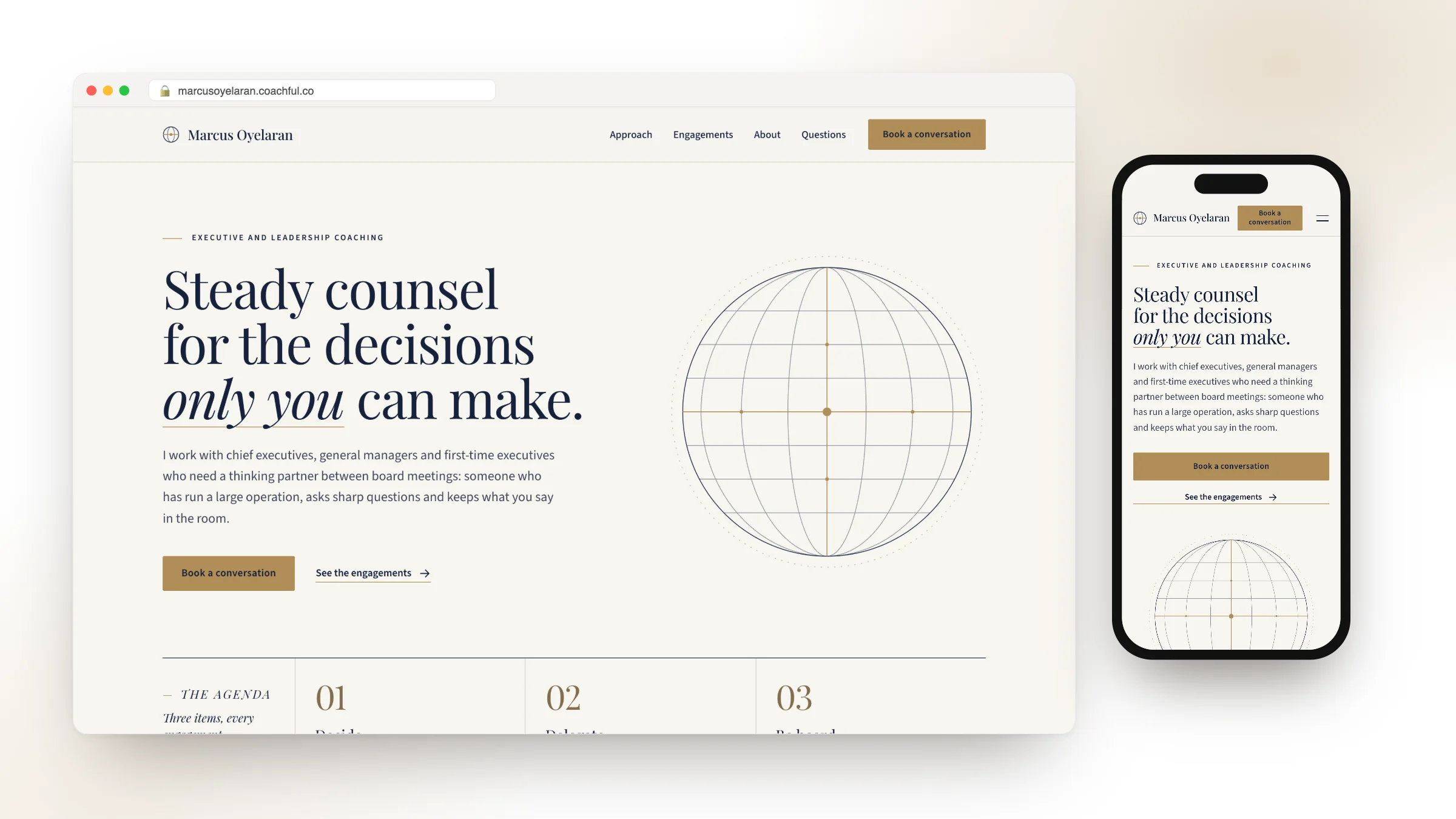
When you're ready to sell engagements, Coachful's team will build your executive coaching website for free on every plan, so the page a CHRO checks before a call looks the part.
Executive coaching certification programs compared
Criteria: ICF accreditation level stated on the program's own site (Level 2 first), then published contact hours.
| Program | ICF status, as stated | Hours | Format and length | Price as listed, October 2026 |
|---|---|---|---|---|
| University of Texas at Dallas, Executive and Professional Coaching | Level II | More than 150 | Fully online, live webinars, 12 months | $12,000 (professional certificate) |
| Georgetown University, Executive Certificate in Leadership Coaching | Level Two, re-approved | 148.5 contact hours | Live online or on campus in Washington, D.C., 8 months | $13,995, materials included |
| Hudson Institute of Coaching, Hudson Coach Certification | Level 2 | 125-plus | Virtual or in person in Santa Barbara, 9 months | $15,500 virtual, $16,500 in person (2027 sessions) |
| Center for Executive Coaching, ICF Certification Program | Meets Level 1 and Level 2 requirements, it says | Not stated | Mostly self-paced online with live webinars, 5 to 6 months | $8,490 |
| College of Executive Coaching | Its intensive is "the first phase of our ICF Level 1 and Level 2 programs" | 44 (intensive); 72 or 128 for its certifications | Five-day intensive, then further phases | Not published |
| Columbia Coaching Certification Program | Not ICF accredited by choice; graduates use the Portfolio path | Not stated; offered for at least 12.6 CEUs | Eight to ten months, including a five-day intensive and a six-month practicum | Not published |
| Marshall Goldsmith Stakeholder Centered Coaching | No ICF accreditation mentioned | Not stated | Live cohorts, about seven months on average | Not published on its page |

The programs in more detail
University of Texas at Dallas: Executive and Professional Coaching
A university program that "holds Level II accreditation" from the ICF and, it says, provides all the training and mentoring required. It runs fully online through live, real-time webinars over three consecutive semesters, more than 150 hours of instruction, with group mentor coaching circles in the second semester and four individual feedback sessions in the third. Tuition for the professional certificate is $12,000, in two installments. Pick it if you want a university name and a fully online Level 2 route.
Georgetown: Executive Certificate in Leadership Coaching
Re-approved by the ICF as a Level Two program, with graduates having demonstrated coaching at the PCC level. Eight required courses and a final skills assessment, 14.85 CEUs (148.5 contact hours) over eight months, live online or on campus two or three consecutive days a month. It asks for a bachelor's degree or equivalent and at least five years of education, training or experience in coaching, HR, leadership, organization development or a related field. Its focus is "both the being and doing of leadership coaching," with coaching inside a systems context. Pick it if you already work in HR, L&D or leadership and want a cohort of peers.
Hudson Institute of Coaching
A Level 2 program of 125-plus hours over nine months, in three four-day intensives with weekly group touchpoints, mentor coach calls and supervised coaching labs, virtual or in Santa Barbara. Participants must coach clients for at least 50 hours before graduating. Hudson says its cohorts average 10 to 20 years of professional experience, about half sponsored by employers. Watch for: the full cost. Beyond tuition, Hudson lists required books (about $600), 10 hours of coaching from a Hudson-certified coach (about $200 an hour), travel for in-person sessions, and its LifeForward program as a prerequisite. It plans for 10 to 15 hours of work a week.
Center for Executive Coaching
Its ICF Certification Program says it's "fully accredited and meets both Level 1 (ACC) and Level 2 (PCC) requirements," delivered mostly self-paced and fully online with live webinars, and includes 10 hours of mentor coaching over a three-month phase. Total length is about five to six months; tuition is $8,490 in one payment or three installments of $2,897. It also has a page for the Board Certified Coach credential and an internal-coach path. Watch for: total hours aren't stated, and the site shows Level 1 and Level 2 logos without mapping them to specific programs, so ask which applies to yours.
College of Executive Coaching
Its Intensive Executive Coach Training is a five-day, 44-hour workshop the college calls the first phase of its ICF Level 1 and Level 2 programs, using a four-step coaching model. From there you continue to its own 72-hour Certified Professional Coach or 128-hour Advanced Certified Personal and Executive Coach credentials. Tuition isn't published.
Columbia Coaching Certification Program
Run by Teachers College, Columbia University. Its FAQ says plainly that Columbia "will NOT seek program accreditation from the ICF," so graduates who want an ICF credential apply through the Portfolio path at the ACC or PCC level. The program is built on four guiding principles, nine research-based coaching competencies and a three-phase coaching process, over eight to ten months. Pick it if the university and its method matter more to you than the faster ICF route; budget for the higher Portfolio fee and longer review.
Marshall Goldsmith Stakeholder Centered Coaching
A method certification rather than a general coach training. A leader picks one behavior to change, stakeholders agree to help, the coach runs "FeedForward," monthly check-ins keep it in focus, and the same stakeholders re-rate the leader at the end, using its Mini-Survey tool. Live cohorts average about seven months, and the certification is described as lifetime. Its page doesn't mention ICF accreditation or continuing education units. Pick it if you already coach and want a measurable behavior-change method to sell to companies.

What executive buyers actually check
- A verifiable credential. Usually an ICF credential, and the PCC in particular. In Europe, Coachful's report notes the EMCC or an equivalent is the recognized standard across much of the continent.
- Relevant leadership experience, which is why several programs above ask for years of professional experience.
- A method for stakeholders and measurement: three-way alignment meetings, 360 feedback, and a way to show progress at the end. You'll use both in niches such as executive presence coaching.
- Contracting and confidentiality with both the executive and the sponsor. Our guides to executive coaching contracts and assessments and stakeholder alignment meetings cover both.
Another option some executive coaches add is the Board Certified Coach (BCC) from the Center for Credentialing & Education. It requires 30 to 120 hours of coach training depending on your degree, a professional endorsement, coaching experience and the BCC exam, with a $279 application and exam fee and $40 a year to maintain, as listed in October 2026.

What executive coaching pays
Coachful's 2026 Coaching Business Report puts executive coaching at $200 to $500 an hour, from the ICF Global Coaching Study 2025 and PayScale, with entry-level executive coaches at $150 to $250 and experienced ones at $250 to $500, from the ICF study and practitioner reports. Corporate engagements typically run 6 to 12 months, at $10,000 to $50,000 per executive, per the same report. See executive coaching rates and our guide to executive coaching rates for how to price an engagement.
At those numbers, the tuition differences above matter less than the route: a Level 2 program that gets you to the PCC directly saves a second application fee, and the PCC is the level most corporate buyers treat as standard.
Red flags in executive coaching certification
- "Certified executive coach" with no body behind it. Ask who awards it and whether a buyer can verify it.
- ICF logos without a level next to a specific program.
- Total hours not stated on a program sold for ICF credentialing.
- Hidden extras: required books, required coaching, travel or a prerequisite program, priced separately.
- Promises of corporate contracts. A program can teach executive coaching; it can't sell it for you.

Which program fits you
| If you... | Look at |
|---|---|
| Want a university Level 2 program, fully online | UT Dallas |
| Work in HR, L&D or leadership and want a peer cohort | Georgetown |
| Are a senior leader with 10+ years of experience | Hudson |
| Need a lower-cost, mostly self-paced ICF route | Center for Executive Coaching |
| Value a specific university method over the fastest ICF route | Columbia (Portfolio path) |
| Already coach and want a measurable stakeholder method | Marshall Goldsmith Stakeholder Centered Coaching |
If you're earlier in the decision, our guide to how to become an executive coach covers backgrounds, niches and first clients. For the ICF side, see ACC vs PCC vs MCC.
Where Coachful fits after you certify
Coachful isn't a training program or a certification body. It's where an executive coaching practice runs, and a Coachful membership includes the Executive Coaching power-up: goals, stakeholders, leadership practice and evidence of progress, kept together with your client. Alongside it:
- ICF hour tracking toward the ACC, PCC and MCC, with an ICF client coaching log export; see ICF hour tracking.
- Session notes and summaries, with an AI briefing per client built from your practice data.
- Booking, payment and e-signed agreements, plus manual invoices for engagements a company pays for.
- Private competency feedback on your own recorded sessions against ICF Core Competencies 3 to 8, when you turn it on; it's a self-development aid, not an ICF assessment.
The Coachful page for executive coaches shows the setup.

Why Coachful stands out: a free white-glove service. Coachful's team builds your executive coaching website, first offer page and first program in your own account, free on every plan, usually within about 24 hours. Coaches we've built for include a leadership coach whose Squarespace renewal was days away: one clean, mobile-friendly homepage with a repeated "talk with me" button. Nothing gets invented, including credentials and client logos. See what the free build includes.

Frequently asked questions
What is the best executive coaching certification?
For corporate work, the one that matters most to buyers is an ICF credential, usually the PCC. The best programs get you there directly through ICF Level 2 accreditation, such as Georgetown's, Hudson's or UT Dallas's, while teaching stakeholder and organizational work.
How much does executive coaching certification cost?
Among the programs we checked, published tuition ran from $8,490 (Center for Executive Coaching) to $16,500 (Hudson, in person, 2027 sessions), as listed in October 2026. ICF application fees are extra: $375 for members for the PCC on the Level 2 path.
Do you need a certification to be an executive coach?
Legally, no; coaching isn't licensed in most countries. Commercially, often yes: Coachful's 2026 Coaching Business Report notes credentials are often mandatory for corporate buyers.
Is Columbia's coaching certification ICF accredited?
No. Columbia's FAQ says it will not seek ICF program accreditation, and graduates who want an ICF credential apply through the Portfolio path at the ACC or PCC level.
How long does executive coaching certification take?
The Level 2 programs we checked run eight to twelve months. After that, the PCC needs 500 coaching hours with 25 clients, 450 of them paid; at five coaching hours a week, that's about two years on its own.
What's the difference between executive coaching and leadership coaching certification?
Mostly the buyer and the language. Executive coaching programs emphasize senior leaders, sponsors and stakeholders; Georgetown's leadership coaching certificate, for example, is aimed at people from coaching, HR, leadership and organization development. Both kinds lead to the same ICF credentials.
Will Coachful build my executive coaching website?
Yes. Coachful's team builds your website, first offer page and first program for free on every plan, usually within about 24 hours. Coachful itself is a paid membership with a free trial; the build costs nothing extra.












