
How to Become an Executive Coach: Credentials and Clients
Most people who become executive coaches get there in the same order. They spend years leading people themselves, add formal coach training (often ICF-accredited, with the PCC credential as the target, because corporate buyers treat it as the working standard), build coaching hours through internal, associate or pro bono work, and then sell engagements to companies rather than to individuals. There's no license for executive coaching. What buyers check instead is credibility: the rooms you've been in, the credential you hold and the leaders who'll vouch for you.
That's how to become an executive coach in short. This guide covers each step properly, including the parts most career-change articles skip: how companies actually buy coaching, the assessment certifications you may need, how to get your first hours, and what it pays. When you're ready to go independent, Coachful's team will build your executive coaching website and engagements page for free on every plan.
What an executive coach does
An executive coach works one to one with a senior leader, usually over six to twelve months, on how they lead: decisions, delegation, influence, a new role, a difficult team, the gap between how they see themselves and how others see them. Unlike most coaching, there are usually three parties. The executive is the client, but a sponsor (a CEO, a chief people officer, an HR or L&D lead) often pays, agrees the goals and expects to see progress, while the conversations themselves stay confidential.
That structure shapes the job. Executive coaches spend real time on contracting, stakeholder interviews, 360 feedback, assessment debriefs and three-way meetings, as well as the coaching itself. Our guide to stakeholder alignment meetings shows what that looks like in practice.
Executive coaching and leadership coaching overlap. Coachful's 2026 Coaching Business Report separates them by buyer: leadership coaching "sits just below executive work because the buyer is often a rising manager rather than the C-suite."
Who becomes an executive coach
The 2026 report's own selection framework matches corporate leadership or management backgrounds to executive and leadership coaching, and it rates the niche as very high on income potential, low to medium on saturation and high on difficulty to enter, summed up as "needs demonstrable credibility" (ICF Global Coaching Study 2025 and practitioner reports, as compiled in the report).
In practice, executive coaches tend to come from one of four places:
- Senior leaders who have run teams, functions or companies and want to work with the next generation of leaders.
- HR, talent and L&D professionals who have sat in promotion and succession conversations and know how organizations judge leaders.
- Consultants who are used to working with senior clients and want to work on the person rather than the strategy.
- Psychologists and therapists who move into organizational work, bringing assessment and behavioral expertise.
Can you become an executive coach without having been an executive? Yes, but you'll need to make up the credibility another way: a deep specialism (say, new engineering managers), a strong credential and results with leaders at the level you want to coach.

Step 1: Get trained and credentialed
Executive coaching is the corner of the profession where credentials matter most, because corporate buyers often make them a condition of hiring. The report notes that for corporate coaching, credentialing is "often mandatory", and that 73 percent of coaches say clients and organizations expect certification (ICF Global Coaching Study 2025).
The ICF credential ladder, with the core requirements as the ICF publishes them (check the current rules with the ICF before you enroll):
| Credential | Coach education | Coaching experience | Why it matters for executive work |
|---|---|---|---|
| ICF ACC | 60+ hours | 100 hours with at least 8 clients, 75 paid | The entry rung; clears basic credential filters |
| ICF PCC | 125+ hours | 500 hours with at least 25 clients, 450 paid | The level most corporate buyers treat as the working standard |
| ICF MCC | 200+ hours | 2,500 hours with at least 35 clients, 2,250 paid | Rare enough to be a positioning asset in itself |
Each level also needs 10 hours of mentor coaching over at least three months and a performance evaluation of recorded coaching. In much of Europe, the EMCC is the recognised alternative. On the money side, the ICF Global Coaching Study 2025, as compiled in the report, puts the average income of PCC holders at $78,000 a year, a published premium of 50 percent over uncredentialed coaches, though some of that reflects the years of practice the hours require. Our comparison of ICF ACC, PCC and MCC goes into each level.
If you're aiming at executive work from the start, consider a program that covers the PCC education hours (125 or more) rather than stopping at 60, so you don't have to go back for more training later.
Step 2: Build your coaching hours
Five hundred hours for a PCC is a lot of coaching. These are the common ways executive coaches build them:
- Internal coaching. If you're still employed, offer coaching to managers in your own organization, with your employer's support.
- Associate work. Coaching firms and digital coaching platforms recruit associate coaches to deliver their engagements. They usually ask for a credential and leadership experience, and they keep a share of the fee. Our guide to associate coach revenue shares explains how splits usually work.
- Pro bono and nonprofit work. Coaching leaders in charities and social enterprises builds hours and references; our guide to ICF pro bono hours covers what counts.
- Your network. Former colleagues stepping into bigger roles are natural first clients, often paying themselves at first.
Log every session from the start. Rebuilding a coaching log from old calendars a year later is slow and easy to get wrong; our ICF coaching log template shows what to record.

Step 3: Learn the executive coaching toolkit
Coach training teaches the conversation. Executive coaching adds a set of tools and processes around it:
- Three-way contracting. Agreeing goals, confidentiality and how progress will be judged with both the executive and the sponsor.
- Stakeholder interviews and 360 feedback. Interviewing the leader's boss, peers and team, and turning what you hear into feedback the leader can use.
- Psychometric assessments. Tools such as personality, emotional intelligence and leadership assessments. Many publishers require you to be certified in their instrument before you can buy it or debrief it, so budget for one or two certifications in the tools your market uses.
- Transition coaching. Structuring the first months in a new role, a common reason companies hire a coach.
- Confidentiality in practice. Knowing exactly what the sponsor will see and what stays between you and the leader.
- Supervision. Regular reflective practice with a coaching supervisor, increasingly expected in corporate work. Our guide to coaching supervision explains it.
For the contract side of assessments, how to scope assessments in an executive coaching contract covers who owns the report and the data.
Step 4: Choose who you'll coach
"Executive coach" is broad. A focus makes you easier to recommend, because a CHRO looking for help with one specific situation can picture you in it:
- First-time executives in their first year at the leadership-team table.
- New CEOs and general managers in their first 90 days.
- Founders whose company has outgrown the way they lead it.
- Senior women leaders preparing for the top job.
- Technical leaders moving from expert to leader of experts.
The strongest focus usually comes from your own career: the industry you know, the transition you made, the level you held. Our list of leadership coaching topics can help you find the problems your future clients bring.

Step 5: Design your engagements and set your rates
Executive coaching is sold as engagements, not hours. Coachful's 2026 report puts executive coaching at $200 to $500 an hour (ICF 2025 and PayScale), with entry-level executive coaches at $150 to $250 by practitioner estimates, and a typical six-month contract of twelve sessions with an assessment and action plans at $8,000 to $20,000. Annual income for executive coaches comes in at $96,000 to $98,000, from ICF 2025, PayScale and Salary.com.
Design two or three engagements with a clear scope: the length, the number and length of sessions, the 360 or assessment, the stakeholder meetings, support between sessions and how the engagement ends. Our guide to executive coaching rates walks through pricing models, corporate buying and how to work out how many engagements your practice needs, and how to create an executive coaching program covers the structure inside an engagement.
Step 6: Set up your practice
An independent executive coaching practice needs a credible website, a way for sponsors to request a conversation, agreements, invoicing that works for companies and a confidential place for the work. In Coachful, all of that is included in your membership:
- A website from designed templates, including several drawn for executive coaches, with an Engagements page and a request form, on your own domain.
- Agreements sent for e-signature before the first session and stored on the client record.
- Payments and invoices: fixed fees, instalments or monthly retainers through your own Stripe or Razorpay account with a 0% Coachful platform fee, plus manual invoices for companies that pay by invoice.
- The Executive Coaching power-up: a shared space for leadership goals, stakeholder feedback rounds sent by email, experiments, decisions, a new-role transition plan and preparation for difficult conversations.
- ICF hour tracking against the ACC, PCC and MCC thresholds, with an exportable client coaching log.

Coachful is GDPR-ready with full data export, though not HIPAA-certified, which rarely matters in executive work but is worth knowing. See the Coachful page for executive coaches, and for what senior buyers look for online, our guide to an executive coach website. Comparing booking tools? See scheduling software for executive coaches.
Have your executive coaching website built for free
Coachful's team builds coaching websites for free on every plan, including the pages executive coaches need: a restrained homepage, an Engagements page, an About page written for senior readers and a "request a conversation" form. Everything is built inside your own account. Coachful itself is a paid subscription, and you can start with a free trial.

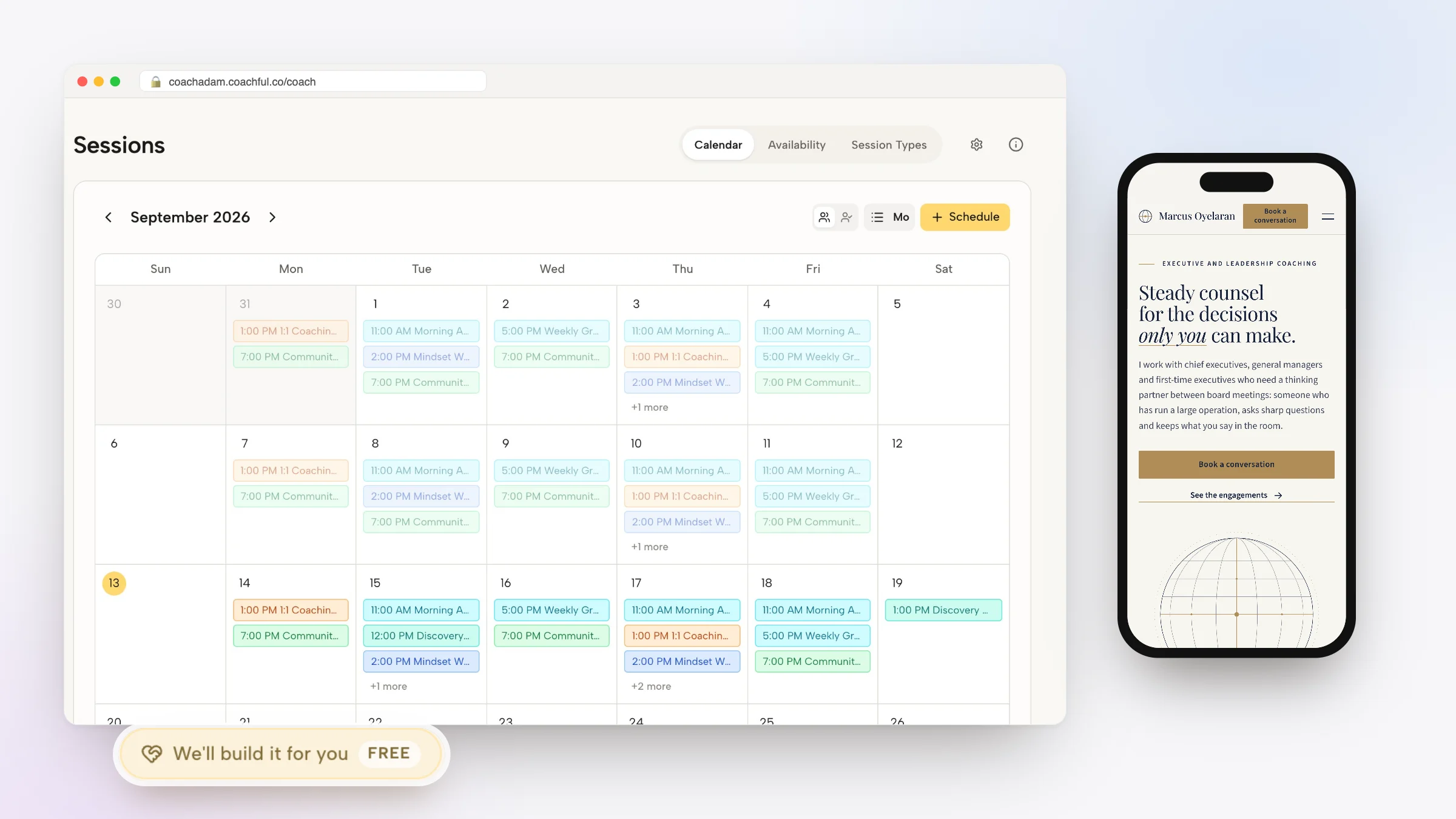
Click Fill in a form on the "Want us to build it for you?" card on the Website page, or choose We'll build it for you · FREE under Create. Tell the team which pages you want and what they should do, describe the path you want visitors to take (read about the engagements, then request a conversation), and paste up to 8 links to sites you like. Attach up to 10 files: your bio, a past proposal, a headshot, a logo.
The team replies by email with next steps, usually within about 24 hours; that's typical, not guaranteed. A recent build for a leadership coach whose Squarespace renewal was days away produced one clean, mobile-friendly homepage with a repeated "talk with me" button, designed to sit alongside the coach's sister company. Nothing is invented: no client logos you can't use, testimonials you don't have or prices you haven't set. The team doesn't write proposals, run outreach, design logos or record video. See everything the free build covers.
Step 7: Win your first corporate clients
The report's comparison of consumer and corporate coaching puts the corporate sales cycle at one to six months, with HR, L&D or the executive team making the decision. Plan for that from the start.
- Start with people who've seen you lead. Former bosses, peers and direct reports who are now in senior roles or in HR.
- Talk to HR and L&D directly. Ask how they currently choose coaches and what they need from a proposal. Many organizations keep a panel of approved coaches.
- Propose a pilot. One or two leaders, a defined scope and a review at the end. Our guide to pitching an employer-paid coaching pilot covers the conversation.
- Write proposals that read like a scope. These coaching proposal examples include a corporate version.
- Be visible where sponsors look. The report names LinkedIn, events and referrals as the main channels for corporate coaching.
- Protect renewals. Corporate engagements renew more often than individual ones, so a well-run stakeholder review at the end is your best sales tool.

How long does it take to become an executive coach?
| Stage | Typical timing |
|---|---|
| Leadership experience before coaching | Usually many years, gained in your earlier career |
| Coach training at PCC level (125+ hours) | Roughly 6 to 12 months part time, depending on the program |
| First 100 hours (ACC) | About a year part time |
| 500 hours (PCC) | Often two to four years, faster with associate work |
| A full independent practice | Depends on your network and pipeline more than your credential |
These are typical patterns rather than measured figures. You can coach paying executives long before you hold a PCC; many coaches do their first paid engagements through their network while they build hours.
Frequently asked questions
Do you need a certification to become an executive coach?
No law requires one, but corporate buyers often do. Credentialing is "often mandatory" for corporate coaching according to Coachful's 2026 Coaching Business Report, and the ICF PCC is the level many organizations treat as the working standard.
What qualifications do executive coaches need?
Most have senior leadership, HR, consulting or psychology experience, coach training from an accredited program and an ICF or EMCC credential. Many also hold certifications in one or two psychometric assessments, because publishers often require certification before you can use their tools.
Can you become an executive coach without being an executive?
Yes, but you need credibility from somewhere else: a deep specialism, a strong credential, an HR or psychology background, or results with leaders at the level you want to coach. Starting with leadership coaching for rising managers is a common route up.
How long does it take to become an executive coach?
Coach training at PCC level takes roughly six to twelve months part time, and reaching the PCC's 500 coaching hours often takes two to four years. The leadership experience behind it usually comes from an earlier career.
How much do executive coaches make?
Coachful's 2026 report puts executive coaches at $96,000 to $98,000 a year (ICF 2025, PayScale, Salary.com) and $200 to $500 an hour, with six-month engagements typically at $8,000 to $20,000. Coaches with premium positioning and business clients earn well above that.
What is the difference between an executive coach and a leadership coach?
The work overlaps, but the buyer differs. Executive coaches usually work with senior leaders and the C-suite, paid by the company; leadership coaches often work with rising and first-time managers. The 2026 report puts leadership coaching at $150 to $400 an hour against $200 to $500 for executive coaching.
How do executive coaches get clients?
Mostly through referrals from former colleagues and sponsors, relationships with HR and L&D teams, associate work for coaching firms, and visibility on LinkedIn and at events. Corporate sales cycles run one to six months, so a steady pipeline matters more than any single channel.
Will Coachful build my executive coaching website for free?
Yes. Coachful's team builds coaching websites for free on every plan, including an Engagements page and a request-a-conversation form. Fill in the form from the Website page or Create and the team replies with next steps, usually within about 24 hours. Coachful is a paid subscription; the build costs nothing extra.












