Executive Coach Website: What Senior Buyers Look For
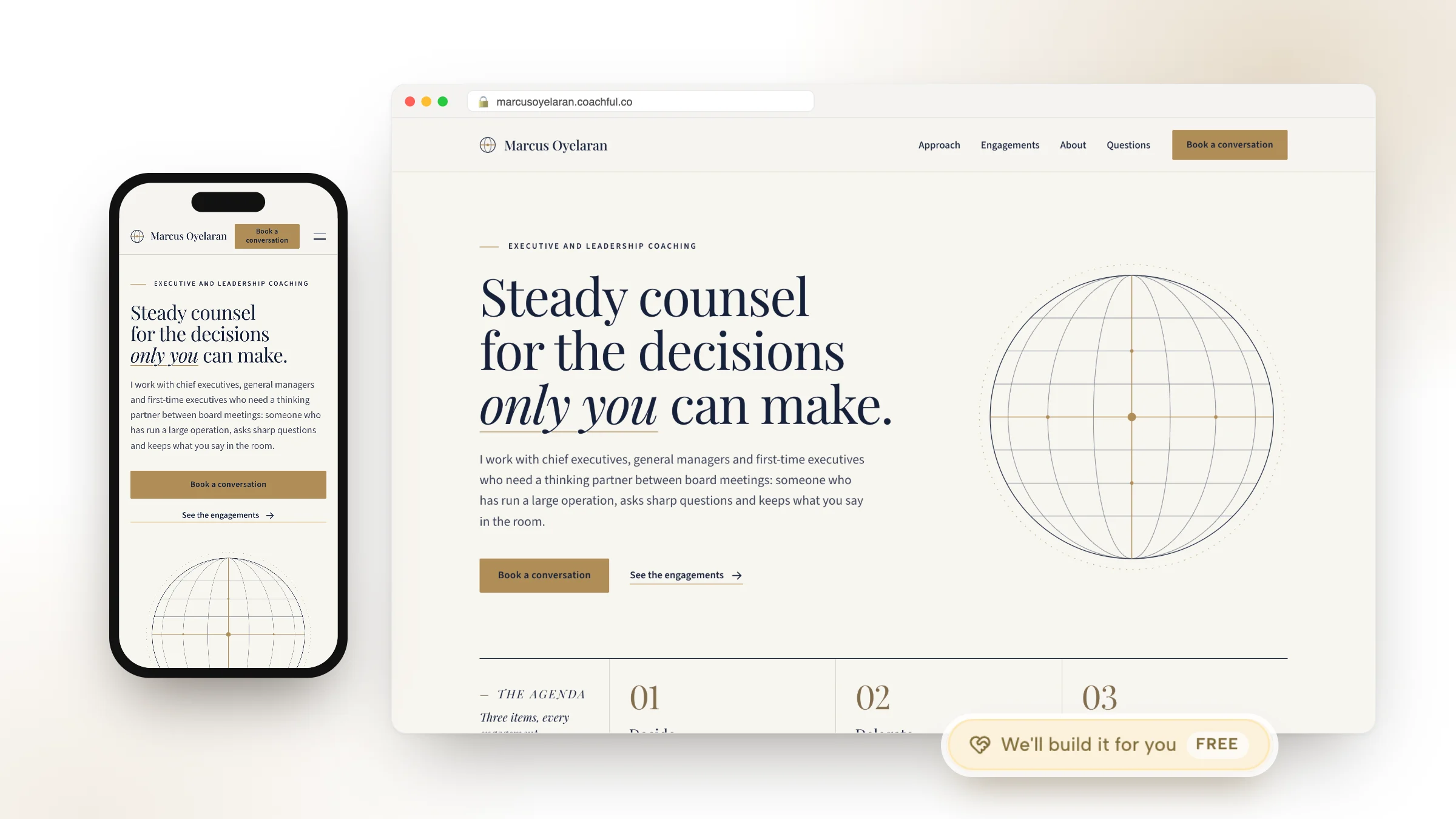
An executive coach website has two readers. The first is the executive: a senior leader who may be quietly looking for help and wants to know whether you've sat in rooms like theirs. The second is the sponsor: the CEO, the chief people officer or the L&D lead who will approve the budget and wants to know how the engagement is scoped, measured and kept confidential. Most executive coach websites speak only to the first reader, and then the second one emails asking for a PDF.
This guide shows how to write for both, what the pages are, a sample Engagements page written like a proposal, how to handle booking when your clients don't click "book now", and three templates with the right restraint. It works the same way for a leadership coach website. And if you'd rather not build any of it, Coachful's team builds executive coaching websites for free on any plan; you send a short form and they build it in your account.
Two readers, one site
| The executive wants to see | The sponsor wants to see |
|---|---|
| That you understand their specific pressure: a new role, a board, a team that isn't working | Who you've worked with by level and sector, without names |
| How a session feels and how confidential it is | How confidentiality works alongside progress reporting |
| Your background in their world | Your method, assessments you use and how goals are set with stakeholders |
| A quiet, low-commitment first step | Engagement length, structure and how fees are set |
| That you won't waste their time | What a mid-point and end review look like |
The simplest fix is a page for each: the homepage and About page speak to the executive, and a "For organizations" page speaks to the sponsor. Link the sponsor page from the navigation and from the Engagements page, where sponsors usually land when someone forwards your link.
Discretion is the design brief
Senior clients rarely want to be seen hiring a coach, and they notice when a site is loud. A few principles that matter more here than in any other niche:
- Quiet design. Generous white space, restrained color, serious type. Think of a well-made annual report rather than a launch page.
- No client logos without written permission. Describe instead: "chief executives and general managers in healthcare, software and financial services."
- Request, don't sell. "Request a conversation" reads better than "Book your free discovery call now".
- Say how many clients you take. "I work with eight leaders at a time" signals focus and explains availability.
- Put confidentiality in writing. One clear paragraph: what stays between you and the client, what the sponsor sees (usually goals and progress, not content), and how notes are stored.

The Atelier template above shows this restraint: fine rules, precise type and a single text link for "Request a conversation". It's one of Coachful's 30 designed homepages, drawn for executive coaches and senior advisors, shown here with a fictional sample coach.
The executive coach website, page by page
- Home. "Steady counsel for the decisions only you can make." One paragraph naming who you work with ("chief executives, general managers and first-time executives") and what you offer (a thinking partner between board meetings). Two links: request a conversation, see engagements.
- Approach. Your method in three or four stages, and the assessments you use, if any (360 interviews, a psychometric you're certified in). Keep it to what you actually do.
- Engagements. Each format with length and structure. See the worked example below.
- For organizations. The sponsor page: how you scope, the three-way goal-setting meeting, stakeholder interviews, reporting, confidentiality, invoicing and contracting. This guide to stakeholder alignment meetings covers the structure many sponsors expect.
- About. Your senior experience first, coaching credentials second, a calm photo third.
- Questions. "Is this confidential from my employer?" "Do you work in person?" "Can my company pay?" "How do we know it's working?"
- Request a conversation. A short form or a booking page with screening questions.
Worked example: an Engagements page written like a proposal
Sponsors often forward the Engagements page internally, so write it to survive being read by someone who has never met you. Here's a sample for a fictional executive coach.
Leadership transition engagement
Who it's for: leaders in their first year in a new executive role, promoted internally or hired in.
Length and rhythm: six months; twelve 75-minute sessions, roughly every two weeks, by video or in person.
Structure:
- Month 1: listen. Chemistry conversation, then a three-way meeting with the sponsor to agree two or three goals. Up to eight confidential stakeholder interviews.
- Months 2 to 5: work. Sessions on the agreed goals, with short written notes after each and access by message between sessions for time-sensitive questions.
- Month 3: check. A brief mid-point review with the sponsor on progress against goals. Session content stays private.
- Month 6: close. A second round of short stakeholder conversations, a final three-way review and a written hand-over plan.
Fees: a fixed fee for the engagement, invoiced in two parts. "Fees are confirmed after the chemistry conversation" is a fine alternative if you prefer not to publish a figure. For a sense of the market, see how much executive coaching costs.
Next step: "Request a conversation" (for the leader) and "Talk about coaching for your team" (for the sponsor).
Add a second card for a shorter format, such as "Board-ready in 90 days" or "Ongoing advisory, quarterly", and keep the same headings so readers can compare. If assessments are part of the work, this piece on scoping assessments helps you describe them.

Writing the About page for senior readers
Executives skim an About page for one thing: has this person carried weight like mine? Lead with the experience, not the coaching journey. A sample opening for a fictional coach:
"I spent nineteen years in operating roles, the last six as managing director of a 900-person logistics business. I've had the board meeting where the numbers were bad and the team meeting where everyone knew before I said it. Since 2019 I've coached chief executives, general managers and first-time executives through new roles, restructures and the loneliness that comes with both."
Then, in a separate short block: coaching credentials, any assessments you're certified to use, languages, where you meet clients and whether you travel. Close with one human detail that isn't a hobby list ("I still read every client's company annual report before our first conversation").
Three things to leave out: a childhood origin story, a list of every course you've taken, and adjectives about yourself. Senior readers trust facts and a calm tone. If you need help with the shorter version for directories and speaker bios, these bio examples adapt well to executive work.
Booking: request, don't schedule
Many executive coaches don't want an open calendar on the homepage, and many executives won't use one. Two flows work:
- A request form. Name, role, organization (optional), what's prompting the conversation and how they prefer to be contacted. You reply personally within a working day and send a booking link. On Coachful, website contact forms land in your submissions.
- A screened booking page. A 30-minute chemistry conversation with three intake questions, available only on certain days. The answers sit on the client record before you meet.
After a yes, send the agreement for e-signature, invoice the sponsor or take payment, and schedule the first session. Coachful does each of those from one account, with two-way Google, Apple and Outlook calendar sync and built-in video or Zoom, Meet and Teams links. More on the setup in how Coachful works for executive coaches.

Three templates with executive restraint
- Meridian: boardroom calm, with wide rules, a numbered agenda and brass hairlines. For executive and leadership coaches.
- Atelier: quiet luxury, with fine rules, precise type and generous space. For executive coaches and senior advisors.
- Velvet: dark luxury in aubergine with champagne hairlines and wide, centered type. For high-ticket coaches of senior women leaders.

Using one fills in your name, photo, published offers and booking link and saves it as a private draft. Your current site stays live until you choose to switch, which matters if you're mid-engagement with clients who use your site to find their session link.
Our team will build your executive coach website for free
Coachful's team builds websites for free on every plan. Coachful is a paid subscription with a free trial to start, and the build doesn't add anything to it. People on our team do the work, inside your own account, so you keep full control afterwards.
Ask from Create > We'll build it for you · FREE, or from the "Want us to build it for you?" card on the Website page.

The form asks which pages to create or improve; what they should do (book calls, collect leads, sell an offer, deliver a resource); what visitors should do after landing; websites or pages you like, including your current site (up to 8 links); branding, copy, images or offers to include, with up to 10 files such as a headshot, a bio, a brand guide or your existing proposal document (no video files); and anything confusing or unfinished.

For executive coaches, two things help the team most: your existing proposal or engagement document (it becomes the Engagements and For organizations pages) and a note on how visible you want to be. The team replies by email with next steps, usually within about 24 hours. That's a typical turnaround, not a promised deadline.
A recent example: a leadership coach whose Squarespace renewal was only days away needed something live quickly. The build was one clean, mobile-friendly homepage with a repeated "talk with me" button, connected visually to the coach's sister company. Another, an author and speaker, sent a copy document and photos and got five pages, including a new welcome homepage and a book page waiting for launch.
Nothing is invented in any build: no made-up credentials, client names, logos or prices. Anything missing is left for you to complete. The team doesn't design logos, record videos, run ads or manage marketing over time. Here's the full scope of the free build service, and if you're designing the engagement itself, see how to create an executive coaching program.
Frequently asked questions
What should an executive coach website include?
A homepage for the executive, an Approach page, an Engagements page with length and structure, a For organizations page for sponsors, an About page with your senior experience, an FAQ about confidentiality and payment, and a way to request a conversation.
Should executive coaches list prices on their website?
Many don't publish exact fees and say "fees are confirmed after a first conversation". Others show a starting fee per engagement to filter enquiries. Either works if the page clearly states engagement length and structure, which sponsors need for budgeting.
How is a leadership coach website different from an executive coach website?
Mostly in audience level. A leadership coach website often speaks to first-time and mid-level managers, may show group programs and can be warmer in tone. An executive coach website speaks to senior leaders and sponsors, so it leans on discretion, engagement structure and stakeholder process.
Will Coachful build my executive coach website for free?
Yes. The build service is free on every Coachful plan; Coachful itself is a paid subscription. Send the website form with your pages, materials and links, and the team replies by email with next steps, usually within about 24 hours.
Can I show client company logos on my executive coaching website?
Only with written permission from each organization. Many executive coaches describe their client base by level and sector instead, such as "general managers in healthcare and software", which protects confidentiality and still tells a sponsor what they need.
Should an executive coach website have a booking calendar?
It can, but a request form or a screened chemistry-call booking page often suits senior clients better. Whatever you choose, make the first step quiet and clear, and answer requests within a working day. For topics to write about on your site, these leadership coaching topics are a good start.