
Executive Coaching Rates: How to Price Engagements in 2026
Executive coaching rates in 2026 typically run $200 to $500 an hour, with the most senior coaches at $500 to $1,500. Almost nobody buys executive coaching by the hour, though. The working unit is the engagement: a six-month contract usually lands between $8,000 and $20,000, and an annual retainer between $20,000 and $80,000. Those figures come from Coachful's 2026 Coaching Business Report, which draws on the ICF Global Coaching Study 2025, PayScale and practitioner reports.
This article is for the coach setting those rates. It covers where your hourly band sits by experience and credential, the pricing models executive coaches use, how corporate buyers actually purchase coaching, a way to work out how many engagements your practice needs, and how to raise rates without losing sponsors. If you're on the buying side, our executive coaching cost guide answers the same question from the client's chair. And if you want your engagements page and inquiry form built for you, Coachful's team does that for free on every plan.
Executive coaching rates by experience
The report frames executive coaching simply: it is "sold to companies rather than individuals, so the fee is measured against an executive's salary and not a household budget." That's why the bands sit well above most of the profession.
| Stage | Typical hourly rate | What usually explains it |
|---|---|---|
| Entry | $150 to $250 | A first credential, a background in management, early engagements often through referrals or coaching firms |
| Experienced | $250 to $500 | A track record with senior leaders, sponsor references, a defined client level (new executives, general managers, founders) |
| Elite | $500 to $1,500 | C-suite and board-level clients, a visible body of work, demand that exceeds capacity |
Stage bands from the ICF Global Coaching Study 2025 and practitioner estimates, compiled in Coachful's 2026 Coaching Business Report for Q2 2026. The overall executive band of $200 to $500 an hour is from ICF 2025 and PayScale. US dollars, before tax and costs.
Two neighbouring figures help you place yourself. Leadership coaching, often for rising managers rather than the C-suite, runs $150 to $400 an hour. And when senior coaches bill organizations directly, the report puts the hourly figure at $300 to $800 (ICF 2025). For annual income, executive coaches come in at $96,000 to $98,000, from ICF 2025, PayScale and Salary.com, though that narrow band hides a very wide spread among self-employed coaches.

Executive coaching engagement prices
These are the engagement shapes the report observes, with what each typically includes:
| Engagement | Sessions and length | What's included | Typical price |
|---|---|---|---|
| Leadership sprint | 6 sessions of 60 minutes over 3 months | Sessions, assessments and written summaries | $3,000 to $8,000 |
| 6-month contract | 12 sessions of 60 to 90 minutes | Sessions, an EQ or DISC assessment, action plans and messaging | $8,000 to $20,000 |
| 1-day intensive | One full day on site | A deep-dive, a team briefing and a 30-day follow-up | $3,000 to $8,000 |
| Annual retainer | Monthly calls and on-call access for 12 months | Priority access, quarterly reviews and ongoing advisory | $20,000 to $80,000 |
Engagement shapes and price ranges observed in the market, from Coachful's 2026 Coaching Business Report (practitioner reports), Q2 2026.
At the organization level the numbers grow again. The report, citing the ICF Global Coaching Study 2025, puts a typical corporate contract at 6 to 12 months, a single executive's engagement at $10,000 to $50,000, and enterprise programs covering many leaders at $50,000 to $500,000 or more.
Pricing models executive coaches use
Most executive coaches settle on two or three of these. The right mix depends on who signs the contract and how predictable you want your income to be.
| Model | How it's priced | Best when | The catch |
|---|---|---|---|
| Fixed engagement fee | One price for a defined scope and length | A company is paying and wants a clear budget line | Scope creep, unless sessions, meetings and the end date are written down |
| Annual retainer | A yearly or monthly fee for access and regular sessions | A CEO or founder who wants a standing thinking partner | Has to keep proving its value; build in quarterly reviews |
| Day rate | A price per day, often for intensives or offsites | Team work, offsites, or a leader who wants concentrated time | Travel, prep and follow-up must be priced in, not absorbed |
| Associate work | A coaching firm pays you a rate to deliver its engagements | Building hours and corporate references early on | The firm keeps a share; the report doesn't publish associate rates |
| Program pricing | A per-leader or per-cohort fee for a group of leaders | An organization wants several leaders coached at once | Longer sales cycles and more stakeholders to keep informed |
If you're weighing associate work, our guide to associate coach revenue shares covers how firms usually split fees. For the scope side of a fixed fee, how to scope assessments in an executive coaching contract covers who owns the 360 and the report.
How corporate buyers purchase executive coaching
Pricing for a company is different from pricing for a person, and most of the difference has nothing to do with the number. The report's comparison of consumer and corporate coaching sets out the shape of it:
| Factor | Paid by the individual | Paid by an organization |
|---|---|---|
| Average engagement fee | $1,500 to $8,000 | $10,000 to $50,000+ |
| Sales cycle | 1 to 3 weeks | 1 to 6 months |
| Credentialing | Preferred | Often mandatory |
| Primary channel | Social, referrals | LinkedIn, events, referrals |
| Decision-maker | The individual | HR, L&D or the executive team |
| Renewal likelihood | 35 to 50% | 55 to 65% |
All coaching, not executive coaching only. From the consumer versus corporate comparison in Coachful's 2026 Coaching Business Report.
What that means for how you price and quote:
- Quote a scope, not a rate. HR and L&D teams approve budget lines. "Six months, twelve sessions, a 360 at the start, three stakeholder meetings" is approvable; "$450 an hour" invites the question of how many hours.
- Expect a buying process. Larger companies may ask you to complete supplier onboarding, sign their own contract terms, or quote against a purchase order. Ask about it in the first conversation, because it can add weeks.
- Agree the invoicing schedule up front. Common options are in full at signing, in two parts (signing and midpoint), or monthly. Ask about payment terms too: large companies often pay some weeks after the invoice date, which matters for your cash flow.
- Put cancellation and change rules in writing. What happens if the executive changes roles, leaves the company or misses sessions. Sponsors respect a coach who has thought about it.
- Price the stakeholder work. Three-way meetings with the sponsor, 360 interviews and the debrief are real hours. Our guide to stakeholder alignment meetings covers how to run them; make sure the fee covers them.
- Plan for renewal. Corporate engagements renew more often than consumer ones. A stakeholder review near the end of the contract turns renewal into a normal conversation.
For layouts and wording, these coaching proposal examples include a corporate version.

Do credentials raise executive coaching rates?
In executive work, they matter more than anywhere else in coaching. The report notes that corporate buyers often treat credentials as mandatory, and that 73 percent of coaches say clients and organizations expect certification (ICF Global Coaching Study 2025). These are the published income figures by credential:
| Credential | Role in the market | Average annual income | Published premium over uncredentialed coaches |
|---|---|---|---|
| ICF ACC | The entry credential | $63,000 | 21% |
| ICF PCC | The level most corporate buyers treat as the working standard | $78,000 | 50% |
| ICF MCC | The master credential, held by a few thousand coaches worldwide | $95,000 | 83% |
| EMCC or equivalent | The recognised standard across much of Europe | $68,000 | 31% |
Income and premium figures from the ICF Global Coaching Study 2025, as compiled in Coachful's 2026 Coaching Business Report.
Read the premiums carefully. Coaches who hold the higher credentials have also been practicing for longer, because the hours take years to collect, so part of the gap is experience rather than the certificate. For executive coaching, the practical point is simpler: a PCC clears procurement filters that a coach without one may not get past. Our comparison of ICF ACC, PCC and MCC covers the hours and fees, and how to become an executive coach covers the path.

How many engagements does your practice need?
Instead of starting from an hourly rate, start from the practice you want and work backwards. The figures below are illustrations inside the published ranges, not market data.
- Set a target before costs and tax. Say $180,000. That sits inside the report's top 10 percent band for coaches with premium positioning and business clients ($160,000 to $500,000, from the ICF Global Coaching Study 2025, PayScale and practitioner estimates).
- Pick a typical engagement. A six-month contract at $14,000, near the middle of the $8,000 to $20,000 range.
- Divide. $180,000 is about 13 engagements a year. Because each runs six months, that's six or seven executives in coaching at any one time.
- Check the calendar. Thirteen engagements of twelve sessions is about 156 sessions a year, roughly three or four a week, plus stakeholder meetings, assessments and messaging. That's a full but sane practice.
- Swap in a retainer. One annual retainer at $30,000 replaces two engagements and smooths your income. Two retainers and you need only nine engagements.
- Check the pipeline. With a sales cycle of one to six months for corporate buyers, thirteen engagements a year means several proposals in motion at all times. If that feels unrealistic, raise the engagement fee or add retainers rather than adding more, cheaper engagements.
Then cost the practice: insurance, assessment licenses and certifications, supervision or mentor coaching, travel, software and payment processing. Our startup budget for a coaching business lists the lines.
How to raise executive coaching rates
- Raise for new sponsors first. Keep existing clients on their rate until their engagement renews, then give them notice of the new fee.
- Raise the scope, not just the number. Adding a stakeholder pulse at month three or a written midpoint review makes a higher fee easier to approve.
- Build an annual increase into retainers. Write it into the agreement so it's expected rather than negotiated.
- Move up a client level. The biggest jumps in rate come from coaching more senior leaders, not from charging the same leaders more.
- Keep a place for lower budgets on your own terms. A nonprofit rate or a few pro bono hours each year, offered deliberately, protects your standard fee.
Whether to publish your rates is its own decision. Many executive coaches show engagement ranges on an Engagements page rather than prices, and share exact figures in a proposal; this piece weighs both.
Running executive engagements in Coachful
Coachful handles the commercial and delivery side of an engagement in one account:
- Agreements sent for e-signature before the first session and stored on the client record.
- Payments and invoices: one-time fees, instalment plans and monthly retainers through your own Stripe or Razorpay account, with a 0% Coachful platform fee, plus manual invoices raised from your product catalogue for companies that pay by invoice.
- The Executive Coaching power-up: a shared place for leadership goals, stakeholder feedback rounds sent by email, experiments, decisions, a new-role transition plan and preparation for difficult conversations.
- Scheduling with two-way Google, Apple and Outlook calendar sync and Zoom, Google Meet or Teams links created automatically.
- ICF hours counted against the ACC, PCC and MCC thresholds, with an exportable client coaching log.

Before each call, the executive sees their next session, any worksheet you've asked them to complete and the notes so far. More on the Coachful page for executive coaches, and on what senior buyers look for online in our guide to an executive coach website.

Get your engagements page built for free
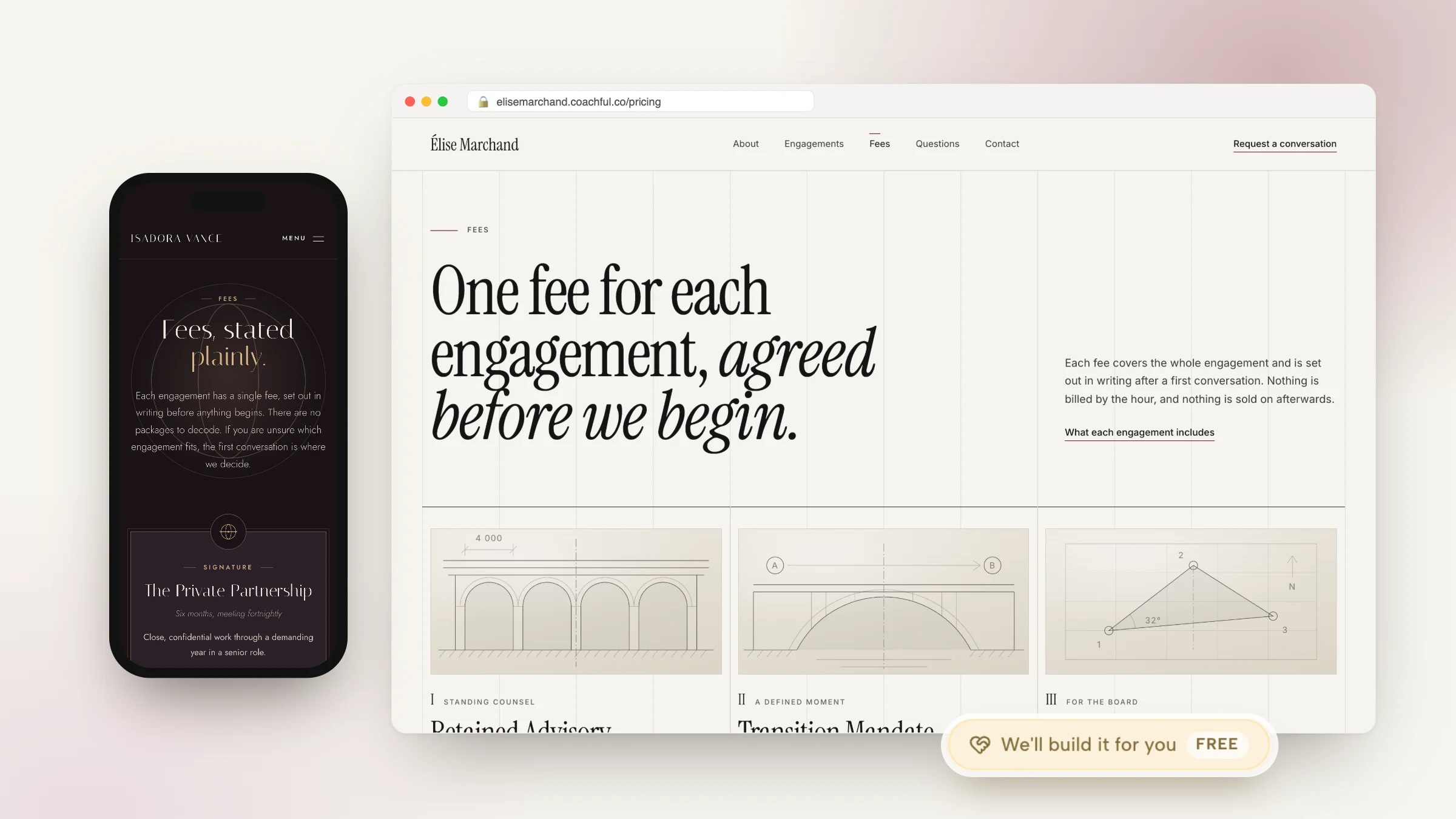
Senior buyers read your Engagements page the way they read a proposal. Coachful's team builds it for free on every plan, along with the rest of your website, an inquiry or application form and the offer pages behind it, all inside your own account. Coachful itself is a paid subscription, and you can start with a free trial.

In Coachful, open Create and choose We'll build it for you · FREE, or click Fill in a form on the "Want us to build it for you?" card on the Website page. Say which pages you want (for example, a homepage, an Engagements page with three engagement types and a "Request a conversation" form), what visitors should do next, and paste up to 8 links to sites you like. Attach up to 10 files: a bio, a past proposal, your logo or a headshot.
The team replies by email with next steps, usually within about 24 hours, though that isn't a guaranteed deadline. A recent build for a leadership coach whose Squarespace renewal was days away produced one clean, mobile-friendly homepage with a repeated "talk with me" button, connected visually to the coach's sister company. Nothing is invented: no fake client logos, testimonials or prices. The team doesn't write your proposals, run your outreach or design logos. See everything the free build covers.
Frequently asked questions
What are typical executive coaching rates per hour?
Most executive coaches charge $200 to $500 an hour in 2026, according to the ICF Global Coaching Study 2025 and PayScale as compiled in Coachful's 2026 Coaching Business Report. Practitioner estimates put entry-level executive coaches at $150 to $250 and the most senior at $500 to $1,500.
How much should I charge for a six-month executive coaching engagement?
A six-month contract of twelve sessions with an assessment, action plans and messaging typically costs $8,000 to $20,000, according to the 2026 report. Price yours from the full scope, including stakeholder meetings and assessment debriefs, not just the hours in the room.
What do executive coaches charge for a retainer?
Annual retainers with monthly calls, on-call access, priority response and quarterly reviews typically cost $20,000 to $80,000, according to the 2026 report. Build an annual increase into the agreement and schedule quarterly reviews so the value stays visible.
Should executive coaches charge by the hour or by the engagement?
By the engagement, almost always. Companies approve a defined scope with a fixed fee more easily than an hourly rate with an open number of sessions, and an engagement fee pays for the stakeholder work and preparation that an hourly rate tends to leave out.
Do I need a credential to charge executive coaching rates?
No law requires one, but corporate buyers often do. Across coaching, 73 percent of coaches say clients and organizations expect certification (ICF Global Coaching Study 2025), and the ICF PCC is the level many corporate buyers treat as the working standard.
How much do executive coaches make a year?
The 2026 report puts executive coaches at $96,000 to $98,000 a year, from ICF 2025, PayScale and Salary.com. Self-employed coaches with premium positioning and business clients can sit in the report's top 10 percent band of $160,000 to $500,000.
Can Coachful build my executive coaching website and inquiry form?
Yes, for free on every plan. Fill in the website form from Create or the Website page with the pages you want, links to sites you like and your bio or past proposal, and the team replies with next steps, usually within about 24 hours. Coachful is a paid subscription; the build costs nothing extra.
How do executive coaching rates compare with business coaching rates?
Executive coaching runs $200 to $500 an hour against $150 to $400 for business coaching, and engagements are larger because an employer usually pays. See what business coaches charge for that side of the market.












