
How Much Do Business Coaches Charge? 2026 Fees and Retainers
How much do business coaches charge? Most business coaches charge $150 to $400 an hour in 2026, and most of their income comes from packages and retainers rather than single hours: a 90-day engagement typically costs $3,000 to $6,000, and a monthly retainer $1,500 to $4,000 a month. Those figures come from Coachful's 2026 Coaching Business Report, which draws on the ICF Global Coaching Study 2025, PayScale and a sample of published rates Coachful collected from 60 business coaches.
Business coaching sits near the top of coaching prices for a simple reason: the client is a business, and the fee can be argued against its revenue. Below you'll find the rates by experience, the package and retainer shapes business coaches sell, the extra offers they add, and a worked method for setting your own fee. If you'd rather not build the sales page and checkout yourself, Coachful's team builds them for free on every plan.
Business coach rates at a glance
| Format | Typical price | Source in the 2026 report |
|---|---|---|
| Hourly rate | $150 to $400 | ICF Global Coaching Study 2025, PayScale |
| Published session rates (60 coaches) | $75 to $1,000; most $150 to $400 | Coachful's verified sample of business coaches |
| Strategy kickstart (4 sessions) | $1,200 to $2,400 | Practitioner reports and published rates |
| 90-day accelerator (8 to 10 sessions) | $3,000 to $6,000 | Practitioner reports and published rates |
| 6-month partnership (12 to 16 sessions) | $6,000 to $15,000 | Practitioner reports and published rates |
| Monthly retainer | $1,500 to $4,000 a month | Practitioner reports and published rates |
| Annual income, business coaches | $80,000 to $110,000 | ICF 2025, PayScale, ZipRecruiter |
All figures compiled in Coachful's 2026 Coaching Business Report for Q2 2026. US dollars, before tax and costs.
What business coaches charge per hour
The working band is $150 to $400 an hour. Where a coach sits in it depends mostly on experience and on the size of the businesses they work with:
| Stage | Typical hourly rate | What it usually looks like |
|---|---|---|
| Newer business coach | $100 to $200 | Coaching solo owners and early-stage businesses, often from a first career in sales, marketing or running a company |
| Experienced business coach | $200 to $400 | A defined niche (agencies, clinics, trades), a named method, referrals from past clients |
| Top of the field | $400 to $1,000 or more | Established firms or fast-growing companies, a visible track record, waiting lists |
Stage bands from the ICF Global Coaching Study 2025 and practitioner estimates, compiled in Coachful's 2026 Coaching Business Report. The stage bands are estimates, not study findings.
Published rates show how wide the spread really is. When Coachful collected the session rates that 60 business coaches list publicly, they ran from $75 to $1,000, with most between $150 and $400. A $75 coach and a $1,000 coach can both be called "business coach", which is exactly why the label on its own sets no price.
For context, the average across all coaching in 2025 was $234 an hour, up from $214 in 2023, according to the ICF Global Coaching Study 2025 and PayScale. Business coaching's band sits around and above that average, alongside leadership coaching ($150 to $400) and below executive coaching ($200 to $500). For the neighbouring niches, see executive coaching rates, what career coaches charge and what life coaches charge.
Business coaching packages and retainers
Very few business owners buy an hour. They buy a period of focused work on a problem: a launch, a stalled revenue line, a first management hire. These are the four shapes the report observes:
| Package | Sessions and length | What's included | Typical price | Per session |
|---|---|---|---|---|
| Strategy kickstart | 4 sessions of 60 minutes over 4 to 6 weeks | Sessions and action plans | $1,200 to $2,400 | $300 to $600 |
| 90-day accelerator | 8 to 10 sessions of 60 minutes over 3 months | Sessions, chat and frameworks | $3,000 to $6,000 | About $300 to $750 |
| 6-month partnership | 12 to 16 sessions of 90 minutes over 6 months | Sessions, chat and reviews | $6,000 to $15,000 | About $375 to $1,250 |
| Monthly retainer | 2 to 4 sessions of 60 minutes a month, ongoing | Sessions and on-call access | $1,500 to $4,000 a month | About $375 to $2,000 |
Package shapes and price ranges from Coachful's 2026 Coaching Business Report (practitioner reports and the verified business coach sample), Q2 2026. The per-session column is our arithmetic: price divided by sessions, and it ignores the time spent on chat and on-call support.
The per-session column is the interesting one. Packaged work pays $300 or more per session even at the bottom of each range, compared with $150 to $400 for an hour sold on its own. Practitioner reports put that premium at 40 to 60 percent per hour across coaching niches. It's an estimate, but the reason is easy to see: the package includes support between sessions, a clear end date and an outcome the owner can weigh against the cost of staying stuck.

Retainer, program or tiers: how business coaches structure fees
Three structures cover almost every business coaching practice. Most coaches end up using two of them.
| Structure | How it works | Good for | Watch out for |
|---|---|---|---|
| Fixed-length program | 90 days or six months, a set number of sessions, paid upfront or in instalments | A defined problem with a finish line | Clients who finish and leave; plan the next step before the last session |
| Monthly retainer | A set number of sessions a month plus on-call access, with a minimum term | Owners who want ongoing counsel after a program | Every month is a decision to stay or cancel, so the value has to show monthly |
| Three tiers | Entry, core and premium versions of the same work | Letting different budgets buy the same method | Too many options; make the middle tier the obvious choice |
The report describes a three-tier structure used by most coaches earning above $100,000 a year, based on practitioner reports and the ICF Global Coaching Study 2025:
- Entry: 3 months, 6 calls, email support only, $1,500 to $3,000.
- Core: 3 to 6 months, 8 to 12 calls with messaging, $3,000 to $6,000 or more.
- Premium: 6 months of weekly calls with priority access between sessions, $7,500 to $15,000 or more.
Our guide to structuring three coaching packages covers how to make the middle tier the natural pick, and when to start the renewal conversation covers the move from program to retainer.

Group programs, VIP days and other offers business coaches add
Many business coaches add one lower-priced and one higher-priced offer around their core work. The report's ranges for those add-ons, across coaching niches, from practitioner reports:
| Offer | Typical price | Notes |
|---|---|---|
| Group coaching program | $500 to $3,000 per person | 8 to 20 participants per cohort |
| VIP intensive day | $1,500 to $15,000 | A single day of deep work |
| Online course | $297 to $2,000 | Self-paced, low-touch |
| Membership or community | $47 to $197 a month | Recurring revenue |
| Corporate or B2B retainer | $3,000 to $10,000 a month | Organization-level contracts |
A group program is often the best second offer for a business coach. Owners at a similar stage learn from each other, and the per-person price opens the door to smaller businesses that can't yet afford one-to-one work. A VIP day suits owners who want a plan in one go; see these VIP day formats for how to run one.
Pricing against the client's revenue
The report sums up business coaching as "priced against the client's own revenue, which gives the fee an obvious return to argue from." That's the conversation to have, carefully.
- Translate the fee into the client's numbers. A $4,500 90-day engagement is about 1 percent of a business turning over $450,000 a year. For that owner, the question is whether the work is likely to be worth more than 1 percent, not whether $4,500 is a lot of money.
- Name the outcome you'll work on, not a promised result. "We'll rebuild the sales pipeline and the weekly numbers review" is a scope. "You'll double revenue" is a promise you can't keep.
- Use the client's own goal as the anchor. If the owner wants a first operations hire in place by spring, the price is measured against what that hire unlocks for them.
- Don't quote an ROI multiple you can't source. A confident multiple on a slide invites the obvious question, "according to whom?", and you won't have an answer you can stand behind.
The report rates business coaching as high on income potential and high on saturation, with a medium barrier to entry: "crowded, but the buyer has a budget." In a crowded market, a narrow niche and a clear method justify a price better than any ROI slide.

How to set your business coaching rate
Here's a capacity-first method, with figures as illustrations inside the published ranges rather than market data.
- Decide how many clients you can serve well at once. Say eight. More than that and the between-session support starts to slip.
- Decide your income target. Say $150,000 a year before costs and tax. That's the report's "75th to 90th percentile" band for coaches with a strong niche and package-based work ($95,000 to $160,000, from the ICF Global Coaching Study 2025, PayScale and practitioner estimates).
- Divide. $150,000 across eight ongoing clients is $18,750 per client per year, or about $1,560 a month each. That sits at the bottom of the $1,500 to $4,000 monthly retainer range.
- Check the hours. Eight clients on two 60-minute sessions a month is 16 coaching hours, plus prep and on-call support. That leaves room for a group program or a waiting list.
- Allow for gaps. Not every slot stays full every month. Build in a margin, or keep a fixed-length program running so new clients arrive as retainers end.
Then cost out the business itself: software, insurance, training and payment processing. Our line-by-line startup budget lists them. Our explainer on what business coaching is covers how engagements run from first call to final review, and if you are still setting up, how to become a business coach covers the steps before pricing.
Should business coaches publish their prices?
Many do, at least as a starting point: "90-day engagements from $3,000" filters out owners who aren't ready and saves a sales call. Coaches who tailor every engagement often publish a range or a rate card instead, and share exact numbers in a proposal after a diagnostic call. Both work. What doesn't work is no price signal at all, because a busy owner who can't guess the cost often won't ask. This piece weighs both approaches, and these proposal examples show how to present the number once you've talked.
Selling business coaching packages in Coachful
In Coachful, each package or retainer is an offer with its own checkout: a one-time price, a payment plan or a recurring subscription billed automatically, with an invoice for every payment. A coaching agreement goes out for e-signature before the first session, and every payment is recorded on the client who made it.
- Retainers as monthly subscriptions, with sessions and messaging included.
- Programs as offers attached to a multi-week program with goals, tasks and check-ins, so the work between sessions is visible.
- Group cohorts created automatically when clients enroll, with a feed, group chat and group calls.
- Invoices for businesses that pay by invoice, raised manually from your product catalogue.
- The Business Growth power-up for scorecards, deals and weekly commitments for the businesses you coach.
- Payments to your own Stripe or Razorpay account with a 0% Coachful platform fee.


The Analytics view shows revenue collected, paying clients and average revenue per paying client. Once instalments, discounts and pauses are counted, that average is a truer measure of your price than the number on your sales page. More on payments in Coachful and the Coachful page for business coaches.
Have your sales page and checkout built for free
A price needs a page that explains it. Coachful's team builds offer and sales pages, websites, funnels and email sequences for free on every plan, inside your own account. Coachful itself is a paid subscription, and you can start with a free trial.

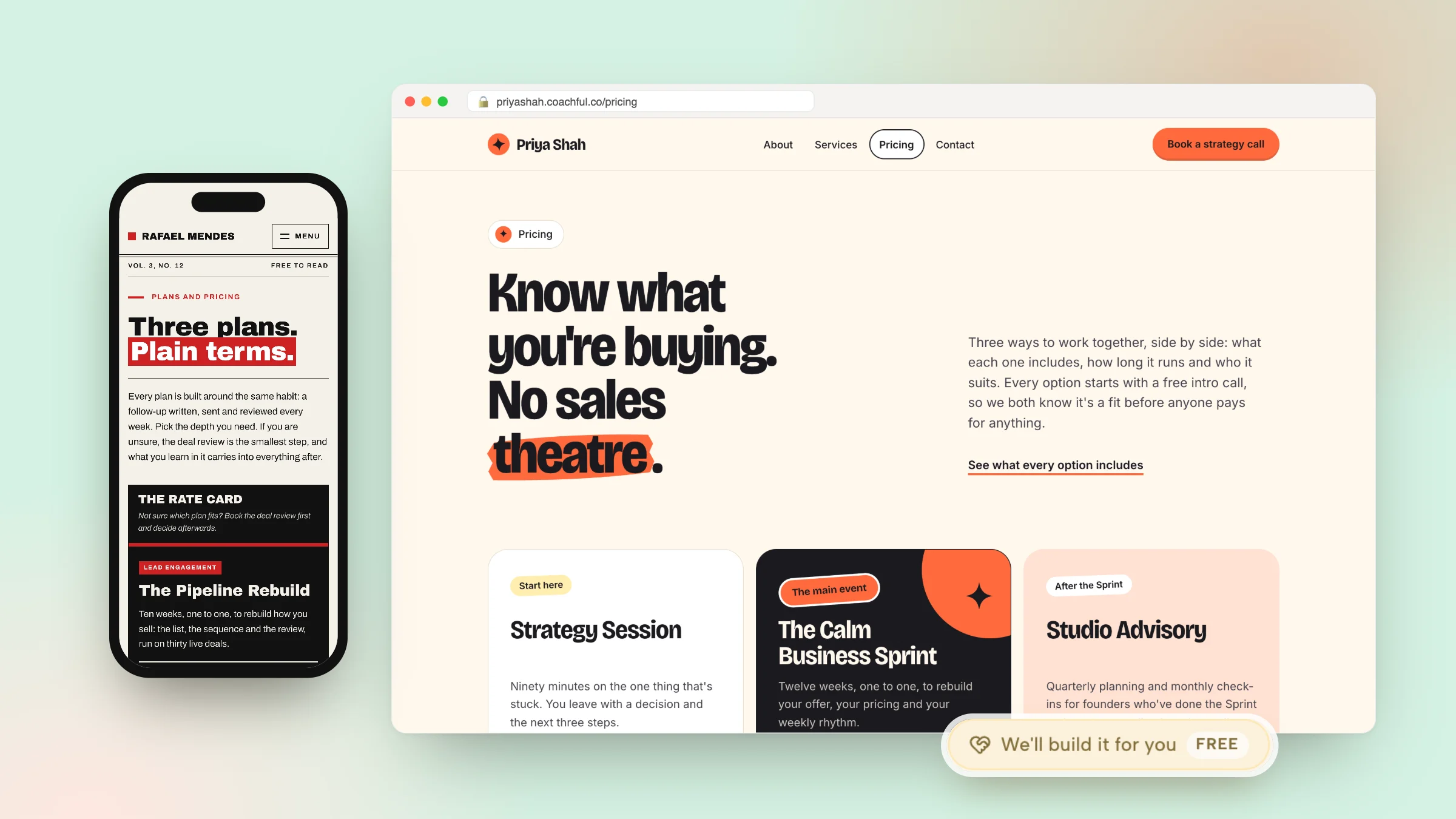
Click Fill in a form on the "Want us to build it for you?" card on Website or Funnels, or choose We'll build it for you · FREE under Create and pick "Offer or sales page". Describe the offer and its price, who it's for and where your traffic comes from, and attach up to 10 files and 8 links, such as an old sales page, a free guide PDF or your brand colors. The team replies by email with next steps, usually within about 24 hours.
Two recent examples. A business mentor for beauty professionals who sells on Instagram got a sales page and checkout for a 12-week mentorship, a free start-up guide funnel that now leads into the sales page, and rewritten follow-up emails, with the design taken from her own guide. A real-estate and money coach got a year-long cohort program with an application form, an eight-page website on their own domain and a free nine-day bootcamp course with its own signup funnel.
Nothing is invented: no fake testimonials, revenue claims or prices. The team doesn't run ads or manage your marketing. See everything the free build covers.
Frequently asked questions
How much does a business coach cost per hour?
Most business coaches charge $150 to $400 an hour in 2026, based on the ICF Global Coaching Study 2025 and PayScale as compiled in Coachful's 2026 Coaching Business Report. In a sample of 60 business coaches' published rates, sessions ranged from $75 to $1,000, with most between $150 and $400.
How much does a business coach cost per month?
A monthly business coaching retainer with two to four sessions and on-call access typically costs $1,500 to $4,000 a month, according to the 2026 report. Group programs cost less per person: $500 to $3,000 for a cohort program.
How much is a 90-day business coaching package?
A 90-day accelerator of eight to ten 60-minute sessions with chat support and frameworks typically costs $3,000 to $6,000. A shorter four-session strategy kickstart costs $1,200 to $2,400, and a six-month partnership $6,000 to $15,000.
Why are some business coaches so expensive?
Business coaching is priced against the client's revenue, so coaches who work with larger or faster-growing businesses charge more. Coaches at the top of the field, at $400 to $1,000 an hour or more by practitioner estimates, usually have a narrow niche, a visible track record and more demand than capacity.
Is business coaching worth the money for a small business?
It can be if there's a specific problem to work on and the owner will do the work between sessions. Compare the fee with the business's annual revenue and the cost of the problem staying unsolved, and be wary of any coach who guarantees a revenue result.
How much should a new business coach charge?
Practitioner estimates put newer business coaches at $100 to $200 an hour. Most do better selling a four-session kickstart or a 90-day program than single hours, and pricing from capacity: decide how many clients you can serve well, then divide your income target by that number.
Can Coachful build my business coaching sales page?
Yes, for free on every plan. The free build covers offer and sales pages, checkouts, funnels, websites and email sequences, built inside your account. Fill in the form from Create, Website or Funnels, and the team replies with next steps, usually within about 24 hours.
How much do business coaches make a year?
The 2026 report puts business coaches at $80,000 to $110,000 a year, from the ICF Global Coaching Study 2025, PayScale and ZipRecruiter. Coaches with a strong niche and package-based work often sit in the $95,000 to $160,000 band the report gives for the 75th to 90th percentile across coaching.












