
How to Become a Business Coach in 2026, Step by Step
To become a business coach, pick the kind of business you understand best, learn to coach rather than consult, build a simple method you can explain in a minute, prove it with a few pilot clients, and then sell a fixed-length engagement to owners who have the problem you solve. No license is required. Business owners judge you on whether you understand their kind of business and whether your past clients got somewhere, and a coaching credential helps you learn the craft and win trust on top of that.
Below is how to become a business coach step by step: what the job is and how it differs from consulting, whether you need to have run a business yourself, training and certification, choosing a niche, building a method, getting proof before you have clients, pricing, and setting up a practice. When you get to the setup, Coachful's team will build your website, sales page and lead funnel for free on every plan.
What a business coach does
A business coach works with an owner or leader over a set period on what the business needs next and on the owner's own follow-through: a plan for the quarter, the numbers to watch each week, the hire they keep putting off, the offer that isn't selling, the sales calls they avoid. The coach asks hard questions, brings structure and holds the owner to what they committed to. The owner keeps every decision.
| Role | What they do | Who owns the answer |
|---|---|---|
| Business coach | Helps the owner decide, plan and follow through, using questions, frameworks and accountability | The owner |
| Consultant | Diagnoses the problem and recommends or delivers the solution | The consultant |
| Mentor | Shares experience and advice from having done it | Shared, informally |
| Fractional executive | Does part of the job, such as part-time operations or finance leadership | The fractional executive, for their area |
Many business coaches mix coaching with some advice, which is fine as long as each client knows which hat you're wearing. Our explainer on what business coaching is covers how engagements run from the first call to the final review.
Do you need to have run a business?
Not strictly, but it helps a lot, and the reason is how owners buy. Coachful's 2026 Coaching Business Report matches backgrounds in sales, marketing or entrepreneurship to business coaching, and describes the niche as "crowded, but the buyer has a budget" (ICF Global Coaching Study 2025 and practitioner reports, as compiled in the report). In a crowded field, owners pick the coach who seems to understand their world.
If you haven't run a business, you can still bring credibility another way:
- Functional depth. Years running sales, operations, finance or marketing for companies like your clients'.
- Sector knowledge. You know clinics, agencies, trades or restaurants from the inside.
- A narrow problem. "Hiring the first manager" or "pricing a service business" is easier to be credible on than "growing your business".
What doesn't work is generic motivation dressed up as business coaching. Owners can tell within a call.

Step 1: Choose the businesses you'll coach
A good business coaching niche combines a type of business, a stage and a problem. The more of the three you can name, the easier you are to refer.
| Business type | Stage | Typical problem you'd coach |
|---|---|---|
| Solo creators and consultants | First year to steady income | Offers, pricing and a working week that doesn't depend on heroics |
| Agencies | 5 to 20 people | The founder is still the bottleneck on sales and delivery |
| Clinics and practices | Owner plus a small team | Hiring, scheduling and a first manager |
| Trades and home services | Owner-operated | Quoting, cash flow and stepping off the tools |
| Venture-backed startups | Seed to Series B | Operating cadence, owners and metrics as the team grows |
| B2B service firms | Founder-led sales | A pipeline that doesn't go quiet when the founder is busy |
Pick the row closest to your own experience, then test it: ask ten owners in that group what solving the problem would be worth, and offer two or three of them a pilot. Our guide to validating a coaching niche with a paid pilot walks through the conversation, and our list of coaching niches has more ideas.

Step 2: Learn to coach, not just advise
This is the hardest step for experienced operators. You're used to knowing the answer, and the instinct is to tell. Coaching asks the owner to find the answer, because a decision they own is one they'll carry out. Training teaches you to listen, ask open questions, hold silence and know when a bit of advice genuinely helps.
Certification isn't legally required. If you want one, ICF-accredited programs are the most widely recognized route, and the ICF ACC asks for 60 hours of coach education, 100 hours of coaching with at least 8 clients (75 of them paid), 10 hours of mentor coaching and a performance evaluation, as the ICF publishes them. The higher PCC and MCC credentials need more hours. Our comparison of ICF ACC, PCC and MCC lays them side by side.
Does a credential pay off? The ICF Global Coaching Study 2025, as compiled in the report, puts ACC holders' average income at $63,000 a year, a published premium of 21 percent over uncredentialed coaches. It matters most if you plan to sell to larger companies, where credentials are often a buying requirement. For owners of small businesses, results and referrals usually count for more.
Step 3: Build a method you can explain in a minute
Business owners buy a process they can picture. Before you sell anything, write down how a typical engagement works in three to five steps. For example:
- Diagnose: a 90-minute session on the numbers, the team and the owner's week.
- Decide: three priorities for the quarter, written on one page.
- Build the cadence: a weekly 20-minute numbers review the owner runs without you.
- Coach the hard parts: fortnightly sessions on the decisions and conversations that stall progress.
- Review: a quarter-end review against the one-page plan, and a decision about what's next.
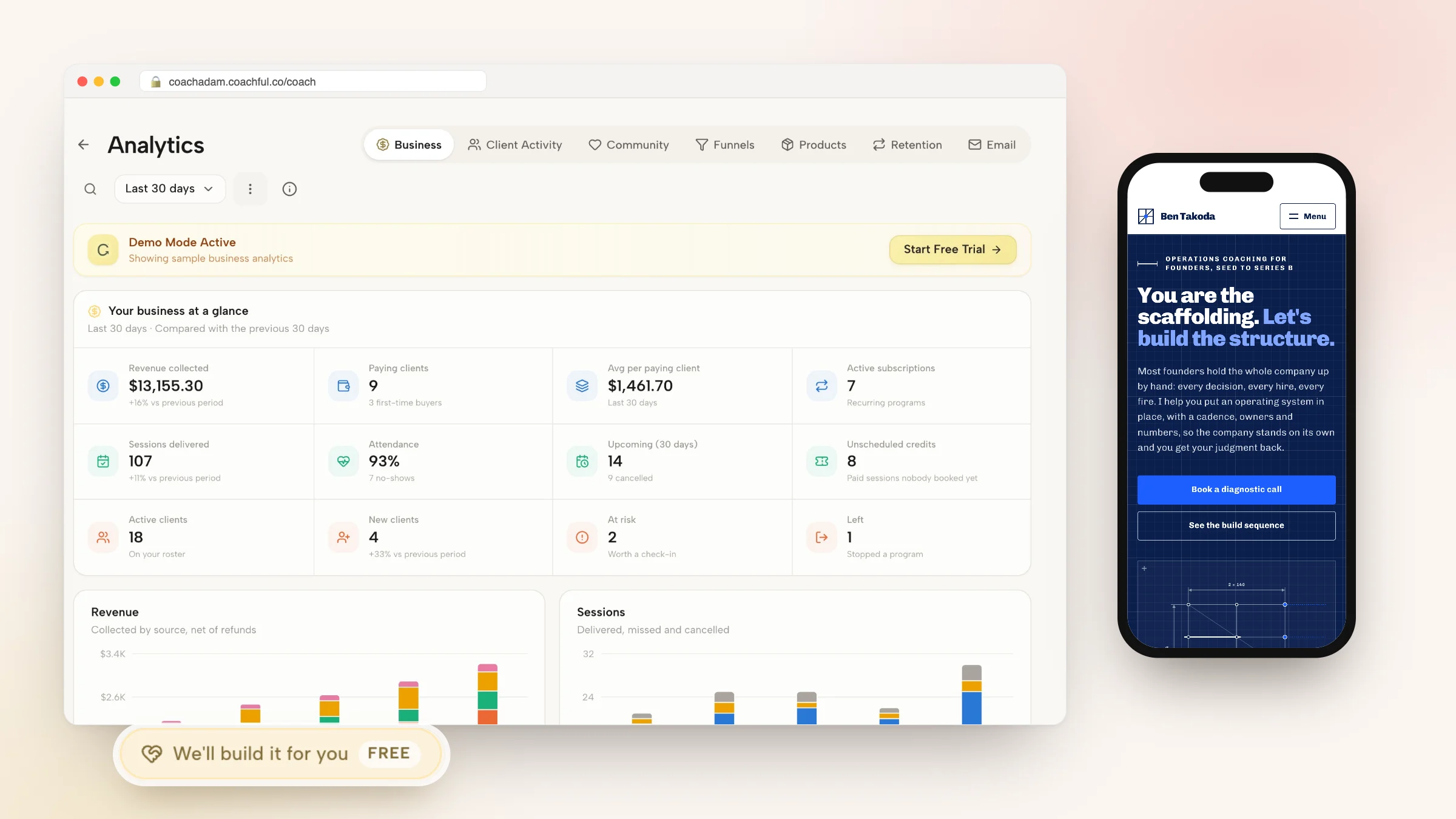
Give it a plain name if it has one, show it as a drawing on your website, and use it in every sales conversation. Coachful's Scaffold template, pictured above, shows a founder operating system as a blueprint with cadence, owners and roles, runway and metrics; Studio's tiles do the same in a lighter way ("Every call ends with a written plan").

Step 4: Get proof before you have clients
New business coaches face a chicken-and-egg problem: owners want results from people like them, and you don't have any yet. Solve it deliberately:
- Run two or three pilots at a reduced fee in exchange for a written case study and permission to use it.
- Agree the measures up front: the owner's hours on the tools, monthly revenue, the number of proposals sent, whatever the engagement is about.
- Write short case stories: the situation, what you worked on, what changed and what the owner said, in their words.
- Never invent or round up a result, and never promise a revenue outcome on your website. Describe the work and let clients describe the change.
Our guide to choosing a growth strategy your results can support covers how to use early evidence honestly.
Step 5: Package and price your coaching
Sell engagements, not hours. Coachful's 2026 report puts business coaching at $150 to $400 an hour (ICF 2025 and PayScale), with newer business coaches at $100 to $200 by practitioner estimates. The engagement shapes it observes include a four-session strategy kickstart at $1,200 to $2,400, a 90-day accelerator of 8 to 10 sessions at $3,000 to $6,000 and monthly retainers at $1,500 to $4,000 a month.
A sensible starting lineup for a new business coach:
- A paid diagnostic or a short kickstart as the entry point.
- A 90-day engagement as the core offer, with a clear scope and an end date.
- A monthly retainer for owners who want to keep going after the 90 days.
- A group program later, for owners at the same stage who can't yet afford one-to-one work.
Our guide to what business coaches charge has the full ranges and a capacity-based way to set your own fee, and how to create a business coaching program covers the structure of an engagement.
Step 6: Set up your business coaching practice
You need a website that names who you coach and how, a way to book a diagnostic, a checkout for each engagement, an agreement, invoices for businesses, and somewhere to keep each client's plan and commitments. In Coachful, all of that is included in your membership:
- A website from designed templates, including several drawn for business coaches, on your own domain, with booking and checkout on the page.
- Offers for one-time engagements, payment plans and monthly retainers, paid to your own Stripe or Razorpay account with a 0% Coachful platform fee, and manual invoices for businesses that pay by invoice.
- Agreements sent for e-signature before the first session.
- The Business Growth power-up for scorecards, deals and weekly commitments for the businesses you coach.
- Group cohorts created when owners enroll in a program, with a feed, group chat and group calls.
- Funnels and email sequences for a free resource that leads to a diagnostic call.

More on the Coachful page for business coaches, and on what owners look for in a site in our guide to a business coach website.
Get your website, sales page and funnel built for free
Coachful's team builds coaching websites, sales pages, funnels and email sequences for free on every plan, inside your own account. Coachful itself is a paid subscription, and you can start with a free trial.

Click Fill in a form on the "Want us to build it for you?" card on the Website or Funnels page, or choose We'll build it for you · FREE under Create. The funnel form asks what the funnel should do (book discovery calls, grow your email list, sell a program or offer, deliver a free resource, fill an event or webinar), who it's for and what they get, the journey people should follow and where your traffic comes from. Add up to 8 links and up to 10 files.
The team replies by email with next steps, usually within about 24 hours, though that's typical rather than guaranteed. Two recent builds for business-focused coaches: a business mentor for beauty professionals who sells on Instagram got a sales page and checkout for a 12-week mentorship, a free start-up guide funnel that now leads into the sales page and rewritten follow-up emails, with the design taken from her own guide PDF. A real-estate and money coach got a year-long cohort program with an application form, an eight-page website on their own domain and a free nine-day bootcamp course with its own signup funnel and emails.
Nothing is invented: no revenue claims, testimonials or prices you haven't given. The team doesn't run ads, design logos or manage your marketing month to month. See everything the free build covers.

Step 7: Win your first business coaching clients
- Start with owners you already know. Former colleagues, clients and suppliers who run businesses in your niche.
- Partner with the people owners already trust. Accountants, bookkeepers, business bankers and local business groups meet owners with exactly the problems you coach.
- Run a short workshop. Forty-five minutes for a chamber of commerce or industry group on one problem, ending with an offer of a diagnostic call.
- Offer a free tool. A one-page scorecard or a weekly numbers template, delivered by email, with a short follow-up sequence.
- Write where owners read. Practical posts on LinkedIn or in industry newsletters about the problem you solve.
- Ask every pilot client for a referral once they've seen a result.
For a booking path you can set up once, see our discovery call funnel guide.
Mistakes new business coaches make
- Consulting instead of coaching. Handing over answers creates dependence and leaves the owner where they were when you leave.
- A niche of "small businesses". It's too broad to refer and too broad to build a method for.
- Selling single hours. Owners renew engagements with clear outcomes; they cancel hourly sessions when they get busy.
- Promising revenue. You don't control it, and the promise invites disputes.
- No written agreement. Scope, confidentiality, cancellations and what happens at the end belong in writing before session one. Start from our coaching agreement template.
Frequently asked questions
Do you need a certification to be a business coach?
No. Business coaching isn't regulated, so no certification is legally required. A credential such as the ICF ACC helps you learn to coach properly and matters more when you sell to larger companies; small-business owners usually care more about your experience and results.
Can you be a business coach without owning a business?
Yes, if you bring credibility another way: deep experience in a function such as sales, operations or finance, inside knowledge of a sector, or a narrow problem you know well. Generic business coaching without that experience is a hard sell in a crowded market.
How long does it take to become a business coach?
You can complete a 60-hour coach training program in a few months and start pilot clients during it. Most new business coaches need several months more to collect case studies, set up their practice and land their first full-price engagements.
How much do business coaches make?
Coachful's 2026 Coaching Business Report puts business coaches at $80,000 to $110,000 a year, from the ICF Global Coaching Study 2025, PayScale and ZipRecruiter, and $150 to $400 an hour. Income depends heavily on niche, engagement price and how many clients you can serve at once.
What qualifications does a business coach need?
There are no formal requirements. The useful ones are business or functional experience in your niche, coach training (ideally ICF-accredited), a clear method and a few documented client results. A credential becomes more important if corporate clients are your target.
What is the difference between a business coach and a business consultant?
A consultant diagnoses the problem and recommends or delivers the solution. A business coach helps the owner find and carry out the solution themselves, with structure and accountability. Many coaches do some of both and make clear which they're doing.
How do business coaches find clients?
Mostly through their network, referrals from accountants and other advisers, workshops for business groups, a free tool such as a scorecard, and useful writing on LinkedIn. Pilot clients who see results become the best source of referrals.
Will Coachful build my business coaching website and funnel for free?
Yes. Coachful's team builds websites, sales pages, funnels and email sequences for free on every plan, inside your account. Fill in the form from Create, Website or Funnels, and the team replies with next steps, usually within about 24 hours. Coachful is a paid subscription; the build costs nothing extra.












