
Guide: What is business coaching and how it unlocks your potential

Coachful

You've probably heard the term "business coaching" thrown around, maybe picturing a motivational speaker or a seasoned exec giving advice. But that's not quite it. You might be thinking, "Is this just another consultant telling me what to do? I've been down that road, and it didn't stick." That's a valid concern.
At its core, business coaching is a strategic partnership focused on unlocking a leader's full potential. It’s less about fixing yesterday's problems and all about building tomorrow's success. It’s a confidential, structured process where a coach helps you get unstuck, see your business—and yourself—more clearly, and take decisive action.
What Business Coaching Looks Like in the Real World
As a coach, you're constantly battling misconceptions. Your inner dialogue might sound like this: "How do I explain that I'm not here to provide a quick-fix answer? My real value is in helping them find their own." The secret is to frame it as a true collaboration. Business coaching isn’t about swooping in with a pre-packaged solution.
Instead, a great coach helps clients find their own best answers. You're a thinking partner—a co-pilot who offers a clear perspective on the instruments, the weather ahead, and the final destination. You don't grab the controls; you empower the leader to fly the plane with more confidence and skill.
For example, a client might say, "My team is disengaged."
- A consultant might say, "Here's a 5-step plan to boost engagement."
- A business coach would ask, "What does engagement look like to you? When was the last time you felt truly connected to your team? What was different then?"
This entire process is built on a foundation of asking powerful questions, listening intently, and creating a framework for accountability. It’s all designed to gently challenge old assumptions and bring a leader's blind spots into the light.
The Heart of the Coaching Partnership
So, what is business coaching, really? It’s a dedicated space for leaders to step back from the daily firefight, elevate their thinking, and sharpen their performance. The goal isn't just a temporary solution; it's about building lasting capability.
This shift in perspective—from seeing coaching as a perk to a strategic necessity—is why the global coaching industry is booming. More and more organizations realize it’s a core investment in their long-term success, a fact supported by growth trends in the coaching industry.
To make this crystal clear, let's break down what a coaching partnership actually involves.
Business Coaching at a Glance
This table simplifies the core principles of business coaching, showing how they translate into tangible actions and outcomes for the client.
| Core Principle | What It Means for the Client | Example Action |
|---|---|---|
| Client-Led Agenda | You're in the driver's seat. You set the goals and decide what we focus on in every conversation. | A client decides to use a session to strategize on improving team communication before a major product launch. |
| Future-Focused | We concentrate on creating the future you want, rather than getting bogged down by past mistakes. | Instead of dissecting a failed project, the conversation shifts to, "What powerful lesson can we take from this to ensure our next launch is a massive success?" |
| Accountability | The coach is your accountability partner, ensuring you follow through on the actions you commit to. | A coach follows up on a client’s commitment to delegate three specific tasks before their next meeting. |
Ultimately, these principles work together to create a powerful dynamic where leaders don't just solve problems—they grow beyond them.
The Difference Between Coaching Consulting and Mentoring
As a coach, one of the first hurdles you face is clarifying what you actually do. You've heard it a million times: “So, you’re like a consultant, right? You just tell me what I should be doing?” Inside, you might be thinking, "If I can't explain this clearly, they'll never understand the unique power of what I offer."
It’s up to you to draw a clear line in the sand. Helping potential clients understand this distinction is key to showing them the unique, and often more profound, value you bring to the table.
These roles are definitely not interchangeable. Each serves a distinct purpose, and knowing the difference helps you articulate your value proposition. I've always found a simple analogy works wonders here.
Imagine you need to catch a fish. A consultant sells you a fish. A mentor tells you how they used to fish. A business coach works with you to develop your own perfect fishing technique, one that you can use for the rest of your life.
This little story gets right to the heart of it. Consulting and mentoring often focus on providing outside expertise or past experiences. Coaching, on the other hand, is all about unlocking a person’s own internal resources to create lasting, self-driven success.
A Clear Comparison of Roles
Let's dig a bit deeper and break down the specific function, approach, and ultimate goal for each role. This framework is incredibly helpful for explaining why coaching creates sustainable change, not just a quick fix.
Coaching vs Consulting vs Mentoring A Clear Comparison
Understanding the key differences in approach, focus, and outcome between these three powerful professional development roles.
| Attribute | Business Coach | Consultant | Mentor |
|---|---|---|---|
| Primary Function | To facilitate the client's own thinking and unlock their potential. | To provide expertise and solve a specific business problem. | To share wisdom, experience, and provide guidance based on their own journey. |
| Approach | Asks powerful questions to help the client discover their own answers. | Diagnoses a problem and provides a specific solution or strategy. | Offers advice and shares personal stories and lessons learned. |
| Desired Outcome | Self-sufficiency and capability. The client learns how to solve future challenges on their own. | A solved problem. The client receives an answer or a deliverable to address an immediate need. | Personal and career growth. The mentee gains insight and learns from the mentor's past successes and failures. |
Think about it in a real-world scenario. A company might hire a consultant to build a new marketing plan from scratch. A senior leader might mentor a new CEO, sharing stories about how they navigated their first difficult board meeting.
So, where does the business coach fit in? The coach’s job isn’t to give the plan or the story. Instead, a coach helps that CEO develop the strategic thinking, communication skills, and leadership presence to confidently walk into any board meeting—now and in the future.
The difference is fundamental: you build the leader, not just solve the immediate problem.
Who Truly Benefits from Business Coaching?

As a coach, you're constantly asking yourself, "Who is my ideal client?" The answer has less to do with a job title and more to do with a mindset. You're looking for that spark: a genuine hunger for growth and the courage to be challenged.
The people who get the most out of coaching are usually standing at a crossroads. They’ve hit a certain level of success, but they have the self-awareness to know that what got them here won't get them there. They can feel the gap widening between where they are and where they want to be. They're ready to do the real work of evolving themselves.
The Overwhelmed Founder
Think about Alex. He’s a brilliant founder, and his company is taking off. But he's drowning, still trying to do everything—write code, run finances, and lead sales calls. His mantra has become, "If I want it done right, I have to do it myself."
Alex doesn't need another article on delegation. He needs a coach to guide him through the difficult identity shift from "doer" to "leader." A coach helps him explore the fear behind his need for control. The conversation isn't just about tasks; it's about trust. For example, a coach might ask, "What's the worst that could happen if you let your lead developer own this project entirely? Now, what's the best that could happen for them... and for you?" The goal isn't just a cleaner calendar; it's becoming the CEO his company desperately needs.
The New Executive with Imposter Syndrome
Or consider Maya, just promoted to VP. On paper, she’s a star. But inside, her mind is racing with self-doubt: "Everyone here is smarter than me. It's only a matter of time before they find out I'm a fraud."
Coaching for Maya isn’t about management skills she already has. It's about helping her dismantle the limiting beliefs chipping away at her confidence. A coach creates a safe space to voice these fears, then challenges them. A session might involve mapping out her actual accomplishments against her feelings of inadequacy, helping her reframe that internal story, own her wins, and step into an authentic leadership presence her new team can rally behind.
Business coaching thrives when a leader is ready to confront not just their business challenges, but the internal roadblocks that create them. The goal is to build capability, not just provide answers.
This kind of deep, personalized support is exactly what the market is asking for. Recent global studies show a major increase in professional coaches, with many now expanding their offerings to include training and facilitation to meet these complex client needs. You can discover more insights about the coaching industry's growth to see the full picture.
The Seasoned Manager in a Changing World
Finally, let's look at David, a manager with 20 years under his belt. His team is now a mix of five generations and remote employees. The old playbook isn't working, and he quietly admits to himself, "I feel disconnected from my team. I don't know how to inspire them anymore."
For David, coaching is about developing emotional intelligence and adaptive leadership. His coach would help him move from "telling" to "asking." For example, instead of giving directives, they'd role-play how to start a team meeting with a question like, "What's one thing that's slowing you down this week, and how can we remove that barrier together?" This shifts the dynamic, fostering the psychological safety his team needs to innovate and give honest feedback.
In every one of these examples, the client is coachable because they are open, self-aware, and ready for change. They don't see coaching as a punishment but as a powerful strategy for reaching their next level of mastery.
Inside the Mind of a Great Business Coach
Being a business coach is a constant internal juggling act. On any given day, you're wearing multiple hats—you're a strategist one moment, a trusted confidant the next. Your inner dialogue is always running: “Is this the moment to challenge their assumption, or do they need me to just listen? Am I pushing them too hard, or not hard enough? How do I hold them accountable without damaging the trust we’ve built?”
This constant internal calibration is where the real coaching happens. It's a skill that goes way beyond any certification or textbook model. Truly great coaching isn't about following a script. It's about intuition, recognizing patterns, and knowing exactly when to stay quiet versus when to ask the one question that changes everything.
The Art of the Game-Changing Question
The biggest difference between a good coach and a great one often boils down to the quality of their questions. A good coach might offer solutions from their own experience. A great coach asks questions that help the client find their own solutions. This might seem subtle, but its impact is massive.
Let's look at a practical example.
Example Scenario
A new executive is always working late, missing family dinners, and feels completely buried.
A good coach might say: “Sounds like you need better time management. Have you tried time-blocking your calendar?” This is helpful advice, but it’s prescriptive. It offers a tactic without digging into the root cause.
A great coach might ask: “If we could wave a magic wand and solve your biggest time-waster, what would you do with that reclaimed energy?” Or, “What belief is driving you to say 'yes' to things that you know are pulling you away from your real priorities?”
See the difference? The second approach sidesteps the tactical problem and connects straight to the client's motivation—the real “why” behind their need for change. It opens a door to a conversation about vision, values, and identity, which is far more powerful than any productivity hack.
The most impactful coaching happens when you help a client connect their daily actions to their deepest aspirations. The goal isn’t just to solve the immediate problem, but to unlock the thinking that created it in the first place.
Listening Beyond the Words
Another foundational skill is deep, active listening. As a coach, you're constantly listening for patterns. Does the client always use the language of obligation ("I have to," "I should") instead of choice ("I choose to," "I will")? Do they consistently downplay their own wins while magnifying their setbacks?
Your mind is like a detective's, piecing together clues. You might think, "Aha, that's the third time he's blamed external factors. What's the fear behind taking ownership here?" Picking up on these subtle cues is how you help clients see the invisible scripts running their lives. This intuitive work is the essence of what makes business coaching so powerful.
The Anatomy of a Powerful Coaching Engagement
So, a potential client is interested. They see the value, but now they have a practical question: “What will we actually do together?” At the same time, you’re asking yourself, “How do I create a smooth, professional experience that delivers real results and keeps clients coming back?”
A powerful coaching engagement isn't just a series of random chats. It’s a structured journey with clear, intentional phases. This structure doesn't kill the magic—it creates the container where breakthroughs can happen. It builds momentum and gives both you and your client a clear roadmap for success.
Phase 1: The Discovery and Foundation
Every great coaching relationship starts with discovery. This is far more than a sales call; it’s your first real coaching interaction. Your inner dialogue is focused: "What's the real problem here? What's the unspoken fear or untapped aspiration driving them to seek me out?"
From that deep listening, you move into setting concrete goals. Using a framework like GROW brings immediate clarity.
- Goal: What do you want to achieve? (e.g., "I need to boost my team's productivity by 15%.")
- Reality: What’s happening right now? (e.g., "Projects are always late, and morale feels low.")
- Options: What could you do to bridge that gap? (e.g., "We could get a new project management tool, provide better training, or finally clarify everyone's roles.")
- Will: What will you do? (e.g., "This week, I’m going to meet with each team lead to pinpoint their single biggest bottleneck.")
This initial phase sets the stage for everything that follows. It ensures you’re both working towards the same destination from day one.
Phase 2: The Rhythm of Progress
Once you have a clear destination, you establish a consistent rhythm of weekly or bi-weekly sessions—the engine of the process. Each session should build on the last, creating a powerful sense of forward motion.
This is where your core coaching skills shine. You're asking insightful questions, gently challenging limiting beliefs, and holding the client accountable. As a coach, you’re thinking, "Last week she committed to having that difficult conversation. I need to create a space for her to reflect on how that went, what she learned, and what the next step is."
A great coaching engagement feels like a story unfolding. Each session is a new chapter, building on previous insights and moving the client closer to becoming the hero of their own narrative.
To keep this process seamless, many coaches use a platform like Coful to systematize everything from scheduling and session notes to goal tracking. It takes the administrative drag off your plate so you can focus 100% of your energy on what you do best: coaching.
Phase 3: Review and Reinforce
Finally, the best engagements include dedicated progress reviews, often quarterly. Think of these as strategic check-ins where you zoom out. You’ll look back at the initial goals, celebrate the big wins, and adjust the plan.
This is your moment to solidify the ROI. You're not just asking, "How are things going?" You're asking, "When we started, you said success would look like X. Let's look at the data. Where are we now?" This review transforms the journey from a series of meetings into a measurable, impactful investment.
How to Measure the ROI of Business Coaching
As a coach, you've heard the big question from potential clients: "How do I justify this expense?" It's a reasonable question, and your ability to answer it well is the key to shifting the conversation from a cost to an investment. Your inner voice says, "I know my work has huge value, but I need to help them see it in their terms."
The trick isn’t to talk vaguely about "growth." It’s about tracking real, measurable results. The return on investment (ROI) from business coaching shows up in two distinct ways: hard and soft ROI.
Hard ROI: The Tangible Wins
Hard ROI is about the numbers you can plug into a spreadsheet. These are the direct, quantifiable results of your work together. Before you even start, you need to work with your client to establish a baseline for these key performance indicators (KPIs).
A great way to frame this is by asking: "If our partnership is wildly successful in six months, what specific numbers will have changed?" This question immediately focuses the engagement on concrete outcomes.
For example, a coaching engagement focused on sales leadership might track:
- Increased revenue: A 15% jump in quarterly sales.
- Higher team productivity: A 20% increase in qualified leads generated per salesperson.
- Lower employee turnover: A reduction in sales team attrition from 25% to 10%.
This is where a structured coaching process comes in. Following a clear journey from discovery to goal-setting and then into your regular sessions ensures every conversation is driving toward these tangible results.
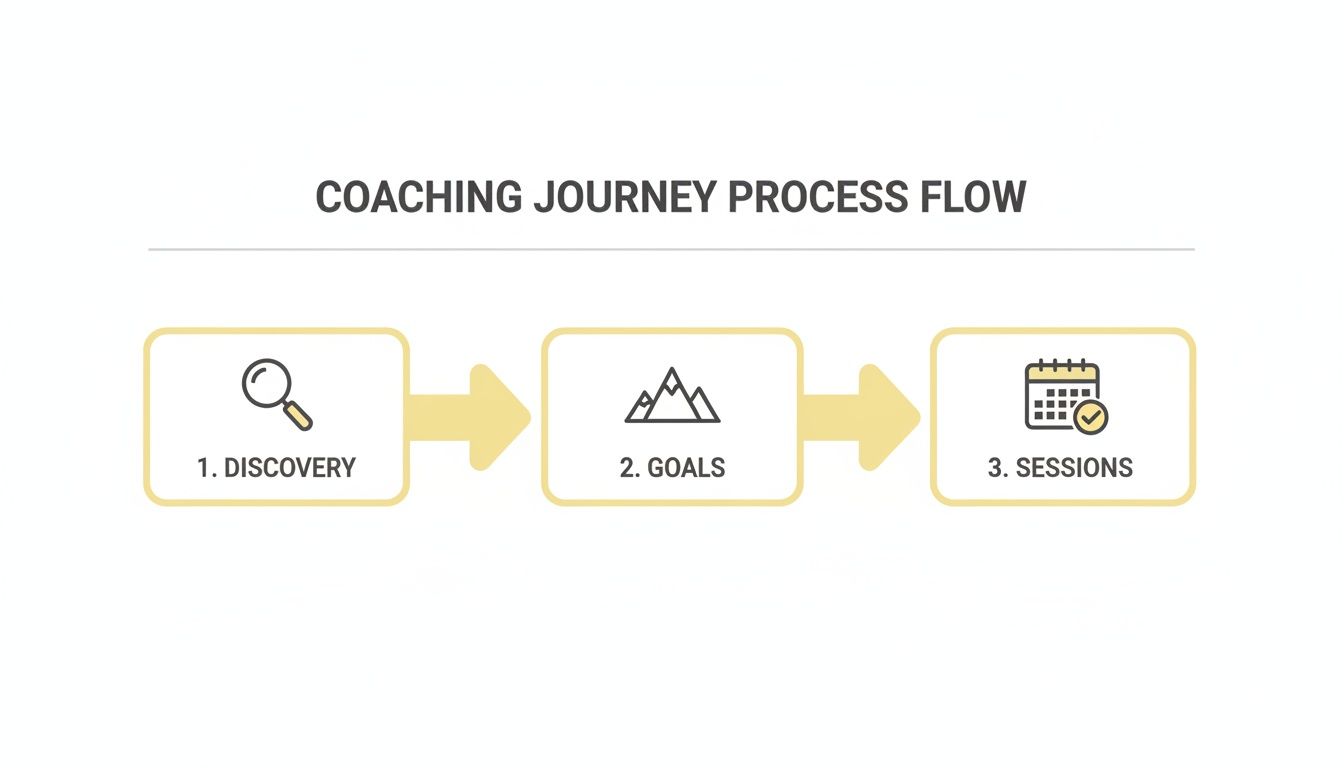
This process isn't just a roadmap; it’s a framework for accountability that keeps the coaching focused on achieving the specific, measurable goals you defined from day one.
Soft ROI: The Intangible Gains
Soft ROI is trickier to quantify, but it's often where the most significant changes happen. These are the powerful shifts in leadership skills, mindset, and company culture that lay the foundation for sustainable success.
While a jump in revenue is a fantastic outcome, the real magic happens when a leader develops the confidence and strategic clarity to generate that revenue year after year.
Think about the powerful ripple effects of gains like these:
- Improved leadership confidence: A leader who was hesitant can now make decisions 50% faster, saving countless hours.
- Better strategic thinking: An executive shifts from spending 90% of their time in day-to-day operations to 40%, freeing them up for high-level strategy.
- Stronger team morale: A 360-degree review shows a 30-point increase in the team's trust in their leader.
Tools like Co soulful are designed to help you track progress against both hard and soft goals. By creating clear, compelling reports, you can prove that your coaching isn't just another business expense—it's one of the best investments they'll ever make.
Your Business Coaching Questions Answered
Even with a clear picture of business coaching, you likely have some lingering practical questions. These are the things that pop into your head right before deciding to invest. Let's tackle them head-on.
How Much Does Business Coaching Typically Cost?
This is a tough one because the price range is huge. Group programs might be a few hundred dollars, while one-on-one executive coaching can run several thousand dollars a month. The fee really comes down to the coach's track record, the depth of the engagement, and the results they consistently deliver.
A better question to ask a potential coach is, "How will we measure the return on this investment?" A great coach isn't a cost; they're an investment that should pay for itself through tangible outcomes—better performance, more revenue, or a more productive team.
How Long Does a Typical Coaching Engagement Last?
Most coaching partnerships last somewhere between six and twelve months. This provides enough time to build trust, dig into core challenges, implement new habits, and see measurable progress.
Shorter engagements of three or four months can work well for very specific goals, like preparing for a major presentation. On the flip side, many leaders keep a coach on retainer for ongoing strategic counsel as they navigate new challenges.
A true professional will lay out a clear agreement from day one, defining the goals and how you'll both track progress. This is a partnership, and the results hinge on the commitment from both sides.
How Do I Find the Right Business Coach for Me?
Finding the right coach is a mix of three key ingredients: their credentials, relevant experience, and that all-important personal chemistry.
- Credentials: Look for certifications from respected organizations like the International Coaching Federation (ICF). This shows they're committed to high professional standards.
- Experience: You want someone who gets your world. Have they worked in your industry or coached leaders facing similar hurdles?
- Chemistry: This is the deal-breaker. Always schedule "chemistry calls" with your top candidates. Pay attention to the quality of their questions. Do they make you think? Do you feel heard? More importantly, trust your gut—a strong sense of connection and trust is non-negotiable.
Ready to manage your coaching practice with a single, powerful platform? Co soulful brings together scheduling, goal tracking, and client management so you can focus on delivering impactful results. Streamline your coaching business today.