How to Create a Business Coaching Program Owners Renew
Ask a business owner what they want from coaching and you will hear one of two answers: more time or more money, often both, usually said with a tired laugh. A business coaching program earns its fee when it picks one of those, ties it to a number the owner already looks at, and changes that number in a set period. Programs built on "growth mindset" and a monthly chat are easy to sell once and hard to renew.
This guide covers how to build a business coaching program from the number outward: choosing the problem, the scorecard, a full sixteen-week sample for independent café and bakery owners, the meeting rhythm, the tools, pricing structures, online delivery and the mistakes to avoid. Coachful's team can also build the program for you, free on any Coachful plan, if you send your outline or notes through a short form.
Choose the business problem first
Business coaching covers a lot of ground. Pick the lane your program lives in, because each one has a different number, a different length and a different client.
| Program lane | Owner says | Number to track | Typical length |
|---|---|---|---|
| Owner time | "The business can't run without me." | Owner hours in the business per week | 3 to 6 months |
| Revenue | "We're busy but not profitable." | Gross margin or monthly profit | 3 to 6 months |
| Sales | "Leads come in and go nowhere." | Conversion rate from enquiry to sale | 8 to 12 weeks |
| Leadership | "My team waits for me to decide everything." | Decisions made without the owner, team turnover | 4 to 6 months |
| Launch | "I want to start, I don't know the order." | First paying customers | 6 to 8 weeks |
If you are still defining your own practice, our explainer on what business coaching is covers the main specialisms and how they are usually priced.
Build the program around one number and a scorecard
Choose the headline number with the owner in the first session and write down its starting value. Then add three or four leading indicators that move first. For an owner-time program, the headline number is hours worked in the business; leading indicators might be tasks documented, tasks delegated and days the owner left before close.
Turn those into a weekly scorecard the owner fills in every Friday. It takes five minutes and does two jobs: it keeps the owner honest, and it gives every session a starting point that is not "so, how's it going?"

Sample: a sixteen-week business coaching program for café and bakery owners
The program is "Out of the Kitchen", for owners of independent cafés and bakeries who work more than sixty hours a week and still close every night. The promise: "In sixteen weeks you work fewer hours in the shop, your key routines are written down, one person runs the morning without you, and you know your numbers each week."
| Weeks | Phase | Focus | Owner's assignment |
|---|---|---|---|
| 1 to 2 | Diagnose | Time audit and baseline numbers | Log every hour for two weeks, pull last quarter's sales and costs |
| 3 to 4 | Diagnose | Where the money and hours go | Rank tasks by "only I can do this" and "anyone trained could" |
| 5 to 6 | Systems | Write the opening routine | A one-page opening checklist, tested by a staff member |
| 7 to 8 | Systems | Ordering, prep and closing | Three more routines documented, with photos |
| 9 to 10 | Team | Choose and train a shift lead | A role description and a two-week handover plan |
| 11 to 12 | Team | Hand over the morning | Two mornings a week away from the shop, then three |
| 13 to 14 | Numbers | Weekly numbers routine | A Friday 20-minute numbers review, every week |
| 15 to 16 | Next quarter | Use the freed hours | A 90-day plan for one growth project, such as wholesale or catering |
Each phase ends with a short review against the scorecard. If hours in the shop have not dropped by week twelve, the next two weeks go back to the team phase before moving on.
The meeting rhythm
Business owners are busy and allergic to meetings that don't produce decisions. A rhythm that works for a sixteen-week program:
- A 90-minute kickoff to set the number, the scorecard and the first assignment.
- 60-minute 1:1 strategy sessions every two weeks, each ending with one written decision and one assignment.
- A monthly group hot-seat call if you run a cohort: each owner brings one problem, gets fifteen minutes of focused help from you and the group.
- The weekly scorecard in the off weeks, with a short written reply from you.
Put a "decision log" at the end of each session's notes. Owners forget what they agreed in week four; the log reminds them in week eight.

The tools inside a business coaching program
Business clients want templates they can use on Monday. Five that pay for themselves:
- Time audit sheet: half-hour blocks for two weeks, with a column for "could someone else do this?"
- Routine template: purpose, when, who, steps, photos, what good looks like.
- Delegation matrix: tasks sorted by skill needed and how often they happen.
- Weekly scorecard: the headline number and three leading indicators, filled in every Friday.
- 90-day plan: one project, three milestones, the first action and who owns it.
Ready-to-film program templates such as The Founder Operating System, Signature Offer Sprint and Sell With Integrity show how these tools can be sequenced week by week, and the Business Growth power-up adds specialist workspaces for business clients.
Pricing a business coaching program
Business owners think in return on investment. Price the program against the result in their terms (hours back, margin improved) rather than against your hours, then sanity-check it against your time.
- A fixed program fee for the sixteen weeks, often paid in four monthly instalments.
- A group cohort price with monthly hot seats, plus a premium seat that adds 1:1 sessions.
- A retainer after the program for owners who want a monthly strategy session and the scorecard review to continue.
If the owner's business pays, they may ask for an invoice to the company. Payments in Coachful go to your own Stripe account with a 0% Coachful platform fee, and invoices sit on the client's record. For ways to frame the value, read our guide on pricing consulting services, which applies closely to business coaching.
Delivering a business coaching program online
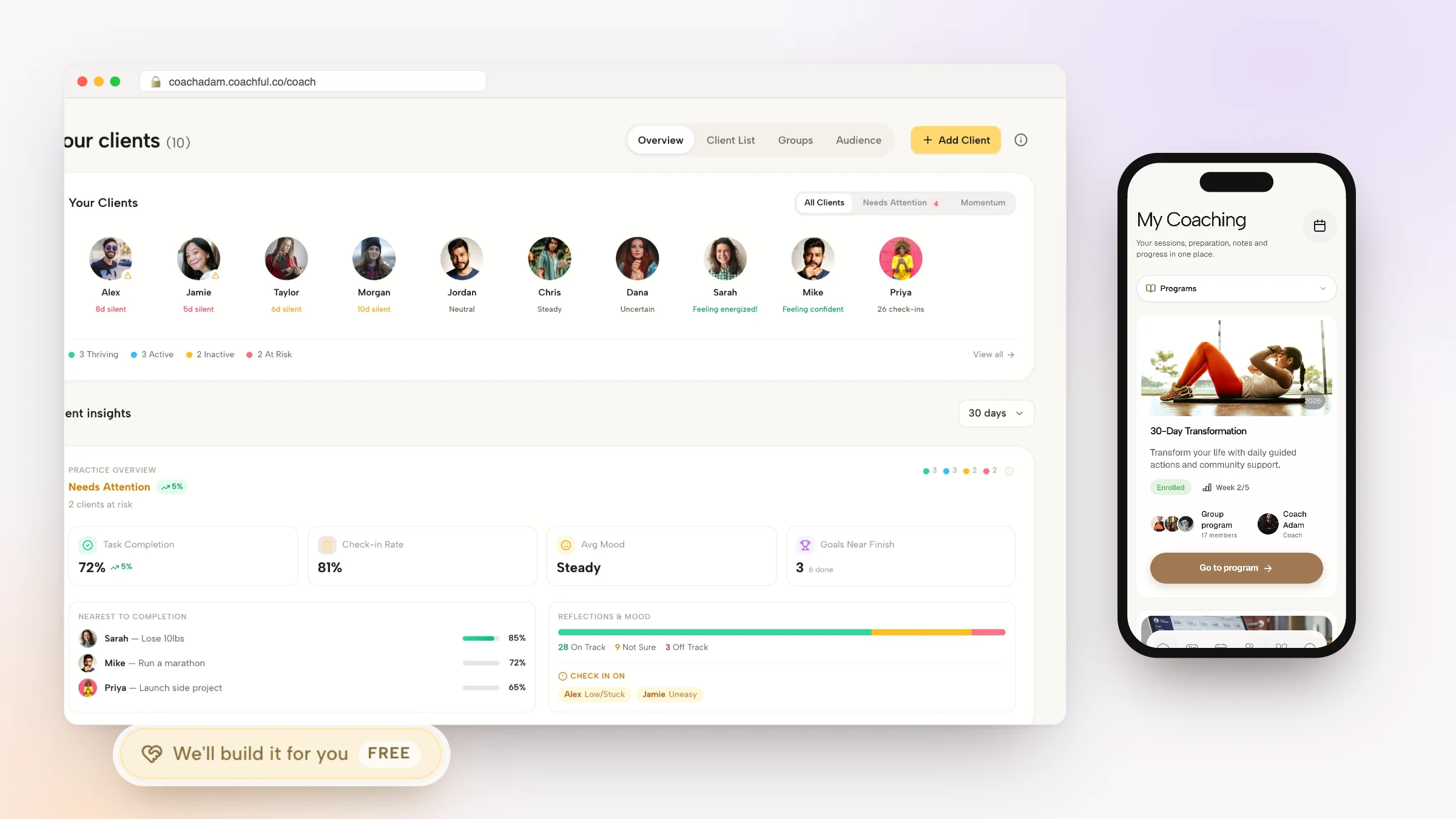
Owners check things between customers, on their phone, at odd hours. The program should be one place they can open in a quiet minute: this week's assignment, the scorecard, the templates and the next call. In Coachful, the program's weeks carry the assignments and templates, the Friday scorecard can run as a form, and a cohort gets its own community feed and chat for the group to share wins and questions. Coachful's page for business coaches shows the setup, and our roundup of business coaching software compares the options.

If you run the program as a cohort, our guide to creating a group coaching program covers group size, call agendas and community setup.

Mistakes that make business programs hard to renew
- No baseline. If you never wrote down the starting hours or margin, you cannot show the change in week sixteen.
- Advice instead of decisions. Sessions that end with "good ideas" and no written decision produce nothing by the next call.
- Templates nobody adapts. A generic routine template stays generic. Ask the owner to fill it in for their business during the session.
- Ignoring the team. Systems fail when staff were not involved in writing them. Have a staff member test every routine.
- Selling a vague "business growth" program. Owners have heard that pitch. Name the number.
Hand the build to our team, free
Coachful's team will build your business coaching program inside your account, free on every Coachful plan. The app shows it as FREE and Complimentary gift.
Start from the Create page, where We'll build it for you · FREE is the first chip under "Unleash your creativity", or from the Want us to build your program? card at the bottom of the Programs list. That card invites you to send your outline, notes or even a voice memo.

Choose Program in the form. Then describe what you want ("a sixteen-week program for café owners with a weekly scorecard, a routine template and monthly group hot seats") and who it is for. You can add up to eight reference links, notes, copy and offers to include, and up to ten files: your scorecard spreadsheet, a slide deck, routine templates or an audio recording of you explaining the method. Video files are not accepted. The last box is for deadlines and anything to avoid.
The Coachful team replies by email with next steps, usually within around 24 hours. That is a typical turnaround, not a guaranteed deadline. The weeks, tasks, worksheets and resources are built in your own account, ready for you to edit before the first client starts.
A recent request came from a business mentor for beauty professionals who sells on Instagram. The team built a sales page and checkout for her 12-week mentorship, a free start-up-guide funnel that now leads into the sales page, and rewrote the follow-up emails. The design came from her own free guide PDF.
The service has limits worth knowing. The team does not record your videos or audio, run your coaching calls, design logos, manage paid ads or handle ongoing marketing. And it invents nothing: no fake credentials, testimonials, client results or prices. Anything missing is left for you. The guide to the free white-glove service covers the rest.
The best business programs are boring in the right way: same scorecard every Friday, same decision log every session, and a number that moves.
Frequently asked questions
What is a business coaching program?
A business coaching program is a structured engagement, usually three to six months, that helps an owner change a specific business result such as hours worked, margin or sales conversion. It combines strategy sessions, assignments, templates and a weekly scorecard, sometimes with group calls for a cohort of owners.
How do you structure a business coaching program?
Pick one business problem, set a headline number and three leading indicators, then move through phases such as diagnose, systems, team and next quarter. Hold strategy sessions every two weeks, collect a weekly scorecard, and end each session with a written decision and an assignment.
How long should a business coaching program last?
Most run three to six months, because operational changes such as documenting routines or training a lead take several weeks each. Sales or launch programs can be shorter, around eight to twelve weeks. Many owners continue on a monthly retainer afterwards.
What tools does a business coaching program need?
A time audit, a routine or process template, a delegation matrix, a weekly scorecard and a 90-day plan cover most programs. Add a place to share them, book sessions, collect the scorecard and, for cohorts, a community feed and group calls.
Can Coachful build my business coaching program for me?
Yes. The Coachful team builds programs for free on any plan. Choose Program in the request form from Create or the Programs list, describe the program and who it is for, and attach your templates, slides or a voice memo. They reply by email, usually within around 24 hours.
Should business coaching be 1:1 or group?
Both work. 1:1 suits owners with sensitive financial or staffing issues. Groups suit owners in similar businesses, who learn a lot from each other's problems. A common model is a cohort with monthly hot seats and a premium seat that adds private sessions.