How to price consulting services: A Proven Guide to Confident Fees in 2026

Coachful

Deciding how to price your consulting services usually boils down to a few familiar models: hourly, per-project, a monthly retainer, or tying your fee directly to the value you create. While we’ll get into choosing the right model for you, the first step is always the same: figuring out a baseline rate that actually supports your business and your life.
Stop Guessing Your Worth And Set Your Baseline Price
Every consultant, no matter how experienced, has heard that nagging voice: “Am I charging too much? Or, even worse, am I charging too little?” It’s a constant source of second-guessing. Let’s put that to rest by building a price foundation based on solid numbers, not on fear or what you think the market will bear.
Many consultants, especially when they're starting out, end up charging what I call a "Mistake Tax" by pricing themselves too low. This isn't just about leaving money on the table. When you underprice your services, you're sending a signal. It can subtly communicate a lack of confidence, which tends to attract clients who will undervalue your expertise and nickel-and-dime you every step of the way.
The True Cost of Underpricing
Setting your rates too low creates a domino effect that can seriously stunt your business growth. Your inner dialogue might sound something like this: "If I price lower, I'll get more clients, right?" But this thinking leads to a trap.
- You attract the wrong clients. People shopping purely on price are often the least committed and most demanding.
- You create a cycle of burnout. To hit your income goals, you have to juggle more and more clients, spreading your time and energy thin.
- It makes raising your rates much harder later. Starting low sets an anchor point that’s tough to escape, both for you and your clients.
The goal here is to shift your mindset. Instead of asking, “What can I get?” you need to start with, “What is this transformation I provide genuinely worth?” And that conversation begins with ensuring your business is profitable from day one.
Calculate Your Absolute Minimum Rate
Before you can price for the value you deliver, you need to know your floor. This is the absolute minimum you must charge to cover your expenses and pay yourself a decent salary. This isn't your final price tag, but it is your non-negotiable starting point. You might be thinking, "But I don't even know where to start with all these numbers." Let's make it simple.
Let’s run through a quick, back-of-the-napkin calculation. Say your goal is to earn $100,000 per year while taking four weeks of vacation.
- Find Your Billable Hours: You plan to work 20 client-facing hours a week for 48 weeks a year. That gives you 960 billable hours.
- Tally Your Business Expenses: Add up your estimated annual business costs—things like software, marketing, insurance, and professional development. Let's peg this at $15,000.
- Calculate Your Revenue Target: Your desired income ($100,000) plus your business expenses ($15,000) means you need to bring in $115,000.
- Determine Your Baseline Rate: Now, just divide your total revenue target by your billable hours. $115,000 / 960 hours = $119.79 per hour.
That $120/hour figure is your survival rate. It’s what you need to keep the lights on, not what your expertise is worth. With this number as your solid ground, you can now explore the market and set your prices from a place of strategy, not desperation. To make this even easier, you can plug your own numbers into a tool like our session rate calculator.
Knowing your baseline is critical because market rates can vary wildly. To give you some context, take a look at the benchmarks below.
2026 Consulting Rate Benchmarks At A Glance
This table gives you a quick snapshot of typical consulting rates. Use it to see where you might fit in and how your pricing compares to the broader market.
| Consultant Type / Experience | Typical Hourly Rate ($USD) | Common Monthly Retainer ($USD) |
|---|---|---|
| Junior Consultant (0-2 yrs) | $50 - $125 | $1,500 - $3,000 |
| Mid-Level Consultant (3-7 yrs) | $125 - $250 | $3,000 - $7,500 |
| Senior Consultant (8+ yrs) | $250 - $500+ | $7,500 - $20,000+ |
| Elite/Niche Expert (e.g., Fractional CMO) | $500 - $1,000+ | $10,000 - $30,000+ |
As you can see, the range is huge. According to this guide to marketing consultant costs, rates on the lower end often belong to those just starting out and building a portfolio.
Having this context—both your personal baseline and the market landscape—is incredibly powerful. It allows you to set a price that feels both fair and strategic, reflecting the real value of the transformation you offer your clients.
Once you’ve figured out your baseline numbers, you’re face-to-face with the next big question: How are you actually going to bill for your services? Should you charge by the hour? Quote a flat fee for the entire project? Or maybe try to land a monthly retainer?
This isn’t just a math problem. The model you choose sends a powerful message about your value, your style, and the kind of consulting business you want to run. It frames how clients see you, and each approach has its own unique feel.
Let's walk through the most common models so you can find the one that fits you best. This flowchart can help you visualize how your financial goals and your time connect to the pricing structure you ultimately choose.
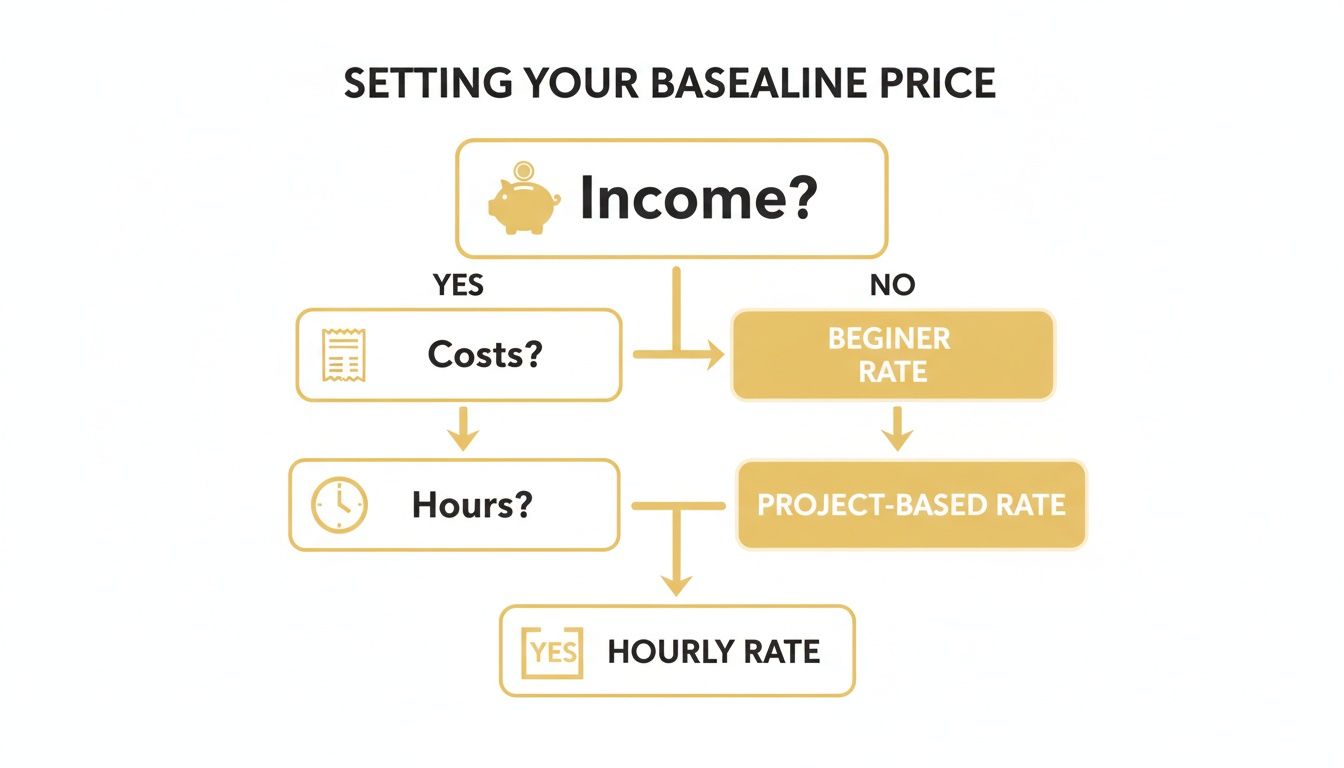
As you can see, your pricing model is the final piece of the puzzle, built on a solid understanding of your income goals, business costs, and available time.
The Trade-Off With Hourly Rates
Charging by the hour is often the first stop for new consultants. It feels safe, transparent, and easy to justify. The thinking goes, "I'll get paid for every single minute I work. Simple."
And it’s true, hourly billing has its place. It works well for:
- Undefined scopes: Perfect for those projects where the client isn't quite sure what they need, and the scope is likely to evolve.
- Quick tasks: Great for one-off strategy sessions or quick fixes where a full project fee would be overkill.
- Getting started: It can be a low-risk way to begin a relationship with a new client before either of you commits to a larger engagement.
But here’s the trap: hourly rates directly chain your income to the clock. The more skilled and efficient you become, the less you earn for delivering the same result. It puts a hard ceiling on your income and can accidentally position you as a hired hand rather than a strategic partner.
The Predictability of Project-Based Fees
This is where you shift from selling time to selling a result. Instead of quoting hours, you charge a single, fixed price for a clearly defined outcome. Your thought process changes to, "My client wants a 'Career Transition Roadmap.' I know I can deliver that, so I'll charge a set fee for the completed package."
Project-based pricing immediately moves the conversation from your labor to their transformation. It frees you to price based on the immense value you create, not the hours you spend. This model is a fantastic fit once you have a repeatable process that delivers a specific, tangible result.
The one major risk? Scope creep. We’ve all been there—the dreaded "can you just quickly..." requests that slowly chip away at your profit. The best defense is a good offense. Build a contingency buffer right into your price. A solid rule of thumb is:
(Your Hourly Rate x Estimated Hours) + 20% Contingency = Your Fixed Project Fee
That 20% buffer is your secret weapon. It protects your profitability and gives you the flexibility to handle small, unexpected requests without derailing the project or your sanity.
The Stability of Monthly Retainers
For any consultant, the retainer is the holy grail of predictable income. It’s an agreement where a client pays you a fixed fee each month for ongoing access to you and your expertise. Your mindset shifts from hunting for the next project to thinking, "How can I build consistent, recurring revenue and finally escape the feast-or-famine cycle?"
Retainers are ideal when your real value lies in continuous support, guidance, and accountability. A business coach, for instance, might offer a $4,000/month retainer that includes two deep-dive strategy calls, unlimited email support for quick questions, and access to a private resource library. The fee isn't for a single deliverable; it’s for the peace of mind that comes with having an expert on call.
By bundling your services into an ongoing package, you transform transactional gigs into long-term partnerships. This model is a cornerstone of many successful coaching businesses and offers a clear path to building a more stable, subscription-based revenue stream. You can get more ideas on how to set this up by exploring what it takes to create a subscription-based coaching website.
Which Pricing Model Is Right For You?
Choosing a pricing model is a strategic decision that shapes your client relationships and your earning potential. The table below breaks down the four common approaches—including value-based pricing, which we’ll cover next—to help you align your pricing with your business goals.
| Pricing Model | Best For... | Coach's Inner Dialogue | Potential Pitfall |
|---|---|---|---|
| Hourly | Unclear scopes, quick tasks, or initial client engagements. | "I need to make sure I'm paid for every minute of my work." | Caps earning potential and can devalue expertise. |
| Project-Based | Services with a clear, repeatable process and a defined outcome. | "I'm selling a specific result, not my time." | Scope creep can eat into profits without a buffer. |
| Retainer | Providing ongoing support, guidance, and strategic partnership. | "How can I build predictable, recurring monthly income?" | Requires a clear definition of what's included to avoid burnout. |
| Value-Based | High-impact projects where you can tie your fee to a tangible business result. | "What is this outcome worth to my client's business?" | Can be complex to negotiate and requires a high level of confidence. |
Ultimately, many seasoned consultants don’t stick to just one model. Trends show that around 60% of firms are now blending approaches, perhaps starting with a small project-based fee and then transitioning the client to a monthly retainer. You don't have to choose one and stick with it forever; the best model is the one that works for you and your client right now.
Craft Irresistible Consulting Packages That Sell Themselves
If you’re just selling your time by the hour, you’re making yourself a commodity. There will always be someone willing to do it for less. But when you start selling a transformation—a tangible outcome—that’s an investment clients will happily make.
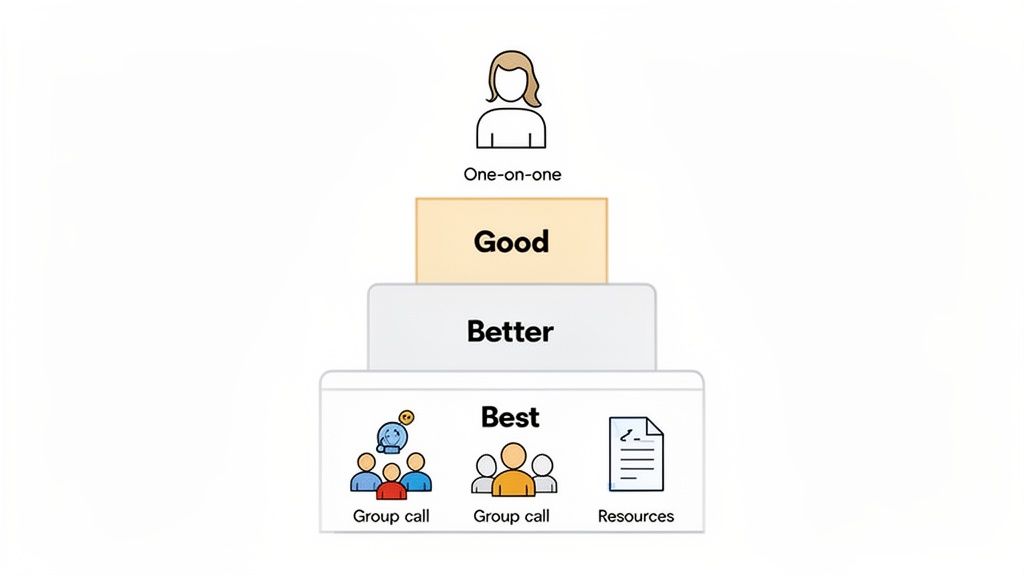
This is where we move beyond abstract pricing models and start building concrete offers. The goal is to bundle your expertise into tiered packages. Think of it as creating a Good, Better, and Best menu that guides clients to the right choice. It shifts the entire conversation from, "What's your hourly rate?" to, "Which one of these results do I want?"
The Psychology Behind Tiered Packages
I hear this all the time: "But what if everyone just picks my cheapest option?" It’s a valid fear, but it comes from a misunderstanding of how people make buying decisions. We don't automatically buy the cheapest thing; we buy what we feel is the best value.
Your job is to architect your tiers so the middle option feels like the most obvious, high-value choice. The lowest tier acts as an accessible entry point, while the highest tier serves as a premium price anchor. This makes your middle package the "sweet spot" that perfectly balances price and deliverables for most clients.
Designing compelling packages is an art. For some real-world inspiration, take a look at these actionable tiered pricing examples to see how other successful businesses are doing it.
Building Your Tiers From The Ground Up
The trick is to make each tier a clear and logical step up from the one before it. You aren’t just tacking on more hours. You’re layering in more access, better resources, and a deeper level of support, making the value jump between tiers totally obvious. You might be thinking, "What do I even put in these different packages?" Let's break it down.
Here are the common building blocks you can mix and match to create your packages:
- One-on-One Sessions: This is the heart of most consulting—your dedicated, personalized attention.
- Group Calls: A fantastic way to build community and serve multiple clients at once.
- Resource Library: Give clients on-demand access to templates, worksheets, and video trainings for added value.
- Direct Messaging Support: A high-impact feature offering quick access for questions and accountability (think Slack or Voxer).
A simple way to think about it is this: your lowest tier is the "DIY with my guidance" option. The middle tier is the "Done With You" partnership, and the top tier is the all-access "Done For You" VIP experience.
An Example Career Transition Program
Let's say you're a life coach who helps people navigate career changes. Instead of just selling "coaching calls," you could create a "Career Transition Program" with three well-defined tiers. This immediately frames your service around a result, not just an activity.
Here’s what that might look like in practice:
| Feature | Starter Package ($997) | Accelerator Package ($2,497) | VIP Immersion ($4,997) |
|---|---|---|---|
| 1:1 Strategy Sessions | Four 60-minute sessions | Six 60-minute sessions | Eight 60-minute sessions |
| Group Coaching Calls | Access to bi-weekly calls | Access to bi-weekly calls | Access to bi-weekly calls |
| Resource Vault | Standard access | Full access + new templates | Full access + new templates |
| Direct Messaging Support | Email support (48hr response) | Slack support (24hr response) | Voxer support (same-day) |
| Resume & LinkedIn Review | Not included | Included | Priority review + rewrites |
| Mock Interview Prep | Not included | Not included | Two dedicated sessions |
See how the Accelerator Package immediately stands out? It offers the direct support and tangible reviews that the Starter package is missing, but without the high price tag of the VIP Immersion. You’ve strategically made the decision easy by creating a package that offers the most compelling blend of features and value. This is how you stop trading time for money and start selling real transformations.
You’ve put in the hours. You’ve crunched the numbers, mapped out your ideal pricing model, and even bundled your services into attractive packages. Now for the part that trips up even the most experienced consultants: actually telling a potential client your price.
That little voice in your head, the one whispering that you’re asking for too much? That’s imposter syndrome, and it loves to show up right before you state your fee. Let's move beyond the spreadsheets and talk about the mindset you need to price with confidence.
It's an Investment, Not a Cost
The language you use completely frames the conversation. It can be the difference between a client seeing a terrifying expense and a smart investment in their own success. It’s time to stop saying things like, "My fee is..."
Instead, connect your price directly to the outcome.
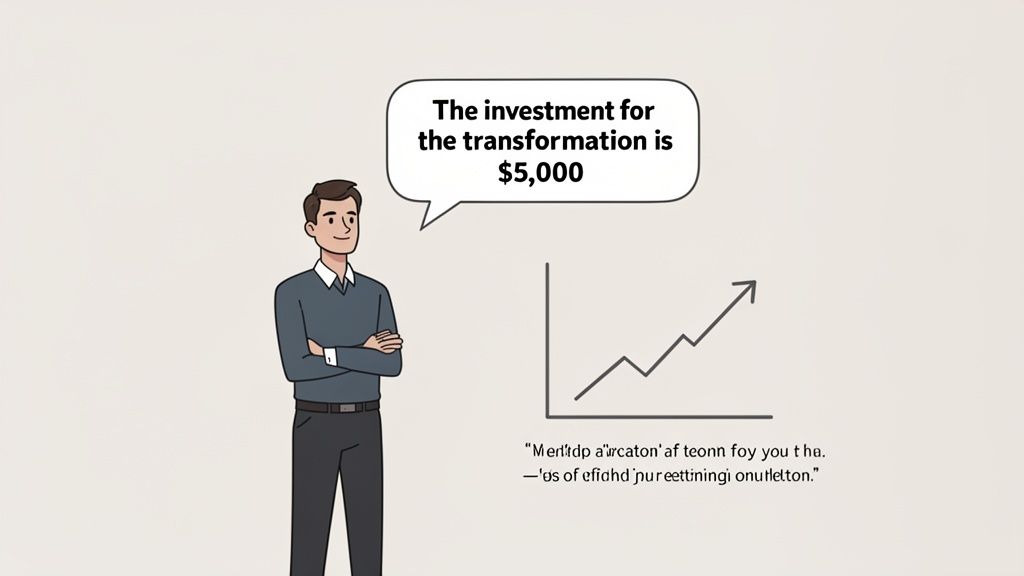
- Don't say: "My fee is $5,000."
- Instead, try: "The investment for this program, which is designed to help you double your leads, is $5,000."
See the difference? You’re not selling your time; you’re selling a result. This small change shifts the focus from what they are paying to what they are getting.
If you're still working on the fundamentals of how to frame your fees, digging into some general pricing strategies can give you a much stronger starting point.
Handle Price Objections Without Offering Discounts
Sooner or later, a client is going to say, "That's more than I expected." Your gut reaction might be to panic and immediately offer a discount. Fight that urge. Slashing your price right away sends a clear signal: you were overcharging to begin with.
Instead, take a breath and get curious. The best first move is always a question, not a concession.
My go-to response is, "I understand. Could you tell me more about what you had in mind?" This opens a dialogue instead of shutting it down. More often than not, the client just needs more clarity on the value they're receiving. It’s your chance to reinforce the tangible outcomes, not to negotiate yourself down.
If the budget is genuinely a barrier, you can always suggest a lower-tier package or a more limited scope of work. This keeps your pricing structure intact while still providing a path forward for the client.
Use Social Proof to Justify a Premium Price
If you’re going to charge a premium, you need to show you’re worth it. This is where your track record becomes your most valuable asset. Client testimonials and in-depth case studies aren't just marketing fluff; they do the heavy lifting of justifying your rates for you. You might think, "I feel arrogant talking about my own wins." But it's not bragging; it's proof.
- Testimonials: These are short, impactful quotes that highlight a specific result or a client's positive experience.
- Case Studies: This is the full story. Walk potential clients through a previous client's challenge, the solution you provided, and the measurable results. For example: "After our six-month engagement, Client X saw a 30% increase in revenue."
When you have a portfolio of these success stories, you can anchor your price to proven results with total confidence.
I’ve seen some great examples of this in other industries. The IT consulting market, which is on track to hit $78.2 billion by 2026, is a good place to look for inspiration. Top consultants there often use data dashboards to visually demonstrate progress, making their value undeniable. You could do something similar by setting a base fee plus a bonus tied to a specific metric, like client revenue growth, and track it all within your client portal. For more on how they structure their pricing, you can check out some common IT consulting rates here.
Figuring out how to price your consulting services is only half the job. The other half is learning to communicate that price with the unshakable confidence that comes from knowing—without a doubt—the incredible value you bring to the table.
Automate Your Payments And Streamline Your Business
You’ve done the hard work. You’ve analyzed your costs, researched the market, and finally landed on pricing that feels right. But all that strategic thinking can fall apart if the simple act of getting paid becomes a mess of spreadsheets, manual invoices, and awkward follow-up emails.
I see it all the time with new consultants. They have their prices figured out, but then they ask, "Okay, now what? How do I actually charge people without spending all my time on admin or feeling like a bill collector?"
Let's get your systems in order. The goal here is simple: create a professional, automated workflow that ensures you get paid on time, every time, with almost no effort on your part. Think about it—a new client signs up, pays, and gets their welcome kit while you’re deep in a session with someone else. That’s not a pipe dream; it’s just a smart setup.
Get Your Packages Out Of Docs And Into a Platform
Your pricing tiers shouldn't just live in a Google Doc. To make them real, you need to translate them into live, buyable offers. This is where a dedicated coaching platform is a game-changer. You might be wrestling with the thought, "Can't I just use PayPal and Calendly?" You can, but trying to stitch together separate tools for invoicing, scheduling, and client portals is a constant battle with broken links and syncing errors.
A single platform lets you build everything in one place, creating a clear, professional storefront for your services.
When you create packages directly in a system like Coachful, you empower clients to help themselves. They can browse your options, pick the one that fits, and pay right then and there with a credit card or bank transfer.
That single click can then set off a chain reaction: the system automatically sends a welcome email, grants them access to a resource library, and maybe even assigns their first pre-session worksheet. You're immediately removed from the admin work, and the client gets an amazing, seamless experience from the very first interaction.
Stop Chasing Invoices With Recurring Payments
If you offer retainers or long-term projects with payment plans, nothing sours a client relationship faster than having to chase down late payments. It’s a huge source of anxiety for you and feels unprofessional to them. That sinking feeling of, "Ugh, I have to email my biggest client again about that invoice," is completely avoidable.
Automated recurring payments are the answer. When you set up a retainer or installment-based project in your platform, you simply configure it as a subscription.
Here’s the simple beauty of it:
- One-Time Setup: The client enters their payment info just once when they sign up.
- Autopilot Engaged: The platform automatically and securely charges their card on the agreed-upon schedule (e.g., the 1st of every month).
- You Get Paid: Funds land in your bank account like clockwork. You don't have to do a thing.
This "set it and forget it" model gives you predictable cash flow and frees you from ever having to send another awkward "Just checking in on this..." email.
Manage Group Programs And Cohort Access Without The Headache
Running group programs introduces a whole new level of complexity. You’re probably wondering, "How do I give 20 people access to the right content at the right time, and then cut it off when the program is over?"
Trying to manage that manually is a recipe for chaos and mistakes. A good platform automates this entire workflow.
When a client buys a spot in your group program, the system can instantly:
- Add them to the correct cohort.
- Unlock access to that program's specific curriculum and private community.
- Enroll them in an automated email sequence for weekly reminders and updates.
Even better, if a client's payment fails, the system can automatically pause their access to the materials and notify them to update their card. This protects your intellectual property and ensures everyone participating is a client in good standing. Using the right coaching business software transforms what would be a massive administrative burden into a smooth, hands-off process.
By automating the money and admin side of your consulting business, you're doing more than just saving time. You're building a polished, premium client experience that reinforces your value and frees you to focus on the work that truly matters: delivering incredible results.
Frequently Asked Questions About Pricing Consulting Services
Even with the perfect pricing structure on paper, the real world always throws a few curveballs. You're not alone in wondering about these tricky situations. Let's walk through some of the most common questions I get from other consultants.
How Often Should I Raise My Consulting Prices?
If you're asking this question, that's a great sign. It means you're growing. That little voice in your head wondering if you're still charging what you're worth? Listen to it.
As a rule of thumb, take a hard look at your prices at least once a year or after you’ve onboarded every 3-5 new clients. If your calendar is consistently booked solid for weeks or you've just collected a new round of incredible client testimonials, that's your cue. Demand has clearly started to outpace your current rates.
A 10-15% increase each year is a healthy benchmark for most established consultants. It accounts for inflation, your deepening expertise, and the simple economics of supply and demand.
When you do pull the trigger on a price hike, give everyone a heads-up. Announce the new rates to your email list and social media followers a few weeks in advance. A great move is to offer your current rate to existing clients for a limited time—it's a simple way to reward their loyalty and often drives a nice surge in business.
What Is The Best Way To Handle A Client Who Wants A Discount?
The discount request. It can make even the most seasoned consultant’s stomach drop. You start wondering, "Will I lose the project if I say no? Am I selling myself short if I say yes?"
The trick is to shift your mindset. This isn't a haggle over your price; it's a conversation about finding the right solution within their budget.
Your first move should never be to offer a discount. Instead, you adjust the scope of work.
If a prospect can't swing your top-tier offering, you can gracefully guide them toward a different package that still solves a core problem for them. This keeps your pricing consistent and fair for everyone while still getting them in the door.
Try saying something like this: "I totally get that the budget is a major factor. To keep things fair for all my clients, I don't discount my services, but my Accelerator Package might be exactly what you need. It's designed to deliver the core outcome of [mention the specific result], and we can always explore upgrading later on."
This approach is empathetic but firm. It reinforces your value, keeps the conversation positive, and gives the client a clear path forward without devaluing your work.
Should I List My Prices On My Website?
This is one of the biggest debates in the consulting world, and the truth is, there's no single right answer. It really hinges on what you sell and who you sell it to. Your inner dialogue is probably a tug-of-war: "If I show my prices, I'll scare people away! But if I don't, will anyone even bother to call?"
Publishing your prices works incredibly well if you offer productized services with clear, fixed scopes. It acts as an automatic filter, qualifying leads before you ever get on a call. This kind of transparency builds immediate trust and makes it easier for the right clients to say yes.
On the other hand, if you specialize in high-ticket, custom engagements, keeping your prices under wraps can be a strategic advantage. It encourages a conversation. This gives you the space to first understand a client's specific challenges and articulate the massive value you can deliver before getting into the numbers.
A fantastic middle ground I often recommend is:
- List a "starting at" price for your packages (e.g., "Packages start at $2,500").
- Keep your custom or enterprise-level work invite-only, requiring a consultation call.
This strategy gives prospects a realistic sense of the investment required while ensuring your most valuable leads land on a call where you can truly connect and showcase your expertise.
Ready to stop juggling spreadsheets and start streamlining your entire coaching business? Coachful brings your scheduling, payments, client management, and program delivery into one easy-to-use platform. Sign up for free and see how it works!