
How to Build a Business Coach Website Owners Trust
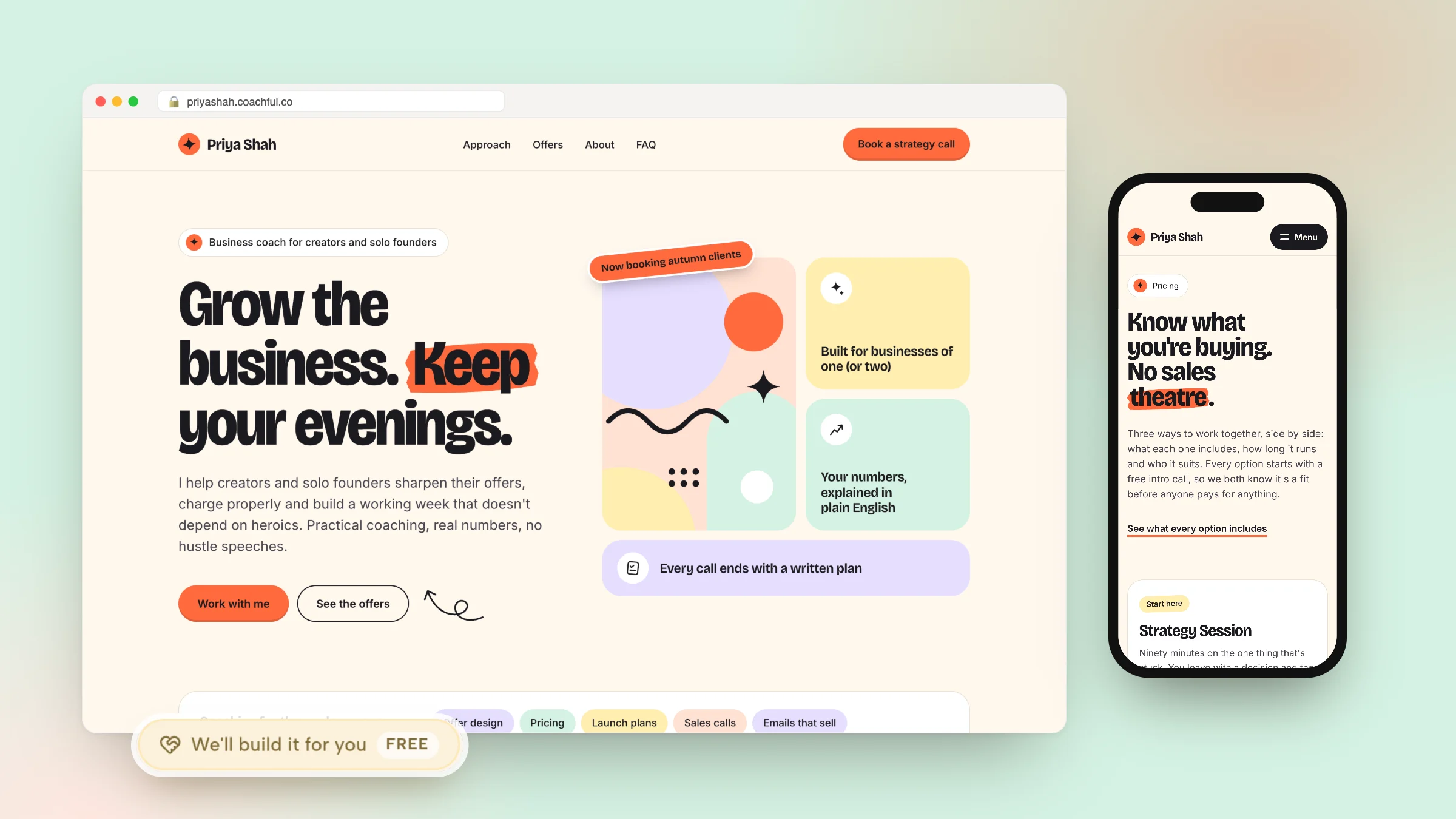
Business owners read a business coach website the way they read a supplier's proposal: quickly, a little suspiciously, looking for the scope and the price. They want to know which kind of business you help, what changes in that business, how the engagement runs and whether anyone like them has done it with you before. A business coach website that answers those four things in the first two scrolls gets calls. One that opens with "Reach your full potential" and a stock photo of a handshake gets a polite close of the tab.
This guide covers what to put on the site, how to pick a niche angle, a worked homepage for an operations coach, how to show proof without stretching the truth, and the offer pages most business coaches need. If you'd rather not build it yourself, Coachful's team builds business coach websites for free on any plan, from a short request form.
The five questions a business coach website must answer
- Who exactly do you help? "Small business owners" is too wide to trust. "Agency founders between 5 and 25 people" or "solo creators making their first six figures" tells the reader whether to keep going.
- What changes? Name the outcome in business terms: fewer hours in delivery, a pricing change, a pipeline that doesn't depend on referrals, a founder who can take two weeks off.
- How does it work? Diagnostic, then a defined engagement, then a review. Length, meeting rhythm, what happens between calls.
- What does it cost, or how is it scoped? Owners expect either a price, a starting price or a clear explanation of how you quote.
- Why trust you? What you've built or run yourself, relevant experience and client results you're allowed to share.
Everything on the homepage should serve one of those questions. If a section doesn't, cut it. If you're still deciding what kind of business coaching you offer, this explainer on business coaching covers the main types.
Choose your niche angle before your design
Business coaching splits into very different buyers, and the site's tone should follow the buyer. Three common angles:
| Angle | Sample headline | Typical offer shape | Template that fits |
|---|---|---|---|
| Creators and solo founders | "Grow the business. Keep your evenings." | Group program plus a few 1:1 spots, or monthly coaching | Studio: playful bento tiles and pastel blocks |
| Operations for funded founders | "You are the scaffolding. Let's build the structure." | Paid diagnostic, then a phased engagement | Scaffold: blueprint lines and offers laid out as phases |
| B2B sales coaching | "Deals don't die. They get ignored." | Deal review, then a fixed-term sales program | Bulletin: a newspaper masthead with column rules |

All three templates above are part of Coachful's 30 designed homepages, each shown with a fictional sample coach. The point isn't the color scheme. A playful site tells a creator "this coach gets my world", and the same site would make a CFO-backed founder wonder whether you've seen a board deck.
Worked example: homepage for an operations coach for founders
Here's the full homepage for a fictional coach who helps seed to Series B founders put an operating system in place. Copy the order; rewrite the words.
| Section | What it says |
|---|---|
| Hero | Eyebrow: "Operations coaching for founders, seed to Series B." Headline: "You are the scaffolding. Let's build the structure." Sub-line: "Most founders hold the whole company up by hand: every decision, every hire, every fire. I help you put an operating system in place, with a cadence, owners and numbers, so the company stands on its own and you get your judgment back." Buttons: "Book a diagnostic call" and "See the build sequence". |
| Signs you need this | Four notes: "Every decision routes through you", "Your leadership meeting is a status update", "Nobody owns the numbers but you", "You haven't taken a full week off since the raise". |
| The build sequence | Three phases with timeframes: "Phase 1, weeks 1 to 2: diagnostic and operating map. Phase 2, weeks 3 to 10: cadence, owners and a metrics sheet. Phase 3, weeks 11 to 12: hand-off and review." |
| What a week looks like | "One 60-minute working session, one written summary with decisions and owners, async questions answered within a working day." |
| Engagements | Two cards: "Diagnostic (two weeks, fixed fee)" and "Operating system build (twelve weeks)". Price or "from" price on each, or "quoted after the diagnostic". |
| Results | Two short case notes with permission: "Founder of a 30-person software company: leadership meeting cut from 2 hours to 45 minutes, three decisions a week moved off the founder's desk." |
| About | "I ran operations at two venture-backed companies before I started coaching." Two more lines and a photo. |
| Questions | "Do you work with non-technical founders?" "Is this consulting or coaching?" "Can my COO join?" "What if we're pre-revenue?" |
| Close | "Start with two weeks and a map." Button: "Book a diagnostic call". |
Note the case note in the results row is an example of the format, not a real client. Use your own, with your clients' agreement.

Proof without inventing anything
Business buyers discount vague praise and notice inflated numbers. A few honest ways to show proof:
- Case notes with the client's permission. Situation, what you did together, what changed, with a number where possible. Anonymize the company if they prefer ("a 12-person design agency").
- Your own operating history. What you built, ran or sold before coaching, stated plainly. That counts as proof for many owners.
- Process artifacts. A sample one-page plan, an example meeting agenda, the diagnostic questions. Showing how you work is persuasive in its own right.
- Short quotes with names and roles, collected properly (this testimonial template helps).
What not to do: logo walls of companies you've never worked with, round-number revenue claims you can't support, or results that belong to your previous employer rather than your coaching. If you're writing your first case study, this 7-step case study template gives a structure.
The offer pages business coaches need
A paid diagnostic or a free strategy call
Many business coaches use a paid diagnostic: a short, fixed-fee piece of work that ends with a written plan, whether or not the client continues. It qualifies buyers and pays you for thinking. Others prefer a free 30-minute strategy call. Either way, the page should say what happens in the session and what the person leaves with. Coachful can sell paid sessions at booking, so a paid diagnostic doesn't need a separate checkout.
The main engagement
One page per engagement: who it's for, length, rhythm, what's included between sessions, price or how it's quoted, and a clear next step. Retainers can run as subscriptions; fixed programs as one payment or a payment plan, all paid into your own Stripe account with a 0% Coachful platform fee. For the page itself, see how to create a coaching sales page.
A group program, if you run one
Cohort dates, group size, the curriculum by week and what members get between sessions. Groups sell on the peer group as much as on you, so describe who else will be in the room. Here's how group coaching runs on Coachful.
A lead magnet for people who aren't ready
A pricing calculator, a hiring scorecard or a one-page operating checklist, delivered by email with a short follow-up series. That's a funnel rather than a page, and it's often the part that turns LinkedIn attention into calls.

Letting our team build your business coach website
Coachful's team will build your website, and the funnel behind it, for free on any plan. Coachful is a paid subscription, which you can start with a free trial; the build has no extra charge.
You'll find the request in three places: Create > We'll build it for you · FREE, and the "Want us to build it for you?" card with a Fill in a form button on both the Website and Funnels pages.

The website form asks which pages to create or improve, what they should do (book calls, collect leads, sell an offer, deliver a resource), what visitors should do after landing, sites you like, materials to include and anything broken. The funnel form asks what the funnel should do, who it's for and what they get, the journey people should follow, and where traffic comes from: Instagram, LinkedIn, Facebook, paid ads, your email list, your website, YouTube or a podcast, or referrals. Both take up to 8 reference links and up to 10 files (logos, photos, screenshots, brand guides, copy, documents or audio, but no video files).

The team replies by email with next steps, usually within about 24 hours, though that's a typical turnaround and not a promised deadline. Everything is built in your own account and stays editable.
What recent business-side builds looked like:
- A business mentor for beauty professionals who sells on Instagram got a sales page and checkout for a 12-week mentorship, a free start-up-guide funnel that now leads into the sales page, and rewritten follow-up emails. The design came from the coach's own free guide PDF.
- A real-estate and money coach got a year-long cohort program with an application form, an eight-page website on the coach's own domain, a free nine-day bootcamp course with its own signup funnel and emails, and legal pages.
Nothing gets invented in any build: no fake credentials, testimonials, client logos or prices. Anything missing is left for you to fill in. The team doesn't design logos, record videos, run ad campaigns or manage your marketing over time. Here's everything the free build service includes, and if your funnel needs more thought than your site, start with how to create a coaching funnel.

Business coach website mistakes worth fixing this week
- Selling "clarity". Owners buy outcomes they can put in a spreadsheet or a calendar.
- No scope anywhere. If nobody can tell whether you cost the price of a laptop or a hire, some won't ask.
- A 20-minute video as the hero. Busy owners skim. Put the video lower down for people who want it.
- Equal weight on five offers. Lead with one engagement and let the rest sit underneath.
- A contact form as the only next step. Give them a calendar. Owners who want to talk want to pick a time now.
The Bulletin template above, drawn for sales coaches and B2B consultants, is a good example of the opposite of all five: one sharp claim, one paragraph of scope, two buttons.
Frequently asked questions
What should a business coach website include?
A homepage that names your niche and the business outcome, an engagements or services page with scope and pricing, a diagnostic or strategy call booking page, an About page with your operating history, case notes or results, and an FAQ. A lead magnet funnel helps if you get traffic from LinkedIn or a newsletter.
Should a business coach show prices on the website?
Showing a price or a starting price usually helps, because owners use it to qualify themselves. If you quote per client, explain how: "engagements are scoped after a two-week diagnostic." Some coaches publish the diagnostic fee and quote the main engagement afterwards.
Do business coaches need case studies on their website?
They help a lot, since owners want evidence. Use real results shared with permission, anonymized if needed. If you're new, show your own operating history and your process instead. Never invent results or show logos of companies you haven't worked with.
Will Coachful build my business coach website for free?
Yes. The build service is free on every Coachful plan; Coachful itself is a paid subscription. Send the website or funnel request form with your pages, offers and links, and the team replies by email with next steps, usually within about 24 hours.
What's the best website platform for a business coach?
It depends on what else you need. A general builder handles pages well but needs separate booking, payment and email tools. An all-in-one coaching platform keeps the site, booking, checkout and client delivery together. This comparison of platforms to build a coaching website lays out the options.
How many pages does a business coach website need?
Four to six is enough for most: home, engagements, about, booking, and optionally results and FAQ. A focused four-page site beats a sprawling twelve-page one. Here's how Coachful works for business coaches once the site is live.












