
What Is Executive Coaching? How It Works and What It Costs
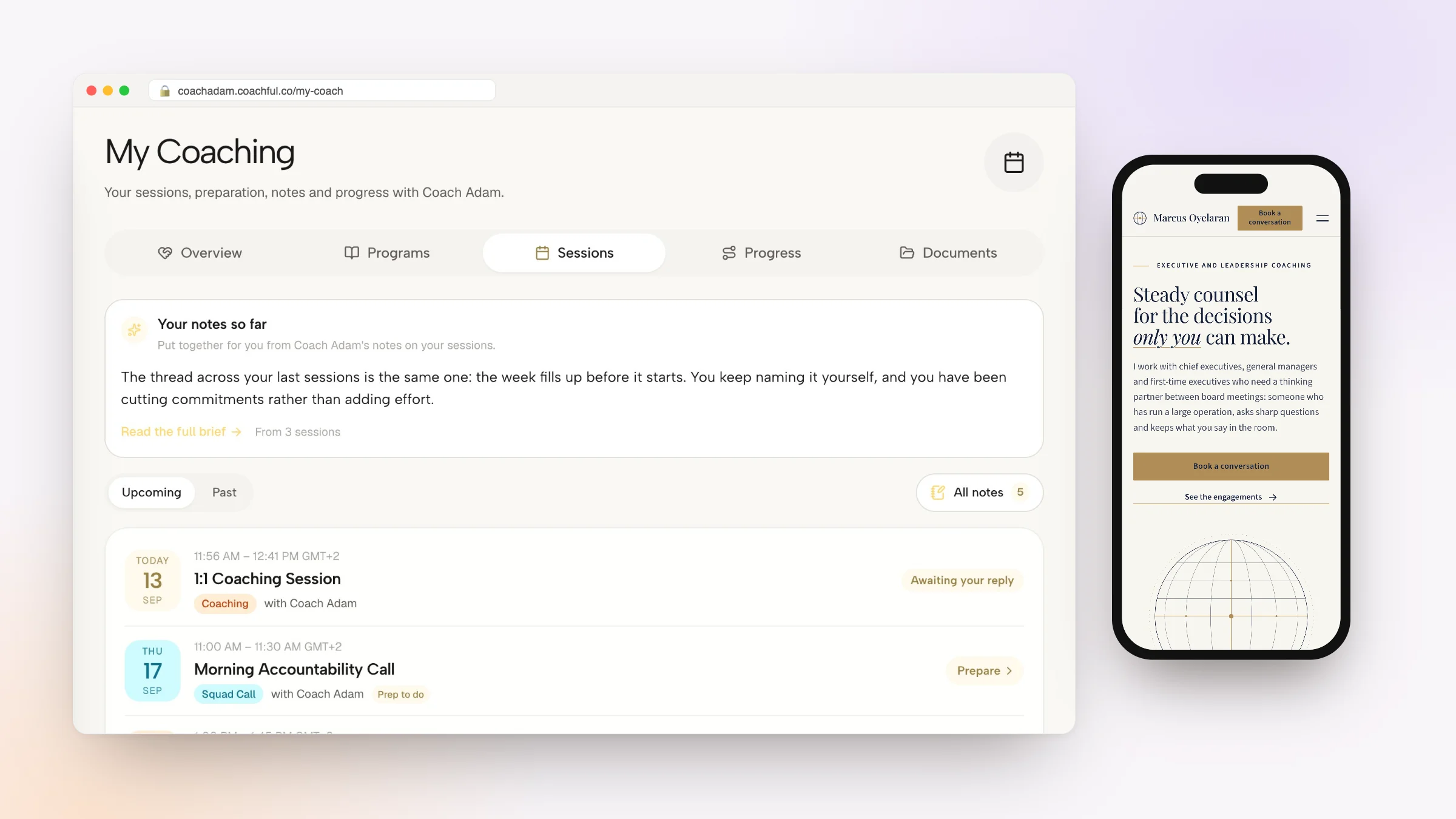
What is executive coaching? It is a confidential, one-to-one working relationship in which a trained coach helps a senior leader change how they lead, usually over six to twelve months, against goals agreed with the organization that pays. The work is about behavior and decisions in the leader's real job: how they set direction, delegate, handle stakeholders, give feedback and make hard calls. The coach asks questions, brings feedback from the people around the leader, and holds them to small experiments between sessions. The leader keeps every decision.
That is the short version. The rest of this guide explains how an executive coaching engagement runs from the first call to the final review, who it is for, what a session looks like, what the research says, what it costs, and how to choose a coach. If you coach executives yourself, there is a section for you at the end.
Executive coaching in plain terms
Executive coaching sits next to several other kinds of help, and the labels get mixed up. The clearest way to tell them apart is who sets the agenda and who supplies the answers.
| Executive coaching | Leadership coaching | Consulting | Mentoring | Therapy | |
|---|---|---|---|---|---|
| Who it is for | Senior leaders: C-suite, VPs, directors, founders | Managers at any level | The organization | A less experienced person | Anyone with a mental health need |
| Focus | The leader's behavior and decisions at the top | Core people-leadership skills | A business problem | Career and craft, from experience | Healing, symptoms, the past |
| Who supplies answers | Mostly the leader | Mostly the leader | The consultant | The mentor, often | A licensed clinician, with the client |
| Usually paid by | The employer | The employer or the person | The organization | Often unpaid | The client or insurance |
For the neighboring definitions, see what leadership coaching is, what business coaching is and our comparison of coaching vs mentoring. The International Coaching Federation's guide puts the consulting difference simply: consultants diagnose problems and prescribe solutions, while a coach asks questions so you find your own (ICF guide for individuals).
How executive coaching works: the engagement, step by step
Most executive coaching engagements follow the same arc. Coachful's 2026 Coaching Business Report, drawing on the ICF Global Coaching Study 2025, puts the typical corporate contract at 6 to 12 months.
| Stage | What happens | When |
|---|---|---|
| 1. Chemistry call | The leader meets one to three coaches and picks the one they trust | Before the contract |
| 2. Contracting | A three-way meeting with the leader, their manager or HR sponsor and the coach: goals, what will be shared and what stays confidential | At the start |
| 3. Assessment | Interviews with colleagues or a 360 survey, sometimes a psychometric tool | Early on |
| 4. Development plan | Two or three goals with observable behaviors, agreed with the sponsor | After the assessment |
| 5. Coaching sessions | 60 to 90 minutes, roughly every two weeks, with practice between sessions | Most of the engagement |
| 6. Mid-point review | Progress check with the sponsor; goals adjusted | Around the halfway mark |
| 7. Close | A final three-way review, a repeat of the colleague feedback, and a plan for keeping the changes | Final month |
The three-way contracting meeting is what most separates executive coaching from personal coaching. It makes the sponsor's expectations explicit and draws a line around confidentiality: typically the sponsor hears about goals and progress, not the content of sessions. The ICF Code of Ethics expects coaches to agree roles, responsibilities, confidentiality and financial arrangements with every party before coaching begins (ICF Code of Ethics). Our guides to stakeholder alignment meetings and scoping assessments in the contract go deeper.

Who executive coaching is for
- Newly promoted executives in their first months, when the habits that got them promoted start getting in the way.
- High-potential leaders being prepared for a bigger role.
- Founders and CEOs whose company has outgrown how they run it, often moving from doing to delegating.
- Leaders with a specific gap named in feedback: influence with peers, executive presence, decision speed, how they handle conflict.
- Leaders in a transition: a merger, a turnaround, a move to a new country or function.
It tends to go badly when the leader did not choose it and sees it as a punishment, when the "goal" is really a performance-management file, or when the underlying issue is clinical, such as depression or substance use, which needs a licensed professional instead.
What an executive coaching session looks like
| Minutes | What happens |
|---|---|
| 0 to 10 | What happened since last time: the experiment the leader tried and what they noticed |
| 10 to 20 | Choosing today's topic and what a useful outcome for this hour would be |
| 20 to 55 | The work: questions, a role-play of a hard conversation, reviewing feedback, mapping stakeholders |
| 55 to 70 | Designing the next experiment: what, with whom, by when |
| 70 to 75 | What the leader is taking away, in their words |
A short example of the middle section:
Coach: You said the leadership team "never pushes back". When did someone last disagree with you in that meeting?
Leader: I can't remember. Maybe March.
Coach: What happened to the person who did?
Leader: I argued with them until they dropped it. Fine, I see it.
Coach: What could you try in Thursday's meeting so that disagreeing feels safer?
Between sessions, the leader runs that experiment (asking for the strongest argument against their own proposal before speaking, say) and notices what happens. That practice is where most of the change happens.

Does executive coaching work? What the research says
The research is broadly positive, with caveats about study size and measurement.
- Across workplace coaching, a meta-analysis found positive effects on all five outcomes it examined: performance and skills, well-being, coping, work attitudes and goal-directed self-regulation, with effect sizes from g = 0.43 (coping) to g = 0.74 (goal-directed self-regulation) (Theeboom, Beersma and van Vianen, 2014).
- A second meta-analysis of 17 workplace studies found an overall positive effect (0.36), larger for affective outcomes and individual results, with no difference between face-to-face and blended or online coaching, and no difference by number of sessions. Effects were stronger with internal coaches than external ones, and smaller in studies that used multi-source feedback (Jones, Woods and Guillaume, 2016).
- Executive coaching specifically: a 2023 meta-analysis of 20 controlled studies found the largest effects on behavior, especially cognitive-behavioral activities, plus positive effects on self-efficacy, psychological capital and resilience; the number of sessions did not change the result (Nicolau and colleagues, 2023).
- The relationship matters. Across 27 samples covering 3,563 coaching processes, the quality of the working alliance between coach and client was consistently linked to outcomes (r = 0.41) (Graßmann, Schölmerich and Schermuly, 2020). Hence the chemistry call.
Many studies are small and lean on self-reported outcomes, so treat the exact sizes with care. The consistent findings are that coaching tends to help, that fit between coach and leader matters, and that more sessions are not automatically better.
How much does executive coaching cost?
Coachful's 2026 Coaching Business Report, compiled from the ICF Global Coaching Study 2025, PayScale and practitioner reports, gives these executive coaching benchmarks in US dollars:
| What you buy | Typical price | Source |
|---|---|---|
| Per hour, typical range | $200 to $500 | ICF 2025, PayScale |
| Per hour, most senior coaches | $500 to $1,500 | ICF 2025 and practitioner estimates |
| Three-month leadership sprint, 6 sessions | $3,000 to $8,000 | Practitioner reports |
| Six-month contract, 12 sessions with assessment | $8,000 to $20,000 | Practitioner reports |
| Annual retainer | $20,000 to $80,000 | Practitioner reports |
| Corporate engagement per executive | $10,000 to $50,000 | ICF 2025 |
Q2 2026 figures. Details by career stage on coachingrates.com.
Most executive coaching is paid by the employer: the same report, citing ICF 2025, says nearly six in ten coaching clients worldwide are employer-sponsored. For a full price breakdown, read how much executive coaching costs; if you are the coach setting the price, see executive coaching rates.
How to choose an executive coach
The ICF's guide recommends interviewing at least three coaches and asking each for two references (ICF guide for individuals). On those calls, ask:
- Which leaders have you coached in roles like mine, and what changed for them?
- How do you structure an engagement, and what happens in the three-way meetings?
- What will my sponsor hear, and what stays between us?
- How do you gather feedback from my colleagues?
- How will we measure progress at the midpoint and the end?
- What training and credential do you hold, and who supervises your work?
Credentials are voluntary, but corporate buyers often look for one. The ICF's PCC (125 or more hours of training and 500 or more of coaching experience) is treated by many buyers as the working standard. Our sibling guide to executive coaching certification explains the routes. Then trust the chemistry call: the research on working alliance says your sense of fit is worth acting on.

Find an executive coach on Coachful
If your employer does not provide a coach, Coachful's Find a Coach directory is public, so you can browse without creating an account. Start with the Business category or search a topic such as "executive", "leadership" or "CEO" to find coaches whose headline or bio mentions it, and switch between browsing coaches and their programs. The Find My Coach quiz asks what you want to improve, where you are now, your preferred style and your monthly budget, then suggests coaches. Profiles show each coach's background, programs and either a calendar to book a discovery call or a way to send a message.


For coaches who offer executive coaching
If you are building an executive coaching practice, our guide on how to become an executive coach covers training, hours and first corporate clients, and Coachful's page for executive coaches shows the platform. The Executive Coaching power-up adds a shared "My Leadership" space for each client with leadership goals, stakeholders, leadership practice, a decision journal, a first-90-days plan, conversations, and an impact and pulse module: choose one goal and up to 20 stakeholders, and each gets a private, single-use feedback link, valid for 30 days, that you share yourself. Agreements are signed online before the first session, and completed sessions count toward ICF credential thresholds.

Senior buyers judge you on your website before they book a call. If yours is not doing that job, the Coachful team will build it in your account at no extra cost through the free white-glove service, starting from a designed template such as Meridian below.

Frequently asked questions
What is executive coaching in simple terms?
Executive coaching is one-to-one, confidential coaching for senior leaders, usually paid for by their employer, that helps them change how they lead over six to twelve months. The coach asks questions, brings feedback from colleagues and holds the leader to practice between sessions; the leader makes the decisions.
What does an executive coach actually do?
An executive coach agrees goals with the leader and their sponsor, gathers feedback from colleagues, runs sessions about every two weeks, helps the leader design experiments such as a new approach to a meeting, and reviews progress at the midpoint and the end.
How long does executive coaching last?
Most corporate engagements run 6 to 12 months, according to Coachful's 2026 Coaching Business Report citing ICF 2025. Shorter three-month sprints of about six sessions are common for a single focused goal, and some senior leaders keep a coach on an annual retainer.
How much does executive coaching cost?
Typical rates run $200 to $500 an hour, with the most senior coaches at $500 to $1,500. A six-month contract of about 12 sessions with assessment usually costs $8,000 to $20,000, according to Coachful's 2026 Coaching Business Report.
Who pays for executive coaching?
Usually the employer. Nearly six in ten coaching clients worldwide are employer-sponsored, according to the ICF data in Coachful's report. Founders and self-employed leaders often pay themselves.
Is executive coaching confidential?
It should be, within limits agreed at the start. Typically the sponsor hears about goals and progress, not what was said in sessions. ICF ethics also require agreeing in advance when confidentiality may have to be broken, such as a risk of harm or a legal requirement.
What is the difference between executive coaching and leadership coaching?
Executive coaching is for senior leaders and usually involves the organization as sponsor, with assessments and three-way reviews. Leadership coaching is broader, covering managers at any level, often in group programs as well as one to one.












