
Is a Health Coach Worth It? What the Evidence Says by Goal
Is a health coach worth it? Often yes, if you already know roughly what needs to change, such as eating, movement, sleep or stress, or how to follow a plan your doctor gave you, and your problem is sticking with it. The best evidence is for health coaching alongside medical care for type 2 diabetes and high blood pressure. Health coaches typically charge $75 to $200 an hour, or $900 to $2,000 for a three-month program. The evidence for coaching aimed at weight loss alone is weak, and a health coach is never a substitute for your doctor or a registered dietitian.
That answer depends heavily on what you want help with, so this page splits it by goal. It also covers what a health coach may and may not do, the studies, 2026 prices, cheaper and covered alternatives, and how to tell a qualified coach from someone selling supplements with a certificate.
Is a health coach worth it for your goal?
| Your goal | Worth it? | What the evidence and common sense say |
|---|---|---|
| Managing type 2 diabetes with your care team | Usually yes | A meta-analysis of randomized trials found coaching lowered HbA1c. Keep your doctor in charge of the plan. |
| Lowering high blood pressure | Usually yes | Trials found modest drops in blood pressure and better eating habits. |
| Prediabetes | Check the covered program first | The CDC's National Diabetes Prevention Program uses trained lifestyle coaches and may be covered. |
| Building habits: sleep, movement, stress, cooking | Often yes | Accountability and planning help people who keep restarting. |
| Weight loss on its own | Be skeptical | The higher-quality studies found little effect from coaching alone. |
| New or unexplained symptoms | No | See a doctor. Coaches do not diagnose. |
| Disordered eating | No | You need a clinician who treats eating disorders. |
What a health coach does, and what they are not allowed to do
A health coach helps you set realistic health goals, plan around the obstacles in your actual week and keep going when motivation dips. The method is usually motivational interviewing and small habit experiments, reviewed every week or two. For the longer explanation, see what health and wellness coaching is.
The limits matter as much as the method. The National Board for Health and Wellness Coaching's scope of practice says that, in the coaching role, health coaches do not diagnose, interpret medical data, prescribe or recommend supplements, provide nutrition consultation, create meal plans or prescribe exercise (NBHWC scope of practice). They work within the treatment plan your care team sets, and a coach who also holds another credential, such as a dietitian's license, should say which role they are in. If a "health coach" offers to read your lab results and design your diet, you are talking to someone working outside the coaching role, or someone who also holds a license, which they should state plainly.
Not sure whether you need a health coach or a wellness coach? Our guide to wellness coach vs health coach covers the overlap.
What the research says about health coaching
- Type 2 diabetes. A meta-analysis of 22 publications of randomized trials found personal health coaching lowered HbA1c at every follow-up period studied, by about 0.2 to 0.7 percentage points depending on follow-up length, with the effect still present at 12 to 18 months (Pirbaglou and colleagues, 2018).
- High blood pressure. Across 12 randomized trials with 2,497 participants, mostly at low risk of bias, health coaching reduced systolic and diastolic blood pressure, improved dietary habits and raised self-efficacy. Phone-based and nurse-delivered coaching worked best (Meng and colleagues, 2023).
- Weight loss. A meta-analysis of 38 studies found the overall evidence was very low quality, with signs of publication bias, and the higher-quality studies showed no effect of health coaching on weight loss (Sieczkowska and colleagues, 2021). Coaching can still help people keep up eating and activity habits, but promises of pounds lost are not backed by good trials.
- Diabetes prevention. The CDC says its yearlong lifestyle change program is proven to cut type 2 diabetes risk in half. Participants meet about weekly for six months, then once or twice a month, in a group led by a trained lifestyle coach (CDC).
The pattern is clear enough to act on. Health coaching works best as a partner to medical care, on a specific, measurable target, and over months rather than weeks. It works least well as a stand-alone weight-loss product.

What a health coach costs in 2026
Health and wellness is the most crowded end of coaching and competes directly with apps and subscriptions, which keeps prices lower than in career or business coaching. These ranges come from Coachful's 2026 Coaching Business Report for the second quarter of 2026, in US dollars.
| What you buy | Typical price | Source behind the range |
|---|---|---|
| An hour of health or wellness coaching | $75 to $200 | PayScale and practitioner reports |
| Newer, experienced and top coaches, per hour | $50 to $100, $100 to $200, $200 to $400 | Practitioner estimates |
| 4-week reset: 4 sessions, habit tracker, food and movement plan | $400 to $800 | Practitioner reports |
| 3-month program: 8 to 10 sessions with weekly check-ins | $900 to $2,000 | Practitioner reports |
| Ongoing monthly: 2 to 4 sessions plus messaging | $300 to $700 a month | Practitioner reports |
| App-based program with a weekly coach check-in | $17 to $149 a month | Practitioner reports |
Compiled in Coachful's 2026 Coaching Business Report. Practitioner reports are estimates rather than measured study results. More detail on coachingrates.com.
Two things can lower the cost. Medicare covers its Diabetes Prevention Program under Part B as a preventive service for eligible people (CMS), and the CDC notes that some employers and insurers cover the cost of the lifestyle change program. For private health coaching, insurance coverage is patchy; our guide to whether a health coach can bill insurance explains when it happens. For package details, see how much a health coach charges.
How to judge whether it is paying off
Health is harder to price than a salary, so judge the return by what changes, and decide what that is before you start.
- Pick one or two markers. Something your doctor already tracks, such as HbA1c or blood pressure, plus something you can see weekly, such as steps, nights with seven hours of sleep or home-cooked dinners.
- Tell your doctor you are working with a coach. Ask which numbers to watch and when to recheck them.
- Set a three-month review. Most programs run about that long, and the diabetes trials found effects within three to six months.
- Count the habits, not only the outcome. If you are walking four days a week instead of none, the coaching is working, even before a lab value moves.
- Stop if it is not working. If nothing has changed in your habits by week six, raise it, change the plan or end the engagement.
A worked example. Priya, 52, has prediabetes and her doctor has suggested lifestyle changes. Her first stop is a CDC-recognized lifestyle change program, because it has the strongest evidence and may be covered. If she cannot make the group times, a private three-month program at $900 to $2,000 is the next option, with her doctor rechecking her numbers at the end. If her real obstacle is late-night eating driven by stress she cannot shake, she might start with a therapist instead, and add a coach later.

How to tell a good health coach from a bad one
| Good sign | Red flag |
|---|---|
| Asks about conditions, medications and your care team at intake | Skips screening and goes straight to a plan |
| Works with your doctor's plan and suggests you share progress | Tells you to stop medication or ignore your doctor |
| Holds a recognized credential, such as the NBC-HWC, or says clearly what training they have | Calls themselves a nutritionist or dietitian without the license your state requires |
| Sets small, specific weekly actions and reviews them | Sells detoxes, cleanses or "cures" |
| Explains what they do not do and refers out | Makes money from the supplements they recommend |
| Puts sessions, price, cancellation and refunds in writing | Promises a number of pounds by a date |
The National Board for Health and Wellness Coaching awards the NBC-HWC credential, with an exam developed with the NBME, and its website has a directory for finding board-certified coaches (NBHWC). Certification is not legally required to call yourself a health coach, so the credential is a useful filter rather than a guarantee. For more questions to bring to a first call, see questions to ask a health coach.

What good health coaching looks like week to week
Most of the change happens between sessions: the reminder at 7 a.m., the quick check-in on a hard day, the note your coach sees before the next call. A good coach sets up a few habits, a simple way to log them and a short check-in, then uses what you logged to adjust the plan.

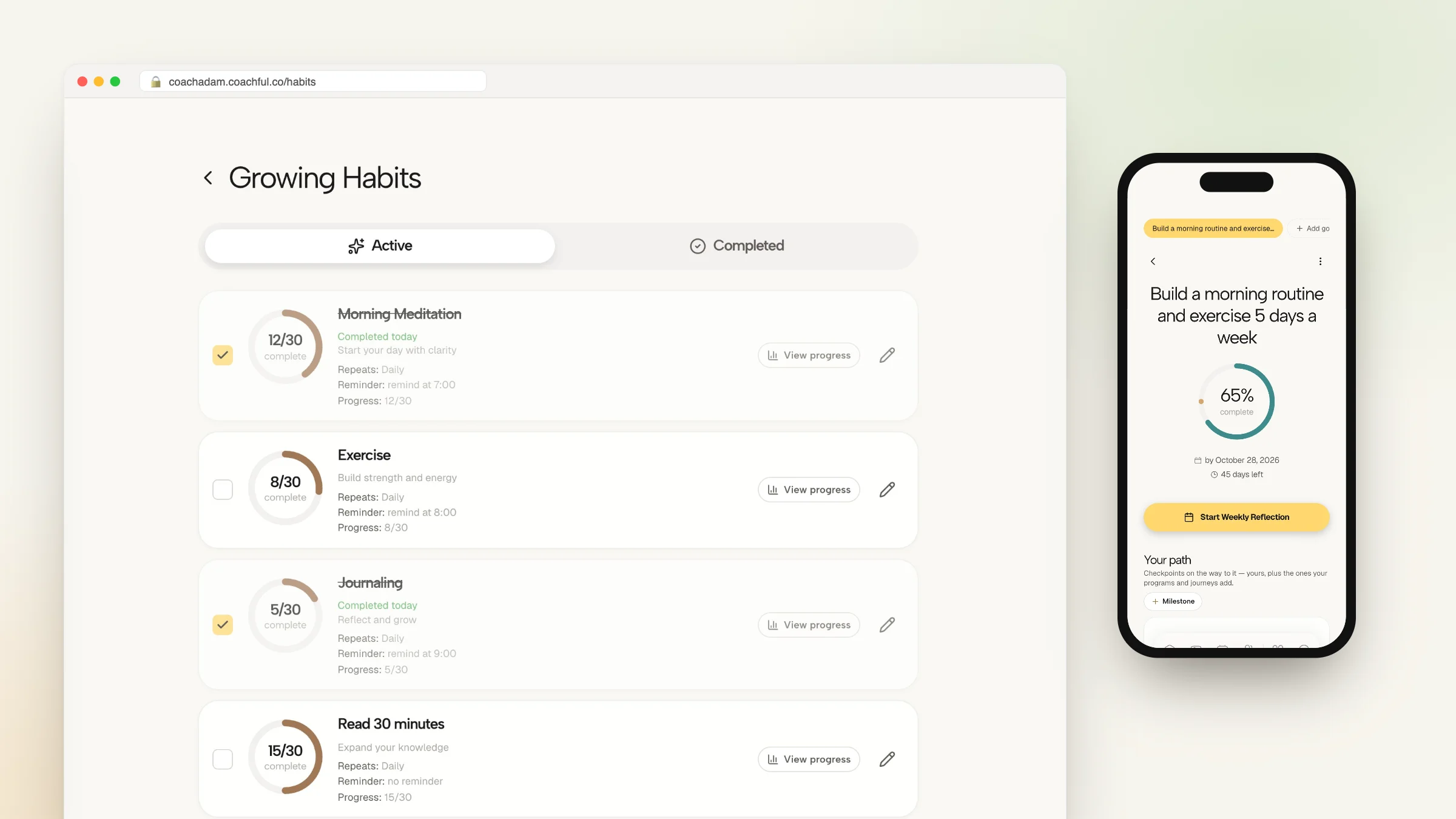
In Coachful's client app, that means daily habits with reminders and progress, goals with milestones and a weekly reflection, and morning or evening check-ins the coach can schedule, all set up by your coach.

Find a health coach on Coachful
Coachful's Find a Coach directory is open to anyone. Browse the Health and Fitness category, search for your goal ("blood pressure", "sleep", "menopause"), or switch to browsing programs. The Find My Coach quiz asks what you want to improve, where you are now, the style you prefer and your monthly budget, then suggests coaches. Profiles show each coach's background and programs, with a calendar to book a discovery call or a form to send a message. Ask about training and scope on that call.

Are you a health coach?
Clients compare you with apps that cost less than a lunch, so your website has to show what a person adds: screening, a plan built around their life and someone who notices. Coachful's team will build that website and a lead magnet funnel for you for free on every plan, usually within about 24 hours: see how the free build works. There is more in what Coachful offers health coaches and our guide to becoming a health coach.

Frequently asked questions
Is a health coach worth the money?
It is worth it when you have a specific goal and keep struggling to stick with the changes, especially alongside medical care. Trials found health coaching lowered HbA1c in type 2 diabetes and reduced blood pressure in hypertension. Expect $75 to $200 an hour or $900 to $2,000 for three months.
Does health coaching work for weight loss?
The evidence is weak. A 2021 meta-analysis of 38 studies rated the evidence very low quality, and the higher-quality studies found no effect of coaching alone on weight. Coaching can help you keep eating and activity habits, but be wary of anyone promising a set number of pounds.
How much does a health coach cost per month?
Ongoing monthly health coaching with two to four sessions and messaging typically costs $300 to $700 a month, and app-based programs with a weekly coach check-in $17 to $149 a month, according to practitioner reports compiled in Coachful's 2026 Coaching Business Report.
Is a health coach covered by insurance?
Usually not for private coaching, though some employer programs and insurers include it. Medicare covers its Diabetes Prevention Program under Part B for eligible people, and the CDC says some employers and insurers cover the National DPP lifestyle change program. Check with your insurer or HR team.
What is the difference between a health coach and a dietitian?
A registered dietitian is a licensed or credentialed clinician who can assess nutrition and provide medical nutrition therapy. A health coach helps you change habits and follow the plan your care team sets. NBHWC's scope of practice says that, acting as coaches, they do not provide nutrition consultation or create meal plans.
What credentials should a health coach have?
The National Board Certified Health and Wellness Coach (NBC-HWC) credential is the main US board certification. To sit the exam, developed with the NBME, a coach must complete an NBHWC-approved program, log 50 coaching sessions and have an associate degree or 4,000 hours of work experience. Health coaching is not licensed, so also ask about experience with your condition and how they work with doctors.
How long should I work with a health coach?
Three months is a common and sensible first commitment, long enough for habits to form and for your doctor to recheck key numbers. Many people then move to a lighter monthly plan. If nothing has changed in your habits by week six, change the plan or stop.












