
How to Become a Sales Coach: Skills, Training and Clients
How to become a sales coach, in short: build real selling experience first, usually several years carrying a target or running a sales team; learn to coach rather than just tell, through coach training; ground yourself in a sales method you can explain; choose who you will coach, such as individual reps, sales managers, founders who sell or a company's sales team; and package the work as a defined program built around call and deal reviews. No license is required, and there is no single official sales coaching certification.
Sales coaching sits between three jobs that people often mix up: the sales trainer who teaches a method to a room, the sales manager who coaches their own team, and the consultant who redesigns the sales process. A sales coach works with individuals or teams over weeks, reviewing real calls and deals and building the habits that move numbers. This guide covers who hires sales coaches, the training and methods worth knowing, how to choose a niche, a session method, pricing, first clients and the tools. Every Coachful plan also includes a free build of your website or program by our team, covered near the end.
What a sales coach does, and how it differs from similar roles
| Role | What they do | Typical format |
|---|---|---|
| Sales coach | Helps a person or team improve their own selling through reviews, questions, practice and accountability | Weekly or fortnightly sessions over months |
| Sales trainer | Teaches a method or skill to a group | Workshops and courses |
| Sales consultant | Diagnoses and redesigns the process, pipeline or pricing | A project with recommendations |
| Sales manager | Runs a team and coaches as part of the job | Employed role |
Coaching managers is part of a sales manager's job description. The BLS says sales managers plan and coordinate training for sales staff and may help staff with presentations, closing sales and ways to improve performance (BLS). That is why many sales coaches are former managers, and why one of the best niches is coaching managers to coach. For the general distinctions, see coaching vs consulting and coaching vs managing.
Who hires a sales coach
- Individual reps and account executives, paying themselves to hit target, earn more commission or move up.
- New sales managers, often promoted from top rep, who need to learn to coach instead of selling for their team.
- Founders and consultants who sell their own service and hate selling.
- Companies, usually through a sales leader or enablement team, for a group of reps or managers.
Individuals buy results they can feel in their commission. Companies buy behavior change across a team, measured in the pipeline. The two need different offers.
Step 1: Build the selling experience
Credibility in sales coaching comes mostly from having done the job. Clients will ask what you sold, to whom, and whether you hit target. There is no fixed number of years, but most sales coaches have carried a target for several years, managed a team, or built sales in their own business. If your experience is narrow, coach in that lane: a coach who sold software to mid-size companies is credible with software reps, less so with car dealerships.
Step 2: Learn to coach, not just tell
The hardest shift for experienced sellers is moving from "here's what I would do" to helping the client find what they will do. Telling works for a while; it stops working when the client is in a deal you are not on. Coach training teaches the questioning, listening and accountability skills that make change stick when you are not in the room.
- ICF-accredited coach training leads to the ICF's ACC, PCC and MCC credentials, which require logged coaching hours: 100+ hours with at least eight clients for the ACC, 500+ with 25 clients for the PCC (ICF). See ICF-accredited coaching programs and ICF certification.
- Corporate buyers are more likely to ask for a credential. Coachful's 2026 Coaching Business Report describes credentialing as "often mandatory" in corporate coaching and "preferred" in consumer coaching.
- Sales-specific coaching certification: in our October 2026 research we did not find an ICF-accredited program aimed specifically at sales coaching. Most sales coaches combine general coach training with sales methodology.
Our guide to coaching skills covers what the training develops.
Step 3: Ground yourself in a sales method
Clients want a coach who can explain why a call went wrong in a shared language. You do not need to sell a branded methodology, but you should know the main ones well. Two books most sales coaches know:
- SPIN Selling by Neil Rackham (McGraw-Hill, 1988). Built on research into 35,000 sales calls in more than 20 countries, it organizes discovery questions into Situation, Problem, Implication and Need-payoff (Wikipedia). Useful for coaching discovery calls.
- The Challenger Sale by Matthew Dixon and Brent Adamson (Portfolio/Penguin, 2011). It sorts reps into five profiles and argues that relationship-building alone is no longer the best approach for complex B2B buying (Wikipedia). Useful for coaching how reps lead a buyer's thinking.
Treat these as shared vocabulary rather than credentials. What matters is that you can watch a call, name what happened and help the client practice the alternative. Our guides to high-ticket sales training and the coaching sales script show the structure of a consultative call.
Step 4: Choose who you will coach
| Niche | Typical problem | A first offer |
|---|---|---|
| B2B account executives | Deals stall after the first meeting | A 90-day deal review program |
| New sales managers | Still selling instead of coaching the team | A manager coaching program with weekly one-to-ones reviewed |
| Founders who sell | Discovery calls that never close | A call review sprint with a written follow-up system |
| Consultants and agencies | Proposals that go quiet | A pipeline and follow-up program |
| A company's sales team | Inconsistent results across reps | A team engagement with group sessions and one-to-one reviews |
Pick the one where your experience is strongest. Our list of coaching niches has more options.

Step 5: Build a method you can run every week
A repeatable session method makes your coaching sellable and your results visible. A simple version:
- Numbers first: calls, meetings, proposals and closed deals since last session, against target.
- One call review: the client brings a recording or notes from a real call. What happened, what they intended, what they would do differently.
- One deal review: the stuck deal, the next step, and who else needs to be involved.
- Practice: role-play the conversation that is coming up.
- Commitments: two specific actions with dates.
Ask clients to bring calls only where recording is permitted and the other party has agreed, and treat buyer information as confidential. The ICF Code expects coaches to maintain strict confidentiality and agree what information is exchanged (ICF Code of Ethics). A short weekly review form helps clients arrive prepared.

Step 6: Package and price your sales coaching
Coachful's 2026 Coaching Business Report does not break out sales coaching as its own niche. The nearest figures are for business coaching, from the ICF's 2025 study, PayScale and practitioner reports:
| Package (business coaching benchmark) | Typical price |
|---|---|
| Per hour, typical range | $150 to $400 |
| Strategy kickstart: four sessions over four to six weeks | $1,200 to $2,400 |
| 90-day accelerator: eight to ten sessions | $3,000 to $6,000 |
| Monthly retainer: two to four sessions and on-call access | $1,500 to $4,000 a month |
| Organization-level B2B retainer (across niches) | $3,000 to $10,000 a month |
US dollars, Q2 2026. Details on coachingrates.com.
For a sense of what your clients earn, the BLS reports a median of $148,270 a year for sales managers in May 2025 (BLS), an adjacent occupation rather than a coach figure. Price individual programs against what a better quarter is worth to the client, and team engagements against the cost of a team missing target. More on setting prices in how much business coaches charge.

Step 7: Get your first sales coaching clients
- Start with your sales network: former reps you managed, peers now in leadership, and founders you sold to.
- Offer a paid deal or call review as a first step: one recording or one stuck deal, reviewed in 60 minutes, with written notes.
- Post call breakdowns on LinkedIn, anonymized: the question that changed a discovery call, the follow-up email that revived a deal.
- Partner with people who see sellers: sales recruiters, enablement leaders and founder communities.
- Pitch a team pilot to a sales leader: four reps, eight weeks, with a review of pipeline numbers at the end.
Never promise revenue or commission increases. The FTC has warned that no one can guarantee you will make lots of money with little to no risk (FTC). Our guides to getting clients as a business coach and getting coaching clients on LinkedIn go deeper.

Step 8: Set up the tools your practice runs on
A sales coaching practice needs booking, payments, a place for reviews and notes, and a way to run groups. On Coachful:
- The Business Growth power-up's Sales edition sets each client's weekly scorecard to calls, meetings, proposals and closed deals against targets, with a deals tracker for every opportunity, its stage and the next follow-up, plus quarterly goals with weekly commitments and a hit rate.
- Programs for a 90-day sprint, with tasks, check-ins and forms for weekly call reviews.
- Courses to carry the teaching, so sessions stay for coaching.
- Groups for team engagements, with a cohort space created on enrollment.
- Agreements, sponsors and invoices, so a company can be billed while the coaching stays with each rep.
- Payments through your own Stripe account with a 0% Coachful platform fee.
Our page for sales coaches has the full setup, and best software for sales coaches compares options.


How long it takes and what it costs to start
| Stage | Typical timing |
|---|---|
| Selling or sales management experience | Usually several years, from your earlier career |
| Coach training to ACC level | A few months part time, depending on the program |
| 100 coaching hours for the ACC | About a year part time, faster with group work |
| A first paid client | Often within weeks, through your sales network |
| A full practice | Depends on your network and pipeline more than your credential |
These are typical patterns, not measured figures. Start-up costs are mostly coach training, a website and your platform. For the full picture, see what it costs to start a coaching business.
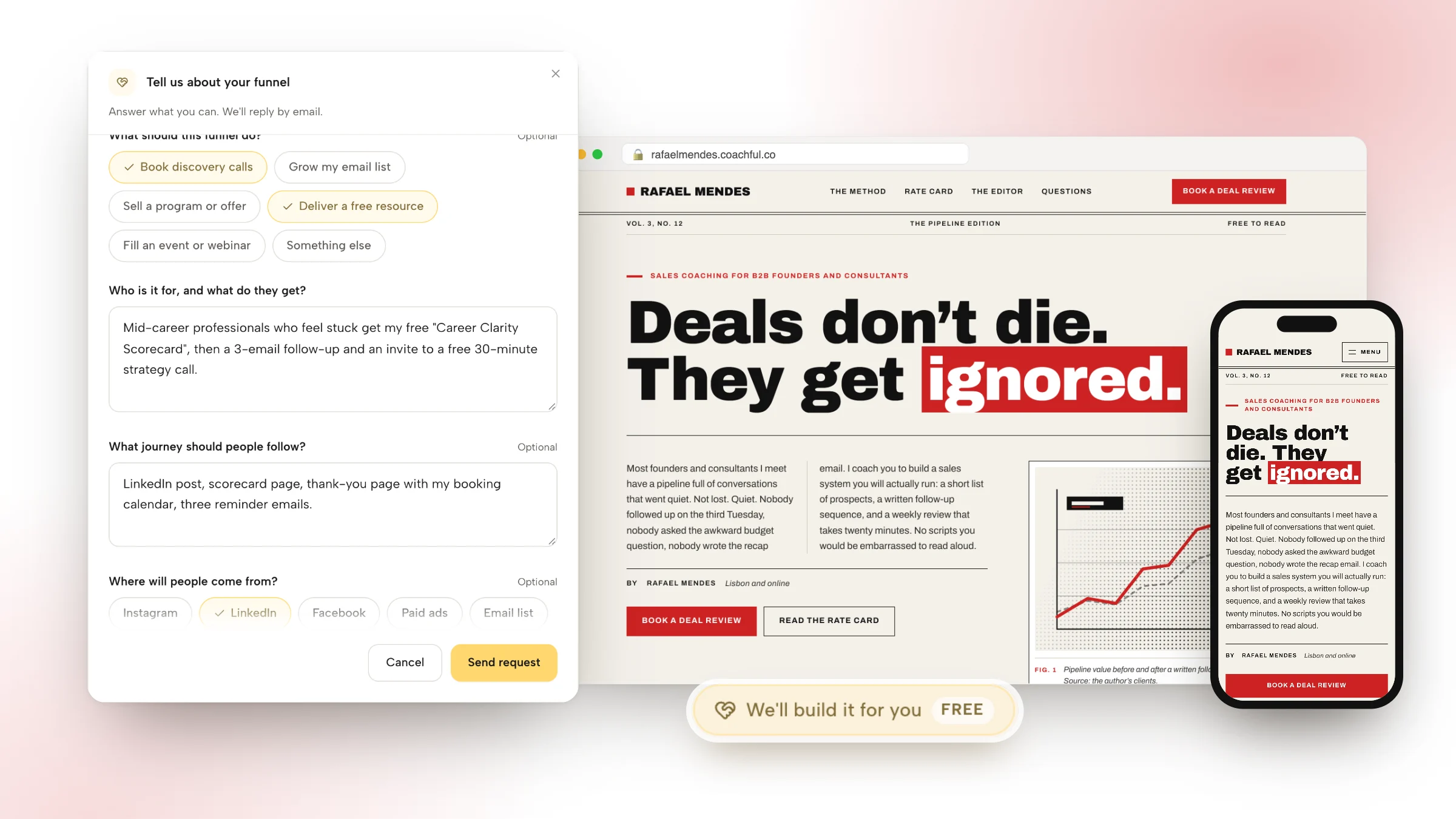
Have your website and first program built for you
Every Coachful plan includes a free white-glove build. From Create, choose "We'll build it for you · FREE" and pick what you need: a website, a funnel for a deal review offer, a program or a sales page. The form takes up to eight reference links and ten files, such as your logo, your method notes and a one-page outline. The Coachful team replies by email, usually within about 24 hours, and builds it in your account, so you can edit everything afterwards. Courses are built as structure and written material; you record any videos.

Frequently asked questions
Do you need a certification to be a sales coach?
No. Sales coaching is unregulated and no license is required. Coach training, such as an ICF-accredited program, builds coaching skill, and corporate buyers are more likely to ask for a credential. Most clients care most about your selling experience and results.
What qualifications does a sales coach need?
Real selling or sales management experience, coaching skills from training and practice, fluency in at least one sales method, and the ability to review calls and deals constructively. A credential such as the ICF ACC helps with corporate buyers.
How much do sales coaches charge?
There is no reliable survey of sales coach rates. The closest benchmark, business coaching in Coachful's 2026 Coaching Business Report, runs $150 to $400 an hour, with 90-day programs at $3,000 to $6,000. The same report lists organization-level retainers across niches at $3,000 to $10,000 a month.
Is there a sales coaching certification?
Not one official credential. Many training providers issue their own certificates, and some sales methodologies offer training. In our research we did not find an ICF-accredited program specifically for sales coaching, so most coaches combine general coach training with sales methods.
How do I get my first sales coaching client?
Start with your sales network: reps you managed, peers now in leadership and founders you sold to. Offer a paid call or deal review as a first step, then invite good fits into a 90-day program.
Can Coachful build my sales coaching website for free?
Yes. Every Coachful plan includes a free white-glove build. Describe your website, funnel or program in a short form, attach your materials, and the team builds it in your account, usually within about 24 hours.
What is the difference between a sales coach and a sales trainer?
A trainer teaches a method to a group, usually in workshops. A coach works with individuals or a team over weeks, reviewing their real calls and deals and holding them to specific changes. Many sales coaches do both.












