High Ticket Sales Training to Master Your Coaching Business

Coachful
Real high-ticket sales training isn't about memorizing clever scripts or aggressive closing tactics. It all starts with a crucial mindset shift—moving away from the idea of trading your time for money. It's about fundamentally reframing your expertise as the key to a guaranteed transformation, which gives you the confidence to ask for premium prices like $5,000 or $10,000 because you know, deep down, the immense value you deliver.
The Mindset Shift for High-Ticket Success
Let’s get real for a moment. The thought of putting a $5,000, $10,000, or even $25,000 price tag on your coaching program is probably sending a jolt of fear through you. That number alone can unleash a torrent of self-doubt.
I've heard these exact thoughts from hundreds of coaches I've worked with:
- "Am I really worth that much?"
- "Who on earth would pay me for this?"
- "I feel like a total fraud even thinking about that price."
This inner monologue is the single biggest roadblock between you and a truly profitable, sustainable coaching business. It's the voice of the old employee mindset, where your value is directly tied to the hours you put in. The most effective high-ticket training isn't about learning slick sales lines; it's about silencing that inner critic by completely reshaping how you see your own expertise.
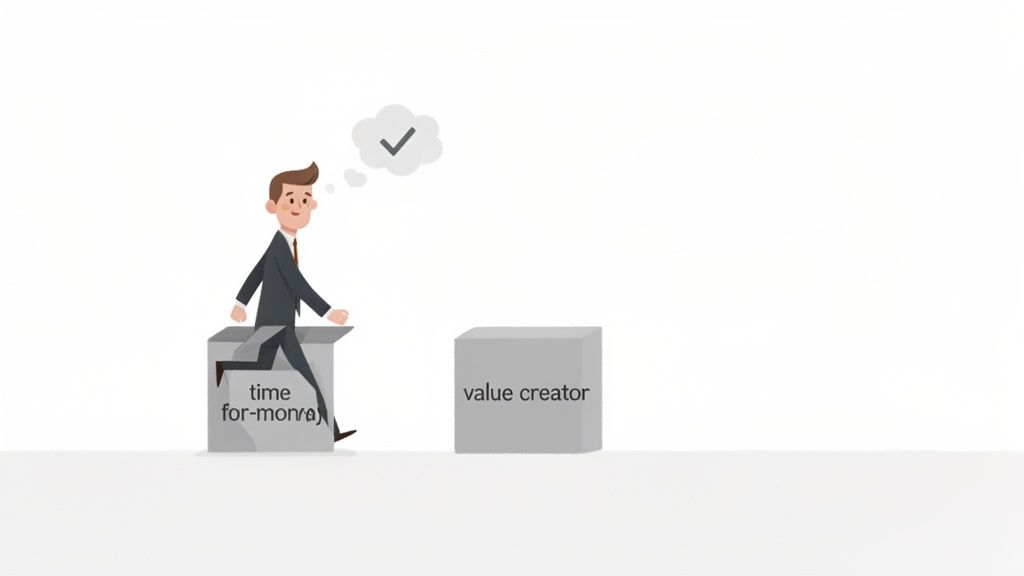
From Hourly Helper to Value Creator
Most coaches I know started out charging by the hour or per session. It feels safe and familiar, right? But it’s a trap that caps your income, forces you to juggle an impossible number of clients, and leads straight to burnout.
The first step to breaking free is understanding one critical distinction: high-level clients are not buying your time.
They are investing in a transformation. They have a painful, expensive problem, and what they want is a clear, reliable path to a solution. They honestly don't care if it takes you one hour or one hundred. They just care about the end result.
Key Insight: Your high-ticket price isn't a fee for your coaching sessions. It's an investment in a specific, life-changing outcome. You're selling certainty and a solved problem, not a spot on your calendar.
Think of it this way: if a business owner has a team dysfunction problem that's costing them $100,000 a year in lost productivity and high turnover, is a $10,000 solution to make that problem go away forever expensive? Not a chance. It's an incredible value. This is the exact perspective your ideal clients bring to the table.
To truly grasp this shift, it helps to see how the two models stack up against each other.
Comparing Low-Ticket vs. High-Ticket Coaching Models
This table lays out the fundamental differences in everything from client outcomes to your own sanity as a coach.
| Attribute | Low-Ticket Model ($50 - $500) | High-Ticket Model ($3,000 - $25,000+) |
|---|---|---|
| Primary Focus | Selling time or information. | Selling a transformational outcome. |
| Client Commitment | Low. Clients have little "skin in the game." | High. The investment ensures they are committed. |
| Client Results | Often partial or incomplete. | Typically dramatic and life-changing. |
| Coach Workload | High volume of clients, often leading to burnout. | Low volume of dedicated clients. |
| Income Potential | Capped by the number of hours you can work. | Scalable and uncapped. |
| Business Model | Trading time for money. | Creating and delivering value. |
Moving to a high-ticket model isn't just about charging more; it's a strategic decision to deliver deeper results for a select group of clients, which in turn builds a more sustainable and fulfilling business for you.
Why Premium Clients Crave Premium Solutions
It’s a common myth that high-ticket buyers are just "rich." In my experience, they are simply decisive people who value their time and are sick of trial-and-error. They've usually already tried cheaper, DIY solutions that didn't work, costing them both time and money.
They are actively looking for a premium guide because:
- They Want a Specialist, Not a Generalist: A high price signals deep expertise and a focused approach. It immediately tells them you are the expert for their specific problem.
- They Value a Clear Process: A structured, high-ticket program promises a reliable system, not just a collection of vague tips. They’re buying a proven roadmap to get from their current pain to their desired future.
- They Are Committed to Getting a Result: A significant financial investment is a commitment device. They have serious skin in the game, which makes them better clients who achieve far better results.
Your confidence in your price is a direct reflection of your confidence in the results you deliver. Once you truly believe in the transformation your program creates, asking for $10,000 stops feeling like a scary, audacious request. It becomes the logical price for the value being exchanged.
The demand for these advanced skills is undeniable. The global sales training market is projected to hit USD 18.94 billion by 2033, which shows just how much businesses recognize the need for value-driven sales expertise. You can see more details in this analysis of sales training market growth. Making this mental shift is your ticket out of the time-for-money trap for good.
Designing Your Irresistible High Ticket Offer
Let’s be honest, the real reason most coaches struggle to command premium prices isn't a lack of expertise. It's that they haven't packaged their genius into an offer so valuable that the price tag feels like a no-brainer.
You’re probably wondering, “How do I take everything I know and turn it into something that’s actually worth $10,000?” This is the million-dollar question, and it's where most coaches get stuck.
It’s not about just listing your services or promising a vague destination. You need to build a reliable vehicle for change—a structured, step-by-step journey that guarantees you can get your client from where they are to where they want to be.
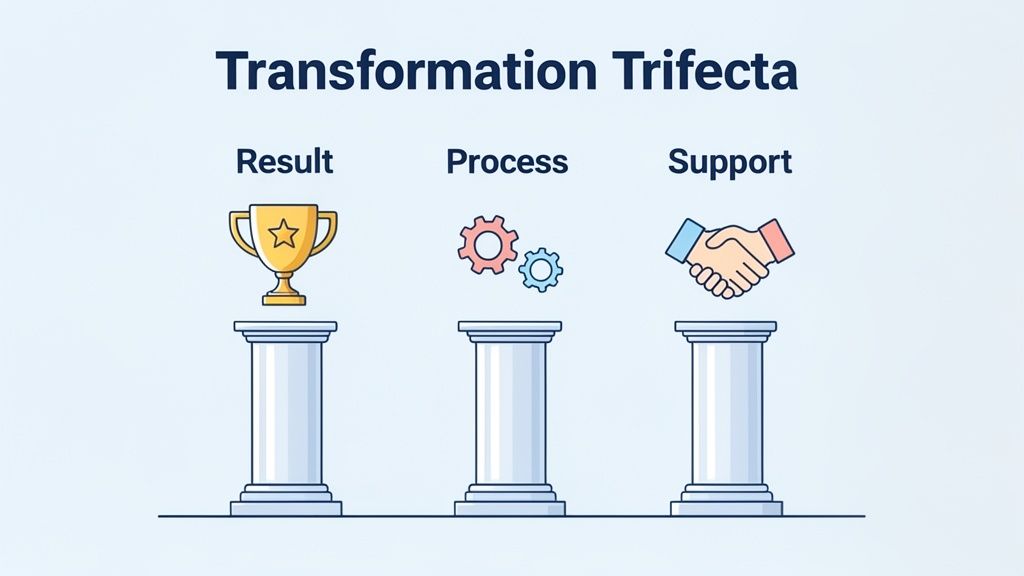
The Transformation Trifecta Method
I’ve seen this work time and time again. The most successful high-ticket offers are built on three fundamental pillars. Get these right, and you stop selling individual coaching sessions and start delivering a complete, premium solution.
First up is a Specific, Quantifiable Result. Vague promises like "more confidence" just don't cut it. They’re impossible to measure and, frankly, they don’t sell. You have to nail down the single biggest, most desirable outcome your client will achieve.
Next, you need a Proprietary Process. This is your unique roadmap, your secret sauce. Give your method a name! This makes it feel tangible and signals to clients that you have a proven system, not just a series of random chats.
Finally, there's High-Touch Support. High-ticket clients are paying for access and accountability. This doesn't mean you need to be on call 24/7. It means providing structured support that makes them feel guided and secure every step of the way.
Imagine a wellness coach trying to sell a "stress reduction" package. They’d be lucky to get a few hundred dollars. But by using the Transformation Trifecta, they can create a $7,500 "Executive Burnout Recovery" program.
- The Result: Go from completely overwhelmed to reclaiming 10+ hours per week and sleeping through the night—all in 90 days.
- The Process: A 12-week program called "The Energy Renewal Method," with clear phases for diagnosis, implementation, and long-term optimization.
- The Support: Weekly 1-on-1 calls, daily accountability check-ins via a private portal, and access to curated resources for nutrition and mindfulness.
See the difference? That’s the pivot from a generic service to a structured, high-value program.
Building Your Offer's Components
So, what actually goes into your signature program? Think of it like assembling a toolkit for your client's transformation. You want to combine different elements to create a complete support system.
Your offer needs to be a blend of teaching, coaching, and implementation. Give clients the 'what to do' and the 'how to do it,' then add the accountability to make sure it gets done.
Here are a few powerful components I recommend considering:
- Core Curriculum: A library of video modules or guides that teaches your proprietary process. This is the foundation.
- 1-on-1 Coaching Calls: The non-negotiable part. This is where the personalized strategy and deep-dive coaching happens.
- Implementation Weeks: I love these. It’s dedicated time within your program where the only goal is taking action, with you right there to help.
- Done-With-You Support: This adds massive value. Help a client build out something tangible, like their webinar slides or a new hire onboarding plan.
- Expert Reviews: Offer to provide detailed feedback on their work, like reviewing their sales copy or a difficult email they need to send.
Combining these elements is what justifies the premium price. If you’re still feeling uncertain about the numbers, our guide on how to price consulting services can give you a solid framework.
This move toward creating bespoke solutions is a major trend. In fact, investment in commercial sensitivity training hours saw a 27% increase from 2024 to 2025. As you can see in this 2025 sales training analysis from Lepaya, businesses are realizing that human judgment and empathy are critical for crafting the high-value solutions that define a powerful high-ticket offer.
When you design your program with these specific, tangible components, you stop selling your time by the hour. You start selling a predictable, powerful, and truly irresistible transformation. That's the difference between a coach who struggles and one who thrives.
The Art of the High-Ticket Sales Conversation
Let's talk about the moment of truth: the sales call. I know what’s probably running through your mind. “What if I blank on what to say? How do I even mention a five-figure price without my voice cracking? What if they just say no?”
Believe me, we’ve all been there. But those fears are rooted in a fundamental misunderstanding of your role. The single most important shift you can make in high ticket sales training is to stop thinking of this as a "pitch."
It's a consultation. You’re not a salesperson pushing a product; you’re an expert diagnosing a problem.
Your Job is to Diagnose, Not Pitch
Think about it. When you go to a specialist for a persistent issue, they don't greet you at the door with a list of surgical options and their prices. They ask questions. They listen intently. They work to understand the root cause of your pain before ever suggesting a solution.
That’s your entire job on this call. Your goal isn't to talk; it's to guide the prospect on a journey of self-discovery. You want them to articulate their own problems so clearly that your offer becomes the only logical next step. This all starts with leading with powerful diagnostic questions, not a premature list of your program's features.
When you make this mindset shift from seller to trusted consultant, your confidence naturally follows.
The Power of Asking the Right Questions
Great coaching is built on great questions, and the same is true for high-ticket sales. Your gut might be screaming, "Just tell them how you can help already!" Resist that urge. The real magic happens when they are the ones telling you why they desperately need your help.
Here are a few of the most effective types of questions I use to uncover the deep-seated issues:
- Problem Identification: A simple, open-ended start like, "Can you walk me through what's been happening that led you to book this call?" invites them to tell their story in their own words.
- Impact Exploration: Follow up with, "And what has the real-world impact of that been? How is it affecting revenue, or even your personal life?" This connects their business problem to tangible, and often emotional, consequences.
- Cost of Inaction: This one is critical. Ask, "If we're having this same conversation six months or a year from now, and nothing has changed, what does that look like?" This forces them to confront the future they're actively trying to avoid.
By guiding the conversation this way, you're not selling at all. You're co-creating the business case for change, and the prospect is the one holding the pen.
A key insight I've learned: People are infinitely more committed to a conclusion they reach on their own than one that is handed to them. Your questions are the signposts leading them to their own powerful realization: "I have a serious problem, and I need an expert to solve it."
Bridge the Gap from Pain to Possibility
Once the problem is painfully clear, it's time to pivot. You have to skillfully shift the focus from their current state of struggle to their desired future. Your job here is to make their dream outcome feel real, tangible, and—with your help—completely achievable.
Try asking questions that paint this picture:
- "In an ideal world, what would you love to be celebrating three months from now?"
- "If we could wave a magic wand and this entire challenge was solved, what would that unlock for you personally?"
- "What's the one big achievement that feels just out of reach for you right now?"
Their answers are gold. They give you the exact language to frame your offer. For example, if a prospect says, "I would be ecstatic if I could finally launch my group program and hit $20,000 in the first month," you now have your north star. Your offer is no longer just "coaching"; it's the specific bridge they need to get to a $20,000 launch.
For a more structured approach, a solid script or framework is invaluable. To see how this all fits together, grab our free Discovery Call Script Template, which lays out this entire conversational flow.
Handling Objections as Requests for More Certainty
No matter how well the call goes, you'll face objections. The most common is almost always about price: "I can't afford it." Your immediate instinct will be to get defensive or start justifying your fee. Don't do it.
An objection is rarely a final "no." It's usually a request for more information or a plea for more certainty.
Here's how you can reframe the most common objections with empathy and authority:
| Objection | The Real Question Being Asked | Your Empathetic Response |
|---|---|---|
| "It's too expensive." | "I'm not yet convinced the value outweighs the cost." | "I understand it's a significant investment. Can we quickly revisit the financial impact this problem is costing your business each month?" |
| "I need to think about it." | "I'm scared of making the wrong decision." | "Of course. It's a big decision. What specific part of this plan is giving you pause? Let's talk through that piece right now." |
| "I'm not sure if it will work for me." | "I've been burned before, and I don't want it to happen again." | "That's a completely fair concern. Many of my best clients felt the same way at first. Can you tell me what happened in your past experience?" |
When you master this conversational flow—Diagnose the pain, Bridge to the possibility, and Present your offer as the solution—the sales call stops being a terrifying performance. It becomes a natural, collaborative consultation where saying "yes" is the easiest and most logical conclusion.
Generating and Qualifying Premium Leads
So, you’ve built an incredible, high-value offer and you have a solid conversation framework ready to go. But a powerful engine is useless without fuel. The question that's probably keeping you up at night is, “Where do I actually find people who can afford this? And how do I stop wasting my time on calls with people who were never going to invest anyway?”
Let's be clear: you can't just boost an Instagram post and hope for the best. Premium clients require a premium approach. What you need are intentional, repeatable systems that attract genuine buyers, not just curious onlookers who will drain your calendar.
This is exactly where so many coaches get stuck, burning themselves out on an endless treadmill of dead-end discovery calls. The secret to effective high ticket sales training is having lead generation strategies that are built specifically for a sophisticated audience. Let’s walk through three proven systems that will fill your calendar with prospects who are actually ready to invest.
Lead Generation Systems for Premium Clients
Forget casting a wide net and hoping something sticks. High-ticket lead generation is all about precision, positioning, and authority. Instead of shouting into the void, you'll be strategically placing yourself right where your ideal clients are already looking for answers.
Here are three methods I’ve seen work exceptionally well:
The Expert Workshop Funnel: Host a live, value-packed workshop or webinar that teaches a small but crucial piece of your proprietary method. The goal isn't to sell on the spot, but to pre-sell by proving your expertise and giving attendees a tangible win. This naturally filters for motivated people who resonate with your style and are hungry for the next step.
Strategic Partnering: Go find other professionals who serve the same ideal client but don't compete with you. Think of a business coach partnering with a fractional CFO, or a health coach teaming up with a personal trainer. When you build these genuine referral relationships, you get introduced to warm, pre-vetted leads who already trust the person sending them your way.
The Organic Authority Method: Consistently create and share high-value, problem-solving content on platforms where your clients hang out, like LinkedIn or niche Facebook groups. This isn’t about random posts. It’s about becoming the go-to authority who provides such insightful solutions that you become the obvious choice when they're finally ready to invest. Our guide on how to get coaching clients dives even deeper into these kinds of strategies.
This whole process is about creating a structured conversation that builds value and trust before you ever talk about price. It's a fundamental shift from traditional selling.
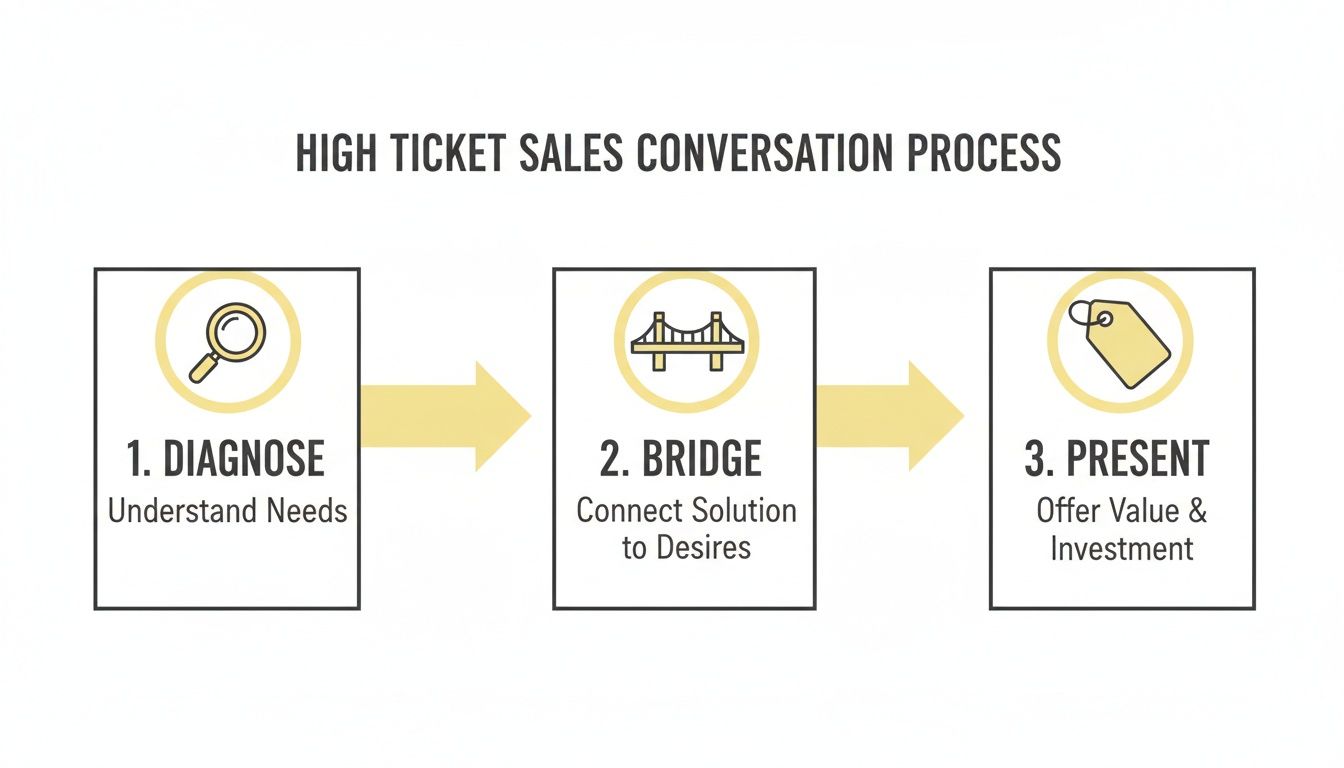
As you can see, this structured flow moves from diagnosis to solution, laying the groundwork that makes the investment feel like the logical next step for the right person.
Stop Wasting Time with a Qualification Scorecard
Once those leads start trickling in, you absolutely need a system to protect your time. A critical skill in this game is learning how to qualify leads in sales so you can focus your energy only on the people who are a perfect fit.
The best way to do this is with a simple application form. Before anyone can book a call on your calendar, they have to answer a few key questions that reveal whether they’re a strong potential client.
Your goal is not to get on more calls. It's to get on more of the right calls. A simple application form is your most valuable gatekeeper.
From there, you can create a simple scoring system to see if they meet your minimum threshold for a full conversation. Here are a few criteria you can score:
- Problem Urgency: Is this a "hair on fire" problem they need to solve right now? (High score) Or is it a "nice-to-have" idea for someday in the future? (Low score)
- Decision-Making Authority: Are they the one who writes the checks and makes the final call? (High score) Or do they need to get approval from a business partner, spouse, or committee? (Medium score)
- Financial Capacity: Do their answers (e.g., about their business revenue or past investments in themselves) suggest they can realistically afford your premium solution? (High score)
This simple scorecard ensures you only invest your valuable time speaking with people who are truly ready and able to move forward. It’s also a powerful positioning tool—serious clients respect a process that values everyone’s time.
The need for a clear, repeatable system like this is huge. While 64% of leaders believe they are coaching their teams more often, a staggering 45% of sales reps find that coaching to be below average. Providing a clear, effective system isn't just a good idea; it's a powerful value proposition in itself.
Delivering a World-Class Client Experience
The sale is closed. The invoice is paid. The adrenaline from the sales call finally starts to fade, and a new thought creeps in: “Oh wow, they actually said yes. What happens now?”
If that question sends a jolt of panic through you, you’re not alone. The moments immediately following a high-ticket investment are critical. A clunky, disorganized, or silent experience can trigger instant buyer's remorse, making your new client question the massive decision they just made.
This isn't just about sending a receipt. This is your first real chance to prove their investment was a wise one. A premium delivery experience is a core part of your high ticket sales training because it directly fuels the glowing testimonials and word-of-mouth referrals that make future sales so much easier.
Crafting a Premium Onboarding Sequence
Your goal is to make your new client feel seen, celebrated, and secure from the moment they pay. A world-class onboarding process isn't just a list of tasks; it’s a strategic experience designed to build momentum and reinforce their confidence in you.
This process should feel personal, organized, and impressive. It immediately validates their decision and sets the tone for the high-level work to come.
Put yourself in their shoes for a second. They just made a huge financial leap of faith. Your immediate actions need to show them they landed safely.
The Critical First 72 Hours
The first three days after the sale are when buyer's remorse is at its absolute peak. Your job is to replace that anxiety with excitement and a clear sense of direction. A simple yet powerful blueprint for these initial hours can make all the difference.
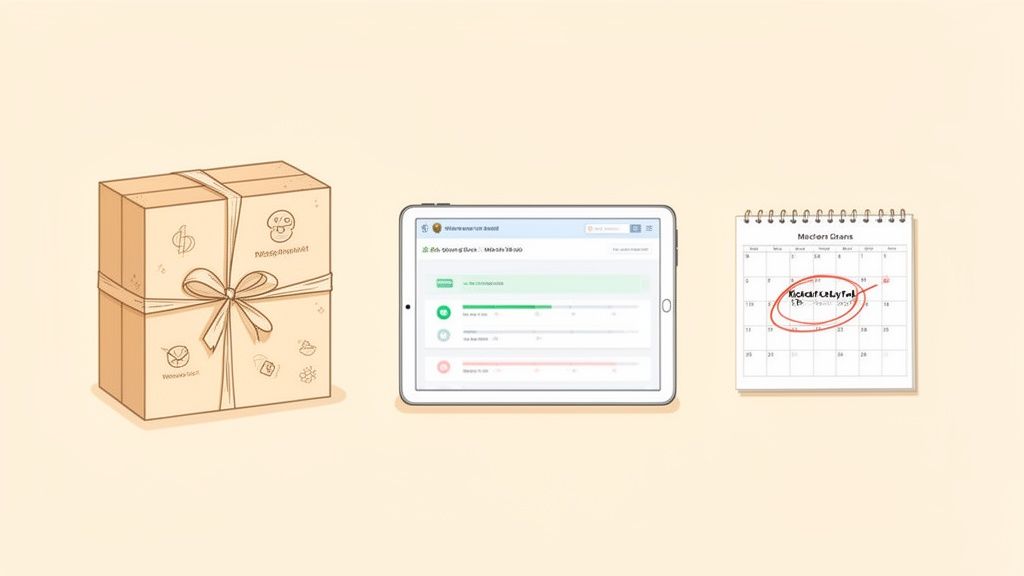
The Instant Welcome The second their payment goes through, they need to receive more than just an automated receipt. A personalized video message from you—even a quick one recorded on your phone—saying, "Welcome to the program, [Client Name]! I'm so excited to get started with you," works wonders.
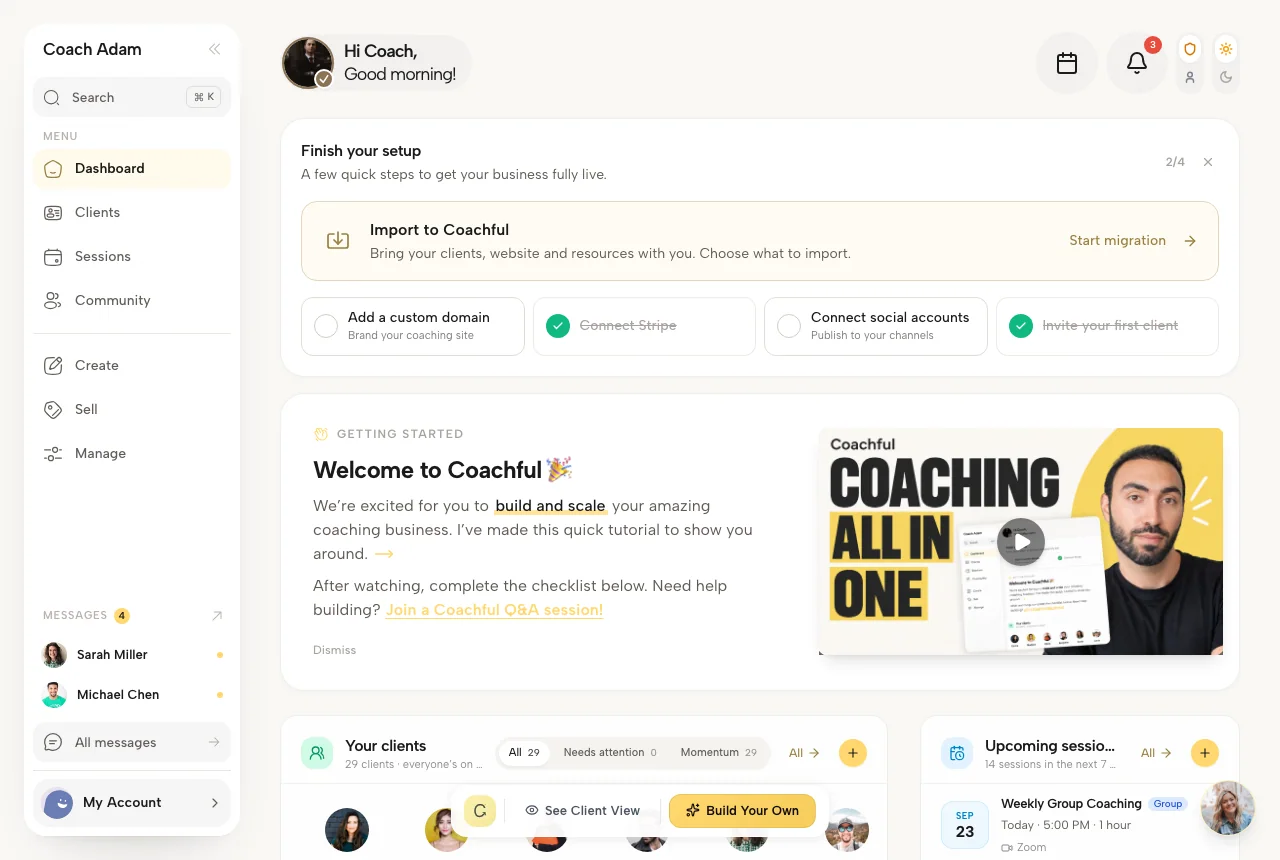
The Digital Welcome Kit Within a few hours, follow up with a beautifully designed email containing everything they need. This should include access to their client portal, a link to book their kickoff call, and a clear outline of the next steps. Platforms like Coachuful make it easy to create a professional, branded client portal that houses everything in one place.
The Surprise and Delight This is a true power move for high-ticket offers. A few days later, arrange for a physical welcome kit to arrive at their door. It doesn’t have to be expensive—a branded journal, a high-quality pen, and a handwritten welcome note can make an unforgettable impression.
This carefully orchestrated sequence does more than just onboard a client; it creates an experience.
A seamless onboarding process is your best marketing tool. It’s the first chapter in the success story your client will eventually tell others about working with you.
Setting the Stage for Success
Once the initial welcome is complete, the focus shifts to setting crystal-clear expectations and establishing a roadmap for their journey. The kickoff call is your dedicated time to make this official.
During this call, you absolutely must cover these points:
- Reiterate the Vision: Remind them of the incredible outcome they are working toward and why they started this in the first place.
- Establish Key Milestones: Break down their journey into clear, achievable steps. Use a tool like Coachuful to map these milestones in their client portal so they can track their own progress.
- Set the Communication Cadence: Clearly define how you'll connect—will it be weekly calls, daily check-ins via the portal, or monthly progress reviews?
When a client knows exactly what to expect, they feel secure. This isn't just about managing a project; it’s about leading your client toward their goal with confidence and clarity. This level of organization is what separates a good coach from a truly premium one.
Your Toughest High-Ticket Sales Questions, Answered
Stepping into the world of premium coaching brings up a lot of "what ifs." That's totally normal. These questions aren't a sign you're on the wrong path; they're proof you're leveling up and thinking like a serious business owner.
Let's get straight to the real-world challenges and mental hurdles I see coaches face all the time and give you some clear, no-fluff answers.
How Do I Price My First High-Ticket Offer?
You're staring at a blank page, that cursor blinking, and the question "What number do I even put here?" is screaming in your head. I get it. Pricing your first premium offer feels huge, but it's not a number you pull out of thin air. It’s a value calculation.
First, you have to completely forget what you used to charge per hour. That model is dead and gone. The only metric that matters now is the value of the transformation you provide.
Think about it this way: if your program helps a marketing consultant land just one extra client worth $10,000, is your program worth $5,000? Without a doubt. That's the heart of value-based pricing.
A solid rule of thumb is to price your offer at 10-20% of the tangible financial return your client can expect. If you can confidently say you'll help a business owner generate an extra $50,000, then a $5,000 - $10,000 price point isn't just fair—it's an incredible investment for them.
"But what if my coaching doesn't have a direct financial ROI?" I hear this from relationship coaches, health coaches, and life coaches all the time. The answer is to frame the value around the cost of inaction. A messy divorce can easily run tens of thousands of dollars, not to mention the emotional wreckage. An $8,000 program that helps a couple rebuild their marriage has an almost immeasurable, life-altering value.
Your first move? Pick a price that feels a little scary but still believable to you. Maybe that's $3,000 or $5,000. It's high enough to attract committed clients and lets you build the confidence and case studies you'll need for your next price increase.
What if I Have No Testimonials for a High-Ticket Program?
This is the classic chicken-and-egg problem that paralyzes so many great coaches. You feel like you need testimonials to get high-ticket clients, but you can't get those testimonials without the clients.
Here’s the simple, proven workaround: run a "beta" or "founding members" round.
The key here is total transparency. Don't fake it 'til you make it. Instead, be honest and turn it into an exclusive opportunity. Reach out to a small group of your best past clients or warmest leads with an offer they can't refuse.
Here's what that sounds like:
"Hi [Name], I'm launching a brand-new, intensive 90-day program to help [their specific goal]. Since you'd be one of the very first people to go through it, I'm offering a few founding members a spot at a significantly reduced rate. All I'd ask for in return is your full commitment and a detailed testimonial when we're done."
This simple strategy does three powerful things at once:
- It Gathers Social Proof: You'll walk away with the exact case studies and success stories you need to sell the program at its full price with total confidence.
- It Refines Your Offer: You get to work out any kinks in your curriculum or delivery in a supportive, low-pressure environment.
- It Builds Momentum: You generate your first revenue and wins, creating amazing energy for your official public launch.
Is High-Ticket Only for Business or Career Coaches?
Absolutely not. This is one of the biggest and most limiting myths in the coaching industry. A high-ticket offer can work in any niche where you solve a painful, urgent problem and deliver a profound transformation. The price isn't tied to the industry; it's tied to the depth of the result.
Let's look at some real-world examples outside of business coaching:
- A Health Coach: A CEO is battling chronic fatigue and brain fog, which is tanking their ability to lead their company effectively. A $10,000 "Executive Performance & Longevity" program that gives them back their energy and focus is a no-brainer investment.
- A Parenting Coach: A family is at its breaking point with a defiant teenager, and the constant conflict is destroying their home life. An $8,000 intensive that restores peace and communication is truly life-changing.
- A Grief Counselor: A widow is completely stuck, unable to move forward in her life and career after losing her spouse. A $6,000 guided journey to process that grief and rediscover her purpose is a lifeline out of overwhelming pain.
If the problem is big enough and the cost of not solving it is high—whether financially, emotionally, or physically—people will gladly pay a premium for a real solution.
How Many Sales Calls Do I Even Need to Make?
When you hear the word "sales," you might picture a high-pressure call center where people are dialing for dollars all day. The beauty of a high-ticket model is that it's the complete opposite. Your new mantra is quality over quantity.
Because your price is higher, you don't need a hundred clients to build a wildly successful business. I know many coaches running six-figure practices who only close 2-4 new high-ticket clients per month.
To get those results, you might only need to have 8-12 qualified sales calls in an entire month. That's it.
Your focus shifts from a high-volume grind to having deep, meaningful consultations with a small number of perfectly-fit prospects. This is how you finally escape the burnout cycle, deliver world-class results for your clients, and build a truly sustainable and profitable business on your terms.
Ready to stop patching together different tools and start managing your high-ticket business like a pro? Coachuful gives you everything you need—from client portals and onboarding workflows to progress tracking and payments—all in one place. See how you can deliver a world-class experience.