
How to Get Clients as a Business Coach: A Practical Plan
How to get clients as a business coach, in short: go where owners already take advice. Accountants, bookkeepers, bankers and business lawyers see owners with the exact problems you coach, local business groups and industry associations book speakers, and owners read LinkedIn and industry newsletters for practical ideas. Make the first step a paid, fixed-price business review that uses the owner's own numbers, offer a group program for owners who are not ready for one-to-one, and ask for referrals when results show up.
Business coaching is crowded, and owners have learned to be wary: plenty of them have sat through a "free strategy session" that turned into a hard sell. The coaches who fill their calendars get around that by proving usefulness early, with numbers. This guide covers the channels that work for business coaches, the paid review that turns interest into clients, scripts, a 30-day plan and how to run it all. If you are still setting up, see how to become a business coach, and for the client system that applies to every coaching niche, how to get more clients as a coach. Every Coachful plan includes a free build of your website or funnel by our team, covered near the end.
The channels that bring business coaches clients
| Channel | Why owners trust it | Speed | What you need |
|---|---|---|---|
| Referral partners (accountants, bookkeepers, bankers, lawyers) | They already advise the owner on money | Slow to start, then steady | A clear niche and a one-page summary |
| Business groups and industry associations | Peers are in the room | Weeks | A 45-minute talk on one problem |
| A paid business review | It is useful even if they never hire you | Days, once you have demand | A questionnaire and a one-page plan template |
| LinkedIn, newsletters and podcasts | Owners hear how you think | Months | Specific, numbers-based content |
| Group programs and masterminds | Lower price, plus peers | Weeks | A cohort start date and a clear promise |
| Client referrals | A friend's results | After your first wins | A habit of asking at the right moment |
Choose one main channel and one supporting channel for the next 90 days. Referral partners plus a talk a month is a strong pair for coaches with a local market; LinkedIn plus a group program suits coaches who work online across regions.
Narrow down to a business type and a problem
"I help small businesses grow" is too broad to refer. An accountant can refer "I help trades businesses with five to twenty staff stop the owner doing every quote" or "I help salon owners raise prices without losing regulars". The niche can be an industry, a stage, a problem or all three. Coachful's 2026 Coaching Business Report rates business coaching as high in income potential and high in saturation, noting that the market is "crowded, but the buyer has a budget". A narrow niche is how you stand out in it. Our list of coaching niches and finding your niche help if you are undecided.

Channel 1: referral partners owners already trust
Accountants and bookkeepers see the numbers every month, and they see which owners are stuck. Business bankers see owners asking for credit to cover cash-flow gaps. Lawyers see partnership disputes and messy hires. All of them benefit when the owner's business is better run: fewer late filings, fewer emergencies, more growth to advise on.
How to set it up:
- Start with your own advisers and those of your past clients.
- Offer something to their clients first, such as a joint workshop on cash flow or pricing, rather than asking for referrals cold.
- Give them a one-page summary: who you help, the problems you solve, what an engagement looks like and how to refer.
- Report back, with the client's permission, so they know their referral went well.
- Be transparent about any referral fee. If money changes hands, tell the client. The ICF Code expects coaches to discuss and manage conflicts of interest with everyone involved (ICF Code of Ethics).
"Hi Tom, I coach trades business owners with five to twenty staff, mostly on pricing and getting out of day-to-day quoting. I suspect a few of your clients have that problem around year-end. Would a 45-minute session for them on reading their own margins be useful? I'd run it, you'd host, and there's no pitch on the night."
Channel 2: talks for business groups and associations
Chambers of commerce, networking groups, industry associations, coworking spaces and founder communities all need speakers. A talk puts you in front of 20 to 50 owners at once, and the ones who stay to ask questions are your warmest leads.
- Teach one problem with numbers: "Why your busiest month loses money" beats "Five keys to business growth".
- Give them something to do on the spot, such as working out their own gross margin on a worksheet.
- End with one offer: a paid business review at a talk-only price for the next two weeks, or a place in your next group cohort.
- Collect emails for the worksheet and follow up within 48 hours.
A note on volunteering: SCORE's mentors are volunteers who advise small businesses at no cost (SBA). Mentoring there is good service and good practice, but treat it as service rather than a sales channel. Our coaching workshop ideas have more formats.

Channel 3: a paid business review instead of a free strategy call
Owners are wary of free calls that turn into pitches. A short, paid, fixed-price review flips that: the owner gets something useful whatever happens, and you get paid for your thinking.
- Before the session: a questionnaire with revenue for the last 12 months, gross margin, number of customers, lead sources, conversion rate if known, team size and the owner's hours.
- The session, about 90 minutes: walk through the numbers, find the one constraint that matters most, and agree three actions for the next 30 days.
- Afterwards: a one-page written plan within two days.
- The offer: credit the review fee toward a 90-day program if they start within two weeks.
Price it at roughly one to two of your hourly rates. Coachful's 2026 Coaching Business Report puts business coaching at $150 to $400 an hour from the ICF's 2025 study and PayScale, so the review is affordable enough to say yes to and expensive enough to be taken seriously. You can still offer a short free call for people who want to check fit first; our comparison of discovery sessions and paid first sessions helps you choose.
Channel 4: LinkedIn, newsletters and podcasts for owners
Owners read practical, specific content: a breakdown of how a five-person agency raised prices, what a healthy margin looks like in a given trade, the weekly numbers to watch. Write that, with the numbers anonymized and the client's permission, and every post points to one place: the review, a short quiz, or your next workshop.
Podcasts for owners in your niche are especially good, because a 40-minute conversation shows how you think far better than a post. See how to get booked on podcasts, and for the profile and outreach side, getting coaching clients on LinkedIn.
One rule for every channel: never promise revenue. The FTC sued the coaching company Lurn for claiming buyers could easily earn six-figure incomes, and warns that "No one can guarantee you'll make lots of money with little to no risk" (FTC). Talk about the work and typical results instead.
Channel 5: group programs and masterminds
Plenty of owners who cannot afford one-to-one coaching will join a group, and many prefer it because of the peers. A cohort of eight to twenty owners with a shared promise, weekly calls and a place to post work between them is a good entry offer. The report puts group coaching programs at $500 to $3,000 and memberships at $47 to $197 a month, from practitioner reports.
Run the first cohort as a pilot at a lower price in exchange for feedback and testimonials, then raise the price for the second. Our guide to creating a group coaching program covers the structure, and early-bird pricing for group coaching covers the launch.


Pricing your business coaching offers
| Offer | Typical price | Source |
|---|---|---|
| Strategy kickstart: four sessions over four to six weeks | $1,200 to $2,400 | Practitioner reports |
| 90-day accelerator: eight to ten sessions | $3,000 to $6,000 | Practitioner reports |
| Six-month partnership: 12 to 16 sessions of 90 minutes | $6,000 to $15,000 | Practitioner reports |
| Monthly retainer: two to four sessions and on-call access | $1,500 to $4,000 a month | Practitioner reports |
US dollars, Q2 2026, from Coachful's 2026 Coaching Business Report. Details on coachingrates.com and in how much business coaches charge.

Messages you can copy
To an owner you met at a talk:
"Good to meet you on Thursday, Ana. You mentioned the busy months feel like the worst months. That's often a pricing and scheduling problem rather than a sales one. If it's useful, I do a 90-minute business review where we go through your numbers and you leave with a one-page plan. Details here: [link]."
Following up a review:
"Here's your one-page plan from Tuesday. The three actions for this month are at the top. If you'd like help putting them in place, the 90-day program starts on the 1st, and your review fee comes off the price until the 14th."
Asking for a referral after a result:
"You took your first two-week holiday in four years, and the business ran. That's the result we set in January. Do you know another owner who's where you were then? I'd be glad to talk to them."
A 30-day plan to get business coaching clients
| Days | Focus | Done when |
|---|---|---|
| 1 to 3 | Write your niche sentence. Build the review questionnaire and one-page plan template. | An accountant could repeat your sentence |
| 4 to 8 | Set up a booking page for the paid review and a short email sequence for workshop attendees. | Someone can book and pay on a phone |
| 9 to 14 | Contact five potential referral partners and two business groups. | Three conversations held, one talk booked |
| 15 to 21 | Message 20 owners you know. Publish three numbers-based posts. | Your first reviews booked |
| 22 to 30 | Run reviews, send plans within two days, invite each owner into the program. Count reviews, programs sold and sources. | You know your review-to-client rate |
Running it on Coachful
Coachful's Business Growth power-up gives every owner you coach a weekly scorecard of three to six numbers against their targets, a deals tracker with follow-ups, quarterly rocks with weekly commitments and a hit rate, and an offer and positioning canvas kept as versions. Editions set the defaults for founders, consultants or sales teams. Around it:
- Booking for the paid review, with intake questions attached so the numbers arrive before the call. See booking software.
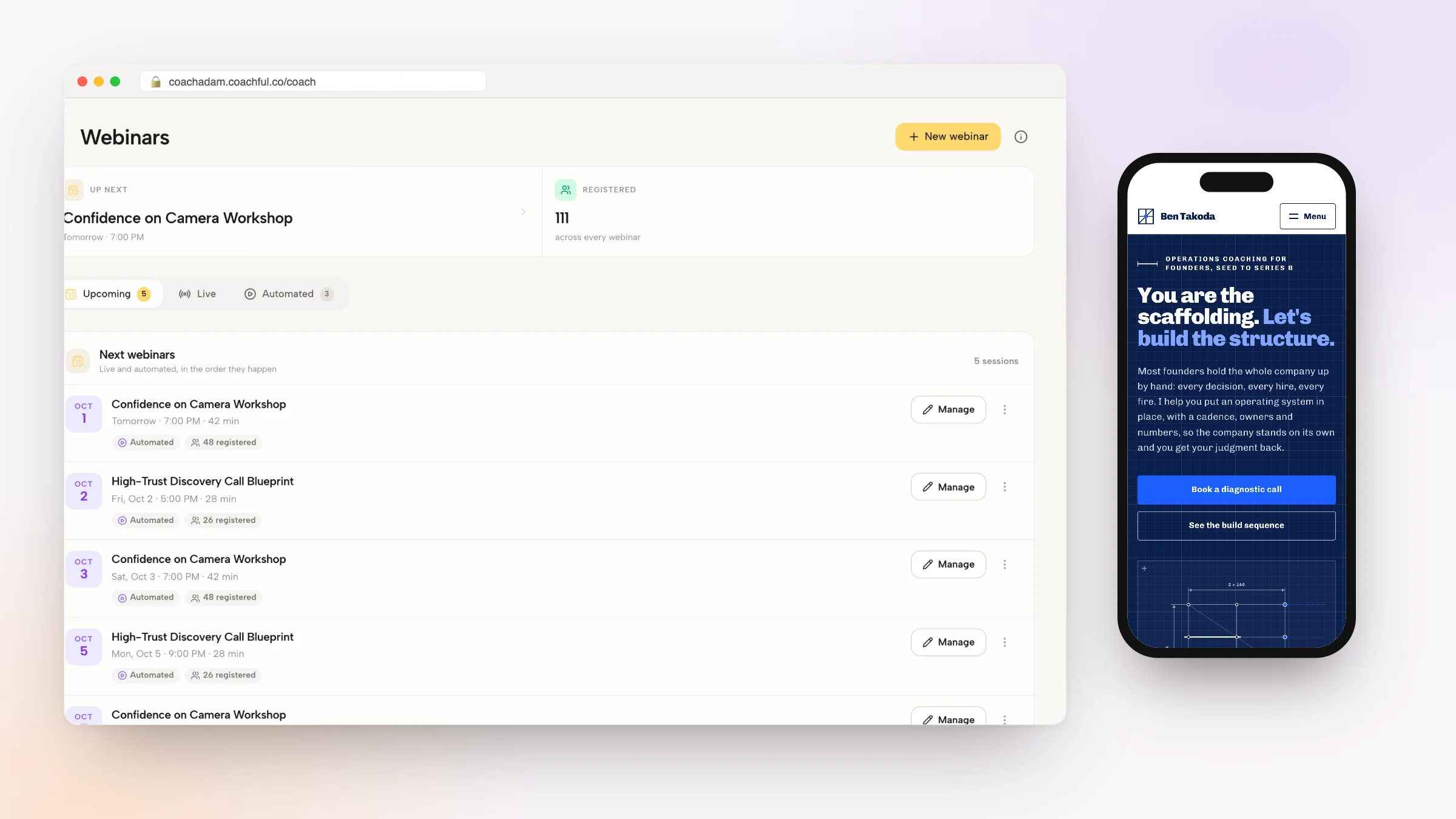
- Webinars and workshops, live or automated, with registrations recorded.
- Funnels for a pricing quiz, an application or a workshop sign-up, with templates for each. See funnel software.
- Offers and bundles with payment plans and subscriptions for retainers, paid into your own Stripe account with a 0% Coachful platform fee.
- Group programs with a cohort space created on enrollment. See group coaching software.
- Find a Coach, Coachful's public directory, with a Business category where owners search by problem.
For your own pipeline, the Diagnostics view names the stage where prospects drop out. Our page for business coaches has the full setup.

Have your sales page and funnel built for you
Every Coachful plan includes a free white-glove build. Open the "Want us to build it for you?" card on Website or Funnels, or choose "We'll build it for you" from Create, and describe what you need: a review booking page, a workshop funnel, an offer page. Add up to eight reference links and ten files. The team replies by email, usually within about 24 hours, and builds it in your account. A recent example: a business mentor for beauty professionals got a sales page and checkout for a 12-week mentorship, with her free guide funnel now leading into it. See business coach website for the pages owners look for.

If you want the whole client system built in order, with weekly live group support around you, the Coachful Collective is a 12-month program for coaches that includes a year of Coachful Pro. Our guide to business coaching for coaches explains who it suits.
Frequently asked questions
How do business coaches find clients?
Mostly through people owners already trust, such as accountants, bookkeepers, bankers and lawyers, through talks for business groups and industry associations, through LinkedIn and podcasts, and through referrals from clients. A paid business review makes a good first step.
How do I get my first business coaching client?
Message 20 owners you know with one sentence on who you help, and offer a paid business review that leaves them with a one-page plan. Ask your own accountant who they know with the problem you solve.
Should business coaches offer free strategy sessions?
A short free call to check fit is fine. Many owners are wary of long free sessions that turn into pitches, so a fixed-price review that is useful on its own often converts better and pays you for your time.
How much should a new business coach charge?
Coachful's 2026 Coaching Business Report puts newer business coaches at $100 to $200 an hour and 90-day programs of eight to ten sessions at $3,000 to $6,000. Sell defined programs rather than single hours.
Can I promise clients more revenue?
No. You do not control their revenue, and the FTC has acted against coaching companies over inflated income claims. Describe the work, the method and typical client results honestly.
Can Coachful build my business coaching website for free?
Yes. Every Coachful plan includes a free white-glove build. Describe the website, sales page or funnel in a short form, attach your logo and copy, and the team builds it in your account, usually within about 24 hours.
Are group programs a good way to get business coaching clients?
Yes, especially for owners who cannot afford one-to-one. A cohort of eight to twenty owners with weekly calls and a shared promise is a lower-risk entry point, and some members later move to one-to-one coaching.












