
Coaching vs Consulting: Key Differences and When to Use Each
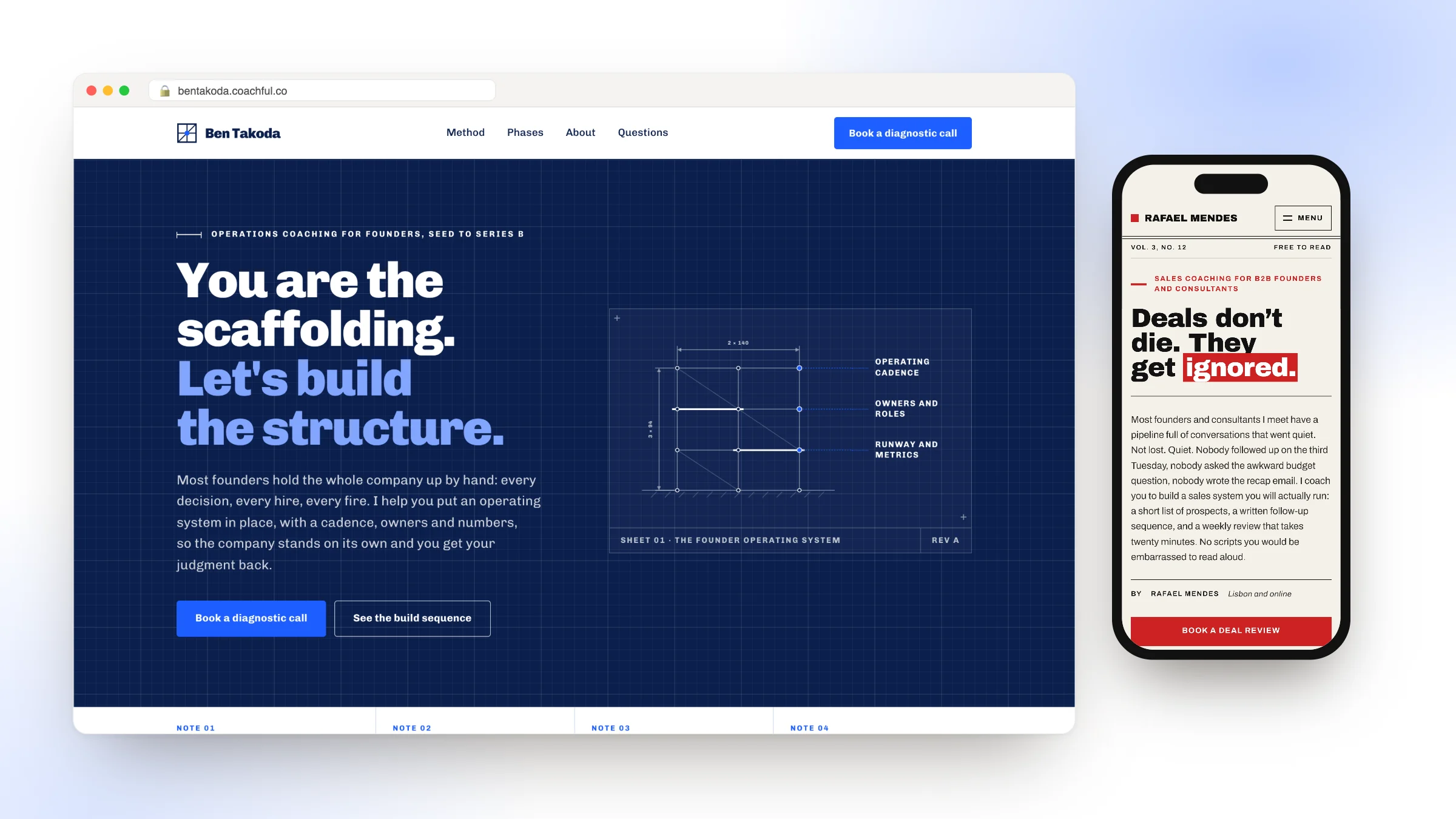
Coaching vs consulting comes down to who supplies the answer. A consultant brings expertise: they diagnose the problem, recommend a solution and sometimes implement it. A coach helps you find and act on your own answer, through questions, reflection and accountability. The International Coaching Federation's own distinction says consultants "diagnose problems, prescribe, and sometimes implement solutions," while coaching "assumes that individuals or teams are capable of generating their own solutions."
In practice many business and executive coaches do both, which is fine as long as everyone knows which one is happening. This guide gives a side-by-side comparison, an example of the same problem handled both ways, when to hire which, and how coaches can blend the two without confusing clients.
Coaching vs consulting at a glance
| Consulting | Coaching | |
|---|---|---|
| Core question | "What should we do?" | "What do you want, and what will you do?" |
| Who holds the expertise | The consultant, in the subject | The client, in their own situation; the coach, in the process |
| Main method | Analysis, diagnosis, recommendations | Questions, reflection, experiments, accountability |
| Typical output | A report, a plan, a system, an implementation | Decisions and behaviour change by the client |
| Who decides | The client, usually on the consultant's recommendation | The client, on their own reasoning |
| Who usually buys | Organisations, for a defined problem | Individuals, or employers on their behalf |
| Typical scope | A project with deliverables and an end date | A series of sessions over months |
| Success looks like | The recommended change is made and works | The client reaches their goal and can keep going alone |
| Regulation | Generally none for "consultant"; some fields need licences | None; voluntary credentials such as the ICF's |
The ICF quotes come from its published distinctions between coaching and other professions, reproduced in a University of North Texas handout (ICF distinctions). The same document separates coaching from mentoring, training and therapy; see coaching vs mentoring, coaching vs teaching and life coach vs therapist.
What a consultant does
The US Bureau of Labor Statistics describes management analysts, "often called management consultants," as people who "recommend ways to improve an organization's efficiency." Their listed duties include gathering information about the problem, interviewing staff, analysing financial and other data, developing solutions, recommending new systems or organisational changes, presenting recommendations to management and conferring with managers to ensure the changes are working (BLS). The BLS lists a median pay of $101,860 a year in 2025 for the occupation, which covers employed analysts, not independent consultants' fees.
The common thread: the consultant studies the problem and comes back with an answer. Clients pay for expertise they do not have, or time they cannot spare.

What a coach does
The ICF defines coaching as "partnering with clients in a thought-provoking and creative process that inspires them to maximize their personal and professional potential" (ICF). In a session, that means agreeing what the client wants from the conversation, listening closely, asking questions that change how they see the situation, and helping them turn insight into action they own. The ICF Core Competencies spell this out. A coach does not need to be an expert in the client's industry, though in business and executive coaching it often helps them ask better questions.
The evidence that this works is reasonable: three meta-analyses of workplace coaching have found moderate positive effects on work outcomes (Cannon-Bowers and colleagues, 2023).
The same problem, handled two ways
An illustrative example: the owner of a small bookkeeping firm says revenue is flat and the team is overloaded.
The consulting approach. The consultant reviews the client list, pricing and time records. They find that 30% of clients produce most of the overtime and pay the lowest rates. They recommend raising prices for those clients, moving three to a fixed monthly package and introducing a minimum fee, and they draft the price letter. Two weeks, one report, one clear plan.
The coaching approach.
Coach: When you say the team is overloaded, where does the week go?
Owner: Mostly chasing a handful of clients who send everything late.
Coach: What do those clients pay compared with the others?
Owner: [pause] Less. I gave them a discount years ago to win them.
Coach: What stops you changing that?
Owner: I'm worried they'll leave. And honestly, I hate those conversations.
Coach: What would you want to say to them, if you weren't worried?
The coach may arrive at the same insight, but the owner found it, and the session moves on to the real blocker: the conversations she avoids. The consultant's plan is faster to write. The coaching changes whether the plan gets carried out. Many owners need both.

When to hire a consultant, a coach, or both
| Situation | Better fit |
|---|---|
| You lack specific expertise: tax structure, a CRM migration, a pricing model | Consultant |
| You know what to do but keep not doing it | Coach |
| You need an outside analysis to show a board or investors | Consultant |
| The problem is how you lead, decide or communicate | Coach |
| You need someone to build or implement something | Consultant, or a done-for-you service |
| You have a plan and need help leading the change through people | Both: consultant for the plan, coach for the leader |
| You are not sure what the problem is | A short diagnostic with either, then decide |
Business coaches who consult, and consultants who coach
The lines blur most in business coaching. Clients often hire a business coach precisely because the coach has built a company, so they expect some advice. That is legitimate, with two conditions.
- Say which role you are in. "I'm going to step out of coaching for a minute and tell you what I'd do" is honest. Presenting advice as a leading question is not. The ICF Code of Ethics asks coaches to "disclose to the client when I am acting in a capacity other than the role of an ICF professional" (ICF Code of Ethics).
- Write both roles into the agreement. If a package includes a strategy review or a written plan, list it as a deliverable separate from the coaching sessions. Our guide to scoping coaching and consulting in employer-funded work shows how.
Organisational psychologist Edgar Schein, of the MIT Sloan School of Management, spent much of his career on what makes help actually helpful, in books including Process Consultation Revisited: Building the Helping Relationship (1998) and Humble Consulting: How to Provide Real Help Faster (2016). His work is a good starting point for anyone who switches between advising and coaching.

Coaching vs consulting for your career
If you are deciding which to offer, consider how you like to work and what clients will pay for.
- Consulting suits people with deep, specific expertise who enjoy analysis and delivering a finished product. Revenue is usually project-based.
- Coaching suits people who enjoy watching someone else work it out. Revenue is usually packages or retainers. Coachful's 2026 Coaching Business Report puts US business coaching at $150 to $400 an hour (ICF Global Coaching Study 2025 and PayScale), with 90-day accelerators of 8 to 10 sessions at $3,000 to $6,000 and monthly retainers at $1,500 to $4,000 (practitioner reports). See coachingrates.com and how much business coaches charge.
- Hybrid offers, such as a diagnostic plus coaching, are common in business coaching. Price the diagnostic as a project; our guide to pricing consulting services helps.
Credentials differ too. Coaching has voluntary credentials such as the ICF's ACC, PCC and MCC; see ICF certification. Consulting rarely has a single credential, and clients judge on track record.

Running a coaching or hybrid practice on Coachful
Coachful is built for coaching, and it handles the pieces a hybrid practice needs: offers and packages with payment, coaching agreements sent for e-signature before the first call, intake forms, session booking and notes, and programmes clients follow between sessions. A diagnostic can be sold as its own offer next to a coaching package. See Coachful for business coaches, coaching packages and what business coaching is.

If you would rather not build your website and offer pages yourself, Coachful's team will build them for free on every plan, usually within about 24 hours, inside your own account: see how the free build works.

Frequently asked questions
What is the main difference between coaching and consulting?
A consultant provides expert answers and often implements them. A coach helps you find your own answers and follow through. The ICF says consultants diagnose and prescribe, while coaching assumes clients can generate their own solutions.
Is a business coach the same as a business consultant?
Not exactly. A business consultant analyses your business and recommends changes. A business coach works with you as the owner on decisions, priorities and follow-through. Many business coaches add some consulting, which should be agreed in writing.
Can a coach give advice?
Yes, when the client wants it and the coach makes clear they are switching role. The ICF Code of Ethics asks coaches to disclose when they act in a capacity other than coach. See our guide to whether life coaches give advice.
Which is more expensive, coaching or consulting?
It depends on the scope. Consulting is usually priced per project, coaching per package or retainer. Coachful's 2026 Coaching Business Report puts US business coaching at $150 to $400 an hour. We have no comparable sourced figure for consulting fees, so compare actual quotes.
Should I hire a coach or a consultant for my small business?
Hire a consultant if you need expertise or a finished deliverable you do not have time to produce. Hire a coach if you know roughly what to do and need help deciding, prioritising and following through. Many owners use both at different stages.
Can you be both a coach and a consultant?
Yes. Many professionals offer both, often as a diagnostic followed by coaching. Keep the roles separate in your agreement, tell clients when you switch, and price each part on its own terms.
Will Coachful build my coaching website for free?
Yes. On every Coachful plan, the team builds your website for free, usually within about 24 hours. You request it from Create or the Want us to build it for you? card on the Website page.












