
Coaching vs Teaching: How a Coach Differs From a Teacher
Coaching vs teaching, in one line: a teacher passes on knowledge and skills toward objectives the teacher sets, usually along a planned curriculum, while a coach helps a person reach goals they set themselves, mostly by asking rather than telling. The International Coaching Federation puts it this way: training programmes are based on "objectives set out by the trainer or instructor," while in coaching, objectives "are set by the individual or team being coached." In real life the two overlap: good teachers coach, and most coaches teach a little.
This guide compares the two side by side, shows the same situation handled both ways, explains instructional coaching in schools and what the research says about it, and has a section for teachers thinking of becoming coaches.
Coaching vs teaching at a glance
| Teaching | Coaching | |
|---|---|---|
| Who sets the goal | The teacher, school or curriculum | The person being coached |
| Starting assumption | The learner needs knowledge or skills they do not yet have | The person has much of what they need and can generate their own solutions |
| Main method | Explaining, demonstrating, practice, assessment | Questions, reflection, experiments, accountability |
| Path | Linear, following a sequence | Non-linear, following the person's priorities |
| Group size | Often a class | Usually one-to-one or a small group |
| Who talks most | Often the teacher | The person being coached |
| Success looks like | The learner can show they have mastered the content | The person reaches their goal and can keep going alone |
| Regulation | Public school teachers need a state licence | Coaching is not licensed; ICF credentials are voluntary |
The ICF's distinction comes from its published comparison of coaching with therapy, consulting, mentoring and training, reproduced in a University of North Texas handout: training "assumes a linear learning path that coincides with an established curriculum," whereas coaching "is less linear without a set curriculum" (ICF distinctions). The same document is the basis of coaching vs consulting and coaching vs mentoring.
Is a coach a teacher?
Partly. Every coach teaches something, even if it is only a framework or a way of reflecting, and many coaching programmes include lessons, worksheets or a short course. The difference is the default. A teacher's default is to explain; a coach's default is to ask, and to teach only when the person lacks something they cannot work out for themselves.
In sport the word "coach" leans much closer to teaching. A swimming coach demonstrates technique, sets the training plan and corrects form, which is instruction. Professional coaching (life, career, executive, health) borrowed the word but shifted the emphasis to the client's own thinking. That is why "coaching" means something different in a gym, a school and a corporate leadership programme.

The same situation, taught and coached
An illustrative example: an adult learner keeps freezing when presenting to her team.
Teaching it. The trainer runs a session on presentation structure: open with the conclusion, three supporting points, one slide per idea, a closing ask. Learners practise a two-minute version and get feedback against a checklist. Efficient, and right if she has never been shown a structure.
Coaching it.
Coach: When exactly does the freeze happen?
Learner: Not at the start. When someone senior asks a question I didn't expect.
Coach: What goes through your head in that moment?
Learner: That I'll look like I don't know my own project.
Coach: What would someone who knew her project well say, if she didn't know the answer?
Learner: "Good question, let me check and come back to you." [pause] I'm allowed to say that, aren't I?
The teaching fixed a skill gap she may not have had. The coaching found the real block, which was the fear of an unexpected question, and she produced the answer herself. Often the best sequence is both: teach the structure, then coach the confidence.
When to teach and when to coach
| Teach when | Coach when |
|---|---|
| The person is new and lacks the basic knowledge | They know what to do but are not doing it |
| There is one correct method, such as a safety procedure | There are many good options and the choice is theirs |
| Time is short and a mistake would be costly | There is time to think, and learning matters more than speed |
| A group needs the same content | The issue is personal: motivation, habits, confidence, decisions |
| They ask "how do I do this?" | They ask "what should I do?" |
Managers face the same choice every week; see coaching vs managing and the coaching leadership style.

Instructional coaching: where teaching and coaching meet
In schools, "coaching" usually means instructional coaching: an experienced educator observing a teacher's lessons and working with them, one to one, to improve their practice. The US Bureau of Labor Statistics lists "mentor or coach teachers to improve their skills" among the duties of instructional coordinators, a role that typically needs a master's degree and five years or more of related experience, with a median pay of $77,440 in 2025 (BLS).
The research here is unusually strong. A meta-analysis of 60 studies with causal designs found that teacher coaching improved instruction by 0.49 standard deviations and student achievement by 0.18 (Kraft, Blazar and Hogan, 2018). The authors define effective coaching programmes as individualised (one to one), intensive (contact at least every couple of weeks), sustained over a semester or year, specific to the teacher's own classroom, and focused on discrete skills. They also found that effects from large programmes were only a fraction of those from small ones, a warning about scaling coaching without keeping its quality.
Those five features describe good coaching anywhere, not only in schools.
Using coaching in the classroom
Teachers do not have to choose. Coaching moves that work in a lesson:
- Ask "what have you tried?" before explaining.
- Let students set one personal goal for a unit and check it weekly.
- Replace "well done" with "what worked, and what would you change?"
- Wait five seconds after a question before rescuing anyone.
- End a project with a reflection the student writes, not just a grade.
Our guide to Socratic questioning has more questions that work in both settings, and types of teaching styles covers the teaching side.

Teachers who become coaches
Teachers who move into coaching bring a lot with them: explaining clearly, planning a sequence, reading a room, giving feedback, running groups. The adjustments are real, though.
| What transfers | What to unlearn or add |
|---|---|
| Planning a sequence of sessions | Letting the client change the plan |
| Explaining and demonstrating | Holding back the answer and asking first |
| Group facilitation | One-to-one contracting with adults, including confidentiality |
| Assessment and feedback | Measuring progress against the client's goal, not a standard |
| Patience with slow progress | Running a business: finding clients, pricing, payments |
Niches that sit close to classroom experience include parent coaching, coaching for students and young adults, ADHD and executive function coaching, career coaching for teachers leaving the classroom, or writing coaching. Training options are covered in how to become a life coach and how to become a coach, and the skills in coaching skills.

Teaching and coaching in one practice
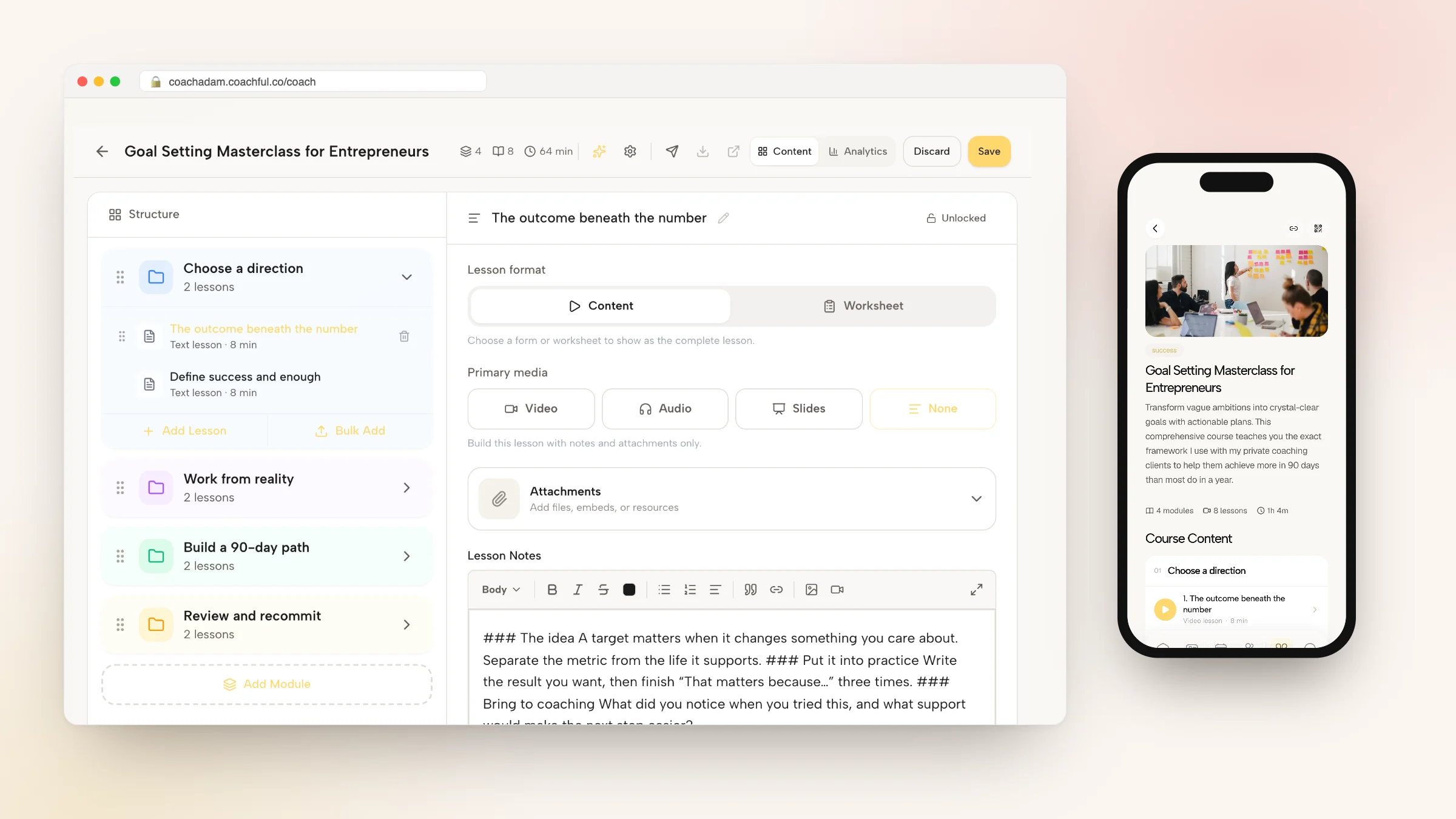
Many coaches combine both on purpose: a course teaches the method, and coaching sessions help each client apply it. Coachful runs both in one place. You can build a course with modules, lessons, video and worksheets, run coaching programmes with weekly goals, habits and check-ins, hold one-to-one or group sessions, and sell it all through one checkout. See courses for coaches, group coaching and our guide to creating an online course.

Coachful also includes more than 40 ready-to-film programme templates and 48 course templates with quizzes, useful if you are turning lesson plans into a coaching offer. And if you would rather not build your website and offer pages yourself, Coachful's team will build them for free on every plan, usually within about 24 hours: see how the free build works. It covers structure and written material; you film any videos.

Frequently asked questions
What is the difference between a coach and a teacher?
A teacher passes on knowledge toward objectives the teacher or curriculum sets. A coach helps a person reach goals they set themselves, mostly through questions and accountability. The ICF describes training as linear with a set curriculum and coaching as non-linear, with objectives set by the person being coached.
Is coaching a form of teaching?
Partly. Coaches teach frameworks and skills when needed, but their default is to ask rather than explain. Sports coaching is much closer to teaching than professional coaching is.
Can a teacher become a life coach?
Yes, and many do. Teachers bring planning, explaining and group skills. They usually need to learn non-directive coaching, contracting with adult clients and how to run a small business. Coaching is not licensed, but recognised training helps.
What is instructional coaching?
Instructional coaching is coaching for teachers, usually by an experienced educator who observes lessons and works one to one on specific skills. A meta-analysis of 60 studies found it improved teaching practice and, to a smaller degree, student achievement.
Is coaching or teaching better for learning?
Neither in general. Teaching is better for new knowledge and correct methods; coaching is better for applying what someone already knows, making decisions and changing habits. Most effective learning uses both.
What does a coaching style of teaching look like?
The teacher asks before explaining, lets students set personal goals, gives feedback through questions, and asks students to reflect on what worked. The curriculum stays; the conversation changes.
Will Coachful build my coaching website for free?
Yes. On every plan, Coachful's team builds your website for free, usually within about 24 hours, inside your own account so you can edit it later. Start from Create, then We'll build it for you.












