Coaching and Consulting for One Employer: Protect Fees and Trust

A company wants you to coach its new director. Then the sponsor adds, "You know our industry. Could you also fix the team's operating plan?" It sounds like a better contract. You are already wondering whether saying yes will mean evenings of unpaid consulting, whether saying no will cost the renewal, and whether the director will still speak freely when you also report to their boss.
When one employer buys both coaching and consulting, define coaching, advice and implementation separately, disclose each role change before it happens, and separate permission to receive advice from permission to spend or share information. The employee can choose an advisory conversation. That choice does not automatically approve a new project fee or let you send their coaching notes to the sponsor. Agree those decisions with the relevant parties before doing the work.
A practical scope example for hybrid coach-consultants: what the company buys, who approves extra work, what the employee can expect, and which records belong in a sponsor update.
This guide focuses on the harder version of a hybrid engagement: the person you coach and the person paying you are different people. Coachful publishes it. The sample wording and engagement below are illustrative recommendations to adapt, not an ICF contract template or legal advice.
Define coaching and consulting before quoting the employer
Start with what you will actually do. "Leadership support" is too broad to settle whether the fee includes a private coaching conversation, your recommendation about a business problem, or a finished document the company can use.
| Service | Your contribution | Who decides and acts? | What the employer is buying |
|---|---|---|---|
| Coaching | Help the director examine goals, assumptions and choices. | The director chooses their actions and carries them out. | Agreed sessions and development support, with an agreed reporting boundary. |
| Advice or consulting | Offer a recommendation based on your relevant expertise. | The named business decision-maker accepts, rejects or adapts it. | A defined advisory contribution, such as reviewing an operating plan and explaining your recommendations. |
| Implementation | Create or change an agreed deliverable. | You perform the specified work; a named approver accepts the deliverable. | A specified output, deadline, revision allowance and fee, rather than open-ended access to your time. |
These are working definitions for this guide. Advice is the recommendation; implementation is doing the work. A discussion can contain both, but "just help me finish this" deserves a pause before you take over.
Keep the promise honest. Coaching can support a director's judgment and behavior. A consulting deliverable can give the company a usable plan. Neither lets you guarantee the director's performance or the company's commercial result. Make the deliverable concrete without promising an outcome you cannot control.
What ICF role disclosure means in an employer-funded engagement
Standard 3.7 of the current ICF Code of Ethics acknowledges multiple professional roles and places disclosure on the professional. Its key instruction is:
"disclose to the client when I am acting in a capacity other than the role of an ICF professional."
Standard 1.1 addresses agreements before coaching starts, including roles, responsibilities, confidentiality and financial arrangements. Standards 2.1 and 2.2 address confidentiality across roles and agreement on information exchange. Standards 3.1 to 3.3 address multiple relationships and conflicts, including seeking help or suspending or ending the relationship when needed. The current Code took effect April 1, 2025.
Our practical application: saying "I am consulting now" does not create permission to change the fee, share private material or undertake work outside your expertise. Set those boundaries separately. The Code does not prescribe the scope table, approval method or pricing structure below.
There is also a point where clearer wording will not solve the problem. If the company asks you to coach the director confidentially and judge whether they should keep their job, the second role can undermine the first. ICF's dual-role case study examines an internal coach being considered for an HR leadership role. It illustrates why some conflicts call for external support or ending a coaching engagement, rather than disclosure alone.
Agree who can approve a role change, a fee and a disclosure
The company may call the director "the client," procurement "the customer" and HR "the sponsor." Put names beside the decisions. It prevents an enthusiastic yes in a session becoming an invoice nobody believes they authorized.
- The person receiving the service chooses whether to receive advice. Explain the switch and let them decline. Their coaching session should not quietly become a consulting interview.
- The authorized budget holder approves extra paid work. Agree the output, price and approval route. A director may have that authority, but their job title alone is not your evidence.
- The agreed information-sharing arrangement governs the record. Identify what the sponsor receives and what needs additional permission. Paying the invoice does not, by itself, settle access to session content.

For example, the director can ask for your view on a meeting agenda within an agreed advisory allowance. They can also ask you to write the entire team operating plan. If that output is outside scope, you can discuss what it would involve without beginning the billable project. Approval of the extra work is still pending.
Use an initial conversation with the director and sponsor to settle this once. Ask, "What would each of you expect me to deliver at the end?" If the director expects private reflection and the sponsor expects an assessment of their weaknesses, resolve that before accepting the engagement. Our guide to executive coaching stakeholder alignment meetings covers the wider goal-setting conversation.

Use a hybrid coaching scope the employer can actually approve
Here is an illustrative engagement for a newly promoted director. The quantities are examples, not recommended industry allowances. The commercial choice is to include a small amount of advice while keeping a substantial deliverable outside the coaching fee.
| Scope item | Included or excluded? | Approval and record |
|---|---|---|
| Six private coaching sessions | Included in the coaching fee. Each session lasts 60 minutes. | Director and coach agree session focus. Sponsor reporting is limited to the categories agreed at the start. |
| Advice on meeting design | Included for up to 15 minutes within a session, with no additional session time. The director can decline the switch. | Note the advisory segment, recommendation and director's response. The recommendation is not automatically a sponsor report. |
| Written team operating plan | Excluded from the coaching fee. Separately quoted consulting project: one draft, one consolidated revision and one review meeting. | Named budget holder approves the fee and deadline before work begins. Named business owner accepts the deliverable. |
| Implementing the plan | Excluded. No managing employees, changing company systems or running the team's meetings. | Requires a new scope if requested. Specify access, responsibilities and what you are authorized to change. |
| Sponsor update | One agreed update meeting. Additional reporting is separately scoped. | Use only the reporting categories and material authorized under the agreement, subject to applicable disclosure obligations. |
The operating plan also needs an input boundary. Build it from business documents and interviews explicitly collected for that project. Do not quietly turn something the director disclosed in confidence into the company's consulting evidence. If private coaching content would be necessary, discuss that use and its implications before proceeding, or change the project.
Define acceptance in terms the company can inspect: the plan covers meeting cadence, decision owners and an escalation process; the named approver sends one consolidated response by an agreed date. "The team performs better" is a hoped-for outcome, not a usable acceptance test for the document.
For the underlying agreement, use our coaching agreement clause guide. For purchase orders, billing entities and payment terms, use company-funded coaching billing setup. Those administrative decisions support the scope; they do not replace it.
Protect your fee without charging for every piece of advice
You do not need a new invoice every time you offer a useful perspective. You need a fee that matches the work you promised. Choose the structure by how predictable the consulting demand is.
- Coaching fee with a bounded advisory allowance. Useful when clients occasionally want your expert view. State whether advice uses existing session time and what happens when the allowance is exhausted. The trade-off is that advice reduces time available for coaching.
- Separate consulting project. Useful when the employer wants an output it can review and use. Quote the research, preparation, document, revision and review meeting. It takes more scoping, but gives extra work a visible price.
- Reserved advisory capacity. Useful when business questions recur but outputs vary. State available time, response expectations, expiry or rollover, and exclusions. An undefined retainer can become a promise to be permanently available.
Before setting the fee, count the hours you would otherwise overlook: sponsor calls, reviewing company documents, revising the deliverable, answering follow-up questions and keeping the engagement record. Our guide to pricing consulting services explores the commercial calculation.
Essential: clear service definitions, agreed fees and limits, permission to change roles, an approval route for extra work, and agreed recipients for information. Optional: separate contracts, separate invoice documents or a separate brand. One agreement can contain separate scopes if it is clear to all parties and suitable for the engagement. Two contracts still need a confidentiality boundary between them.
If you already did extra work without agreement, do not surprise the sponsor with a retroactive project charge. Describe what happened, check the existing terms, and agree the scope for future work. The cost of that lesson should not become another unclear expectation.
Disclose the switch in the coaching session without losing momentum
Use a short sentence that names the service and the consequence. These sample scripts are deliberately different because accepting advice, buying a deliverable and permitting a disclosure are different decisions.
- When the director wants your view: "I can offer my consulting view within today's session. It will use part of our time, and you can decide whether to use it. Would that help?"
- When they ask you to build something: "Writing that plan would be a separate deliverable. I can outline the scope, but I need the budget holder's approval before starting."
- When the sponsor asks about private content: "That is outside our agreed reporting. I can discuss the approved progress categories, or we can review a specific sharing request with the director."
- When you return to coaching: "That was my recommendation. Returning to coaching, what do you want to choose, and what would make that choice workable for you?"
- When the second role would affect trust: "Assessing the director for an employment decision changes my role substantially. We need to review whether I can continue as their coach before accepting that work."
Confirm the change in writing afterwards where it affects scope, fees or reporting. You are protecting the director's choice and the sponsor's budget, which is a reasonable explanation even when everyone wants to move quickly.

Keep coaching notes, consulting records and sponsor updates separate
One mixed call can produce three different records. Combining them into "session summary" is how a private concern ends up in a management report or an advisory suggestion becomes something the director supposedly agreed to do.
The director's session record
Record the coaching focus, any disclosed advisory segment, the recommendation, the director's response and their chosen next step. Keep the distinction between your suggestion and their decision. Include whether implementation was discussed, approved or left pending.
Illustrative client summary: "You chose to ask the team for input before changing the meeting format. With your agreement, I used 10 minutes to offer an advisory view on a shorter agenda. You will test one meeting. Writing a team operating plan is outside the coaching scope; no implementation was approved today."
The consulting project record
Record the authorized scope version, approver, inputs, deliverable, revisions, acceptance and billing basis. For an hourly allowance, record the time used against it. Keep confidential coaching disclosures out of project notes unless their use has been specifically agreed and is appropriate.
Illustrative project entry: "Operating plan, scope v1. Sponsor approved the quoted fee and deadline in writing. Inputs: existing team agenda and a project interview. One draft and one revision included. No permission to alter company systems. Coaching session content excluded from project inputs."
The sponsor update and invoice
Write the update for its agreed audience. Attendance, goals, progress categories and deliverable status are possible reporting topics to negotiate, not automatic entitlements. The invoice should identify the purchased service and relevant reference without revealing private session detail.
Illustrative sponsor update, assuming these categories were agreed: "Three of six coaching sessions completed. The director is testing the agreed meeting practice. The separately scoped operating plan draft is due on the agreed date. No change to scope requested."
Before sending anything, read it as the director: would they recognize what they chose, and would they be surprised by who receives it? Then read it as the budget holder: can they tell what was approved and what remains outside scope?

The ICF's official video below explains confidentiality and information exchange across roles, with sections on records and technology. It supports the reporting boundary here; it does not endorse our sample commercial arrangement.
Where Coachful helps with hybrid coaching delivery
Coachful's coaching software is a practical option when coaching is the center of the employer engagement and consulting is a defined addition. Its verified capabilities include agreements with e-signature, booking pages with paid sessions and session credits, a branded client portal, and transaction invoices plus manual invoices with catalog products.
Use those capabilities to make the agreed service visible: send the agreement before the first call, give the consulting deliverable a distinct description, and keep the client-facing session record understandable. Built-in video calls are included in the Coachful subscription, so a separate video-call subscription is optional.
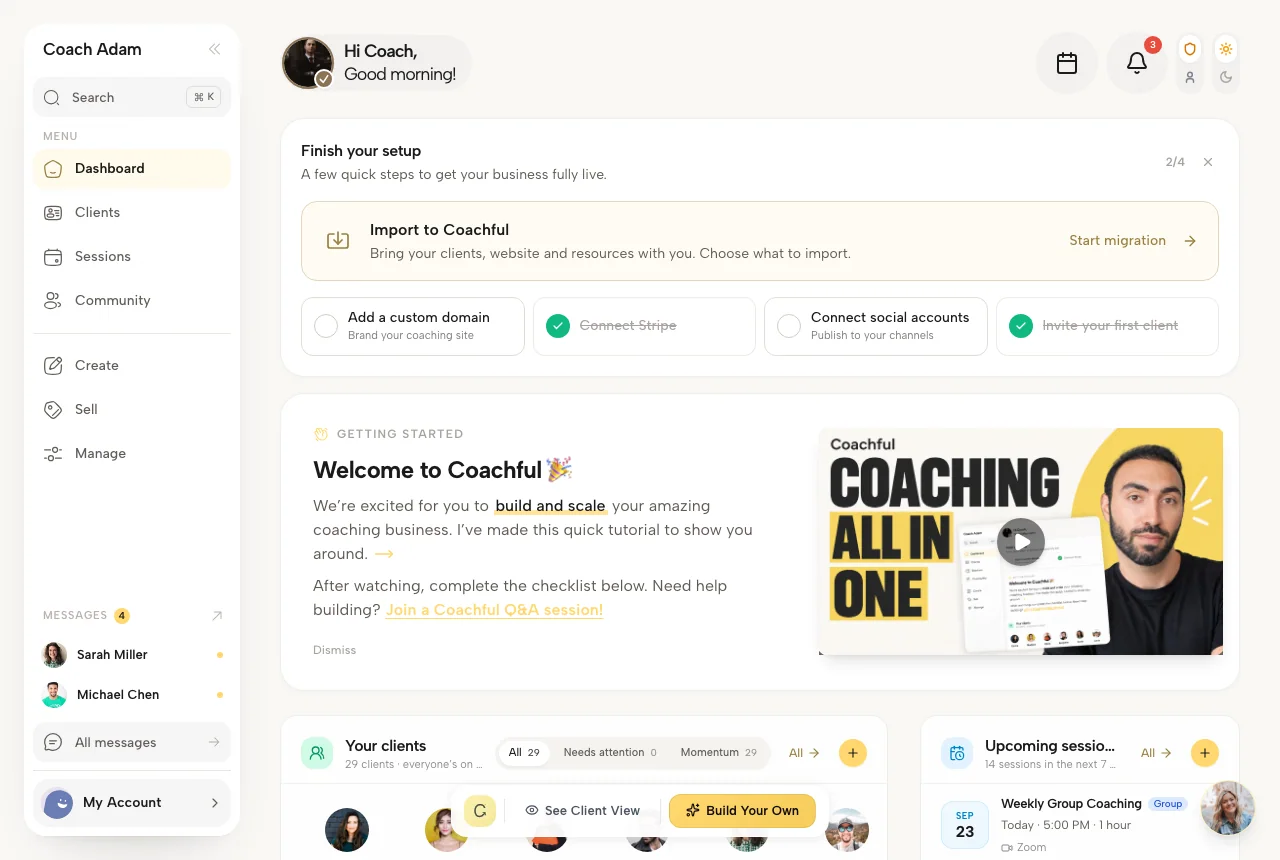
The screenshots above show a populated client email conversation and the client's sessions and notes view. They do not demonstrate sponsor-specific permissions, consulting approval gates or a billable project timesheet. Do not assume that a client portal gives the employer access to private coaching material, or that a label proves extra work was approved. Establish the audience and verify the permissions of the tools you use before putting confidential information in them.
If most of the contract involves managing a large implementation project, use a project system suited to its tasks, time tracking and approval needs alongside the coaching service. If your current tools already support the agreed records and permissions, clearer scope may be the change you need. Software can carry the agreement; it cannot make the professional judgment for you.
Employer-funded coaching and consulting: common questions
Can I coach an employee and consult for their employer?
Potentially, if the roles, information boundaries and conflicts can be managed. Explain both roles to the employee and sponsor before accepting the arrangement. Evaluate the consulting task itself: designing a meeting process differs from recommending whether your coaching client should be dismissed. Some combinations call for a different professional rather than another clause.
Is saying "I am consulting now" enough?
It names the switch, but leaves other questions open. Does the employee want the advice? Is it inside the paid scope? Who can receive the resulting record? A brief advisory segment may already be covered. A new implementation deliverable needs its own agreed scope and authorized fee approval.
Can the employee approve extra implementation work?
Only if they have the spending authority you agreed with the company. The person receiving coaching can request a deliverable without being authorized to buy it. Record the named approver and approval route in the scope. Until approval arrives, describe or quote the proposed work rather than performing it.
Does the employer get the coaching notes because it pays?
Payment alone does not settle information-sharing rights. Agree the categories, recipients and method of reporting with the relevant parties before coaching begins, including applicable disclosure obligations. Keep the sponsor update distinct from the director's session record. An invoice should describe the service without becoming a disclosure of private session content.
Should I charge more for advice than for coaching?
There is no universal rate rule in this guide. You can include a bounded amount of advice in the session fee or quote a separate advisory service. Price implementation for the actual output and work involved, including preparation and revisions. The important commercial distinction is what the fee includes, not whether one role is automatically worth more.
Do I need separate contracts and software?
Not automatically. A clear agreement can contain separate service scopes, while separate contracts may help a larger project. Choose software according to the delivery and permission needs. Coachful includes built-in video, agreements and invoicing; a substantial consulting project may also need dedicated project tracking. Separate documents or tools do not remove conflicts between roles.
What if the sponsor asks me to assess the employee's performance?
Pause and review the relationship before accepting. Explain the proposed role to the employee, examine how it affects confidentiality and trust, and seek appropriate professional guidance. If the conflict cannot be managed, separate the providers or suspend or end the affected engagement. A disclosure cannot make every combination of roles workable.