What to Do When a Client Doesn't Know What They Want From Coaching

The call was going well until you asked the obvious question. “So what would you like to work on?” A pause. “Honestly, I'm not sure. I just know something has to change.” They like you. They are ready to pay. And you are a newer coach with a short list of enquiries, wondering whether you are about to take money for twelve weeks of pleasant, shapeless conversation, or talk yourself out of a client you need.
Say yes to the person and hold off on the full package. A client who can't name a goal is a normal place for coaching to start, but it changes what you sell first: a short clarity step, made of a few written prompts and one focused conversation. Then you make one decision and say it out loud. Begin, with a first experiment and a review date. Defer, with a dated check-in. Or refer, when the need sits outside coaching. This guide covers how to run that step, how to tell the three decisions apart and the words to use for each.
A new coach asked exactly this in a public r/lifecoaching thread: “what do you do when a client doesn't know what they want from coaching?” Their own hunch was a good one: “My instinct is that not knowing exactly what they want to work on doesn't necessarily mean coaching can't be helpful.” That is one coach's question on a forum, and we are not presenting it as research. It is the right instinct to build on.
What to do when a client doesn't know what they want from coaching: the short version
- Don't sell the long package yet. You would both be agreeing to something neither of you can describe.
- Run a clarity step. Send five written prompts, then hold one conversation of 30 to 45 minutes whose only job is to produce a working focus in the client's own words.
- Make one of three decisions. Begin, defer or refer. “Let's see how it goes” is not on the list.
- Put it in writing with a date. A first experiment and a review date if you begin, a check-in date if you defer, a named next step if you refer.

The clarity step is real work, so treat it as the first thing you deliver. The client leaves it with a written summary of what they want to change and your honest recommendation. That is worth having even if they never book again.
What it costs a coach to say yes too fast or no too soon
There are three ways to get this wrong, and each one is expensive in a different way.
You sell the full package on a feeling. Take an invented example: a three-month package at $1,500. Session one is warm. By session four you are opening with “what would you like to talk about today?” and getting a shrug. In week six an email arrives saying it isn't really working and asking what happens to the remaining sessions. Now you are working out a refund halfway through, there is no testimonial, and the person tells friends that coaching didn't do much. The part that lingers is what it does to your nerve on the next sales call.
You send them away to “get clear first”. It sounds principled. What the person hears is that they failed a test nobody told them about. If you have had three enquiries this quarter, you have also just closed a third of your pipeline over something that one conversation could have settled.
You miss that it is not a coaching problem. Sometimes “I don't know what I want” sits on top of something a coach is not trained to hold. Taking that on because you needed the client is the costliest version, for them and for you.
The clarity step exists to make all three less likely. It costs you an hour or two. Compare that with twelve weeks of drift.
Why a coaching client with no clear goal is normal, and when it is a warning
People rarely book a first call because they have a goal. They book because of a feeling: stuck, behind, restless, flat. If they could state the goal in one clean sentence, many of them would already be acting on it. Finding the sentence is often the first piece of the work, which is why it deserves to be named and agreed instead of hidden inside a package.
So “I don't know” on its own tells you very little. What sits behind it tells you a lot.
| What they say | What it usually means | What to do |
|---|---|---|
| “Something has to change, I can't say what.” | Unfocused. The most common case. | Clarity step. |
| “Career, health, money, my relationship, all of it.” | Too many goals, which works out the same as none. | Clarity step, and choose one to start. |
| “My partner thinks I should get a coach.” | The goal belongs to someone else. | Ask what they want. If the answer is nothing yet, defer. |
| “You're the expert, you tell me what I need.” | They want advice or a plan handed to them. | Explain how coaching works. If they want answers, refer to a mentor or consultant. |
| “I can barely get through the week.” | Possibly a need that is not a coaching need. | Slow down and consider a referral. See below. |

There is a fair objection here. Some coaches work without fixed goals at all and do it well, and a goal named in week one often turns out to be the wrong one by week five. Both are true. The clarity step does not ask for a perfect goal. It asks for a working focus, good enough to test for a month, with permission to change it.
The coaching clarity step: five written prompts and one conversation
Writing comes first because people who freeze when asked a big question out loud will often answer it on paper at ten at night. Send the prompts two or three days before you talk. Tell them it takes about ten minutes, that rough answers are fine and that “I don't know, but my guess is…” counts.
- Why now? What made you look for a coach this month and not six months ago?
- What takes up the most room? Which part of your life or work do you think about most when you are not trying to?
- What have you already tried? And what happened when you did?
- What would you notice first? If things were better three months from now, what is the first small thing that would be different on an ordinary Tuesday?
- How much does it matter? On a scale of 1 to 10, how important is it to change this now, and what makes it that number and not a lower one?
If someone cannot pick an area at all, a structured exercise helps. Our free Wheel of Life assessment has them score eight areas of life and see where the gaps are, which gives the conversation somewhere to begin.

Then the conversation. Thirty to 45 minutes. The aim is narrow: you are not trying to solve anything yet. You are trying to leave with one sentence you both recognise. Read their answers beforehand and ask from them:
- “Of everything you wrote, which one would you be most relieved to have sorted?”
- “You gave it a 7. What would have made it a 4?”
- “What makes this hard to do on your own?”
- “What would you want from me that you can't get from a friend?”
Close by writing the working focus together, in their words: “For the next month I want to work on ___, so that ___.” If they cannot fill in the blanks after a real attempt, that is not a failure. It is the information you needed, and it points to defer.
Free or paid? Either can work, and the trade-off is plain. A free clarity step gets more people to say yes and costs you unpaid hours. A paid one filters for commitment and pays for your preparation, but some people will not book it. A middle route is to charge a modest fee and credit it toward the first block if they go ahead. Whichever you choose, say what they get: the prompts, the conversation, a short written summary and your recommendation. Our guide to discovery sessions versus paid first sessions goes through the pricing side in more detail.
It helps to watch someone do this well. InnerLifeSkills, a coach training school, published a demonstration built around this exact difficulty. Its description says the video shows how to “convert a big vision into a focused session contract”, and its chapter list includes “Why avoiding the word ‘goal’ can help clients open up” and “From future vision to a clear session contract”. The demonstration is about contracting inside a session, which is the skill the clarity conversation depends on.
“How to Coach without Saying "Goals" - An MCC Demonstration,” InnerLifeSkills, published November 10, 2025. The channel belongs to a coach training school and its description links to its own courses. Watch on YouTube.
Begin coaching: a working focus, one first experiment and a review date
Begin when four things are true. The client can say the working focus in their own words. It is theirs, not their partner's or their manager's. They have the time to act between sessions. And it sits inside what you are trained to do.
Then keep the first commitment small enough to match how sure you both are.
- A short first block. Three or four sessions over a month, instead of the three-month package. You earn less up front and you lose the refund risk. If it works, the longer package is an easy second sale because the client now knows what they are buying.
- Or the full package with a written review point. If you prefer to sell the whole thing, add a review at session three where either of you can stop and unused sessions are refunded. Put that wording in the agreement. Our coaching agreement template shows where a clause like that belongs.
The first experiment. Before session two, the client does one small thing that tests the working focus. If the focus is “work out whether I want to stay in my job”, the experiment might be one honest conversation with their manager about the role they would want, or two evenings spent on the thing they keep saying they would do instead. Call it an experiment on purpose. “That wasn't it” is a useful result, and it costs a week.
The review date. Put a date in both calendars, about four weeks out, and decide the questions now: Is this still the right focus? What changed? Do we continue, change direction or stop? A client who knows a review is coming is far less likely to drift quietly and then cancel.

Once the focus holds, it can turn into proper goals. Our guide to coaching goal setting picks up from there.
Defer coaching: give the prospect a dated check-in
Defer when the person is a reasonable fit for coaching but the timing is wrong. The usual signs:
- They could not name a working focus after a genuine attempt.
- The goal belongs to someone else, and they have not yet found their own reason.
- They are in the middle of something that has to settle first, such as a move, a new job or a new baby.
- They have no room to act between sessions for the next couple of months.
A deferral that works has three parts. One thing to do in the meantime, for example a two-week note of when the stuck feeling shows up and what was happening. A date, usually four to eight weeks away. And a clear owner, which should be you: “I'll email you on the 14th” is a plan, while “reach out when you're ready” is a goodbye.
Be honest about the trade-off. Some deferred prospects will not come back. That still costs you less than a client who pays, drifts and leaves unhappy, and the ones who do return tend to arrive with a focus.

The follow-up itself deserves care. Our guide on following up after a discovery call has wording that does not sound like chasing.
Refer out: signs the need sits outside coaching
You are not there to assess anyone's health, and nothing here asks you to. You only need to notice when what a person describes is not what you offer. Consider a referral when:
- They describe distress that is making ordinary days hard to get through, and that is what they most want help with.
- The conversation keeps returning to something painful from the past that they want to work through.
- They need advice only a licensed professional should give: medical, legal or financial.
- They want an expert to tell them what to do in a field you don't work in. That is a mentor or consultant.
- You notice you would be out of your depth, even if you can't say exactly why.
Talk about what you do, not about what they have. No labels. You can suggest they speak to their doctor or a licensed therapist, offer a name if you know a good one, and say plainly that coaching may be useful later or alongside that support.
If someone tells you they are in danger or thinking of harming themselves, the clarity step is over. Encourage them to contact local emergency services or a crisis line in their country right away, and do not carry on as if it were a normal sales call.
Two related guides go further: keeping therapy and coaching separate if you are trained in both, and ending an engagement when the fit is wrong if you only see it after you have started.
How to word each coaching decision: begin, defer or refer
Say the decision in the conversation, then send it in writing the same day. These are starting points to adapt.
Begin. “Here's what I heard: you want to work out whether to stay in your role, so that you stop spending Sundays dreading Monday. I think coaching can help with that. I'd suggest we start with four sessions over the next month. Before our second session you'll have that conversation with your manager. On [date] we review: is this the right focus, and do we carry on? How does that sound?”
Defer. “I don't think starting now would be a good use of your money. We couldn't land on one thing you want to change yet, and I'd rather not charge you while we look for it. For the next two weeks, jot down when the stuck feeling shows up. I'll email you on [date] and we can talk for twenty minutes about what you noticed. If it's clearer then, we start.”
Refer. “Thank you for telling me that. What you're describing matters, and it isn't what I'm trained to help with. I think you'd get more from talking to [your doctor / a licensed therapist / a financial adviser] first. If it's useful, I can send a couple of names. If coaching makes sense later, I'd be glad to hear from you.”
The written version is three lines: the working focus or the reason, the decision, the date. Keep a copy with the person's record. In two months you will not remember which of four prospects you promised to email.
Objections coaches raise about a clarity step
“Isn't finding the goal the coaching? Why not just start?” It is coaching work. That is the argument for naming it and agreeing it as the first deliverable, so the client knows what they are paying for in week one.
“I'll lose the sale.” Sometimes, yes. A person who will not spend 45 minutes getting clear was unlikely to stay for three months. For most new coaches, a small, definite yes is worth more than a large, shaky one.
“What if they still don't know afterwards?” Then you defer, with a date. If there was real movement, offer one more short conversation. Do not solve the uncertainty by selling the bigger package.
“What if the focus changes in week three?” It often does. That is what the review date is for, and it is why the first block is short.
“I'm new. Shouldn't I take everyone?” Take people. Just don't take them into an open-ended commitment with nothing defined. Your first ten clients are also where your referrals and testimonials come from, so how each engagement ends matters more now than it ever will again.
Where Coachful fits when a coaching client has no clear goal, and where it does not
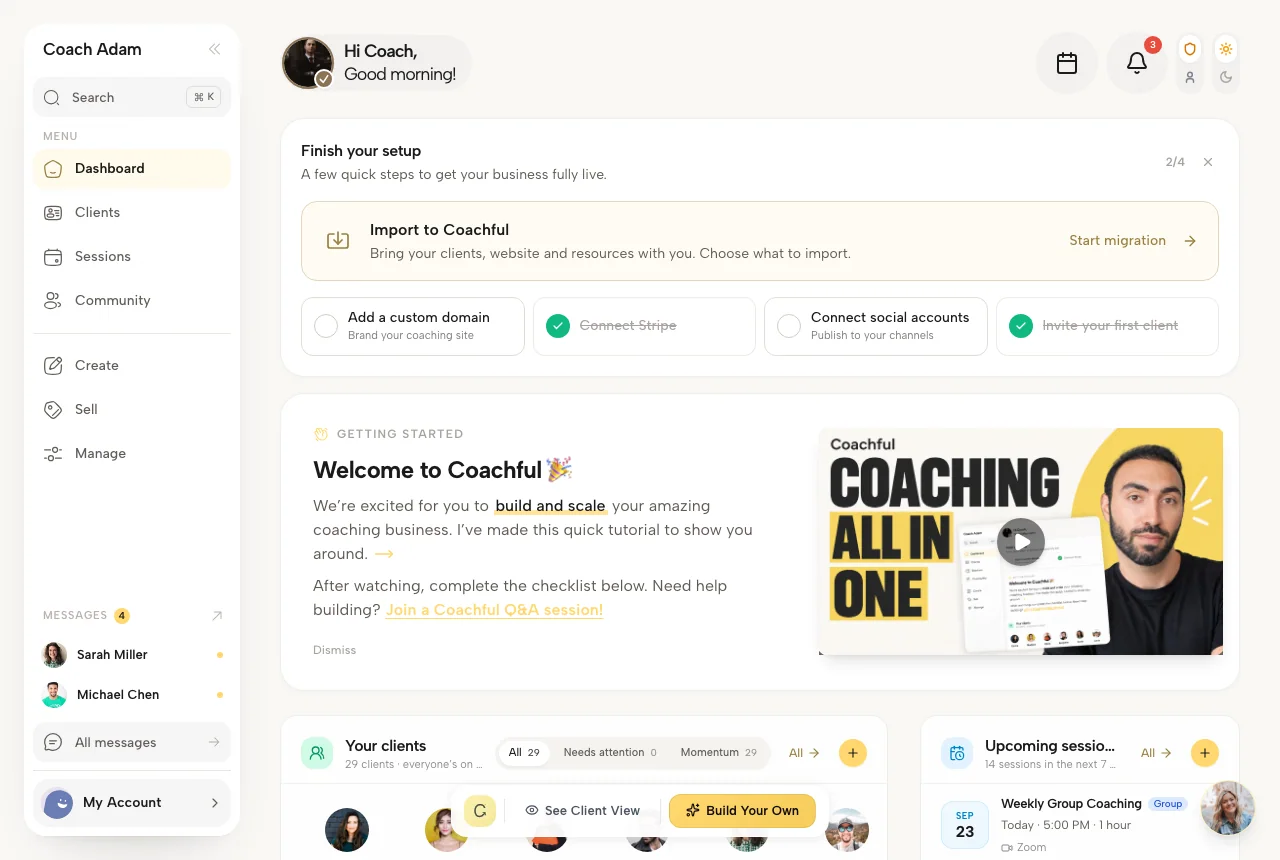
Coachful publishes this guide, so read this section with that in mind.
The clarity step is mostly a conversation, and no software has that conversation for you. What software can do is stop the pieces around it from getting lost in email. In Coachful:
- The prompts can sit on the booking page. Booking pages take questionnaires and intake fields, and the answers attach to the client record, so you read them before the call instead of hunting for a reply. Booking pages also support paid sessions, if you charge for the step. See coaching forms and questionnaires, and our guide to coaching intake forms for what to ask.
- A worksheet can wait for the client before a session. The client hub shows a required worksheet with a due date above the next session, which suits a review-date check.
- A deferred prospect gets a dated follow-up. Lead management keeps follow-ups with a date and a note, and flags the overdue ones.
- The call itself is covered. Video calls are built in and included in the subscription. Zoom, Google Meet or Teams links can be created automatically if you prefer them, but you do not need to pay for a separate video tool.
- Once you begin, goals with progress bars and weekly check-ins give the working focus somewhere to live, and agreements can be signed electronically before the first session.
The limits are just as real. Coachful does not decide whether someone should begin, wait or be referred, and we are not claiming any feature that works out a client's goal for them. That judgment stays with you. This guide also does not walk through setup steps, so check how forms and worksheets are assigned in your own account before you promise a client a particular flow.
If your current process is a calendar link and a hope that the prospect arrives with a goal, the smallest useful change is to put the five prompts in front of the booking.
Frequently asked questions about coaching clients who don't know what they want
What do you do when a client doesn't know what they want from coaching?
Run a short clarity step before selling a package. Send five written prompts, hold one conversation of 30 to 45 minutes and write a working focus together in the client's words. Then make one decision: begin with a first experiment and a review date about four weeks out, defer with a dated check-in, or refer if the need is outside coaching.
Is it a red flag if a coaching client has no clear goal?
Not on its own. Many people come to coaching with a feeling, such as being stuck or behind, and no sentence for it yet. It becomes a concern when the goal belongs to someone else, when they want you to hand them answers, or when what they describe sounds like a need for a therapist, doctor or other licensed professional.
Should I take on a coaching client who doesn't have a goal?
Yes, if a clarity conversation produces a working focus they can state themselves and they have time to act on it. Start with a short block of three or four sessions, or a full package with a review at session three, so that neither of you is locked into months of work on a guess.
What questions help a client figure out what they want from coaching?
Five work well in writing before the call: why now, which area takes up the most thought, what they have already tried, what they would notice first if things improved, and how important the change is on a scale of 1 to 10. In the conversation, ask which answer they would be most relieved to have sorted.
Should a coaching clarity session be free or paid?
Either works. Free gets more people through the door and costs you unpaid time. Paid filters for commitment and covers your preparation, though fewer people book. A common middle route is a modest fee credited toward the first block of sessions. In both cases, tell the client they will receive a written summary and a recommendation.
How long should I work with a client before a goal has to appear?
Set a review date about four weeks in, or at session three, and agree it before you start. At the review, ask whether the focus is still right, what has changed and whether to continue. If there is still no focus and no movement by then, stopping or pausing is the honest call.
When should I refer a prospect to a therapist instead of coaching?
When the main thing they want help with is distress that makes ordinary days hard, or something painful from the past they want to work through. Describe what you do and don't offer, without labelling them, and suggest their doctor or a licensed therapist. If they mention being in danger, point them to emergency services or a crisis line at once.
How do I tell a coaching prospect to wait without losing them?
Give three things: a reason that is about timing and not about them, one small task for the next two weeks, and a date on which you will contact them. “I'll email you on the 14th” keeps the relationship alive. “Get in touch when you're ready” usually ends it.
Sources and Coachful capabilities reviewed October 4, 2026. The Reddit question is quoted from our research record of October 2, 2026. Reddit blocks automated access from our review environment, so the thread was not reopened, and nothing beyond the quoted words is attributed to it. The $1,500 package is an invented example. The clarity step, the five prompts, the table, the timings and the scripts are our editorial judgment, not research findings. The video is described from its public title and description. This guide is not medical, psychological or legal advice.