
Coaching Invoice Template That Gets Paid

Coachful

You've finished the coaching session, written the follow-up, and opened last month's invoice. You change the client's name, hesitate over the payment terms, and wonder whether asking for payment will undo the warmth you've just built. Then a corporate client replies asking for a purchase order reference, and your polished PDF suddenly feels unfinished.
A useful coaching invoice template takes the awkwardness out of that moment. It tells the client what they bought, tells accounts payable how to approve it, and gives you a record you can reconcile later. The logo matters less than whether the right person can understand, process, and pay the bill.
Build a Coaching Invoice Template Field by Field
Fields to lock into a coaching invoice template
| Field | What to enter | Required when |
|---|---|---|
| Invoice number | Unique sequential number, never reused | Always |
| Issue and due dates | Calendar dates; never vague requests to pay promptly | Always |
| Service period | Billing month or session dates, no session notes | Always |
| Coach identity | Legal name, address and applicable tax identifier | Always |
| Client identity | Person or contracting legal entity and billing address | Always |
| Buyer VAT or tax ID | Customer VAT or GST number | EU B2B and many GST cases |
| Line description | Sessions, retainer, workshop or assessment, not a vague package label | Always |
| Quantity and unit price | Count and net unit price in one currency | Always |
| Tax treatment | Rate and amount, exemption or reverse-charge wording | Registered or cross-border |
| PO or cost center | Buyer reference, approver and installment number | Corporate accounts payable |
| Payment instructions | Bank details or card link, plus currency | Always |
| Late-payment clause | Wording that matches the signed agreement | Commercial clients |
Before you hit send, read the document as someone who wasn't in your sales conversation. Can they identify the buyer, recognize the service, and find the amount due without emailing you?
This isn't just presentation. A 2017 Sage study of small and medium-sized businesses across multiple countries found that 11.0% of all SME invoices were paid late and 7.5% were eventually written off as bad debt. A template can't guarantee collection, but you can remove avoidable questions before they become reasons to postpone payment.
Establish the invoice's identity
Assign a sequential invoice number and never reuse it.
Keep a master register rather than trusting the filename of your latest document. When a payment arrives, you should be able to connect its reference to a single issued invoice. If you need to correct a bill, preserve the original and follow the correction or credit-note process that applies locally.Enter the issue date, service period, and an explicit calendar due date.
These answer different questions: when you issued the bill, what work it covers, and when payment is required. A billing month belongs in the service-period field, not in place of the due date. If the agreement requires payment before coaching begins, make that timing visible rather than expecting the client to remember your consultation.Identify both legal parties.
Use your legal business name and address, with the applicable tax identifier. Add your trading name if clients know you by it, but don't let it replace the legal supplier identity. For the buyer, ask: Who signed the agreement and owes the money? The person receiving coaching may not be the contracting company.
Your template can start in a spreadsheet or document editor. If you need a basic self-employed layout before adding coaching-specific fields, you can find a freelancer invoice template from renn and adapt its structure. Keep the underlying fields editable instead of turning the whole design into an image.
Describe the purchase without exposing the session
- Itemize services so the charges and tax calculation make sense.
Give sessions, group-program access, assessments, and retainers their own descriptions where the agreement prices them separately. Include quantity, net unit price, currency, any discount, tax rate and amount, and the total. Show an agreed package discount explicitly rather than changing the session rate.
For example, an executive coach billing a German company for six leadership sessions should identify the sessions, quantity, net price, relevant VAT treatment, and customer VAT number where applicable, consistent with the European Commission's VAT invoicing requirements. The description must support the transaction and tax treatment, not reproduce confidential conversations.
You might use a description such as leadership coaching sessions for the contracted service period, with delivery dates listed separately. Avoid personal goals, assessment findings, or the topic a participant discussed in confidence.
Practical rule: Describe what the buyer purchased, not what the coachee disclosed.
State exactly how to pay.
Include the accepted methods and the relevant bank or processor details. For bank transfers, tell clients to use the invoice number as the payment reference. For card payments, use the actual payment link associated with the bill, not a general website address that leaves them searching.Carry forward the signed terms.
Cancellation, refund, renewal, and late-payment wording should match the agreement. The invoice isn't the place to introduce a tougher policy because you feel nervous about collecting. Use a concise summary and an agreement reference so the client can find the governing wording.
Preserve the fields and the evidence
Store country, tax treatment, and currency as separate fields.
Don't hard-code your usual tax rate into every copy. Keep the billing country, relevant registrations, and treatment associated with the particular customer and supply. If you're unsure whether a service is taxable, resolve that before issuing the bill rather than selecting a rate because it looks familiar.Generate and preserve the issued version.
Build the invoice from those fields, save a locked PDF or equivalent issued copy, and keep it with the agreement and payment status. Retain the editable master separately. That prevents an innocent change to your template from altering the record of what you sent.
The IRS recordkeeping guidance identifies invoices, receipts, deposit slips, and payment evidence as supporting business documents. Keep enough information to trace the amount, source, date, description, and settlement of a transaction.
Once they pay, can I delete it? No. The IRS guidance on record retention generally suggests keeping records for three years, with longer periods in specified circumstances, including seven years for records supporting certain bad-debt or worthless-security claims.
That's a U.S. retention framework, not a universal deletion schedule. Follow the applicable rules for your business and preserve related contracts and confirmations too. The invoice is not your ledger: your accounting records must still clearly and accurately reflect gross income and expenses.
Payment Terms Taxes and Late Fees
Due dates and late fees by client type
| Scenario | Due date to write | Late-fee rule | Do not assume |
|---|---|---|---|
| Individual life-coaching client | Due on receipt, with a calendar date, or another short stated date | Only a fee the consumer contract actually allows | That UK business statutory interest applies |
| UK company with no interest clause | The date in the coaching agreement | Statutory interest of 8% plus the Bank of England base rate | Stacking statutory interest on a contractual rate |
| EU commercial invoice with no term | 30 calendar days after the client receives the invoice | Daily simple interest after that period, plus possible fixed €40 recovery compensation | A longer period without checking the rules |
| US or mixed international client | One exact calendar date | Whatever the contract and local law allow | That requesting prompt payment establishes a deadline |
| Package paid in instalments | A due date and installment number on each invoice | The same clause as the agreement | That work is billable before the contractual trigger |
The UK formula in the table comes from the UK government's commercial-debt guidance, which sets statutory interest at 8% plus the Bank of England base rate unless the contract specifies another rate. The EU default of 30 calendar days after invoice receipt, with daily simple interest, is set out in the EU late-payment directive; the EU summary of commercial late-payment rules explains the possible €40 recovery compensation.
Choose clarity before a penalty
Can't I just copy another coach's late fee? That feels efficient until their clause applies to a different country, contract, or type of buyer. A life-coaching client purchasing personally isn't automatically subject to commercial-debt rules.
Payment timing deserves more attention than threatening wording. Xero small-business invoice records summarized by Paidnice indicate that businesses in the United States, United Kingdom, Canada, New Zealand, and Australia generally wait about 24 to 30 days after issuing an invoice; payments run approximately 8.5, 8.3, 11.3, 4.7, and 6.0 days late, respectively.
State the currency, calendar deadline, accepted methods, and whether billing is upfront or after delivery. A calm payment note can say: Please pay by the due date shown above using the payment details below, with the invoice number as your reference.
A payment reminder should point to an existing obligation, not announce a new punishment.
Cancellation and no-show charges belong on a separate line, with the relevant policy reference, only when the agreement permits them. Don't disguise a cancellation fee as a delivered session.
Check tax and manage the follow-up
Tax treatment needs its own decision. For an Australian nonprofit engagement, Everglow Prosperity's guide to understanding GST thresholds for non-profits provides relevant background, but the buyer's nonprofit status alone shouldn't determine your invoice treatment. For configuration steps, use the guide to adding VAT, GST, or sales tax to coaching offers.
Issue the invoice when the contractual billing trigger occurs and schedule reminders before and after its deadline. Review overdue balances in 1–30, 31–60, 61–90, and over-90-day buckets, operational categories included in the EU payment-reporting proposals described by the EU summary linked above.
When a payment is late, first check whether the client received the invoice and whether approval is blocked. Then apply only the remedy the agreement and governing law allow.
Worked Examples for Life and Corporate Coaching
Sample coaching invoice totals
A sample price can help you check how an invoice adds up, but it is not a recommended rate. Billbooks' 2026 life-coaching template lists $50 for discovery, $100 for a one-on-one session, and $400 for a package. InvoiceSonic's 2026 business-coach example lists $50 per hour or $1,500 per project with Net 14 terms. Use these figures as template examples, not as a market-rate guide.
| Example | Sample lines | Sample total | Terms to show |
|---|---|---|---|
| Life-coaching template, 2026 | $50 discovery, $100 one-on-one, $400 package | $400 for the package | A stated due date |
| Business-coach template, 2026 | $50 per hour or $1,500 per project | $1,500 for the project | Net 14 |
| Coaching program | One package fee, optionally split into instalments | The agreed package fee | Deposit and instalment amounts, each with its due date |
| Corporate executive engagement | Retainer, workshop, assessment, and expenses on separate lines | Contracted fees plus permitted expenses | PO, approver, and installment number |
An individual client's invoice and a corporate invoice can share a layout while serving different approval needs.
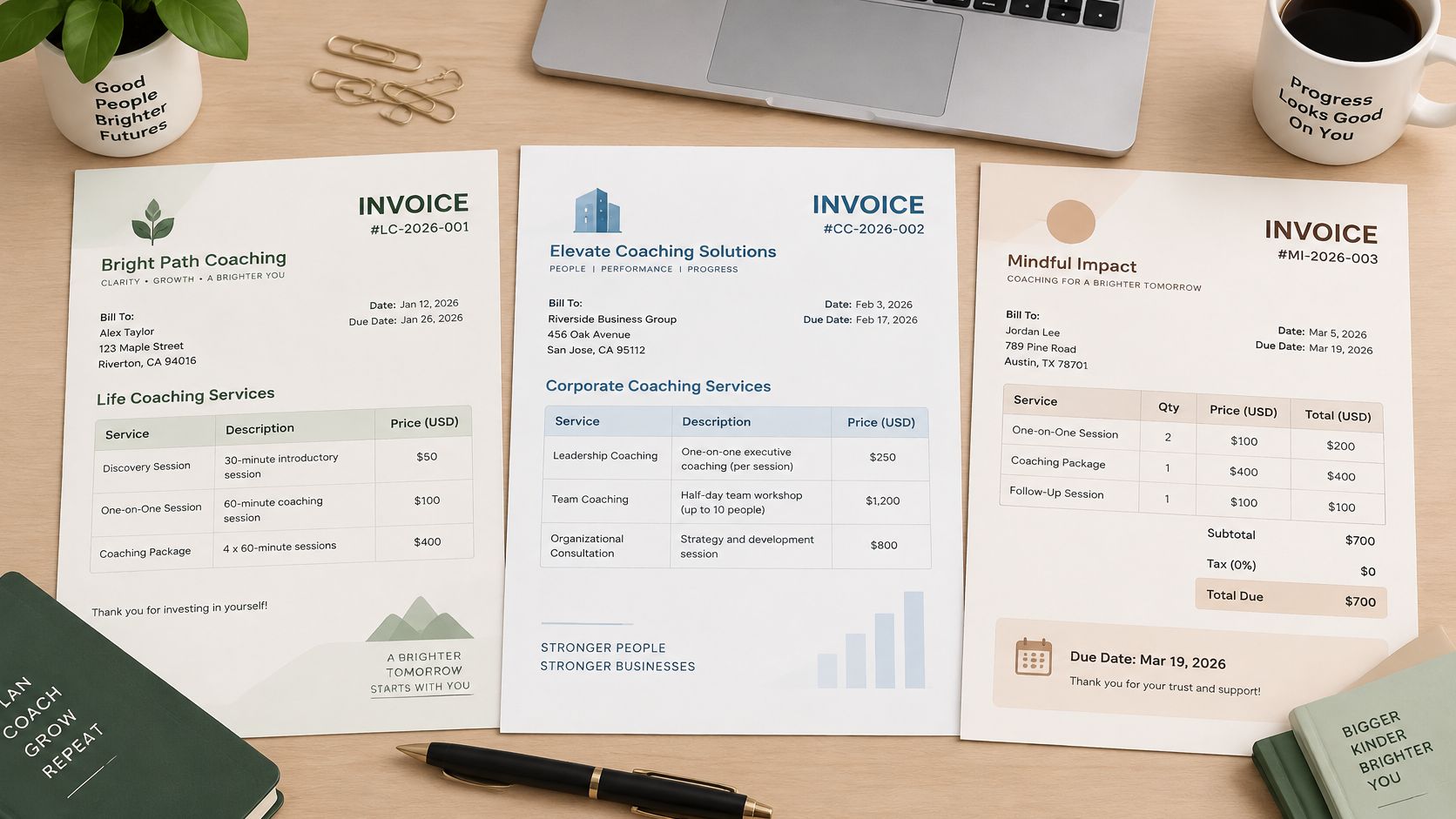
The individual client buying a package
When a life client buys a package, invoice the agreed package price, describe what it includes, and make the current amount due clear. The sample discovery and session prices are not extra charges unless the client bought those services separately.
For an instalment plan, keep the full package price visible and identify the instalment covered by this invoice. That distinction answers a common private worry: “Am I being charged a new rate?” The invoice can say, “This invoice covers the scheduled instalment under your coaching agreement; your program price hasn't changed.”
The corporate bill that needs approval
They know what coaching is. Can't I leave the description generic? The sponsor may understand a broad label, but accounts payable needs enough detail to match the bill to an approved purchase. Bonsai's coaching invoice guidance covers corporate details such as the legal buyer, purchase order, agreement reference, instalments, delivered services, participant counts, and permitted expenses.
Suppose the engagement includes a monthly retainer, a leadership workshop, group-program seats, an assessment, travel, and accountability calls. Give each contracted or chargeable item its own line. State which services are included in the retainer, so they cannot be mistaken for additional fees.
Show delivery dates without disclosing session content, and send the invoice to the designated billing contact as well as any required approver.
Clear to the coachee does not always mean ready for corporate approval.
Before sending, check the legal entity, PO or cost center, approver, engagement reference, installment number, delivery dates, relevant participant count, permitted expenses, currency, and contracted payment instructions. Ask the buyer to confirm the required submission channel. A polished PDF alone may not meet the buyer's procurement process or local tax requirements, so include the corporate references and jurisdiction-aware tax fields the recipient requires.
Keep a life-client version and a corporate version based on the same core information. The details change with the buyer's approval process, while the underlying invoice remains consistent.
Branding Printable Files and Payment Tools
You've spent an hour adjusting the logo, but the buyer still can't process the file. That's the point to stop designing and ask what format their billing system accepts.
Keep the visual choices restrained: your logo, brand colors, and a short footer with your legal name and invoice reference. Leave out stock photographs and session quotes. Put the amount due, due date, and payment instructions in a consistent payment summary.
Use this visual as a reminder to keep presentation and payment instructions equally clear.
Choose the file the buyer can receive
| Format | Use it when | What to check |
|---|---|---|
| Printable PDF | An individual or small firm accepts it and pays by card or bank transfer | No structured-invoice requirement applies |
| Structured e-invoice | Local law or the buyer's network requires machine-readable invoice data | Required format, network, identifiers, and validation |
| Both | A corporate buyer wants a readable copy and a system submission | Both versions contain matching information |
A structured e-invoice isn't just a PDF sent by email. It contains invoice data in a specified machine-readable format for processing through the required system or network.
According to Billtrust's November 2025 e-invoicing compliance update, Germany began requiring businesses to receive standardized structured e-invoices in 2025, with broader issuance obligations continuing through 2027, while France's schedule requires businesses to receive e-invoices by September 2026, followed by phased B2B issuance. The same update describes domestic B2B requirements beginning in some jurisdictions in January 2026 and progressive Singapore InvoiceNow obligations for GST-registered businesses.
Those schedules show why a reusable design needs jurisdiction-aware data. Country rules change, and a local tax adviser should confirm the applicable treatment, scope, and implementation dates.
Keep an editable source and a compliant output
Maintain an editable spreadsheet, document, or billing-system record behind the printable copy. That source should accommodate tax registration numbers, currency, place of supply, VAT or GST treatment, applicable reverse-charge wording, and buyer reference IDs. It also needs a credit-note path and a way to export and retain records.
Check payment tools on practical grounds: can the client identify the bill, use an accepted method, and obtain confirmation? For accounting handoff, follow the guide to sending coaching invoices to QuickBooks or Xero.
Before sending, check for mixed currencies, a client name that doesn't match the agreement, and payment terms that contradict the contract. A clean layout won't compensate for any of those errors.
For a supplementary walkthrough, use the video below alongside your own buyer's submission requirements.
Send the Next Invoice Without Rebuilding It
A manual coaching invoice template is useful when bills are occasional, engagements differ, or a corporate buyer needs a one-off procurement packet. Keep it if you can issue, track, and reconcile those documents reliably. You don't need to automate an occasional task.
The calculation changes when you're retyping the same retainer or checking whether the next instalment has been requested. At that point, the problem isn't the invoice's appearance. It's maintaining an agreed schedule without relying on your memory.
Keep the document and automate the repetition
Our Stripe-powered billing at Coachful lets you go from an offer idea to a live checkout link in under 15 minutes, with automatic recurring billing, smart retry logic, and direct payouts to your bank account. Stripe handles the automatic charge schedule for payment plans, so you don't need to create a manual invoice for every instalment.
Automatic collection must be turned on under Billing → Settings → Invoice settings in Stripe. We create the subscription schedule on your behalf; that setting determines whether instalments are charged automatically.
Clients pay you directly through Stripe Connect. We take no revenue share or platform fee from program sales, and you keep the payment minus Stripe's standard processing fee. Each workspace has an isolated billing environment, and clients see your subdomain, offer names, and payment confirmation emails.
Put the next real package through the process
Choose a package you're already selling, not a hypothetical offer you might launch later.
- Confirm the commercial terms. Check the price, deposit, instalments, and billing currency against the signed agreement.
- Set the collection schedule. Make the payment dates and tax treatment match the offer and checkout page.
- Keep documents available. Use the guide to generating and resending coaching invoices when a buyer needs a copy.
Reserve your branded PDF for clients who require a document, and let scheduled billing handle repeat collections. Before the next bill goes out, compare the agreement, due date, and tax treatment with what the client will see.
Coachful brings coaching offers, payment plans, and invoice workflows together so you can stop rebuilding the same bill. Visit Coachful, set up one live package with its agreed payment schedule, and keep your corporate-ready invoice template for buyers who need it.


