Coaching Needs Analysis Template: 12 Questions for HR

Coachful
Editorial Team
When HR asks for a coaching program, how do you know whether coaching is actually the right answer? Run a short needs analysis before you quote: define the observable gap, hear from the people affected, test alternative causes and agree what evidence would justify a pilot. A request for “more confident managers” is a starting point, not a program specification.
This coaching needs analysis template gives you 12 questions, a copyable one-page brief and a worked example. It is written for independent coaches and small practices responding to organizational buyers. The aim is to recommend work you can defend, including a different intervention when coaching would not address the problem.
What is a coaching needs analysis?
A coaching needs analysis investigates the difference between current and desired capability, then considers whether coaching could help close that gap. It should connect an organizational priority with observable work and the participant’s own development interests. It is not a personality test, an employee ranking or a way to turn every business frustration into a coaching sale.
The CIPD’s learning needs analysis guidance starts with current and future capability requirements and existing skills, attitudes and knowledge. It emphasizes organizational strategy and multiple stakeholders. The coaching-specific questions below are an original practical adaptation of that general discipline, not a validated assessment instrument.
Keep three jobs separate. Needs analysis helps decide what intervention to propose. An individual assessment explores a particular person’s development within an agreed scope. Stakeholder alignment establishes shared goals and reporting boundaries for an engagement. They can inform each other, but buying one does not automatically authorize all three.

Before the questions: agree the boundaries
Tell the buyer what this preliminary work includes. A short scoping conversation may be enough to identify an obvious mismatch. Interviews, document review and a written recommendation can become a separate paid diagnostic assignment. Put its deliverables, access, fee and limits in writing rather than doing an open-ended consulting project inside a free sales call.
Explain who will see information before collecting it. Do not promise anonymity if a small group, job title or distinctive incident could identify the speaker. Ask only for information needed to make the decision. You usually do not need medical details, private session notes or complete personnel files to understand whether a proposed learning intervention fits.
Also explain the outcome: you may recommend coaching, training, an operational change, specialist support, more investigation or no project. That is a credible needs analysis. A questionnaire whose every possible answer leads to your largest package is a sales funnel wearing a lab coat.
12 coaching needs analysis questions to ask HR
Use these in a sponsor conversation and adapt the wording for participants. Do not send a long form and assume the responses settle the diagnosis. Written answers give you hypotheses to check, particularly when the buyer and the people expected to attend see the situation differently.
- What business or organizational priority makes this worth addressing now? Ask for the specific event, decision or requirement behind the request. “Leadership development” is broad; “new team leads are taking responsibility for cross-functional handovers” gives you a context. Record the priority without promising that coaching alone will improve the associated business result.
- What do people need to do differently in their actual work? Translate labels into observable behavior. Replace “be more strategic” with a description such as comparing options before escalating a decision. Check who sets that expectation and whether participants understand it. You cannot sensibly assess a gap against a standard nobody has explained.
- What evidence suggests that this gap exists? Request concrete examples and their source. Distinguish an observed incident, a participant report, a sponsor interpretation and an unanswered question. A survey score may flag an issue without explaining it. A vivid complaint from one manager is not automatically a representative picture of the whole organization.
- Whose perspective have we heard, and whose is missing? Include an appropriate participant voice instead of relying entirely on the purchaser. Depending on scope, useful perspectives might include managers, colleagues or operational owners. Agree access and confidentiality first. Do not recruit an informal network to collect identifiable employee commentary behind participants’ backs.
- What do potential participants want help with? Ask what would make the work useful to them, not merely whether they will attend. A sponsor may want delegation while managers want clearer authority; those interests can overlap. If participants see the project as covert evaluation, investigate that concern before selling a developmental experience they cannot realistically trust.
- What has already been tried, and what happened? Look at previous training, process changes, mentoring and coaching where relevant. Ask what people could actually use afterward and what remained difficult. “We ran a workshop” says little about learning transfer. Separate lack of opportunity to practise from evidence that a particular method did not help.
- Is the main barrier knowledge, application or the working environment? Someone who has never learned a technique may need teaching. Someone who understands it but struggles in live situations may benefit from coaching and practice. Someone without sufficient time, authority or equipment may need a management decision. Several causes can coexist; avoid forcing a single explanation.
- What can the organization change alongside the development work? Ask who can clarify roles, protect practice time or remove conflicting incentives. Name that person’s commitment. A coach can help a manager think through a difficult conversation, but cannot promise to repair an approval process that the organization refuses to change. Sponsor action belongs in the plan too.
- What format would fit the need and the people involved? Consider individual coaching, group coaching, a skills workshop, mentoring or a combination. Shared knowledge does not automatically require private sessions. Sensitive individual goals may be unsuitable for a group. Choose for the work, privacy and access requirements, rather than choosing the format with your preferred margin.
- What time, budget and delivery constraints are real? Establish availability, location, accessibility, language, purchasing requirements and any relevant technology restrictions. Identify the decision-maker and budget owner. A proposed weekly program is not feasible if employees cannot leave shifts to attend. Mark unconfirmed resources as assumptions, not as commitments you can quietly build the price around.
- What evidence would help us decide whether to continue? Agree a modest baseline, relevant observations and a review point. Participation and satisfaction can tell you about delivery, but not necessarily workplace behavior. Combine appropriate participant reflection with agreed observable evidence. Avoid guaranteeing a revenue, retention or productivity improvement that your intervention cannot independently establish.
- What finding would make coaching the wrong recommendation? Ask this explicitly. Examples include an unresolved role-design issue, a compulsory performance investigation presented as development, or needs outside your competence. Agree who owns the alternative route. You are not obliged to become the organization’s investigator, clinician, employment adviser or technical trainer because you discovered a problem.

Turn the answers into a recommendation, not a score
Do not add twelve ratings and announce that the company “needs 84% coaching.” These questions are not a psychometric scale. Their value is in explaining a decision and its uncertainty. One serious privacy concern or missing operational prerequisite can outweigh several positive indicators of interest.
For each proposed priority, write four short lines: the desired behavior, the supporting evidence, plausible alternative explanations and the next verification step. Label facts and interpretations separately. If sources disagree, record the disagreement instead of averaging it into a confident-sounding conclusion.
Then prioritize with the buyer using relevance, practical influence and feasibility. A high-stakes concern outside your competence is not an attractive “stretch project.” A modest, well-evidenced need with an available sponsor and willing participants can be a stronger pilot than a sweeping culture-change promise.

Check your side of feasibility as carefully as theirs. Who will deliver the work, who can cover absence and how much preparation does the recommendation require? A real team workload view can inform delivery planning, but it cannot tell you whether the buyer’s managers need coaching. Keep practice capacity and client need as two separate judgments.
Choose coaching, training or another intervention
Use training when people need knowledge and guided practice
If managers have never been shown how to write a delegation brief, a short taught session with examples and feedback may be a sensible first component. Coaching can help with application afterward, but making participants discover every basic method through questioning is not automatically a better service.

A course library illustrates one way to provide structured learning resources. It does not prove that a course will solve this buyer’s problem, and it is not a substitute for checking the actual content, accessibility and opportunity to practise. Recommend specific learning requirements rather than a catalog of everything you already own.
Use coaching when reflection, choice and application are central
Coaching may fit when participants have a meaningful development goal, can influence the relevant behavior and need space to examine decisions or test new approaches. Confirm their involvement in defining the goal. The sponsor purchasing the sessions does not remove the need for clear agreements about participation and information sharing.

Choose the program structure only after making that judgment. A multi-week engagement might support repeated experiments and review; a short consultation might show that no coaching is needed. Do not convert the number of themes in a questionnaire into the same number of paid sessions. Scope should follow the work and its limits.
Use a combined or non-coaching response when the causes demand it
A combined recommendation might separate a taught skill session, participant coaching and a sponsor-owned process change. Name the purpose and owner of each component. If the main issue is unclear authority, fixing decision rights may need to precede any developmental work. That is not a failure to sell; it is an honest recommendation.

Packaged services can make a combined offer understandable, but the bundle should not blur responsibilities. Specify what you teach, what you coach, what the organization changes and what remains outside scope. If an issue concerns harm, safeguarding, discrimination or serious distress, use the appropriate specialist or organizational route rather than treating it as a motivation problem.
A one-page coaching needs analysis template
Copy the following headings into a document. This is a decision brief, not a contract, diagnosis or certified assessment. Keep a separate restricted record of source material where necessary; do not attach every interview note to a proposal circulated through procurement.
- Decision to make: [What intervention, if any, should we propose?]
- Organizational priority: [Why this matters now, in the buyer’s words.]
- People and context: [Who is affected, whose perspectives were included and who is missing.]
- Desired observable behavior: [What people would do differently, in which situation.]
- Current evidence: [Examples, sources, dates where relevant and limits.]
- Alternative explanations: [Knowledge, practice, resources, authority, incentives or other causes to check.]
- Participant perspective: [What participants want, concerns and unresolved differences.]
- Recommendation and rationale: [Coaching, training, operational change, combined work, further investigation or no project.]
- Prerequisites and owners: [What must happen before work begins and who is responsible.]
- Scope and exclusions: [Proposed outputs, boundaries and items requiring specialist input.]
- Evidence and review: [Baseline, observations, reviewer, timing and conditions for continuing.]
- Information agreement: [Purpose, access, sharing limits, retention arrangements and open privacy questions.]
Worked example: “Our managers need more confidence”
This example is hypothetical, not a Coachful customer story or a promised outcome. A company asks an external coach for a confidence program for newly promoted managers. The coach’s first job is to understand the request, not rename an existing program and send a quote.
In the example, the sponsor reports that work is repeatedly escalated upward. Managers describe uncertainty about which decisions they can make. A limited review of agreed examples shows that delegation briefs often omit an owner or review date. None of that establishes a personality deficit or proves that low confidence caused the escalations.

The resulting recommendation has distinct owners. The sponsor clarifies decision rights. A short taught component introduces an agreed briefing method. Optional coaching then helps participants explore difficult handovers and test how they apply the method. The coach does not promise that coaching will eliminate escalations or compensate for an unavailable sponsor.
The review asks whether the agreed brief elements are being used, what participants notice in live delegation and whether the authority clarification is working. Escalation counts can add context, but changes in workload or staffing might affect them too. The buyer receives only the information agreed for that purpose, not private coaching disclosures.

A client progress view can make an individual’s development work easier to revisit. It is not an organizational impact study. Keep personal goals and practice records separate from the sponsor’s agreed reporting, and do not turn an app completion measure into evidence of improved leadership without checking what it actually represents.
Frequently asked questions
Is needs analysis the same as a discovery call?
A discovery call can reveal whether further analysis is worth doing. It usually cannot support a detailed organizational recommendation on its own. If the buyer needs interviews, document review or a written diagnostic, define that additional work and its terms instead of pretending a short introductory conversation supplied the missing evidence.
How many people should a coach interview?
There is no universal number. Choose a proportionate range of perspectives for the decision, the size of the assignment and the information risks. A few conversations can expose a missing viewpoint without proving prevalence. State who was included, who was not and what the resulting recommendation cannot establish.
Can I use these questions as an employee assessment?
Not as a validated measure of competence, personality or suitability. They are scoping prompts. If a buyer needs a formal assessment, check the instrument’s purpose, evidence, qualification requirements and information arrangements. Do not infer individual scores from this template or quietly reuse developmental information for employment decisions.
Should I charge for a coaching needs analysis?
You can make substantial diagnostic work a separately scoped service. Explain exactly what the buyer receives and whether any later engagement is optional. Keep the recommendation independent of a promised follow-on sale. Your fee should reflect the agreed work, not imply that a coaching program is already the inevitable answer.
Build the brief before building the program
Take one current corporate enquiry and complete the decision brief before creating a new package. If you cannot name the behavior, evidence, participant perspective and sponsor-owned prerequisites, your next step is clarification, not a longer proposal.
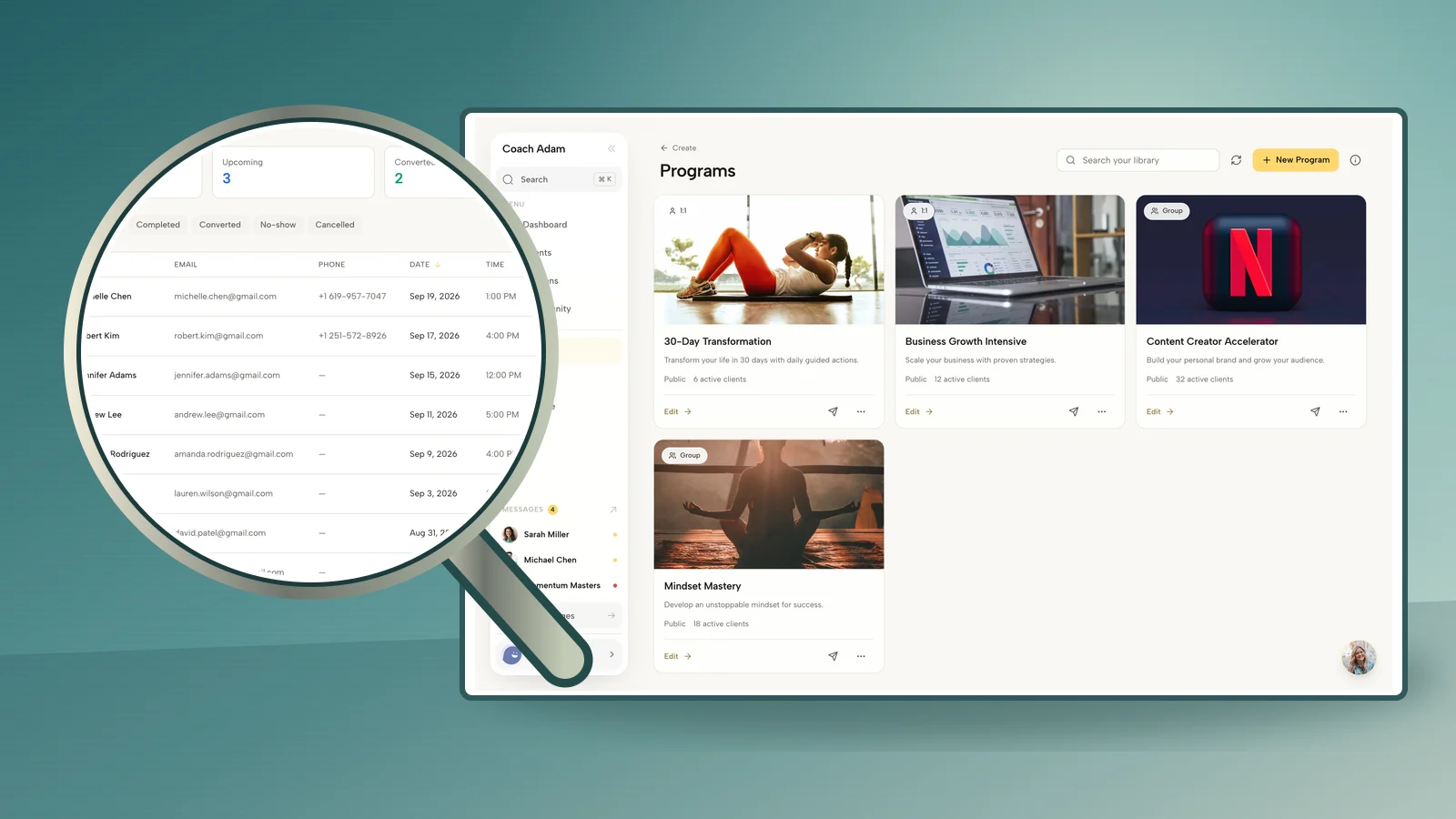
When the need is clear, inspect how you would manage the practical handoff from intake to the chosen learning or coaching structure. Try the interactive Coachful demo to explore the real intake, courses and programs shown here. Use it to evaluate delivery administration, not to diagnose the organization or generate a ready-made needs analysis.
Source and limits: CIPD supports the general learning-needs principles described above. The questions, decision matrix, brief and worked scenario are original practical guidance. They are not legal, clinical or employment advice, and the screenshots show demo data rather than the hypothetical company or its results.