Coaching Platform for Coaches: A Practical Buyer's Guide

Coachful

Sunday evening, laptop open on the kitchen table, and you're doing the least coaching-like part of the job. You copy a client's goal out of a message thread into a spreadsheet, check whether last month's invoice cleared, and try to work out which of two clients called Sarah asked for the 8am slot.
None of that is coaching. All of it decides whether your practice feels calm or chaotic.
You're not running a niche of one. The ICF Global Coaching Study collected 14,591 valid responses across 157 countries and estimated 109,200 coach practitioners in 2022, a 54% increase on 2019. A market that size raises client expectations: people who pay for coaching notice when the invoice is late, the notes are missing or the reminder never arrived.
This guide treats a coaching platform for coaches as two decisions before it becomes a feature list. The first is client experience, meaning what the work feels like between sessions. The second is privacy, meaning who can see what, where it lives, and what happens when AI touches it. Features only matter where they serve those two.
What a Coaching Platform Replaces in Your Week
Maya is a life coach with 14 active clients. Her week runs across a calendar app, a goals spreadsheet, invoices from a payment app, a folder of worksheets she emails after each session, and a notes document she keeps open during calls. Nothing is broken. Everything requires her to be the integration layer.

Think of a platform the way you'd think about a clinic. In a clinic you don't book at reception, pay the pharmacist, then phone a third person to find your file. The building holds all of it so the clinician can concentrate on the patient. A coaching platform is that front desk and filing room under one roof: intake, scheduling, payments, messaging, programs, session notes and progress tracking share one workspace, so booking, records, billing and reminders stop living on sticky notes.
The scale behind this is real. The 2025 coaching revenue figures compiled by Gaugius put the profession's total annual revenue at an estimated $5.340 billion in 2025, according to the International Coaching Federation. When coaching is a business of that size, admin efficiency stops being a luxury for the organised few.
What a platform is not
It does not replace the coaching conversation. It won't choose your method, and it won't make you a better listener. If your sessions are weak, software will only document them faster.
"I'm too small for a system" is the objection worth answering directly. A small practice repeats the same admin for every client, every week. The repetition is the problem, not the client count. A coach with six clients still sends six reminders, chases six payments and rebuilds the same worksheet six times.
The test isn't how many features a platform advertises. It's whether the work between sessions gets less repetitive in week three than it was in week one. If you're still retyping the same goal into a second tool, nothing has changed. To see what a client management system for coaches holds, compare it against the list of tasks you did by hand this week.
Sunday test: count how many tools you open during a single client session, then count how many times you retype the same information (a goal, an email address, a payment date) in one week.
Platform Features to Compare Before You Buy
Score each platform on eight criteria, then mark every one must-have or nice-to-have for your practice. That single habit prevents the most expensive buying mistake: paying for depth you'll never open while the basics stay thin.
| Criterion | What to Verify | Red Flag |
|---|---|---|
| Client records | Intake, goals, notes and tasks linked to one client | Notes scattered across email and documents |
| Scheduling | Booking page, time zones, automatic reminders | Manual calendar swaps and missed sessions |
| Payments | Recurring billing, failed-payment retries, payouts to own bank | Coach chases invoices by hand |
| Messaging | In-app messages attached to the client record | Client chats only in a personal messaging app |
| Programs and content | Multi-week programs, assignments, resource sharing | Copying PDFs again for every cohort |
| Client app | Mobile access for clients with your branding | Web-only portal that clients abandon |
| Data permissions | Role-based access, data export, deletion on request | No export or unclear deletion process |
| Pricing model | Transparent per-client or per-seat pricing and fees | Transaction fees hidden in checkout |
Walking the rows
Client records come first because every other row leans on them. Put a client's goal in a document that sits apart from the session notes and you'll copy it by hand each week until it drifts out of date.
Scheduling earns its fee when it deletes messages, not when it produces a prettier calendar. A booking page that displays the client's own time zone and fires a reminder 24 hours ahead removes the two-email shuffle that eats a Tuesday morning.
Payments only count if they handle failure. Recurring billing that retries a declined card and tells you it failed is the difference between a retainer that arrives and one you chase.
Messaging belongs beside the record. A client's question about last week's assignment should sit next to that assignment, not in a personal messaging app on your phone.
Client app, read through an accessibility lens. Open the client view on a phone, in your second language, with a screen reader, on a weak connection. The career-coaching guidance from the National Career Development Association notes that clients without reliable broadband, digital literacy or English fluency can be excluded from services, while multilingual support and text-to-speech widen access. Ask which of those your clients need before you score the row as must-have. A cohort of city executives and a cohort of rural parents need different answers.
Data permissions and pricing are the two rows coaches skip and later regret. On permissions, ask who can read private notes inside your own team. On pricing, read the fee schedule, not the headline.
Three questions to ask any vendor
- Export: how do I take all my client data with me, in what format, and how long does it take?
- Visibility: who inside my account can read private session notes?
- Exit: what happens to a client's records when they stop working with me, and when I stop working with you?
A trial proves more than a demo. Book a real session, take a real payment, write one real set of notes, then find them again from the client's record. If locating yesterday's note takes three clicks and a guess, the platform won't survive a busy month. Do the scoring with one real client in front of you, ideally the one who reschedules twice a month. All-in-one platforms, ours included, sit in the same grid and lose points on the same rows.
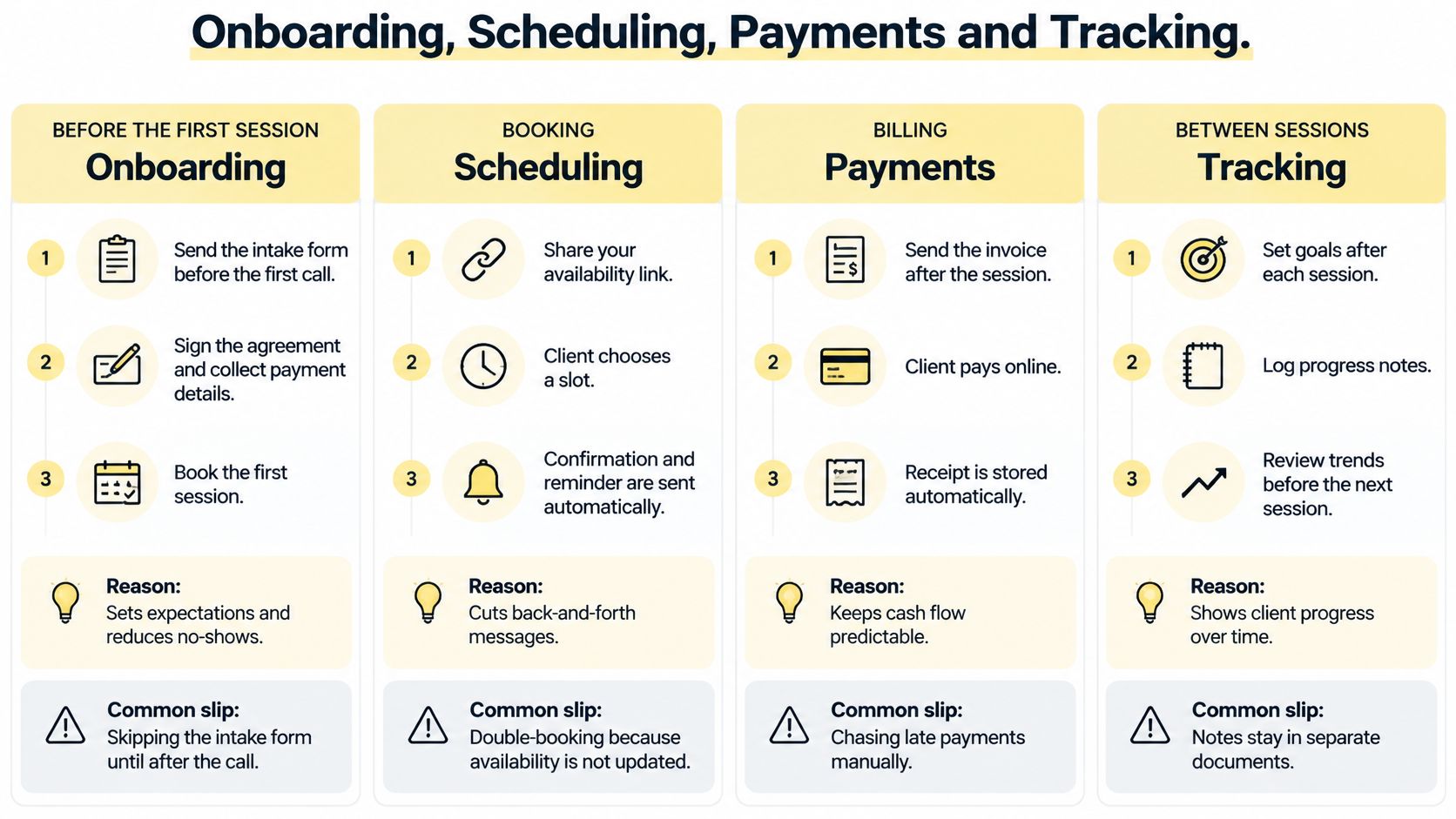
Onboarding, Scheduling, Payments and Tracking
A working setup follows four phases, and each phase has one failure that undoes the rest. Written on a single page, these twelve steps move a whole practice across in an afternoon.
Before the first session
- Send the intake form before the first call. You get context, the client gets a sense of how you work, and the first paid hour goes to coaching rather than history taking.
- Sign the agreement and collect the payment method in one flow. Consent and card details belong together; split them and that's how retainers start unpaid.
- Import existing clients, programs and content so nothing is retyped. Coachful helps import a coach's clients, programs and content during onboarding, which matters more than it sounds: retyping 14 clients and three programs is how trials die.
- Record the starting goal inside the client record. A goal captured in the intake stays attached to every later note instead of living in a document nobody opens.
The common slip here is putting off the intake form until after the call. You then spend the second session asking the questions you should have asked at booking.
Booking and reminders
- Publish one booking link that shows the client's time zone and your real availability. One link, everywhere, beats a paragraph of instructions. If you want the mechanics of a coaching booking software setup, that's the piece to study first.
- Set automatic reminders at 24 hours and one hour before. Two touches, not five; the second catches the client who forgot on the morning of.
- Write the reschedule rule into the booking confirmation. Clients respect a stated boundary far more readily than an awkward conversation three days later.
The slip that costs real money is a booking link without time zones. Two missed calls in a month is enough to question the whole system.
Billing
- Connect your existing Stripe account. Coachful uses Stripe Connect, so a coach's existing Stripe account links to Coachful instead of forcing a second processor and a second payout schedule.
- Set the package shape as a single session, a fixed-length program or a monthly retainer. Each attracts a different kind of client, and mixing them in one invoice creates confusion later.
- Turn on recurring billing and failed-payment retries. A retainer that fails on the 3rd is worse than one you know about on the 1st.
An unlinked payment method is the phase-two version of the same mistake: the client is booked, the sessions happen, and the money never moves.
Between sessions
- After every session, record four things: the goal, the agreed action, the due date and the question you'll ask next time.
- Open the next session by reviewing that action. Coachful offers iOS and Android coaching apps for both coaches and clients, so a client can tick off a commitment on a phone before the session starts.
After two weeks of this, a specific feeling shows up: no client has been asked for the same information twice, and every outstanding commitment is visible on one screen. That's the whole return on the switch.
Which Platform Features Fit Your Coaching Audience
An employer funds a six-month leadership program for one executive. The employer wants attendance and milestone summaries. The executive owns the reflections she wrote after a hard week with her manager. One engagement, two people, opposite rights to the same file.
That's not an edge case. The 2023 ICF study summarised by the Academy of Executive Coaching found that, on average, 57% of clients were sponsored and 43% were primary clients. Sponsored means someone else pays, and the moment that happens your platform needs roles: payer, participant, program administrator, coach.
"I only have five clients, so I don't need roles." Then one of those five arrives with an employer-funded package and you're exporting notes into a spreadsheet to protect confidentiality. Roles are cheaper to switch on before that conversation than after it.
The rows, one at a time
| Audience | Main Pain | Must-Have Feature | Example |
|---|---|---|---|
| Solo life coach | Juggling calendar, invoices and notes | Scheduling with reminders and one client record | Maya runs 14 clients from one booking link |
| Executive or business coach | Employer pays, employee owns the conversation | Separate payer and participant roles | Sponsor sees attendance, not session notes |
| Coaching school or academy | Running cohorts with many coaches | Group programs with assignments and shared resources | 12-week cohort shares one assignment set and a sponsor attendance summary |
| Health or performance coach | Sensitive health data in session notes | Permissions and controlled access | Sleep and blood-pressure notes visible only to the coach |
| Consultant or course creator | Selling several package types | Packages as single sessions, programs or retainers | One program offered as self-study, group and VIP 1:1 |
Career-change work runs through most solo practices, and clients often ask where to rebuild a CV without paying a designer. For the clients in tech, pointing them at a free tool to make a developer resume online from ParakeetAI removes a chore from the session and keeps the hour on the interview story, which is the part only a human can coach.
The academy row is the one people underestimate. A school running five coaches through one cohort needs assignments, shared resources and a summary a sponsor can read, all in one program, while the participants' reflections stay private. Health coaches need the strictest setting on the permissions row, because a note about medication has a different consequence than a note about a morning routine. Consultants need package variety more than depth: one program sold as self-study, group and VIP one-to-one should be three prices on one record, not three separate documents.
Find your own row, circle the two must-haves that match it, and treat everything else as optional until a client asks for it.
Privacy, Consent and AI Without Losing Client Trust
A client mentions she's been anxious and has started a new medication. You write it down, because it's relevant to the goal. The question most coaches never answer out loud is whether that sentence belongs in ordinary notes.

Not automatically. Under Article 9 of the EU General Data Protection Regulation, health data is generally prohibited from processing unless a specific exception applies, and for many coaches the workable route is explicit consent for one or more clearly defined purposes, as this guide to the legal basis for data processing in coaching explains. Voluntary disclosure in a session does not create permission to store, reuse or share that sentence.
A five-step routine that holds up
- Classify what you collect. Goals, commitments and session themes are one category. Health, medication, sleep and performance data are another, and they need a stronger basis and tighter handling.
- Write the purpose in one sentence the client can read, and record consent beside it. "I keep notes to prepare for our sessions and to track your goals; I don't share them with your employer."
- Restrict access so only authorised people can open sensitive notes. That includes your own team, your VA and any assistant you bring in for a busy quarter.
- Decide retention, and know how a record gets deleted when a client asks. "We keep everything forever" is not a policy.
- Check where the data is stored and which vendors process it on your behalf. Cross-border coaching makes this a live question rather than a legal footnote.
Where AI fits, and where it doesn't
Use AI for summaries, reminders, drafting and administration. Keep relational and interpretive coaching human. A 2025 survey of 205 coaching professionals, reported in Springer's chapter on AI and coaching practice, found widespread generative AI use for research, content and administration while relational work stayed largely human-led, and almost 94% of respondents primarily used a version of ChatGPT. A general-purpose chatbot is not built for sensitive personal disclosures, which is the tension our guide to whether coaches can use ChatGPT with client information works through in practice.
Three safeguards make AI use defensible. Anonymise before processing, stripping names and identifying details from any note that reaches an automated tool. Let clients opt out, and record the choice where you'll see it. Audit every generated summary for bias and factual error, because a fluent summary of a session can still be wrong.
Privacy-first help with visible human control. If a client can't tell who read her disclosure, the tool has already cost you more trust than it saved time.
Real Coaching Cases and the Pain Points They Solve
A solo coach with 12 clients reclaims four hours a week. Twenty minutes per client on messages, reminders, notes and payment status adds up to four hours of non-coaching work, every single week. Consolidate those four tasks into one workflow with automatic reminders and recurring billing and the time goes back to billable sessions, plus the replies clients notice.
The ICF study summary on coaching growth puts the average coach at 12.2 clients and about 11.9 hours of coaching per week, which is exactly the ratio that makes tracking infrastructure rather than decoration.
An executive client stops restarting every session. He's preparing for a difficult delegation conversation. The coach records the goal, the agreed action, the due date and the review question. Next session opens with "What happened when you tried the delegation conversation?" instead of a general check-in. Ten seconds of reading replaces twenty minutes of catching up.
A coaching academy stops rebuilding its cohort by hand. Twelve weeks of assignments, shared resources, session dates and a sponsor summary of attendance and milestone completion live in one program. Participants' reflections stay private to each participant and coach, which is the part that protects the academy's reputation as much as its clients.
The doubt worth naming
"I already remember what each client is working on." You do, in the session. The loss happens between sessions, when three clients have three different deadlines and one commitment was never written down. Memory reconstructs the discussion and loses the due date. That's not a character flaw, it's how recall works under load.
What a platform adds is an external memory both parties can see: the goal, the action, the date, the question. The client no longer wonders whether she really promised to do something, and you no longer open a session with a general enquiry when you could open it with evidence.
The value is less ambiguity between sessions, not more surveillance. A client who feels tracked performs. A client who can see her own progress compounds it.
Confirm Your Platform Choice This Week
- List your three must-have criteria from the checklist and the audience table.
- Shortlist two platforms that cover them. One can be an all-in-one tool.
- Move one real client into each trial and run a full cycle: intake, booking, payment, session notes, follow-up action.
- Run the exit test from the vendor questions: export that client's records and request a deletion.
- Compare both results against your must-haves and decide by Friday.
Coachful is an all-in-one option that brings scheduling, a coaching CRM, payments, contracts, group coaching, a website builder and digital products into one workspace, so test it against the same checklist rather than taking our word for it. The free pricing and revenue calculators can show whether a platform fee changes your income before you commit.
If you run a handful of one-to-one sessions from a simple calendar and never invoice anyone, a lighter tool may serve you better, and the checklist will tell you so.
Coachful gives coaches one connected workspace for scheduling, client records, payments, contracts, group programs, a branded client app and digital products, with a 0% platform fee on what you earn. Take the checklist from this guide, move one real client through a full cycle, then run the export and deletion test before you commit. Visit Coachful and judge it on how calm your next Sunday evening feels.