
Coaching Program Names: 5 Formulas and 25 Examples

Coachful
Coachful Editorial
Does your coaching program name need to sound distinctive, or does it need to tell people exactly what they are buying? If every promising idea feels either painfully generic or impossible to explain, start with the second job.
Choose a short, credible coaching program name, then add a plain-language descriptor that identifies the audience, the work and the actual format. Do not ask three clever words to explain your entire offer. A useful name helps the right person recognize the program without promising a result you cannot control.
This guide gives you five naming formulas and 25 original illustrative examples, followed by a practical shortlist test. The names are starting points, not trademark-cleared recommendations. No example is presented as a real coaching business or a tested conversion winner.
What makes a good coaching program name?
A good name is understandable, easy to say and consistent with the experience you actually deliver. It should work in a referral conversation, on a sales page, in a payment confirmation and inside the client’s program library. Distinctiveness matters, but clarity comes first when someone has never heard of you.
Consider this hypothetical combination:
- Name: The Delegation Practice.
- Descriptor: Six-session coaching for first-time managers.
- Scope: Practise briefings, handovers and review conversations.
The name provides a handle. The descriptor explains who should pay attention. The scope sentence makes the work tangible. None of these claims that every participant will secure a promotion or become a perfect manager.

Separate three things before brainstorming: your business name is the umbrella, your program name identifies one offering, and your method name identifies a process. They can share language without being identical. If you need the umbrella first, use the coaching business names guide. This article is about naming the thing a client enrolls in.
1. Audience plus task: use this when relevance matters most
Formula: [specific audience] + [recognizable task] + [honest format]. This is a strong starting point for an unfamiliar offer because it gives the buyer something to recognize immediately. It is particularly useful when different people use the same broad word, such as confidence, to mean very different work.
- The New Manager Delegation Lab.
- The Returning Professional Career Review.
- The Solo Consultant Offer Workshop.
- The First-Time Founder Planning Sessions.
- The New Team Leader Conversation Practice.
Each example narrows the audience and identifies an activity. Choose a format word carefully: a workshop should contain actual facilitated work, while coaching sessions should leave room for the client’s agenda. Do not label private coaching a mastermind merely because the word feels expensive.
The trade-off is length. If the name becomes a whole sentence, move the audience or format into the descriptor. “The Delegation Lab” followed by “Small-group coaching for first-time managers” may read better than forcing every detail into the title.

2. Practice plus container: use this for repeatable behavioral work
Formula: [specific practice] + [sessions, studio, lab or program]. This route puts attention on what participants will practise rather than on a guaranteed after-state. It can fit leadership, life, relationship and business coaching when the work involves trying something, reflecting and adjusting.
- The Boundary Practice.
- The Difficult Conversation Studio.
- The Weekly Planning Sessions.
- The Feedback Practice Program.
- The Better Briefing Lab.
These names still need context. “The Boundary Practice” might mean a leadership program, a relationship workshop or something clinical. A descriptor such as “Private coaching for freelancers setting working-hour and client-contact boundaries” removes much of that ambiguity.
Use the word “practice” honestly. If you mainly deliver recorded lessons with no opportunities to apply or review them, explain that format instead. A grounded name does not rescue an unclear delivery model; it exposes the questions you still need to answer.
3. Decision plus format: use this for a bounded choice
Formula: [decision or situation] + [review, studio, sessions or intensive]. This works when a person seeks coaching because they need to decide something, not because they want an open-ended transformation. The program name can point to that moment without pretending that the coach chooses the answer.
- The Career Options Studio.
- The Next Role Review.
- The Partnership Decision Sessions.
- The Business Direction Intensive.
- The Return-to-Work Planning Program.
State what the client leaves with that is within the engagement’s scope: a comparison of options, a written decision rationale, an experiment plan or a set of questions for stakeholders. Do not guarantee that an employer, partner or market will respond in a particular way.
For an intensive, make the actual time commitment visible. A buyer should not have to discover after paying that “intensive” means six weeks of scheduled work rather than one focused afternoon. If your work includes consulting, explain where advice is offered rather than hiding it inside a coaching label.

4. Real duration plus focus: use this when the container helps people choose
Formula: [actual duration] + [focus of the work]. A duration can make an unfamiliar commitment easier to understand. The key distinction is that it describes the program’s length, not a deadline by which an external result is guaranteed.
- Eight Weeks of Leadership Practice.
- The Six-Session Career Review.
- A Quarter of Business Planning.
- The Four-Week Routine Experiment.
- The Twelve-Week Communication Practice.
Only use these durations if they match the real offer. Include session frequency, access dates and what happens during breaks in the description. “Six sessions” and “six weeks” are not interchangeable if participants can book flexibly over several months.
This route is less flexible when delivery changes. If you are still piloting and expect to adjust the length, keep the duration in the descriptor instead of the core name. That lets you improve the program without renaming it every time you learn something.

Check the title on the client’s phone as well as your sales page. Long strings, abbreviations and names that differ only at the final word become difficult to distinguish in a compact program list. Recognition after enrollment is part of a name’s job, not an administrative afterthought.
5. Metaphor plus plain descriptor: use this when you already have a story
Formula: [simple memorable metaphor] + [literal description beside it]. A metaphor can give an established offer personality without locking it to one duration. It is the riskiest route for an unknown audience because the phrase may tell them very little on its own.
- The Working Compass: Career Coaching.
- The Next Draft: Coaching for Career Change.
- The Handrail: Coaching Through a New Leadership Role.
- The Open Notebook: Reflective Coaching for Business Owners.
- The Practice Ground: Small-Group Leadership Coaching.
These are illustrative constructions, not available brands. Familiar metaphors are often used by other businesses. Do not assume an invented combination is original, distinctive in your market or legally safe just because it emerged from your own brainstorming session.
Choose this approach if you can explain the metaphor in a short sentence and your descriptor still works without it. Avoid spending the first half of every sales conversation explaining a private reference. Your client is trying to judge the work, not pass a test on your vocabulary.

How to choose between the five naming formulas
Use audience-plus-task when the buyer needs to recognize themselves quickly. Use practice-plus-container when repeated application is central. Use decision-plus-format when the engagement concerns a bounded choice. Use duration-plus-focus when the real time commitment is an important buying distinction. Use a metaphor when you can afford to explain a little and still provide a literal descriptor.
You can combine two routes, but stop before the title turns into a paragraph. “The New Manager Delegation Lab” combines audience, practice and format naturally. Adding “Eight-Week Transformational Leadership Accelerator Experience” does not necessarily make it more persuasive. It mainly creates more claims to explain.
The aim is not to find a supposedly premium word. A plain title with an accurate scope is usually a better starting point than a dramatic title hiding an undefined offer. Pricing, fit and delivery still need their own explanations.
A practical process for naming your coaching program
Write the offer before the name
Complete this sentence: “This is [format] for [person in a specific situation] who wants to work on [task or decision], delivered through [real structure].” If you cannot finish it, revisit the offer. For the method and delivery work, see how to create a signature coaching program.
Collect language from actual enquiries and conversations, using permission and removing personal details where appropriate. Look for repeated descriptions of the problem, not testimonials you can turn into an unsupported promise. “I keep rewriting my team’s work” is more useful naming material than “I want to reach my highest potential.”
Create a short list, not an endless naming project
Draft one or two candidates using each formula. Pair every candidate with the same truthful descriptor so you are comparing names rather than different offers. Remove anything that requires an explanation, implies a qualification you do not hold or promises a result dependent on someone else.
Keep a working name if the offer is still changing. You can test how people understand the program before buying a logo or building a separate website. A name is not evidence that the program has demand.

Test understanding before preference
Show a small number of plausible buyers the name and descriptor without delivering your pitch. Ask who they think it is for, what they expect to do, what kind of support they expect and whether they hear a guaranteed result. Then ask them to say the name aloud or type it after hearing it.
This is directional qualitative feedback, not a conversion experiment. If people love a name but misunderstand the service, revise it. If they correctly describe the program but dislike a harmless stylistic detail, that is a different problem. Do not collapse both answers into one popularity score.

Check conflicts before you commit
Search the exact phrase, close spellings and similar services. Look beyond domains and social handles. A free web address is not trademark clearance, and an existing registered company name is not the whole legal picture. Relevant rights and restrictions depend on the jurisdictions and services involved.
The USPTO trademark search resources are a starting point for US research, not a substitute for advice on a particular name. Ask a qualified professional when a close name already exists, you plan to invest heavily, or you intend to license the program. This article is practical naming guidance, not legal advice.
Put the shortlisted name in the places clients will see it
Preview it in a landing-page heading, offer description, booking confirmation, invoice line and program list. Say it inside a normal referral sentence: “I am doing [name], a coaching program for [audience and task].” If that sentence needs a footnote, simplify the title or strengthen the descriptor.

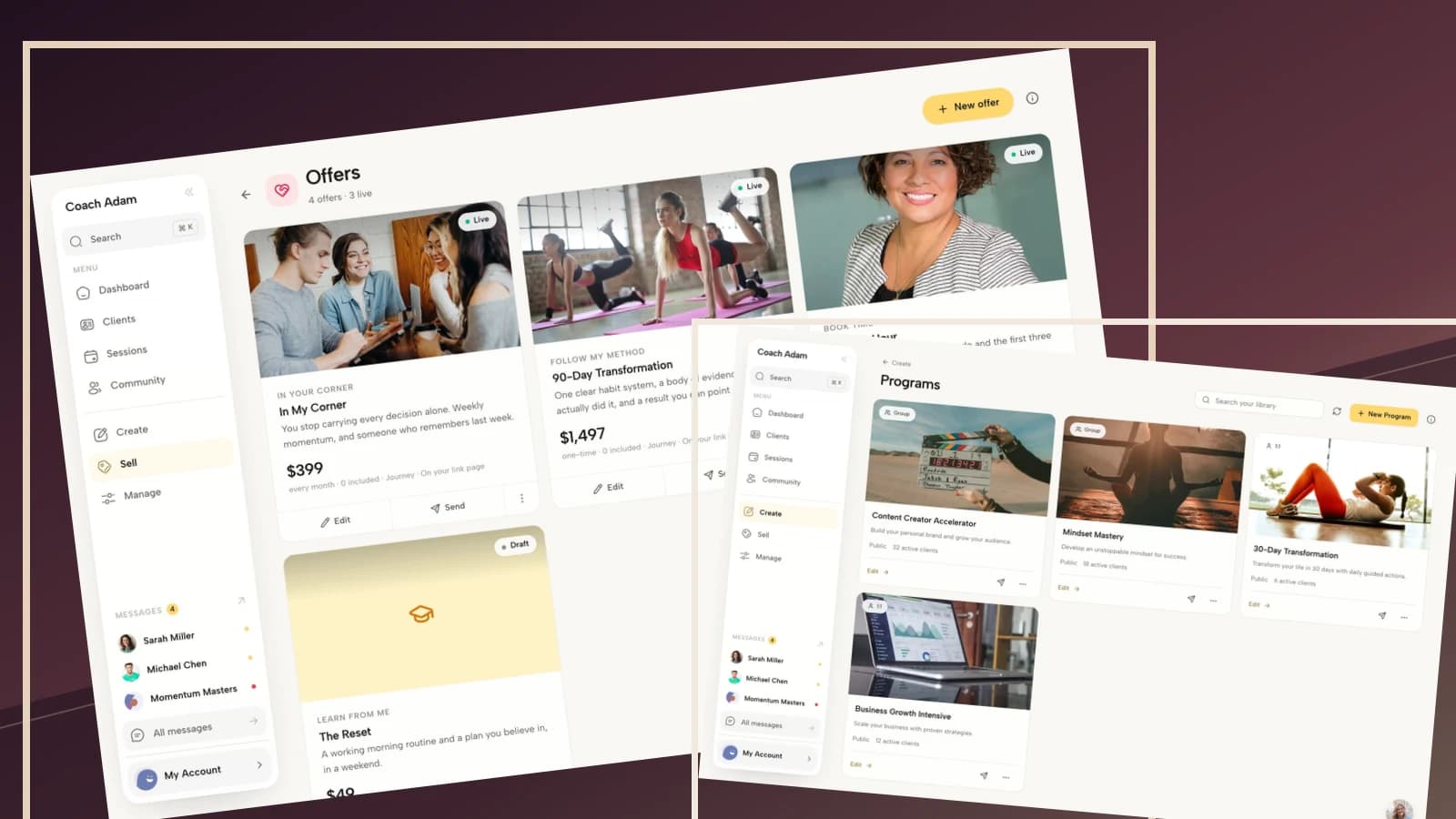
Coachful’s demo can help you inspect the real offer, program and website surfaces illustrated here. Once you have a shortlist, try the interactive demo and consider where the name and its explanation would need to remain consistent. This is a presentation check, not a trademark search or evidence that a particular name will sell.
Do not assume changing one label updates every page or past record. Check the actual surfaces you use and keep existing clients informed if a familiar program is renamed. Preserve the agreed scope, access and terms unless you separately agree to change them.
Frequently asked questions about coaching program names
Should I use “program,” “course” or “mastermind”?
Use the word that matches the delivery. A course commonly signals structured teaching; a coaching program should explain the coaching support; a mastermind implies meaningful peer participation. Mixed formats are fine if you describe them. Do not use a fashionable label to conceal what clients will actually do.
Does every coaching package need a unique name?
No. A clear descriptive label can be enough, especially for a straightforward private package. Distinct names become more useful when clients need to distinguish several offers or refer to a repeatable experience. Do not create unnecessary brands for slightly different payment options.
Can I use a result in the name?
You can name the focus or aspiration, but check the promise a reasonable buyer might hear. “Interview Practice” describes work. “Guaranteed Job in Thirty Days” implies an external outcome. Avoid earnings, health, relationship or employment guarantees you cannot substantiate or control.
Should I change an existing program name?
Consider changing it when people consistently misunderstand the audience, work or format. First test whether a better descriptor would solve the problem. If you rename it, explain that it is the same program where that is true, update your active materials and avoid making previous clients wonder whether their purchase has changed.
The best coaching program name is a useful label attached to a clear offer. Choose a defensible shortlist, test what people understand, check conflicts, and put the strongest candidate beside a truthful descriptor. Then get back to improving the work it represents.












