Coaching Services Page: 5 Examples and a Copyable Template

Coachful
Editorial Team
Should your coaching services page list everything you do, or help someone choose one next step? Help them choose. A useful services page explains who each option is for, how the options differ, what the client is committing to and where to go next. A row of impressive package names is not enough.
Start with the decision your visitor needs to make, then choose the page structure. One signature offer needs a focused explanation. Several genuinely different services need a comparison. Corporate buyers may need a separate route from individuals. The five examples below show how to handle those different situations without turning your website into a confusing catalogue.
These are original, hypothetical copy examples for coaches to adapt, not real client results or ready-made Coachful templates. Any duration, inclusion or response commitment must match what you actually sell. The purpose is to write a clearer service-selection page, not to promise a particular conversion rate.
What is a coaching services page?
A coaching services page, sometimes called a Work With Me page, helps a visitor understand the ways they can hire you. Its main job is selection: which service fits this situation, and what should I do next?
That is different from an About page, which establishes who you are, or a detailed offer page, which explains one particular purchase. Your services page can send someone to a detailed offer, an application or a booking page. It does not need to repeat the complete contract or squeeze every program lesson onto one screen.
For example, a coach might have a short services page that separates individual coaching, a cohort program and workshops for organizations. Each route can then have its own detail page. If you sell only one engagement, you may combine selection and offer detail rather than creating extra pages merely to look established.

Before writing, decide what the visitor is choosing
Write down your current offers and the meaningful difference between them. Ignore names for a moment. Are clients choosing a different problem, a different format, a different commitment or a different buyer relationship? Those distinctions should drive the page.
Two packages that differ only in the number of sessions may belong together on one offer page. Individual coaching and an employer-funded team engagement usually need more explanation because the buyer, participants and agreement may be different. Do not make visitors decode that distinction from labels such as Essential, Elevate and Elite.

Use these five page architectures as a selection rule:
- One signature engagement: explain one service clearly, without manufacturing extra tiers.
- Different stages of the same problem: help the visitor recognize their starting point.
- Individual or group delivery: compare the actual experience and trade-offs.
- Individuals and organizations: separate buyer routes and explain the inquiry process.
- Coaching and workshops: distinguish an ongoing relationship from a defined event.
These are not five niches with the same text swapped around. Each structure solves a different selection problem. Choose the one that resembles your practice now, rather than combining all five into a sprawling menu.

1. One signature coaching engagement
Use this when: most suitable clients buy the same basic service, with the conversation tailored to them. You do not need three invented price tiers to justify having a services page.
Example services-page copy
Coaching for your first management role
You have become responsible for other people's work, but your week still looks like your old job. This individual coaching engagement gives you space to examine the decisions, conversations and boundaries that come with managing a team.
We meet for six private sessions over three months. Between sessions, you choose a practical action to test at work and bring back what you notice. This is coaching, not an outsourced management service or a guarantee of promotion.
Read the engagement details for the fee, scheduling arrangements and support boundaries. If the approach looks relevant, book an introductory conversation to discuss fit before deciding.
Why this structure works: it names the situation before explaining the format. It also tells the reader what the service is not. The introductory conversation has a reason to exist: both parties still need to assess fit.
What to add: your actual fee or a clear link to it, relevant credentials, an accurate description of between-session contact and a concise explanation of what happens after booking. Do not borrow the six-session structure if your real service works differently.
Trade-off: a focused page will not accommodate every possible buyer. That is acceptable if it accurately reflects the practice. Add another service only when it represents a genuinely different purchase, not because the page feels too short.
2. Services organized by the client's starting point
Use this when: the same audience needs different work at different stages. The distinction should change the engagement, not simply rename the same service.
Example services-page copy
Choose the career conversation you need now
Exploring a change: you know your current work no longer fits, but you have not chosen a direction. We examine priorities, constraints and possible routes, then identify a small way to investigate an option.
Preparing for a specific transition: you have a direction and want coaching around the decisions and conversations involved in moving toward it. We work with the situation you are facing, rather than returning to a general career exploration exercise.
Open the relevant service description to see its scope, format and fee. If you are unsure which starting point describes you, use the inquiry form and explain the decision you are trying to make.
Why this structure works: the visitor selects by a recognizable situation. They do not need to understand your internal methodology before finding the relevant path.
What to avoid: implying that exploration is a mandatory prerequisite for every other service. A client who has already made a decision should not be pushed through an unnecessary purchase. Equally, do not describe job placement, recruitment or CV writing as included unless you actually provide those services and distinguish them from coaching.
Keep the comparison fields consistent. If one option states its duration and the other does not, the visitor cannot compare them fairly. Explain the intended starting point, focus, format, price basis and next action for both.
3. Individual coaching versus a group program
Use this when: visitors are choosing how they want to participate, not simply deciding how much to spend. Group coaching is a different experience, not necessarily a cheaper version of private coaching.
Example services-page copy
Private coaching or a shared program?
Individual coaching: private sessions focused on the situations you bring. Consider this route if you need a flexible agenda and want to discuss matters outside a group setting.
Group program: scheduled sessions built around a shared theme, with facilitated discussion and opportunities to learn alongside other participants. Consider it if the theme fits and you can attend the published dates.
Read the group page for the timetable, participation expectations and confidentiality agreement. Read the individual coaching page for availability, scope and fees. Neither route guarantees a particular result, and group participation does not mean unlimited individual access to the coach.

Why this structure works: it compares the experience, not just the price. The reader can assess privacy needs, scheduling and the type of support they want.
What to add: the real cohort dates, whether recordings exist, what happens after a missed session and whether any private calls are included. Explain group confidentiality honestly: you can set expectations and agreements, but cannot promise complete control over other participants' behavior.
Do not use vague labels such as “community access” when the actual inclusion is a monthly facilitated call. Name the thing being purchased. A program page can provide the full detail; the services page should make the important difference visible before the click.
4. Separate routes for individuals and organizations
Use this when: a self-funding person and an HR or learning-and-development buyer both arrive on your website. They may want related coaching, but they are not making the same purchasing decision.
Example services-page copy
Coaching for you, or for people in your organization
For individuals: explore private coaching around your own leadership decisions and working relationships. Read the engagement details and book an introductory conversation if the approach fits.
For organizations: discuss coaching for a leader, a leadership group or a defined development initiative. Use the organization inquiry form to share the intended participants, broad purpose and timing. Please do not include private employee performance or health information in the initial form.
We will clarify scope, sponsor involvement and commercial terms before an engagement is agreed. Where a sponsor is involved, the agreement will specify what can be shared and what remains confidential.

Why this structure works: the corporate route does not pretend that an inquiry is an instant purchase. It names the information needed to begin and protects against collecting sensitive details too early.
What to add: your actual response expectation, relevant procurement information and the kinds of engagements you are equipped to deliver. Only mention assessments, stakeholder interviews or sponsor reports if they are genuinely in scope.
Trade-off: separate routes add navigation. Use them when the buying process really differs, not merely to make a solo practice look like a large firm. If organizations rarely buy from you, a clearly labeled inquiry link may be enough.
5. Coaching and workshops as different purchases
Use this when: you offer both an ongoing coaching relationship and a defined workshop or learning event. A workshop buyer needs to understand the event's audience, purpose and delivery, not read a private coaching package with a different title.
Example services-page copy
Choose an ongoing conversation or a focused event
Individual coaching: an ongoing engagement for a person's own decisions and development. Explore the coaching page for the format, support boundaries and fee.
Workshops: a facilitated session for a group around an agreed learning objective. Ask about a workshop by sharing the audience, intended learning and proposed date. We will discuss scope before quoting.
A workshop is not a substitute for private coaching, clinical care or an employee investigation. If the brief involves a sensitive organizational issue, we will first clarify whether this format and my expertise are appropriate.
Why this structure works: it separates a relationship-based service from an event-based purchase. A workshop can have defined materials, delivery hours and logistics, while coaching has a different agreement and rhythm.
What to add: the workshop topics you can actually deliver, whether customization is available and which costs a quote includes. Do not promise that one workshop will resolve an organization's culture, conflict or retention problem.
For a complete event listing rather than a service overview, use our coaching workshop description examples. Keeping the two jobs separate prevents your main services menu from becoming a long event brochure.
A coaching services page template you can copy
Replace the bracketed fields with verified details. This is a writing framework, not legal language or a requirement to offer every type of service.
- Page opening: “Coaching for [specific audience or situation]. Choose [the meaningful decision between your services].”
- Short orientation: “If you are [starting point], begin with [service]. If you need [different requirement], explore [other service].”
- Service name: use a plain-language name, with a branded title secondary if useful.
- Who it is for: describe the situation and any relevant suitability limits.
- What happens: state the format, duration, actual inclusions and between-session boundaries.
- Fee: show the applicable price or explain how a quote is determined and where details are available.
- Evidence: include relevant, accurately described credentials or permissioned client feedback, without implying guaranteed outcomes.
- Next step: name the action and explain what follows it.

On mobile, show the same fields in the same order for each service. Long comparison tables can become unreadable on a phone; stacked service sections with clear labels may be easier to use. Keep important details in live text rather than embedding your entire service description in an image.
Where should each services-page button go?
Book a conversation when a discussion is needed to assess fit or scope. Tell the visitor the purpose of the call and whether it commits them to anything. Do not call a sales conversation a coaching session if that is not what you will provide.
Apply when you need information to decide whether to invite someone into a program. Explain what you review and what happens afterward. An application button should not unexpectedly open a checkout.
View details or enroll when the offer is sufficiently defined for that action. Before asking for payment, make the relevant fee, schedule, inclusions and terms available. A visitor should not discover material conditions only after purchasing.

You can repeat a clear action after a long explanation, but avoid giving every service the identical “Learn more” label without context. “Explore individual coaching” and “Ask about an organization workshop” identify different destinations.

What should you leave off the page?
Remove services you are not currently able to deliver, invented urgency, unexplained acronyms and outcome claims you cannot substantiate. A precise description is more helpful than a promise to “transform every area of your life.”
Do not manufacture testimonials to fill a design. If your practice is new, describe your training, relevant experience and process accurately. Hypothetical examples can explain how you work, but must not masquerade as completed client engagements.
Keep the boundary between coaching and other professional services visible where it matters. Health, financial, legal or therapeutic work may involve qualifications and local requirements beyond a coaching credential. Describe your own scope rather than suggesting that a website disclaimer authorizes everything.
A practical final check before publishing your page
Ask someone unfamiliar with your offers to read the page and tell you which service they would choose, why and what they expect after clicking. Treat confusion as information about the page, not evidence that the person is the wrong audience.
- Can they explain the difference between services without using your branded package names?
- Are the fee basis, inclusions and support boundaries accurate?
- Does every button reach the intended live destination on mobile?
- Can someone understand the offer with images disabled?
- Does an inquiry collect only the information needed at this stage?
Real public pages show different approaches: LGK Coaching separates individual and group experiences, while Vision Coaching distinguishes executive coaching, team coaching and coaching-skills training. These are structural references, not endorsements or evidence of conversion performance. Borrow the clarity of the distinction, not another coach's claims or terms.
Build the selection path before polishing the design
A good services page makes the buying decision easier without deciding for the client. Choose the page architecture, write the differences plainly and test the next step. Extra animation will not rescue three offers that nobody can tell apart.
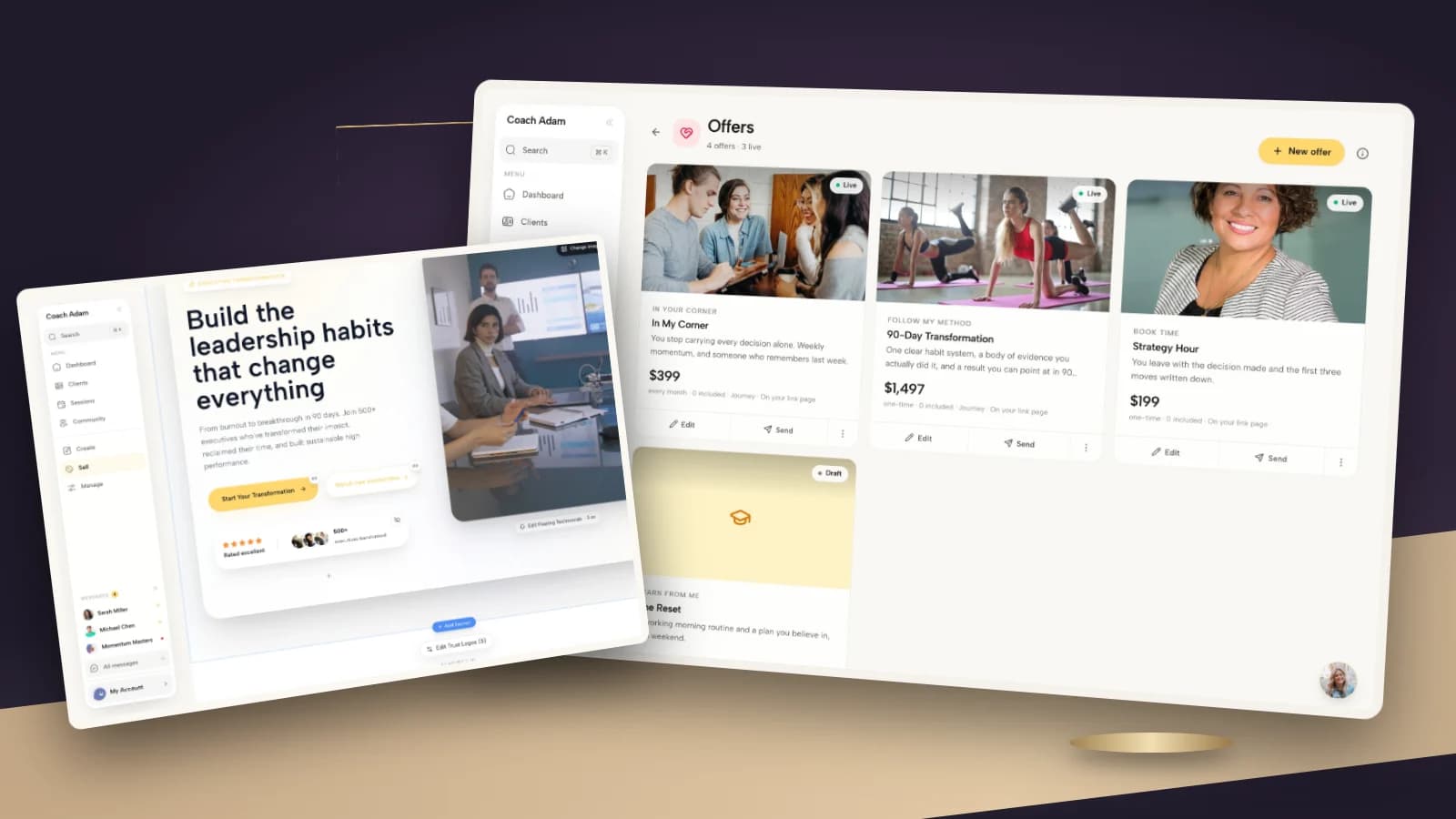
If you want to see how the page and its destinations could work together, try the Coachful interactive demo and inspect Website, Offers and the links workspace shown here. Start with one real service and trace the route a visitor would take. The demo is a way to evaluate the workflow, not a reason to add services your practice does not need.
Visual note: all product images use real Coachful demo screenshots. The cover and two explanatory compositions combine those screenshots with original editorial framing; none depicts the hypothetical page examples as a shipped product template.