Time Audit Template for Coaches: A 7-Day Client Exercise

Coachful
Editorial Team

How do you help a client who says, “I have no idea where my time goes,” without giving them another exhausting thing to track? Run a short observational time audit: agree on one question, record broad activity blocks for an agreed week, then use the pattern to choose one realistic experiment. Do not turn the exercise into a verdict on how hard the client works.
A useful time audit template needs start and end times, the primary activity, a little context and space for the client’s interpretation. It does not need screenshots of their computer, minute-by-minute surveillance or a score for being a good person.
This guide gives coaches a copyable log, a seven-day setup, a worked example and a review agenda. It is a practical coaching exercise, not a validated assessment, clinical screening tool or promise to recover a particular number of hours.
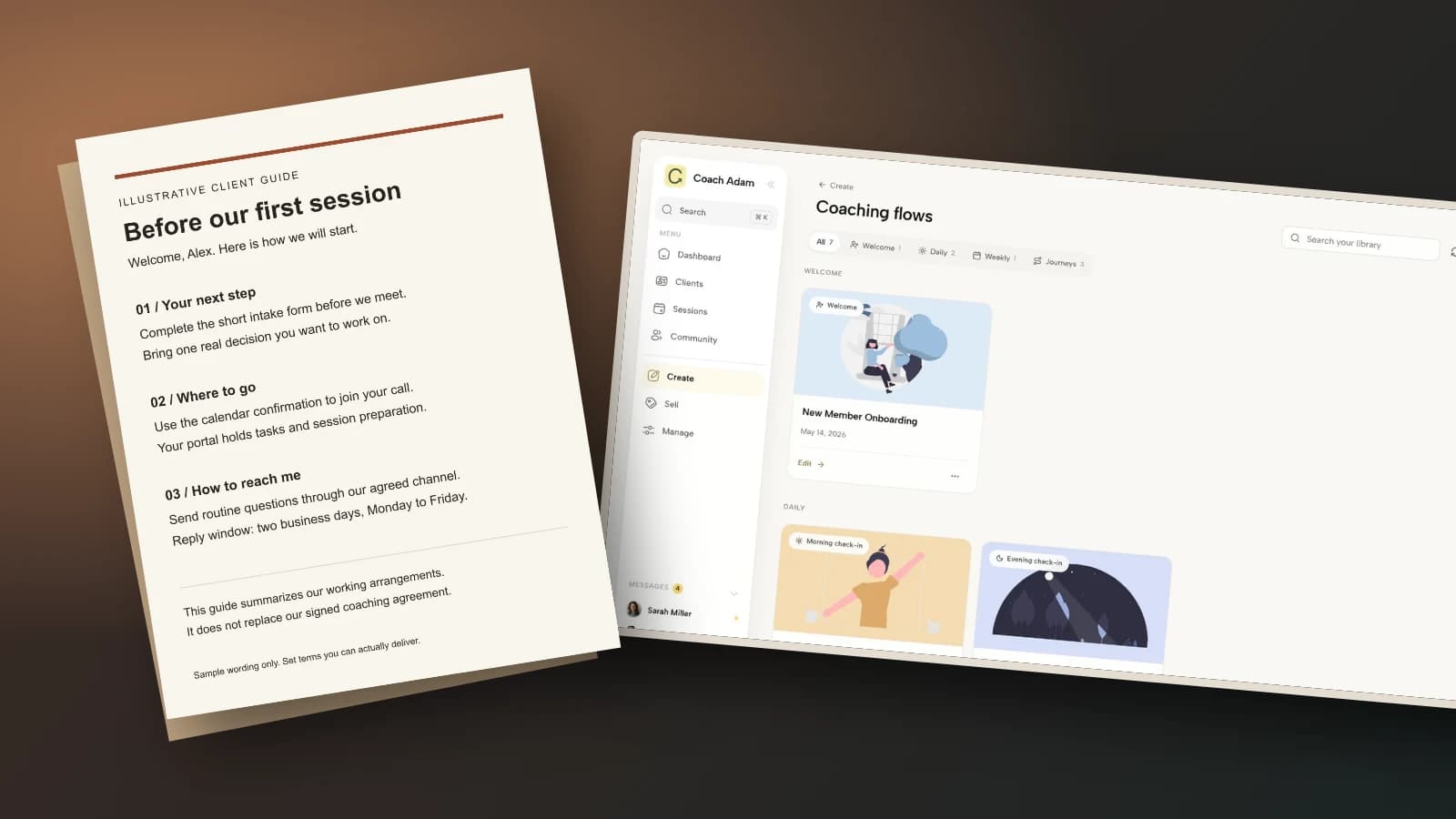
The cover is an illustrative AI-generated photograph of a physical week-mapping exercise. The examples below are hypothetical, not accounts of Coachful customers.
What is a time audit in coaching?
A time audit compares what a client thinks happens during a period with what they record happening. The point is to make a useful decision: renegotiate a commitment, understand an interruption, revise an estimate or protect something important.
It is different from planning. A calendar says what was intended; an audit records what happened. It is also different from a timesheet, which may serve billing, attendance or employment requirements. Do not quietly repurpose a confidential coaching exercise into an employer performance report.
For the broader engagement, see our guide to time management coaching. This article focuses on running the audit itself, including the awkward bits: incomplete records, overlapping activities and conclusions that turn out to be premature.
1. Agree on the decision before choosing the template
“Be more productive” is not specific enough. Ask what the client needs to understand about their week and what decision the answer could inform.
- A manager: “What displaces the project work I intend to do before lunch?”
- A self-employed professional: “Which parts of delivering this service take longer than I allow for?”
- A working parent: “What makes the transition from work to home feel rushed?”
- A career changer: “Where could a small, repeatable job-search block realistically fit?”
Choose one question. A client who wants to understand their working morning does not need to disclose their entire evening. Start with the smallest scope that can answer the question.
Then explain what the exercise cannot do. A week of observations cannot establish that a person is lazy, diagnose ADHD or prove a workplace is adequately staffed. It can offer examples to explore.
“Would you be willing to observe this part of your week? You choose the level of detail. We will look for a pattern together, not grade how you spend your time.”
Agree who will see the log, where it will be kept and when it will be deleted or reviewed under your records policy. If a sponsor pays for coaching, clarify the reporting boundary before collecting anything. A sponsor’s interest in progress is not permission to receive a client’s raw daily record.
2. Choose a tracking rhythm the client can tolerate
A seven-day window is a useful starting design when work and non-work days both matter. It is not a scientifically required dose. For a work-only question, five relevant working days may be enough to begin a conversation. For a rotating schedule, sample the different shift types rather than assuming Monday to Friday represents normal life.
Choose the capture method together:
- At transitions: Record a block when changing activities. This suits relatively distinct work or household tasks.
- At agreed checkpoints: Make a brief note at lunch, the end of work and another relevant transition. Label reconstructed entries as estimates.
- In broad intervals: Use a simple grid if repeated check-ins feel easier than remembering transitions. Choose an interval that does not disrupt the activity being observed.
Do not prescribe frequent alarms by default. An exercise about interruptions should not become the main source of interruptions. If recording is burdensome, reduce the scope, shorten the trial or use a brief daily reconstruction with an explicit accuracy caveat.

For each block, select one primary activity. If messages interrupted proposal writing, either split the block into separate non-overlapping periods or keep proposal writing as the primary activity and note the interruptions. Do not count the same minutes twice.
Some activities genuinely overlap: commuting while listening, or caregiving while doing administration. Note the overlap without pretending you can allocate attention precisely. Where a time total matters, choose and state a consistent primary-activity rule.

3. Copy this time audit template
Copy the following into a document, notebook or spreadsheet. Keep one entry per activity block. A spreadsheet is optional; consistency matters more than the software.
Audit agreement
Question we are exploring: [One question]
Dates and hours in scope: [Agreed period]
Capture method: [Transitions, checkpoints or intervals]
Level of detail: [What will and will not be recorded]
Who can access it: [Client, coach and any explicitly agreed exceptions]
Review date: [Date]
Storage and retention agreement: [Location and policy]
Repeat this entry
Date: [Date]
Start and end: [Times, or an explicitly marked estimate]
Primary activity: [Plain description]
Category: [Client-agreed category]
Context or interruptions: [Optional brief note]
Choice or constraint: [Chosen, required, negotiated, uncertain]
Client’s interpretation: [Optional; can wait until review]
If energy is relevant to the original question, add a simple optional note such as “steady,” “tired” or “energized,” using the client’s own language. Do not turn every field into a requirement. An exhausted client does not need a second shift completing your worksheet.
Use neutral categories that fit the client’s life. Possibilities include focused work, meetings, communication, administration, caregiving, travel, rest and other. “Waste” is not a neutral category. Neither is “distraction” when the activity was responding to a genuine responsibility.
Include “not recorded” in summaries. Leave sensitive details out. “Personal appointment” may be enough; names, diagnoses, messages and confidential employer information usually add little to the coaching question.

A short end-of-day reflection
- What do you notice, without explaining it away?
- What relevant context would someone miss from the log?
- Was recording manageable, and what should change tomorrow?
If you use a form for this reflection, keep it short. Coachful’s demo form builder shows editable form fields and a preview, which can help you think through how to collect a brief review. The screenshot is not a ready-made time audit or proof of automatic activity capture.

4. Run the week without coaching every entry
Set up the exercise in a session and complete one example together. Ask the client to explain how they would log a meeting interrupted by an urgent request. This catches ambiguity before it produces a week of incomparable entries.
A manageable seven-day sequence looks like this:
- Before day one: Agree the question, privacy boundary and method. Book the review.
- Day one: Try the simplest version. Notice whether the act of logging is disruptive.
- Day two: Adjust the format if necessary. Record the change rather than silently mixing methods.
- Days three to six: Continue observing. Note unusual events, leave missing blocks missing and avoid adding new goals.
- Day seven: Finish the agreed window and write a short reflection. Do not spend the evening manufacturing a perfect record.
- At the review: Separate observations, interpretations and possible changes.
Tell the client whether you will look at entries before the review and what response, if any, they should expect. A shared document is not an agreement that you are monitoring their day in real time.
Also acknowledge that observing can change behavior. A client may check messages less because they are recording it. That is useful context, not a reason to dismiss the exercise or claim that the recorded week is their unaltered baseline.
Do not praise a full log as evidence of being a better client. A partial record with honest gaps is more useful than an immaculate account reconstructed to please you.
5. Summarize the record without inventing precision
First establish what was actually observed. Check for overlapping blocks, missing days, different recording methods and unusual events. Calculate totals only within the agreed scope.
Hypothetical example: An eight-hour workday contains three recorded hours of meetings, two of focused work and one of messages. Two hours were not recorded. The recorded total is six hours, not eight; the missing two hours remain unknown.

That summary does not show that meetings are bad, messages should disappear or focused work was effective. A necessary decision meeting may be the most valuable activity of the day. Ask what the categories contained and how they connect to the client’s goal.
If the client estimated an activity beforehand, keep the estimate beside the recorded duration rather than rewriting it. The mismatch is something to explore. It might reflect interruptions, unclear scope, unfamiliar work or simply a rough estimate.
Avoid extrapolating a disrupted Tuesday into an annual total of “wasted hours.” Avoid treating a calendar invitation as proof of actual attendance or a checked habit as proof of duration. Different records answer different questions.
For a large log, summarize one relevant pattern rather than producing a dashboard for its own sake. “The three protected morning blocks were each interrupted by requests from the same project” is often more actionable than an elaborate color-coded productivity score.
6. Use a review agenda that leaves interpretation with the client
Let the client read their record before offering your theory. A coach can notice a pattern without claiming to know its meaning.

Here is a suggested 30-minute review. Adapt it to the client and the session agreement; the timings are a facilitation example, not a prescribed protocol.
- Minutes 0 to 5: check the evidence. What is missing or unusual? What can this record reasonably tell us?
- Minutes 5 to 12: hear the client’s interpretation. What surprised them? Which entry needs context?
- Minutes 12 to 20: explore one pattern. What is chosen, required, negotiable or outside their authority?
- Minutes 20 to 27: choose one experiment. What would they like to test, and what support or permission is needed?
- Minutes 27 to 30: agree the review. What will they observe, when will you discuss it and when should they stop?
Useful questions include:
- Which activity mattered more than its duration suggests?
- Where did the week differ from the week you expected?
- Which apparent choice was actually a constraint?
- What responsibility is missing from this record?
- What should we protect rather than remove?
- What would need to be discussed with someone else before changing this?
Do not assume that rest, social contact or caregiving is spare capacity. If the client’s commitments exceed what they can reasonably do, support a conversation about priorities and resources. A better tracking system cannot create a second person.
7. Turn one observation into one experiment
End with a small test the client chooses. Avoid replacing the audit with a heroic new timetable.
In a hypothetical example, a client notices that messages repeatedly interrupt proposal work. They decide to discuss a protected work block with their team, including how genuinely urgent requests will reach them. They record whether the block happens and what interrupts it, then review the result with their coach.
The test is not “ignore everyone and be disciplined.” It includes the relationship and operating constraints that made the original pattern possible.

Write down the proposed behavior, when it will be attempted, the permission or support needed, the evidence to collect and the review date. Include a stop or adaptation rule if the experiment creates problems.
If the chosen test is recurring, a simple habit check-in may help the client remember and reflect. Coachful’s demo habit view shows repeated behaviors and check-ins. That can support the experiment, but a completion mark does not measure time spent or establish that the change improved the client’s life.

The next practical question is how to carry the review into the next session without asking the client to maintain a second elaborate system. Try the interactive Coachful demo to explore forms and client habits, then decide whether those surfaces fit your way of coaching. Keep the observational log wherever the client can maintain it reliably; do not move it merely because another tool exists.
When should a coach adapt or skip the audit?
Adapt it when detailed recording is inaccessible, when the client cannot safely record at work or when the week is dominated by an unusual event. A broad daily reconstruction, a shorter sample or a conversation about one recurring transition may be more suitable.
Skip or stop it if the client does not consent, recording creates significant distress or the exercise becomes compulsive self-monitoring. Do not use a time audit to diagnose attention difficulties, burnout, depression or any other condition. Where symptoms or concerns fall outside your competence, discuss appropriate support from a qualified professional.
For employer-sponsored coaching, do not let a request for “accountability” erase confidentiality. Agree any sharing specifically and keep your coaching role separate from performance investigation or employee monitoring.
Frequently asked questions
How long should a coaching time audit last?
Choose a period that can answer the client’s question. Seven days is a practical starting point when weekends matter; a work-only sample may use relevant working days instead. Extend or repeat only for a clear reason, not because more data must be better.
Should the client log every 15 minutes?
Not necessarily. Transitions or agreed checkpoints may be easier. Choose a rhythm that produces useful information without repeatedly disrupting the client. Mark estimates and missing periods honestly.
Is a time audit the same as an energy audit?
No. A time audit describes duration and activities. An energy audit explores how the client experiences those activities. You can add a brief optional energy note, but do not infer energy from the number of hours or treat either exercise as a clinical measure.
What if the client completes very little?
Review whether the method was too intrusive, confusing or poorly matched to their circumstances. Ask what the available record can support. Then simplify, change the method or stop. Incomplete homework is not a diagnosis of motivation.
What is the most important output?
One better-informed decision. The log is a means to that decision, not a deliverable the client has to perfect. Use the audit to understand the week before asking the client to redesign it.