Coaching Statement of Work Template: A Corporate Example

Coachful
Editorial Team
A coaching statement of work should specify exactly what an organization is buying: who receives coaching, the sessions and supporting work, the delivery window, responsibilities, fees, reporting boundaries and the process for changing scope. For a corporate engagement, use it as the delivery schedule attached to the governing agreement, not as a promise that every participant will achieve a particular personal or business result.
If HR has said yes and procurement has asked for a SOW, you do not need another sales brochure. You need a document that lets the sponsor, participating employees and your coaching team agree on the same purchase before anyone starts delivering it.
Below is a copyable coaching statement of work template and a hypothetical four-manager example. This is operational guidance, not legal advice or a ready-to-sign contract. Ask a qualified lawyer to review how the schedule connects to your agreement, the buyer's purchasing terms and local law.
What is a coaching statement of work?
A statement of work, often shortened to SOW, describes a particular engagement. A proposal helps a buyer decide whether to purchase. An agreement sets the legal terms of the relationship. A SOW makes the delivery obligations specific enough to administer. A purchase order, where required, belongs to the buyer's purchasing process.
These can overlap or be combined. Their legal effect depends on the actual wording and governing law, not the heading at the top. Do not assume that calling something a SOW makes it binding, nonbinding or subordinate to another document.
There is genuine coaching-specific purchasing demand for this document. For example, the AAAS Science & Technology Policy Fellowships coaching instructions ask for the coach, service description, goals, timeline, sessions and costs, and require a new SOW for changes. Those are that program's rules, not universal limits or a market-rate guide.
If you still need to persuade a buyer, start with our coaching proposal examples. If the purchase is agreed and the question is what will actually be delivered, use the schedule below.
1. Identify the buyer, participants and accountable people
Separate the legal customer from the person being coached. “Client” can otherwise mean the organization in one paragraph and the employee in the next. Name the commercial contact, sponsor, lead coach and person authorized to approve changes.
Keep participant names in a restricted roster when they do not need to circulate through procurement. A SOW may be forwarded much more widely than a coaching record. Give the shared document an engagement ID and refer to the controlled roster instead of embedding sensitive development concerns.
Template: This schedule covers [engagement name and reference] between [coach's legal business name] and [buyer's legal entity]. Sponsor: [role/contact]. Delivery lead: [name]. Authorized commercial approver: [role/contact]. Eligible participants: [number and selection criteria], recorded in [restricted roster]. Effective version: [number/date].

For the running example, imagine an independent coach engaged by a fictional company, Northbank, to coach four newly promoted managers. HR coordinates enrollment; a director approves spending. The participants are not responsible for interpreting the company's invoice instructions.
2. Separate development objectives from purchased deliverables
An objective explains why the work matters. A deliverable explains what you are committing to provide. “Help managers delegate more effectively” is an objective. “Six individual coaching sessions per participant” is a service commitment.
Do not turn an employee's promotion, a retention figure or an improvement in a company survey into an unconditional acceptance test for your coaching. Those outcomes depend on the participant, manager and workplace as well as the coaching. You can agree how to evaluate progress without guaranteeing the result.
Template: Development objective: [observable capability or decision the engagement supports]. Purchased services: [session count, length, format and eligible recipients]. Supporting deliverables: [named materials, meetings or summaries]. Outcomes will be reviewed through [agreed method]; this schedule does not guarantee an employment, financial or clinical outcome.

In our example, each manager receives six individual 60-minute sessions. The engagement also includes one sponsor alignment meeting, one midpoint administrative review and one closing review. Define whether each meeting is with HR, the participants or both; “three stakeholder meetings” is not specific enough.
If assessments, stakeholder interviews or custom workshop design are excluded, say so. A coach can be excellent at the commissioned work without agreeing to every adjacent service a buyer later remembers wanting.
3. Define the delivery window, sequencing and dependencies
Write a start condition as well as an end date. “Twelve weeks from signature” can create a problem if the company takes a month to nominate participants. Decide whether the window begins on an agreed calendar date or after specified prerequisites are complete.
Also distinguish a provisional diary hold from a confirmed commitment. If you reserve capacity while the buyer completes approvals, state when that reservation expires and what happens if the start moves. Do not imply you can keep the same slots indefinitely.
Template: Planned delivery window: [start/end or defined start trigger]. Prerequisites: [executed documents, purchasing authorization where required, participant consent and roster]. Session scheduling: [booking method and time-zone convention]. Buyer dependencies: [named inputs and dates]. Delays will trigger [review and written rescheduling process], not automatic extra delivery.

Northbank's hypothetical window is 12 weeks after the agreed kickoff. HR supplies the roster and participants agree their initial appointments before that date. If a manager becomes unavailable, the coach and authorized contact review the remaining plan rather than silently extending the whole engagement.
Resolve missed sessions, cancellations, substitutions and unused capacity with the governing agreement. Refer to the relevant provisions explicitly. Do not invent a second cancellation policy inside the schedule that contradicts the contract.
4. Put limits around between-session support
“Support included” is one of the most expensive phrases a coach can leave undefined. It might mean a short preparation worksheet to you and unlimited personal messaging to a participant. Describe the channel, purpose, availability and response expectations.
For a team practice, specify which coach responds and how absence is handled. Do not promise a handover that ignores participant consent or gives another team member unrestricted access to confidential material.
Template: Between-session support is limited to [purpose], through [channel], on [working days/hours and time zone]. The expected response window is [commitment you can meet], excluding [holidays/absence arrangements]. This is not an emergency service or unlimited consulting. Additional support requires [approval process].

For the example, the coach offers brief clarification of agreed exercises on working days, with a response within two working days. Reviewing a manager's entire departmental strategy is outside that promise. The distinction is the type of work, not whether a request arrives in the same chat.
If there is no between-session messaging, say that plainly and explain how participants can raise questions at the next session. A bounded service is not a lesser service when the boundary is clear before purchase.
5. Specify reporting without selling access to private sessions
Corporate buyers need evidence that an engagement is being delivered. That does not make session notes an invoice attachment. Identify the recipient, content, timing and review process for each report, then align these with the participant's informed agreement and applicable duties.
A useful operational update might confirm dates, completed service units and an agreed next milestone. A development update might discuss participant-approved goals or themes. These are different documents with different information boundaries. Even attendance data should be covered by the agreed sharing arrangements.
Template: Administrative reporting: [fields, recipients and cadence]. Development reporting: [agreed information, approval/review process and recipients]. Excluded: [private notes, verbatim disclosures, recordings or other restricted material]. Confidentiality, exceptions, retention and access are governed by [specific agreement/policy references].

For Northbank, the sponsor receives an agreed delivery-status summary at midpoint and close. Participants decide with the coach what development information may be included under the agreed process. The sponsor does not receive raw worksheets or private chat transcripts simply because the company pays.
Do not promise anonymity in a four-person group without considering how easily details identify someone. “Aggregated” is a method of presentation, not a guarantee that a small audience cannot recognize an individual.
6. State fees, expenses and completion evidence
Make the commercial schedule understandable without a follow-up call. Identify the currency, total fee, tax treatment, invoice triggers, due dates or payment terms, expense rules and the approved destination for invoices. Where the buyer requires a purchase order, agree when it must be in place.
Specify how delivery is evidenced. For sessions, that could be a minimal service log under the agreed data-sharing rules. For a promised document, specify its format and contents. Payment approval should not require disclosure of confidential coaching content.
Template: Total service fee: [amount/currency and tax basis]. Invoice schedule: [amount or proportion, trigger and terms]. Approved expenses: [rules and cap, if any]. Purchasing reference: [PO or alternative authorization]. Delivery evidence: [minimal records]. Review contact and correction process: [person, period and procedure agreed in the contract].

A session taking place is not the same as an employee achieving a promotion. Keep completion evidence tied to the purchased service, while reviewing development progress through the separate process you agreed. This protects both the integrity of coaching and the buyer's ability to check an invoice.
For the mechanics of purchase orders and accounts-payable routing, use our company-funded coaching billing guide. Here, the task is making the delivery schedule and its evidence unambiguous, not choosing a universal corporate payment policy.
7. Define exclusions and a usable change process
A scope boundary is only useful if people know how to cross it legitimately. List the likely additions, identify who can approve them and require agreement on cost and timing before the extra work begins.
Do not treat a participant's casual request as corporate spending authorization. Equally, do not hide every reasonable clarification behind a change fee. Use changes for a material addition to the purchased services, capacity, reporting or period.
Template: Excluded services: [specific items]. A requested change must describe the addition or removal, effect on fee and delivery dates, reporting implications and any updated purchasing authorization. Only [authorized roles] may approve. No additional work is committed until the change is agreed through [documented process].

A simple change request can read: “Add one 60-minute coaching session for each of the four participants. Proposed delivery window: [dates]. Additional fee and tax basis: [amount]. Effect on existing milestones: [effect]. Confidentiality terms remain unchanged unless expressly revised and agreed. Approval required from: [authorized buyer and coach].”
That is not a legal change-order form, but it gives your lawyer and buyer a precise commercial instruction. Avoid “a few more sessions” and “we can sort the paperwork later,” which leave both capacity and price unresolved.
8. Reconcile the documents before approval
Read the SOW beside the main agreement, proposal and purchasing documents. Check the legal entities, session quantities, dates, currency, taxes, payment terms, cancellation rules and data commitments. A correct total cannot rescue conflicting definitions of what was purchased.
Ask counsel to define document precedence, amendment requirements and the approval method. Do not write your own “this document overrides everything” sentence to solve a conflict you have not understood. Some buyers also need a separate participant agreement explaining coaching and confidentiality.
Template: This schedule relates to [governing agreement/reference]. Document priority and amendment requirements are as stated in [reviewed provisions]. Required approvals: [authorized signers or agreed method]. Participant arrangements: [referenced agreement/process]. Delivery begins only when [agreed prerequisites] are satisfied.

A filled corporate coaching SOW example
The following is a fictional delivery schedule, not a market-price benchmark or a claim about a real engagement. All dates, commercial amounts and legal provisions must be completed for the actual buyer before use.
- Engagement: Northbank New Manager Coaching, version 1.0. Customer: Northbank's verified legal entity. Provider: the coach's verified legal business. Four participants on a restricted roster; HR coordinates and the named director approves commercial changes.
- Purpose: Support managers in practicing delegation and feedback. Each participant chooses relevant development goals. No guaranteed promotion, performance rating or business result.
- Purchased service: Six individual 60-minute sessions for each of four participants, plus one 60-minute sponsor alignment meeting, one 60-minute midpoint administrative review and one 60-minute closing review. No assessments, team workshop or consulting deliverables.
- Window: Twelve weeks from an agreed kickoff after authorization, participant arrangements and initial bookings are complete. Specific dates and time zones recorded in the approved schedule.
- Support: Brief exercise clarification on working days, with a response within two working days. No emergency service, unlimited messaging or review of unrelated business documents.
- Reporting: Delivery-status summaries to the agreed sponsor at midpoint and close. Development information follows the participant-approved process; no private session notes or raw messages.
- Commercial schedule: Insert negotiated currency, total, taxes, invoice triggers, payment terms, expenses and purchasing references. Do not send the schedule for approval with these fields blank.
- Changes and governance: Added participants, sessions, reports or extensions require written agreement from the named commercial approver and coach, including fee, timing and purchasing implications. Legal terms remain in the reviewed governing documents.
Before pricing, count the commitments: four participants receiving six hours each means 24 individual coaching hours. The three specified stakeholder meetings bring scheduled live delivery to 27 hours, before preparation, coordination, messaging, reporting or administration. These are scenario calculations, not a recommended fee or a capacity estimate for every coach.
Turn the approved scope into a delivery plan
Once the documents agree, map each obligation to a delivery owner, calendar commitment and minimal completion record. Keep private coaching material separate from the evidence the buyer is entitled to receive. Do not assume that creating a program or invoice automatically enforces the SOW.
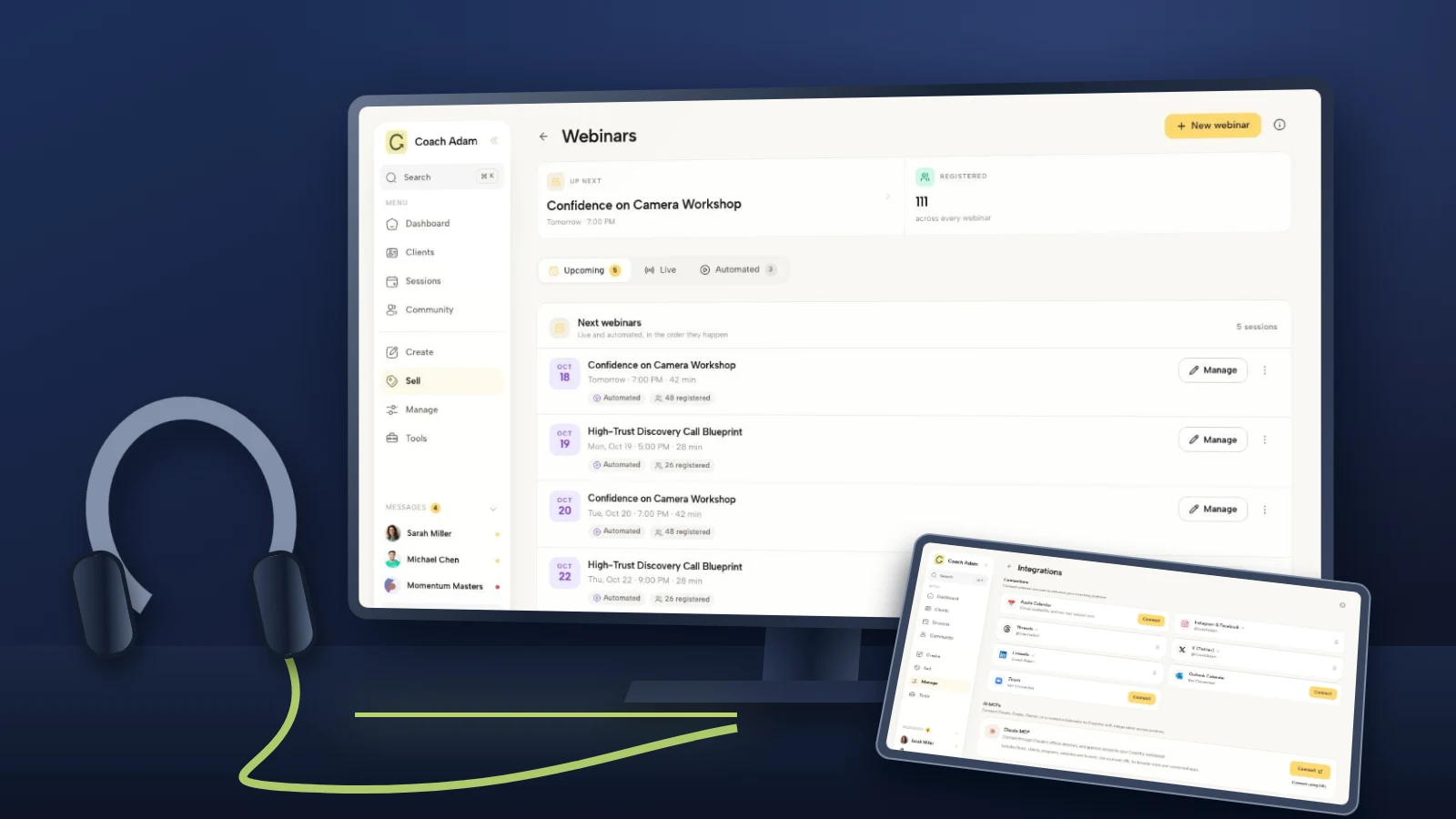
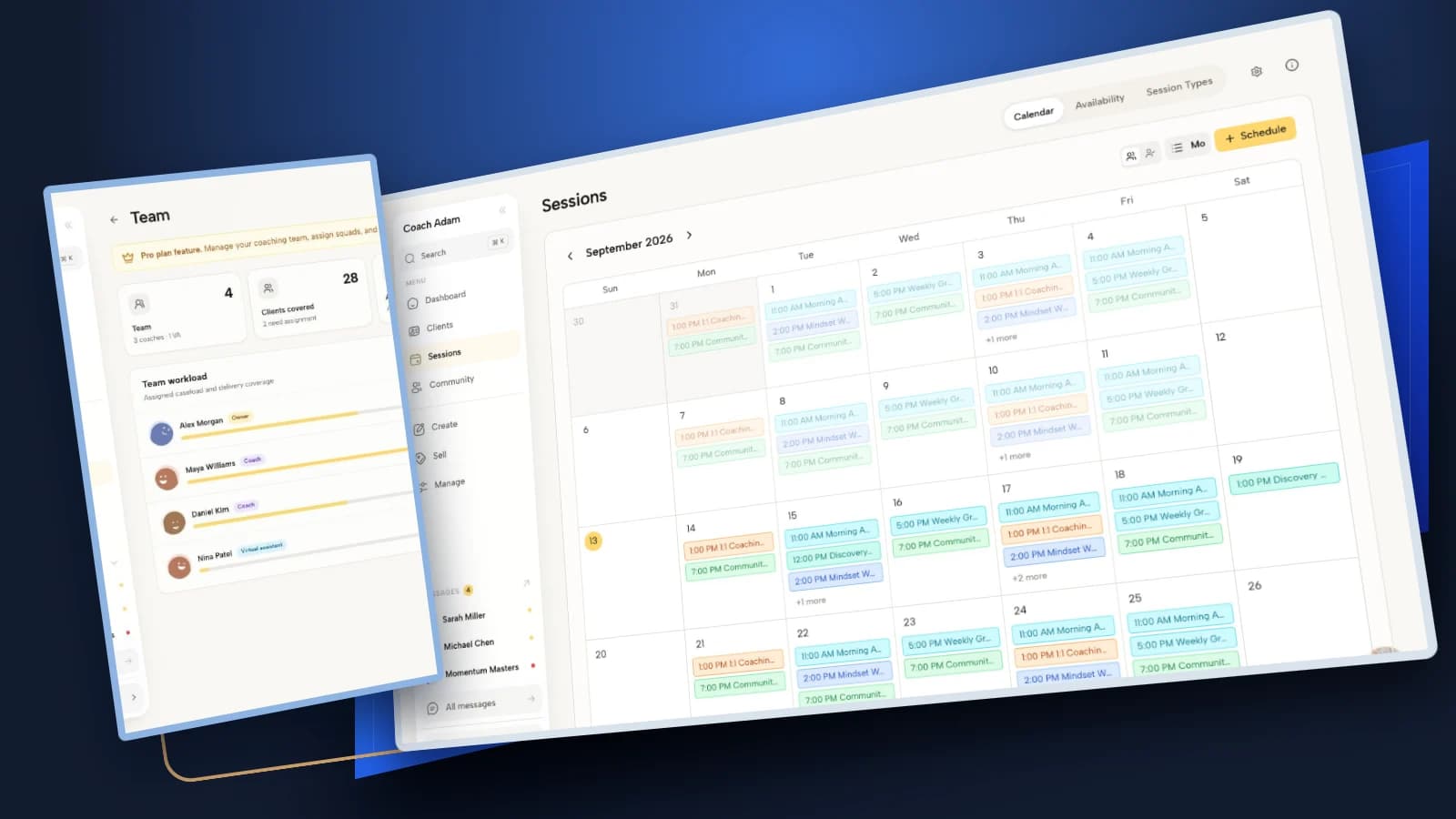
The Coachful demo screens in this guide show actual team, scheduling, program, communication and client-progress surfaces. They illustrate places to administer agreed work, not a built-in SOW generator, legal review service or automated procurement integration.
If your next step is testing whether the promised delivery can be run without losing the boundaries you just wrote, try the interactive Coachful demo. Walk through one participant's scheduling and progress experience, then ask whether it matches the service you intend to sell.
Frequently asked questions
Is a coaching statement of work the same as a contract?
Not necessarily. It can be a schedule incorporated into a contract, part of a combined document or a separate instrument. Its legal effect depends on its wording and the surrounding documents. Get legal review rather than relying on the label.
Does every coaching client need a separate SOW?
No. A simple individual engagement may state the complete scope in one reviewed agreement. A separate SOW becomes useful when a corporate buyer, multiple participants, several deliverables or a purchasing process makes a dedicated schedule easier to administer.
Can a sponsor approve changes on behalf of participants?
Commercial authority and participant consent are different questions. A sponsor may approve additional spending without having authority to change what private information a participant shares. Review both when a change affects reporting, access or the nature of coaching.
What if procurement sends its own template?
Use the buyer's required structure, but reconcile it with your actual service and reviewed legal terms. Flag clauses that demand guaranteed outcomes, unrestricted access to notes or services outside your competence. A familiar template is not evidence that the provisions are appropriate.
What is the most important final check?
Ask whether another coach could identify exactly what must be delivered, and whether the participant could identify exactly what remains private. If either answer depends on a conversation nobody documented, the schedule is not finished.