Coaching Workshop Invitation Email: 5 Templates to Adapt

Nour
Founder, Coachful
“How do I invite people to my coaching workshop without sounding pushy or leaving the important details out?”
Lead with a problem the intended participant recognises, explain the work they will actually do, and give one specific registration step. Include the date, time zone, duration, format and price before asking for a commitment. A good invitation helps someone decide whether to attend; it does not need to turn one workshop into a promise to change their life.
Choose the template by the relationship and the purchase decision, not just the coaching specialty. An invitation to existing subscribers, a paid-workshop offer and a message a partner forwards need different explanations. Below are five complete coaching workshop invitation email templates, plus a practical editing and registration check.
All workshop titles and arrangements in the samples are fictional teaching examples. Bracketed details must be replaced with your real information. These are copy templates, not live events, campaigns or evidence of registration results.
Write down the workshop facts before the email
The annoying version of workshop promotion is rewriting a lovely invitation because the event page says something different. Create a short source-of-truth brief first. You should be able to answer these questions without improvising:
- Who is it for? Name the person and situation, including any important prerequisite.
- What happens? Distinguish listening, individual work, paired practice and individual coaching.
- What can they leave with? Choose a draft, practised skill, comparison or next action the session can support.
- What are the practical terms? Confirm date, time zone, duration, location or online format, price, materials and cancellation arrangements.
- What is the next step? Use an actual event registration or enquiry destination, not an unrelated offer.
Also settle recording, sharing expectations and any optional sales segment. Do not promise a replay before deciding whether participant discussion can appropriately be recorded. A registration page can hold fuller terms, but the email must not create the opposite impression.

Choose one of these five invitation templates
These templates serve five genuinely different situations: a general subscriber invitation, a relevant-resource follow-on, a standalone paid workshop, a partner-forwarded invitation and an employer-sponsored session. Pick the closest situation and remove details that do not match your delivery.
Each sample needs your normal sender details, business information and appropriate unsubscribe mechanism. The bracketed registration instruction is a placeholder, not a working link. Replace it with a visible, specific HTTPS link in the real email and test it before sending.

1. The invitation to your existing, opted-in audience
Use when: people already receive relevant marketing from you, but may not have heard about this workshop. Give enough context to understand the event without retelling your entire professional biography.
Subject: A workshop for the career decision you keep circling
Preview text: Compare two options and plan a useful next investigation.
Hi [first name],
If you are weighing two career directions and keep returning to the same pros-and-cons list, this workshop is designed for that decision.
In Career Decisions: Compare Two Options, we will use guided reflection and individual worksheet time to examine your priorities, compare your options and identify what you still need to find out.
Bring one realistic decision. You will work on a comparison you can continue using afterwards; you do not have to share personal details with the group.
It takes place [date], [start and end time, time zone], [online or venue]. The price is [actual price and currency, or clearly state free]. [State recording and materials arrangements accurately.]
Read the details and register here: [specific HTTPS registration URL].
[Your name]
Why this works: the opening describes a recognisable situation, while the body names the actual activities. A comparison to continue using is a proportionate takeaway. “Finally discover your perfect career” would promise a much larger result than the workshop controls.
Change before using: replace the sample audience, activities and participation rules. If sharing is essential, do not leave the optional-sharing sentence in place because it sounds reassuring.

2. The next-step invitation after a relevant resource
Use when: a subscriber has requested a related resource and your permissions allow this relevant marketing. Explain how the workshop extends the topic without pretending the download proves they need coaching.
Subject: Want to practise the delegation conversation?
Preview text: A working session that follows the conversation guide.
Hi [first name],
You requested my [actual resource name], so I wanted to share a related workshop: Delegation Conversations: Practise the Opening.
The guide covers preparation. This session makes time to draft an opening, rehearse it with a partner and revise it using a short feedback prompt.
It is for [actual audience] who have a suitable conversation to practise. Bring a low-sensitivity example, or use the fictional scenario provided.
We meet [date and time zone] for [duration], [format]. Participation includes [actual activity expectations]. The price is [actual amount or free], with [actual materials and recording arrangements].
If that practice would be useful, see the session details and register: [specific HTTPS registration URL].
[Your name]
Why this works: the reason for the email is explicit. The workshop adds practice, rather than charging for information deliberately missing from the free resource. It also helps readers distinguish a practice lab from a presentation they can watch quietly.
Change before using: mention the resource only when the person actually requested it. Avoid invented behavioural claims such as “I noticed you have been struggling with delegation.” A click or download is not evidence of a private problem.
3. The standalone paid-workshop invitation
Use when: you are asking someone to buy a ticket. Name the price and inclusions, and make clear whether the workshop is useful without buying a subsequent coaching package.
Subject: Build a weekly planning routine you can test
Preview text: A paid working session, with the worksheet included.
Hi [first name],
If client requests keep displacing your own priorities, I am running a practical workshop on building a weekly planning routine.
We will review one recent week, identify the commitments that disrupted your plan and draft a routine you can test the following week.
The ticket costs [actual total and currency, with applicable charges stated clearly]. It includes [actual session length, materials and access]. It does not include [important exclusions, such as individual coaching or ongoing messaging].
The workshop is [date, start and end time, time zone], [online or venue]. [Explain preparation, participation and recording arrangements.]
You do not need to purchase further coaching to use the workshop materials. [Include this only if true.]
Review the full details and ticket terms, then book here: [specific HTTPS registration URL].
[Your name]
Why this works: the reader can assess the purchase before clicking. The message sells a bounded piece of useful work, not a vague transformation or access to support you have not priced.
Change before using: remove bracketed coaching notes and put the real price in the email. If there is a genuine registration deadline or participation cap, state it with its reason. Do not manufacture a countdown, claim seats are nearly gone without evidence or hide an unavoidable additional charge.

4. The partner-forwarded invitation
Use when: a relevant organisation or partner has agreed to share the event with its own appropriate audience. Give them transparent, ready-to-adapt wording rather than asking for their email list.
Subject: An optional workshop for [community name]
Preview text: [Coach name] is hosting a session on [specific working objective].
Hi [first name],
We are sharing an optional workshop from [coach name], who works with [accurate audience and expertise].
[Workshop title] is designed for [participant situation]. During the session, participants will [actual activities], with the aim of leaving with [proportionate takeaway].
The event takes place [date and time zone], [format and duration]. The price is [actual amount or free]. [State any membership condition, recording arrangement or important participation requirement.]
[Explain the real relationship or any relevant commercial benefit. Do not claim an endorsement the partner has not given.]
Read the workshop details and register directly with [coach or organiser]: [specific HTTPS registration URL].
[Partner sender name]
Why this works: readers know who is presenting and who is sharing the invitation. The partner does not have to impersonate your voice or imply a personal experience of your coaching that never happened.
Change before using: agree the wording, relationship disclosure and registration route with the partner. Do not add their members to your list. The registration experience should explain who receives information and what further messages a participant is choosing to receive.

5. The employer-sponsored workshop invitation
Use when: an organisational sponsor invites a defined group to a session you facilitate. The main uncertainty may be participation and privacy, not the ticket price. Agree the facts with the sponsor before they send it.
Subject: [Team]: feedback-conversation practice on [date]
Preview text: What we will practise, how to prepare and who will attend.
Hi [first name],
We have arranged a workshop with [coach name] for [defined participant group] on practising the opening of a feedback conversation.
The session includes a demonstration, scenario-based rehearsal and a group debrief. Please bring a low-sensitivity example or use the fictional scenario supplied.
It is [optional or required, accurately stated] and takes place [date, time zone, duration and location or online format]. [Explain how the employer covers the cost and any participant action required.]
[State the agreed recording arrangements, what information the facilitator will share with the sponsor, and how individual examples will be handled.]
Please review the participation details and [register or confirm attendance] here: [specific HTTPS event URL]. For access arrangements, contact [actual contact].
[Sponsor name and role]
Why this works: an employee can understand the purpose and expectations without wondering whether an apparently optional workshop is an undisclosed assessment. The sponsor's authority should not turn an unclear invitation into compulsory personal disclosure.
Change before using: settle attendance, reporting and recording explicitly. Do not promise absolute confidentiality across a group or imply you will provide individual performance reports unless that is an appropriate, clearly agreed part of the service.
Who should receive the invitation?
A useful template is not permission to email every name in your contact system. Review why you hold each address, what the person agreed to receive, whether the event is relevant and whether they have opted out. A past discovery call or previous event registration does not automatically create permission for all future promotions.
Requirements depend on jurisdiction and recipient type. The FTC's CAN-SPAM guide explains US commercial-email requirements, including accurate sender information, non-deceptive subject lines, a valid postal address and an opt-out route. The UK ICO's electronic-mail marketing guidance describes consent rules and the limited soft-opt-in exception; that guidance is currently marked as under review. These are different frameworks, not a universal permission rule.
Use the rules applicable to your practice and audience, and obtain qualified advice where needed. Do not send a promotional “permission request” to an otherwise ineligible list as a shortcut. Existing clients may need operational information about an included session, but adding a paid-workshop promotion changes the purpose of that message.

Invitation, confirmation and reminder are different emails
An invitation asks an eligible person to register. A confirmation tells a registrant what they signed up for. A reminder helps that registrant attend. Mixing them makes the experience clumsy: someone who has already booked should not keep receiving “Have you reserved your place?” messages.
For a modest event, start with one clear invitation and decide whether a second, genuinely useful note is appropriate. It might answer a common participation question or clarify the preparation. There is no universal send count or best hour that guarantees registrations.
If there is a real closing date, a final invitation can state it accurately. Suppress people who registered and people who opted out. Separately, registered participants need the correct access information and any preparation or change notices. Check the real audience rules rather than assuming automation knows which message belongs to whom.

Keep the post-event task separate too. Our webinar follow-up email templates cover messages after the event. Do not copy a replay email into the invitation sequence or promise a recording you have not decided to provide.
Check the registration link as a participant would
Open the exact link from the finished email on a phone. Confirm the workshop name, timing, price, inclusions and participation terms match. Complete the permitted test or preview steps in your own setup without accidentally making a live purchase, enrolling a real contact or sending a campaign.
The page should make the commitment understandable before the action. A free-looking email must not lead to a surprise paid checkout. A public profile can support discovery, but an invitation for a specific workshop should not make the reader search a long menu to find it.

Check the confirmation as well: correct date and time zone, correct access route, accurate preparation, and a clear contact for practical questions. Read the email with images hidden. The workshop promise, logistics and registration link must remain understandable without a banner or screenshot.
Frequently asked questions
How long should a workshop invitation email be?
Long enough to explain fit, activity, commitment and the next step, without repeating the full landing page. Start with a short opening, a concrete description, readable logistics and a linked action. Paid or interactive workshops need more explanation than a familiar, included session.
Should I put the price in the invitation?
Yes, when you are promoting a fixed-price ticket. State the real amount and currency and make relevant charges clear. For an organisational enquiry that genuinely requires scoping, explain why and invite a scope discussion rather than pretending there is a public ticket.
Can the subject line say “You're invited”?
It can, but pair it with a recognisable workshop topic. “You're invited: practise your next feedback conversation” tells the reader more than “An exclusive opportunity.” Do not imply exclusivity, personal selection or urgency when the same open invitation goes to the whole list.
Should the email include a discovery-call link as well?
Usually keep registration as the primary action. If someone needs to ask about access or fit, provide a practical contact route without turning the invitation into several competing sales paths. Explain any optional coaching offer inside the workshop description rather than disguising the event's purpose.
Send an invitation your workshop can keep
Pick the template that matches the relationship, replace the fictional details and compare the email with the event page. Then review permissions and test the actual next step. The strongest invitation is not the one with the loudest promise; it is the one a suitable participant can understand and trust.
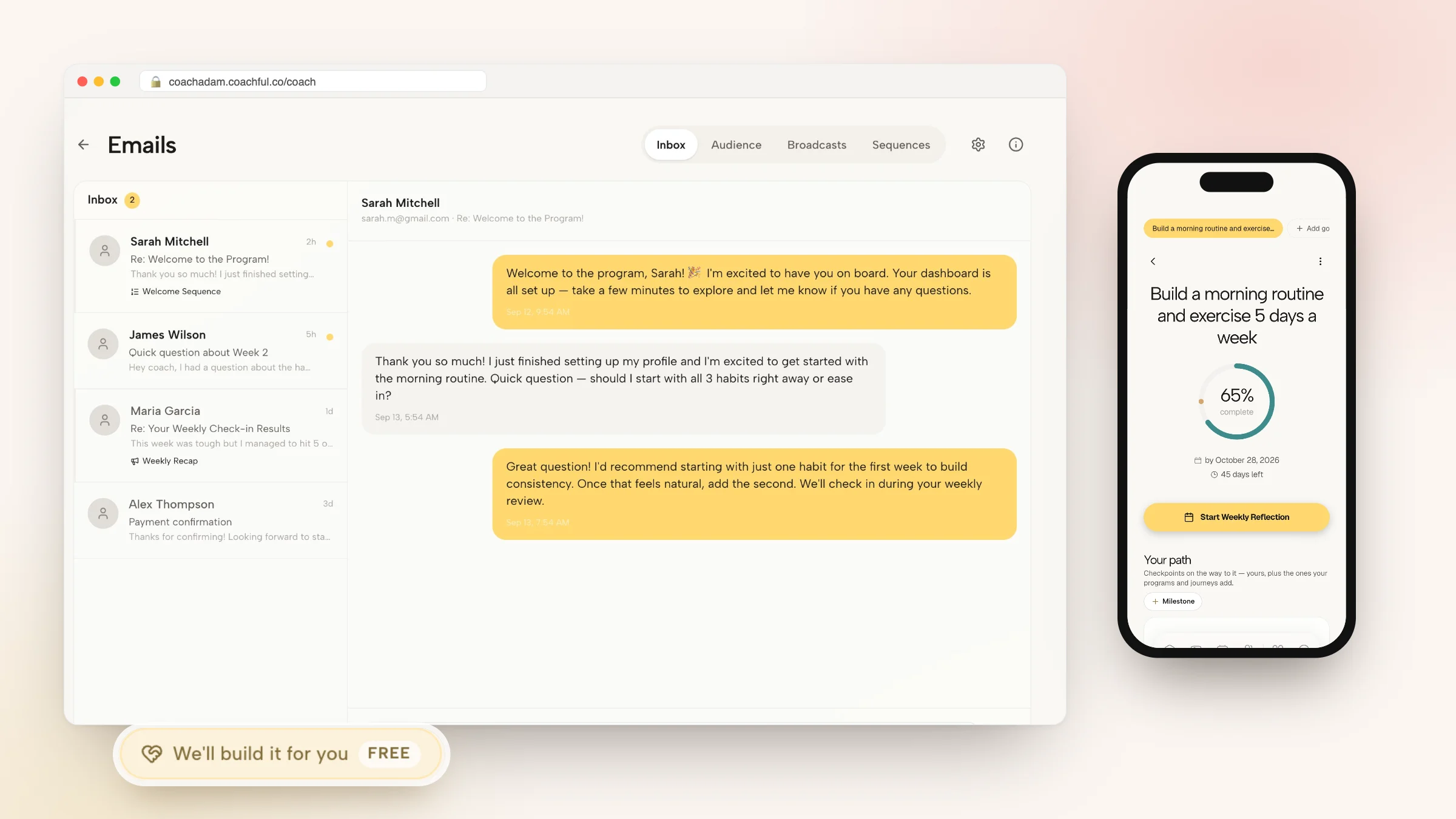
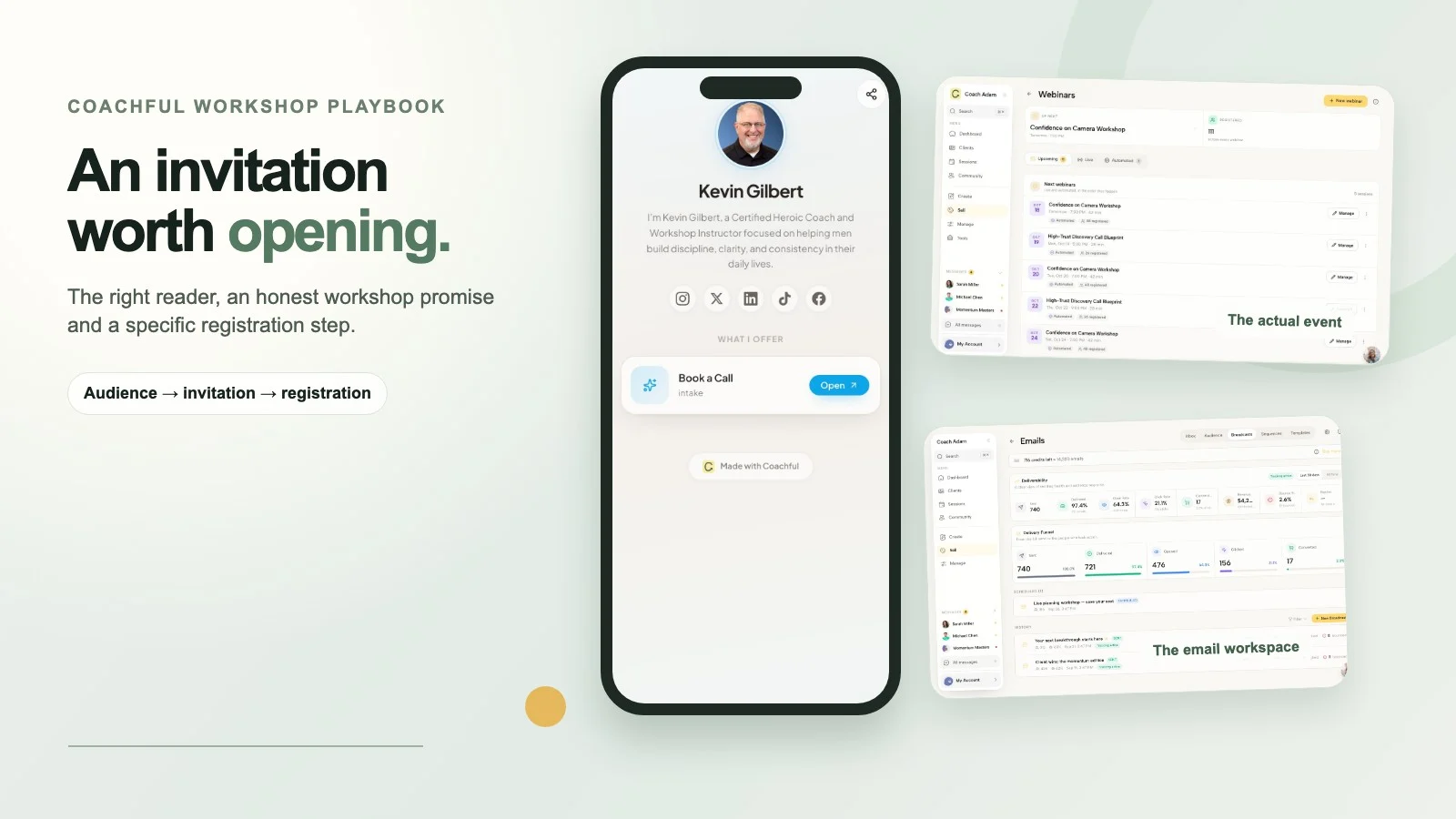
If you are choosing how to organise that experience, try the interactive Coachful demo. Inspect the event, email, page and follow-up workspaces shown here, then compare them with the journey your workshop needs. These screens illustrate real demo surfaces, not an already configured campaign or a guarantee about your event results.