Coaching Workshop Learning Objectives: 5 Worked Examples

Nour
Founder, Coachful
How do you write learning objectives for a coaching workshop without promising a transformation you cannot deliver in an hour?
Write what participants will practise or produce, under what conditions, and what will count as a usable attempt. Then build an activity that lets them demonstrate it. “Understand boundaries” is a topic. “Draft a response to a non-urgent request that states availability and offers a next step” is an objective you can actually design around.
This guide gives coaches five worked examples, a reusable writing template and a practical way to check whether the workshop supports its promise. The examples are fictional planning material, not customer results, accredited curricula or ready-made Coachful workshops.
What is a workshop learning objective?
A learning objective describes something a participant should be able to do by the end of a defined learning experience. For a coach facilitating a workshop, it connects the invitation to the exercise and the evidence you will review. It is not your presentation agenda, your client's entire coaching goal or a guarantee of later success.
Caltech's guidance on writing learning objectives recommends specific, measurable, observable actions that are taught and assessed within the experience. That distinction matters in coaching: a reflective conversation can be valuable without proving that a participant has mastered a skill.
- Topic: difficult conversations.
- Facilitator activity: explain a conversation structure.
- Participant objective: rehearse an opening that distinguishes an observation from an assumption.
- Longer-term aspiration: have more constructive conversations at work.
You can care about the aspiration while assessing only the bounded objective. Do not turn “we practised a conversation” into “our workshop improved workplace relationships.” Those are different claims requiring different evidence.

A copyable learning-objective template for coaches
By the end of [workshop or segment], participants will be able to [one observable action] using [scenario, tool or resource], with [criteria that make the attempt useful].
For example: “By the end of the practice lab, participants will be able to draft a delegation request using a fictional task, including the intended outcome, decision boundaries and a check-in point.” The standard describes the content of the draft, not a promise that the employee will accept it.
Choose verbs that match the work: compare, draft, distinguish, rehearse, prioritise, revise or explain. “Become confident” is difficult to observe directly. “Rehearse the opening and identify one revision” gives you something to examine without pretending confidence has a universal pass mark.
Do not add a number merely to make the sentence look measurable. Naming three strengths may be useful, but naming three arbitrary strengths is not automatically better than describing one relevant strength with evidence. The quality criterion should serve the participant's decision.

5 coaching workshop learning-objective examples
These five examples are selected by the kind of work participants do: compare, rehearse, prioritise, draft and design a test. They are not the same objective with five niche labels. Choose the pattern that fits your actual workshop and adjust the difficulty to the audience.
1. Compare two options against explicit criteria
Use this for: a career or business decision workshop where participants already have two plausible options. It is not an exercise for choosing someone else's career for them.
By the end of the workshop, participants will be able to compare two realistic options using a decision worksheet, showing their criteria, available evidence and one important uncertainty.
Activity: demonstrate the method with a fictional choice, then give participants individual working time. Invite them to challenge one assumption behind their comparison. They may use the fictional case rather than reveal personal plans.
Evidence: an anonymised or private worksheet containing two options, relevant criteria, reasons for the comparison and an unanswered question. A useful review asks whether the evidence supports the distinction, not whether the facilitator likes the eventual choice.
Do not claim: that everyone will identify their ideal career or the most profitable business direction. A defensible output may be a better question to investigate, not a final decision. If participants cannot name two options yet, use an exploration workshop instead.
2. Rehearse a specific conversation opening
Use this for: leadership workshops where participants need practice rather than another lecture on communication.
By the end of the practice lab, participants will be able to rehearse a feedback opening using a fictional workplace scenario, separating an observed behaviour from an interpretation and inviting the other person's perspective.
Activity: show one example and one deliberately weak opening. Let pairs practise, exchange feedback against the stated criteria and try a revision. Offer a written version where speaking practice is not appropriate or accessible, while being clear that it demonstrates a different form of performance.
Evidence: a short observer note recording what was heard, followed by the participant's chosen revision. “You seemed confident” is less useful than “you named the missed deadline without saying the colleague was lazy.”
Do not claim: that a single rehearsal proves management competence or resolves a real conflict. This is practice in a bounded scenario, not a performance assessment for an employer. Agree separately what, if anything, a sponsor receives.

3. Prioritise commitments using a stated constraint
Use this for: planning workshops where participants need to make a trade-off, not simply produce a longer task list.
By the end of the workshop, participants will be able to prioritise a sample week's commitments using a capacity limit, making required work, discretionary work and one explicit trade-off visible.
Activity: provide a fictional week with competing requests. Ask participants to build a first plan, introduce a realistic interruption, then let them revise it. Afterwards, they can privately apply the process to their own week.
Evidence: a plan that respects the chosen limit and explains what was postponed, reduced or renegotiated. A packed calendar is not proof of good prioritisation. Ask what the participant would communicate to anyone affected by the trade-off.
Do not claim: that participants will eliminate overwhelm or gain a fixed number of productive hours. You are checking a planning decision within the exercise, not measuring their future wellbeing or performance.
4. Draft a boundary message with an actionable next step
Use this for: a coaching workshop about everyday availability, scope or non-urgent requests. Avoid using a simple communication exercise to handle abuse, danger or a legal dispute.
By the end of the workshop, participants will be able to draft a response to a non-urgent request using a fictional scenario, stating their availability or scope and offering an appropriate next step.
Activity: give two versions of a request: one within the agreed arrangement and one outside it. Invite participants to draft responses and consider how the relationship or power imbalance changes what is safe and realistic.
Evidence: a message that makes the limit understandable without insulting the recipient or inventing an obligation. A suitable next step could be a different time, a scope discussion or a simple decline. An alternative is not always owed.
Do not claim: that better wording guarantees respect. The other person may still react badly. Allow participants to opt out of personal disclosure, and stay within your competence when situations involve coercion, clinical concerns or employment rights.

5. Design a small behaviour experiment
Use this for: a workshop in which participants want to test a planning or follow-through practice. The learning is in designing an informative test, not in promising a permanent habit.
By the end of the workshop, participants will be able to design a one-week experiment using a planning worksheet, naming a cue, a manageable action, a likely obstacle and a review question.
Activity: compare an oversized resolution with a small test, then let participants design their own. Ask a partner to identify what would make the result hard to interpret. Revise the test before the workshop closes.
Evidence: a plan that specifies what will be tried and what will be reviewed. “Did I do it?” may be part of the review, but so can “Was the cue visible?” or “Did the action fit the situation?” Missing a day is information, not a character judgement.
Do not claim: that a one-week plan creates lasting behaviour change or treats a health condition. If you are running health-related coaching, maintain the relevant scope and referral boundaries. The workshop objective here is to design a test.
How many objectives should a coaching workshop have?
Use as few as you can teach, practise and review properly. For a short workshop, one substantial performance may be more honest than six ambitious objectives. This is a design recommendation, not an accreditation rule or a universal learning limit.
Work backwards from the evidence. If you promise an individual rehearsal, each participant needs an actual opportunity to rehearse. A large attendance number and a facilitator demonstration do not create that opportunity on their own.
Here is a fictional 75-minute practice lab: 10 minutes for orientation and boundaries, 10 for demonstration, 15 for a first attempt, 15 for feedback and revision, 15 for another attempt and 10 for a review and transfer plan. Adjust the timing for your format and access needs. If introductions consume the practice period, remove content or reduce the promise.

Separate essential objectives from optional extensions. The essential objective must remain achievable for someone who completes the advertised workshop. Do not quietly depend on a later paid program to deliver the central promise.
Check learning without making the room feel like an exam
Assessment can be a brief review of an example, a draft, an explanation or a rehearsal. Tell participants what you are looking for before the activity. Otherwise, they are guessing the standard while trying to learn.
Use a small set of descriptive criteria. For the boundary-message example, check whether the message states the limit, stays within the facts of the scenario and gives a suitable next step. Invite a revision rather than treating the first attempt as a verdict.
Keep three kinds of information separate: satisfaction, engagement and performance. A participant may enjoy the session but struggle with the task. They may watch every video but be unable to apply the method. They may perform the exercise well while disliking the format.

A self-rating can help start a conversation, but it does not independently demonstrate skill. If you collect a confidence score before and after, report it as a self-rating from the respondents, with the limits of that evidence. Do not relabel it as proven competence or commercial return.

Decide what to retain before collecting participant work. Explain who can see it, whether feedback is private and whether a sponsor receives any summary. Use fictional scenarios where real details are unnecessary. A learning objective does not create permission to store personal disclosures or publish examples.
Make the participant-facing promise match the lesson
Once you have written the objective, compare it with your workshop description, materials and actual delivery. A registration page that promises mastery should not lead to a session that offers only an introduction. A lesson title should make the activity easy to locate, not require people to decode your internal framework.

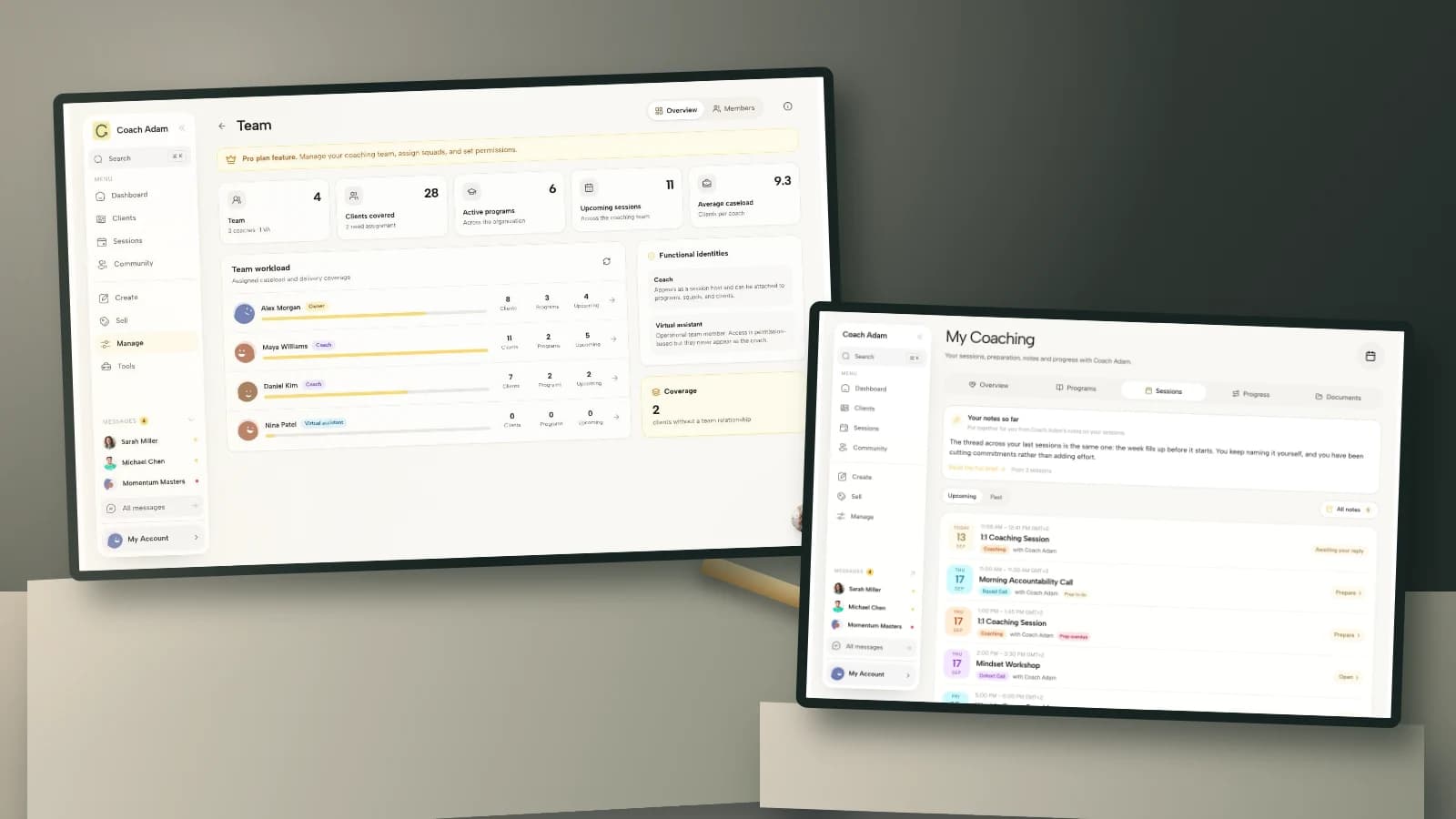
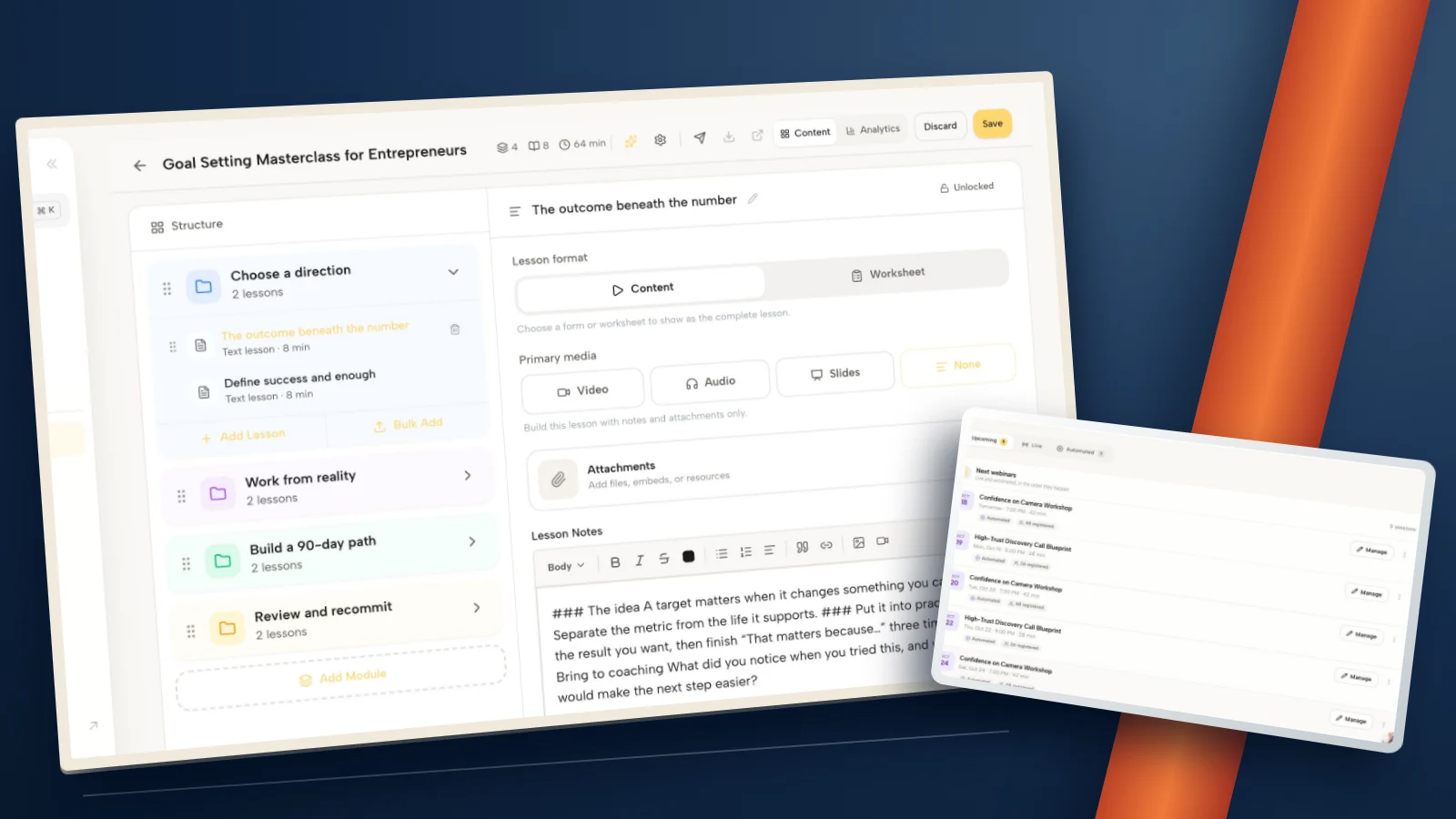
Coachful's demo includes course editing, webinar, form and course-analytics workspaces. These can illustrate organising delivery and reviewing participation. They do not establish that a workshop objective has been met, and the sample courses shown here are not the five examples in this article.
You do not need software to write a good objective. Start in a document. Once the objective and exercise fit, inspect the actual participant path: can someone find the relevant material, understand the activity and see how to prepare? Use the demo to explore the delivery surfaces rather than assuming a particular assessment or reporting workflow is already configured.
A final five-question objective audit
- Can I observe it? Replace a vague internal state with a relevant action, without denying the value of reflection.
- Do I teach and practise it? The agenda needs time for the action, not just an explanation of it.
- Is the standard useful? State what makes the attempt workable, rather than adding an arbitrary score.
- Is the promise proportionate? Separate an in-session attempt from mastery or a later personal result.
- Can participants take part safely? Clarify disclosure, accessibility, feedback and reporting arrangements before the activity.
If an objective fails the audit, either change the workshop or change the sentence. Polishing the sales copy cannot repair a delivery mismatch. For the promotional layer after that, use the coaching workshop description examples.
Frequently asked questions
Are learning objectives the same as coaching goals?
No. A coaching goal can describe a broader change the client chooses to pursue over time. A workshop learning objective describes a bounded action the session is designed to support. Connect them where useful, but do not treat one completed exercise as proof that the wider goal has been reached.
Can a reflective workshop have measurable objectives?
Yes, if the evidence respects the purpose. Participants might compare interpretations, identify an assumption or draft a question to explore. You do not need to grade their private values or demand disclosure to make the workshop purposeful. Some insights can remain private and unassessed.
Should I use Bloom's taxonomy?
It can help you choose the level of action, but a sophisticated verb does not rescue a poorly designed task. Start with the work participants genuinely need to do. “Evaluate” is only useful when you specify what they evaluate, using what criteria and with what support.
Do these objectives qualify a workshop for continuing education?
Not by themselves. Approval depends on the relevant accrediting body, program requirements and application process. Do not advertise continuing-education credit, certification or accreditation because the objectives look formal. Confirm the actual rules before making that claim.
Write the evidence before the headline
Choose one useful thing participants can attempt. Write the criteria, design the activity and make room for a revision. Then describe that experience honestly. A modest-sounding objective with a strong exercise is more useful than a dramatic promise with no way to practise it.
When you are ready to connect that exercise to delivery, Try the interactive demo to inspect Coachful's course, webinar and form workspaces. Keep the objective in charge of the setup, not the other way around.