Email List Migration Checklist for Coaches: 7 Checks

Coachful
Editorial Team
How do you move your coaching email list without accidentally mailing people who already unsubscribed? Transfer the mailing decisions, not just the addresses. Keep promotional sending disabled until the new provider preserves exclusions, permission evidence, audience boundaries and the position of any ongoing sequence.
A CSV full of names is not a working migration. The expensive mistake is importing a former client as a fresh subscriber, restarting a welcome sequence they finished last year, or letting two providers send the same launch email.
This email list migration checklist is for a coach switching newsletter or email-marketing systems. It is not a guide to moving Gmail inbox messages, transferring payment subscriptions or inviting clients to a new coaching portal. Those are separate jobs with different permissions.
The seven checks before your first send
- Define what is moving and who owns the cutover.
- Preserve exclusions before making anyone send-eligible.
- Map permission and audience fields without inventing consent.
- Reconcile unique addresses and conflicting records.
- Rebuild sequence position without replaying old promises.
- Reconnect signup points and test both joining and leaving.
- Approve a controlled cutover with a rollback plan.
The practical deliverable is an explained recipient count, a tested exclusion process and a single system responsible for the next newsletter. A larger imported audience is not a success measure.
1. Define the migration before exporting anything
Write down the source provider, destination provider, newsletters included, responsible person and proposed cutover time. Note which forms feed each audience, which sequences are running and whether messages are already scheduled. Keep the working document private.
Separate marketing subscribers from service contacts. A paying coaching client may need session information while declining your newsletter. A newsletter reader may never have been a client. Moving these people into the same database must not silently make their communication choices identical.

Decide which historical data you actually need. Subscription source, relevant signup wording, preference changes, exclusion reason and sequence position can matter. Private session notes, health information and detailed coaching goals usually do not belong in a marketing migration file.
Confirm both providers' actual export and import behavior before relying on a spreadsheet. An export labeled “all contacts” may include unsubscribed records; another may contain only active subscribers. An import may update existing contacts, trigger automation or overwrite fields. Read the documented behavior and ask support when it is unclear.
Keep the destination's promotional sending and automations inactive during preparation, using the provider's supported controls. Do not assume that importing is a silent operation. If you cannot establish what an import triggers, resolve that before uploading real records.
2. Move exclusion rules before making contacts eligible
Identify unsubscribes, complaints, provider-suppressed addresses, hard bounces and any practice-specific do-not-market decisions. Retain the reason and scope where available. A newsletter-specific opt-out and a global marketing opt-out are not automatically the same instruction.
Campaign Monitor's email-provider switching checklist explicitly includes creating a suppression list alongside importing subscribers. The important operational point is ordering: exclusions must already work when anyone becomes eligible to receive a campaign.

Map each source status to the destination's supported status or exclusion mechanism. Do not simply import an “unsubscribed” text column and assume the sending engine reads it. A label is documentation; a functioning exclusion is behavior you must verify.
If the destination cannot represent the necessary choice, hold that address out of promotional sending while you establish a supported method. Do not turn an opt-out into an ordinary contact tag and hope everyone remembers to filter it.
Follow the source provider's actual bounce classifications. Mailchimp's bounce guidance distinguishes hard and soft bounces and notes that providers handle them differently. A temporary mailbox problem is not permission to ignore repeated failures, but it is also not interchangeable with a confirmed unsubscribe.
Preserve the minimum information needed to honor exclusions through an appropriate retention process. Deleting every trace of an opt-out can let a later import bring the same address back. This is practical operational guidance, not a universal legal retention rule; requirements depend on your circumstances.
3. Map permission evidence, not a convenient yes/no guess
For each send-eligible address, establish why it belongs in that newsletter. Useful evidence includes the signup source, date, wording or form version, topics selected and any later preference change. The exact evidence available will depend on the old system.
Do not translate “client,” “attendee,” “downloaded worksheet” or “booked discovery call” into “subscribed to all marketing.” Those labels describe activities, not a complete permission basis. Moving providers does not expand what a person agreed to receive.
Keep unknown permission as unknown. Exclude that group from the migration's send-eligible population while you review it. Do not send a promotional “please consent” blast merely to fix missing records. Whether any contact is appropriate depends on the relationship, proposed message and applicable rules.

Recorded engagement is not a replacement for permission. Apple Mail Privacy Protection can inflate open tracking by downloading content without the recipient reading it. Missing tracking can also obscure genuine attention. Neither a recorded open nor a missing one establishes a subscriber's choice.
For coaches, this distinction protects the service relationship as well as the newsletter. Someone can value your work and dislike promotional email. Do not require them to accept launches and offers to keep receiving necessary information about an existing engagement.
4. Reconcile counts and conflicting records
Before importing, count unique mailing addresses under a documented matching rule. Review duplicate and conflicting records instead of automatically keeping the newest row. A recent export of a stale signup form should not override a later unsubscribe recorded elsewhere.
Trim accidental whitespace and inspect obvious formatting problems, but do not guess a person's corrected address. Do not merge distinct addresses because their names look similar. Avoid provider-specific rewrites, such as stripping dots or plus-addressing from every mailbox, as a universal deduplication rule.
Build mutually exclusive reconciliation categories so one address is counted once. The example below is fictional and illustrates bookkeeping, not a recommended list-cleaning threshold or Coachful customer data.
- 600 unique source records.
- 40 addresses excluded for existing stop requests or complaints.
- 20 additional addresses excluded for documented invalid-delivery status.
- 80 additional addresses held out because permission evidence is unresolved.
- 50 additional addresses already sunset under the source mailing policy.
- 410 addresses remaining eligible for the defined newsletter.

The calculation is 600 − 40 − 20 − 80 − 50 = 410. These categories are nonoverlapping by design. If an address is both unsubscribed and invalid, assign it to one count category while retaining all relevant reasons in its protected record.
Reconcile the destination against this explanation, not merely against the original 600. Keep separate counts for total stored contacts, suppressed contacts and newsletter-eligible recipients. Providers can display those populations differently.
If the numbers disagree, stop and locate the discrepancy. Possible causes include rejected rows, duplicates, field mapping, exclusions or differing report definitions. “Close enough” is not an acceptable reconciliation when the difference might be people who asked not to hear from you.
5. Rebuild sequences without starting everyone again
Inventory each running sequence: purpose, entry condition, emails already received, waiting steps, exit conditions and next intended action. Export what the source makes available. A subscriber list alone may not preserve any of this state.

Do not bulk-enroll existing subscribers into the new welcome sequence unless that is genuinely the intended and appropriate experience. Someone halfway through a resource course should not receive the first lesson twice or an invitation for an event that has already happened.
Choose an explicit treatment for people already in progress. You might let a bounded sequence finish in the source while new signups enter the destination, or move a carefully defined cohort to a supported equivalent step. These are planning options, not promises that either provider transfers sequence progress automatically.
Document which system owns each message during any overlap. If a person remains in a source sequence, ensure that the destination does not send the same sequence. Keep opt-outs synchronized through a supported process, or avoid overlapping promotional sending when that cannot be made reliable.
Review scheduled broadcasts separately from sequences. Copying content does not cancel the original schedule. Record what is canceled, retained or recreated, and verify the actual records. Do not assume closing a browser tab or removing a contact from one list stops every pending message.
6. Reconnect signup points and test leaving, not just joining
List the public entry points: website forms, resource pages, link-in-bio pages, workshop registration flows and older links still circulating. Update only the ones you control and have authority to change. Keep a record of any old endpoint that still accepts signups.

Use a minimal signup form that accurately describes the newsletter, expected content and relevant frequency. Do not carry a coaching intake questionnaire into newsletter registration simply because the old form had those fields. A subscription usually does not require a person's wellbeing scores or private circumstances.
Check the destination's supported confirmation and preference mechanism. A thank-you page proves only that a page loaded. It does not prove the correct subscription record was created, an exclusion was respected or a preference changed.

Test using an authorized environment or addresses you control. Never use real subscribers as unannounced test subjects. Your test set should cover the important states, including someone already excluded from marketing.
- New signup: the stated newsletter and confirmation behavior match the promise.
- Existing subscriber: repeating a signup does not create duplicate sends or replay an unwanted sequence.
- Excluded address: an import or unrelated form submission does not silently reactivate promotional eligibility.
- Opt-out: leaving changes the actual destination record and prevents the relevant future marketing.
- Active client: newsletter choices do not unexpectedly remove agreed service access or essential communication.
If a person independently requests to subscribe again, use the provider's supported resubscription process and applicable rules. Do not interpret a migrated row, a page visit or a link scanner's click as that request.
7. Approve the cutover and retain a rollback plan
Before the first real campaign, verify the sender identity, reply path, domain authentication, unsubscribe route, intended audience and destination links. Complete the provider's sending-domain setup rather than assuming a domain that worked elsewhere is ready in the new account.

Keep a baseline of the old provider's recent delivery reports with their definitions. Review the first destination sends against that context, but do not promise identical inbox placement. A correctly migrated address list is only one part of email delivery.
Approve one system as the owner of new newsletters at the cutover. Keep the old account available, subject to your plan and retention needs, until you have checked late opt-outs, pending sequences and any records needed for reconciliation. Do not delete the source account as the first cleanup step.
Write a rollback instruction before sending: who can stop destination campaigns, how to preserve new preferences, which source messages must remain paused, and what must be investigated before resuming. Rolling back software must not roll back a person's newly expressed opt-out.
Commercial-email and privacy obligations vary. The FTC's CAN-SPAM guidance explains US commercial-email responsibilities and the distinction from transactional or relationship messages. Other jurisdictions can impose different or additional requirements. A migration checklist does not replace an assessment of the rules that apply to your practice.
Copy this migration sign-off
This is a manual control record, not an automatic Coachful report. Complete it before authorizing the first destination campaign. Keep personal data and raw exports in appropriately protected storage, not in a shared public checklist.
Source / destination: [providers and relevant account identifiers].
Scope: [newsletters, forms and sequences included].
Cutover owner and time: [person, date, time zone].
Counts: [unique source, exclusions by reason, unresolved, eligible destination].
Permission mapping: [fields, source wording and unresolved gaps].
Sequences: [cohort, next step and responsible system].
Opt-out tests: [test record, expected result and observed record state].
Service continuity: [client communication route checked].
First campaign: [sender, audience and reviewed content].
Rollback: [stop procedure, preference preservation and owner].
Approval: [reviewer and any outstanding exception].
Frequently asked questions
Should I email everyone to announce the new provider?
Not automatically. Subscribers usually care about the content and their choices, not your software purchase. Send a notice only when it is appropriate and useful, for example when a relevant service detail changes. A system switch is not permission to contact unsubscribed or unproven addresses.
Can a list-verification service establish consent?
No. A mailbox assessment concerns an address's technical characteristics, not whether its owner asked for your coaching newsletter. It also introduces another data processor to assess. Do not upload client data to a new service without reviewing necessity, security, terms and applicable obligations.
Should I delete inactive subscribers during the move?
Do not mix a provider migration with an unexplained new deletion policy. Preserve existing states first. If you separately review inactivity, consider permission, cadence and imperfect tracking. Our newsletter re-engagement templates address that different editorial decision.
Does importing coaching clients subscribe them to marketing?
It should not be treated as permission to do so. Verify the actual destination behavior and keep service records separate from promotional eligibility. If a tool cannot preserve that distinction safely, hold promotional sending until the problem is resolved.
Move the choices, then move the sending
Start with the exclusion map and count reconciliation, not the import button. The useful result is a newsletter whose recipients and stopping rules you can explain before the first message leaves the new provider.
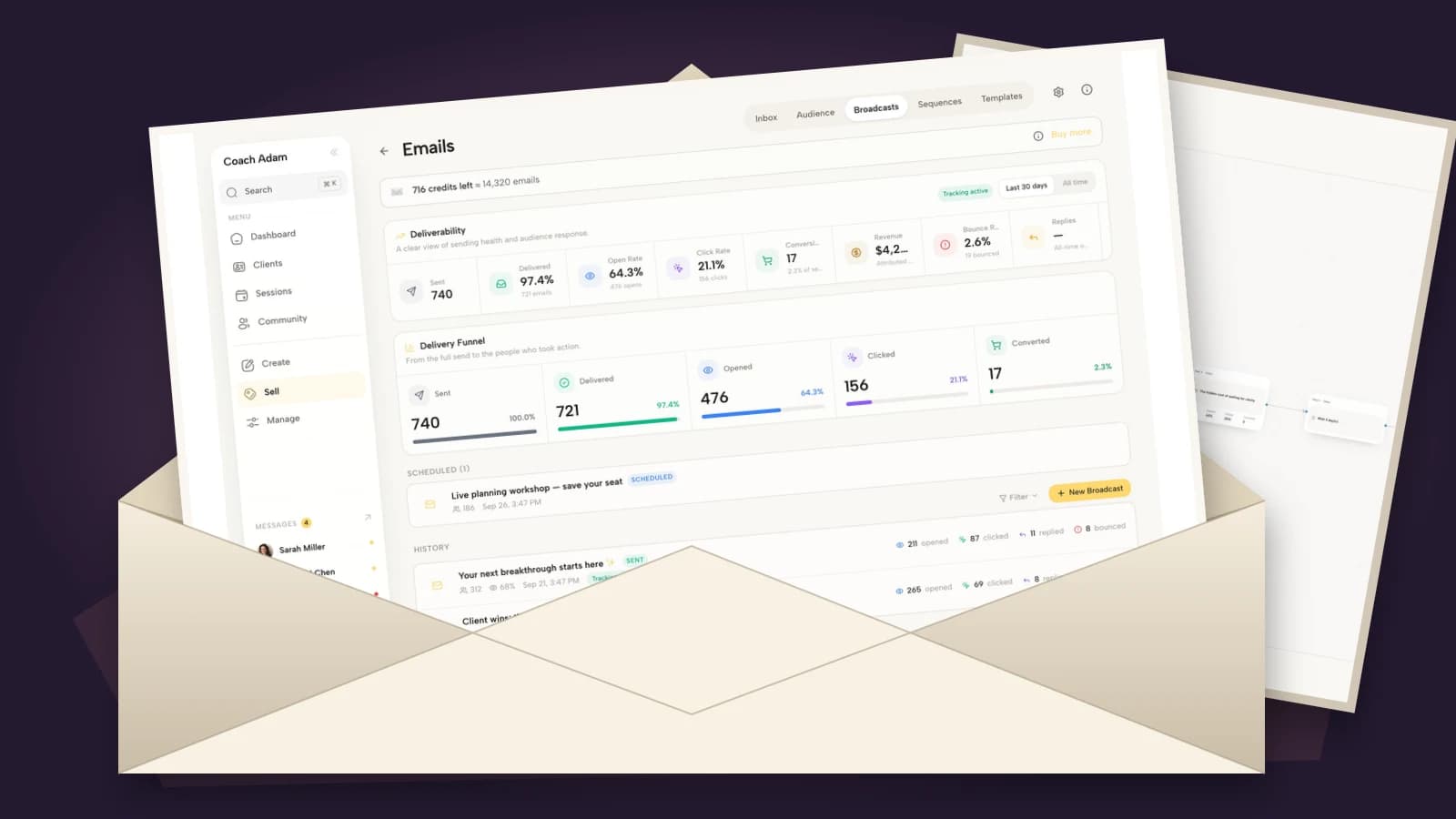
If you are considering Coachful as part of the move, Try the interactive demo to inspect the actual email, sequence, form and link workspaces. Then verify the migration and suppression mechanisms available for your account before uploading subscribers. The screens here demonstrate those workspaces, not a one-click transfer of consent, sequence state or provider reputation.
Sources and limits: Campaign Monitor supplies the provider-switching reference; Mailchimp explains bounce handling and Apple privacy-related open tracking; the FTC supplies US commercial-email context. The checklist, fictional reconciliation and illustrations are original editorial guidance. No subscriber import, audience change or email send is performed by this article.