End-of-Engagement Coaching Feedback That Isn't a Testimonial Ask

The last session ends warmly. A week later you send a short email: "It would mean a lot if you could write a few words about working with me." Maybe you get two kind sentences. Maybe you get nothing. Either way you have learned almost nothing about what to change, the client has quietly noticed that your goodbye was also a request, and six months later they have no particular reason to think of you when a friend asks for a coach.
The International Coaching Federation's advice to established coaches is to "Establish robust feedback systems to collect client insights. Use this information for data-driven enhancements to your practice and to reconnect with former clients." Notice what is not in that sentence: testimonials. Feedback is for learning and for the relationship. Proof is a separate request.
The short answer: split the end of an engagement into three moments and ask for each separately. First, learn: a final review conversation and a short written feedback request with open, specific questions. Second, reconnect: a check-in some months later that asks how they are doing and offers something useful. Third, and only where it is welcome, proof: a separate testimonial invitation to people who have already said something you would love to share, with their permission. Then turn the feedback into changes you can point to.
Coachful details were checked on 3 October 2026.
Why feedback requests turn into testimonial asks
- The timing is the same. Both requests land in the week after the last session, so clients read them as one.
- The questions lead. "What did you love most?" invites praise, not insight.
- There is no follow-up. If nothing changes after clients give feedback, they stop giving it.
- Every touch is an ask. When the only messages former clients receive want something, they stop opening them.

The end-of-engagement feedback system in four touchpoints

1. A final review session
Use the last session, or part of it, to look back together: where they started, what changed, what is still unfinished and what they will do next. This is coaching, not a survey, and it gives the written feedback something concrete to refer to.

2. Short written feedback within a week
Send a few questions while the experience is fresh. Keep it short enough to finish in a few minutes, and say how you will use the answers. Give people the option to answer anonymously if you want blunter feedback, knowing you lose the chance to follow up on specifics.
3. A check-in some months later
Ask how things are going, nothing more. Results from coaching often show up after the engagement ends, and this is when former clients notice who remembered them. Offer something useful, such as a resource or an invitation to an alumni event, rather than a sales pitch.
4. A testimonial invitation, only where welcome
If someone has already said, in the review or the check-in, something you would love to share, ask separately whether you may use it. Offer to draft it from their own words, let them edit it, and ask how they want to be named. Everyone else is simply never asked.
Samantha Kasbrick explains why the way a client engagement ends deserves its own process, the same thinking behind a planned feedback sequence. Source: YouTube.
Coaching feedback questions that produce useful answers
- "What is different for you now compared with when we started?"
- "Which part of our work helped most, and why?"
- "What got in the way, from your side or mine?"
- "If you were designing this program for the next person, what would you change?"
- "Was there anything you wanted to say during our work together and didn't?"
- "Who, if anyone, do you think this kind of coaching would suit?"
Avoid questions that can only be answered with praise, and avoid long rating grids. A rating tells you that something felt off; an open question tells you what.
Turning coaching feedback into delivery improvements
- Group comments into themes such as pacing, between-session support, materials and scheduling.
- Check themes against what clients actually did. If several say the middle weeks dragged, look at check-ins and task completion for those weeks.
- Change one thing at a time, so you can tell whether it helped.
- Close the loop. Tell former and current clients what you changed because of feedback. Few things build more trust.

For the numbers worth tracking alongside feedback, see coaching business KPIs, and for catching problems before an engagement ends, spotting at-risk clients.
Reconnecting with former coaching clients without a pitch
- Tag clients as alumni when the engagement ends, so later messages can be written for them specifically.
- Plan two or three check-ins across the following year, each with a reason: a question, a resource, an invitation.
- Mention new offers only when relevant, and never in every message.
- Respond personally when someone replies. The automated part is the reminder, not the conversation.

For writing to alumni as a segment, see segmenting a coaching newsletter by client stage. If someone is ready to continue, see when to start the renewal conversation.
Asking for a coaching testimonial the right way
- Ask separately from feedback, and only people who have expressed something specific.
- Quote their own words back and ask permission to use them.
- Let them edit, and agree how they are named: full name, first name, role or anonymous.
- Record what they agreed to, and remove it if they change their mind.
- Never offer anything in exchange for a positive review.
Permitted, specific testimonials are also what make a website credible; see the coaching website audit. If an engagement ends early because it was not a fit, handle that differently; see ending an engagement that is not a fit.
Mistakes that undermine a coaching feedback system
- Sending the feedback form and the testimonial request in the same email.
- Asking only for ratings.
- Collecting feedback and never changing anything.
- Contacting former clients only when you have something to sell.
- Keeping feedback in scattered emails where patterns are invisible.
- Holding personal feedback longer than you need it; see record retention and deletion.
Running end-of-engagement feedback in Coachful
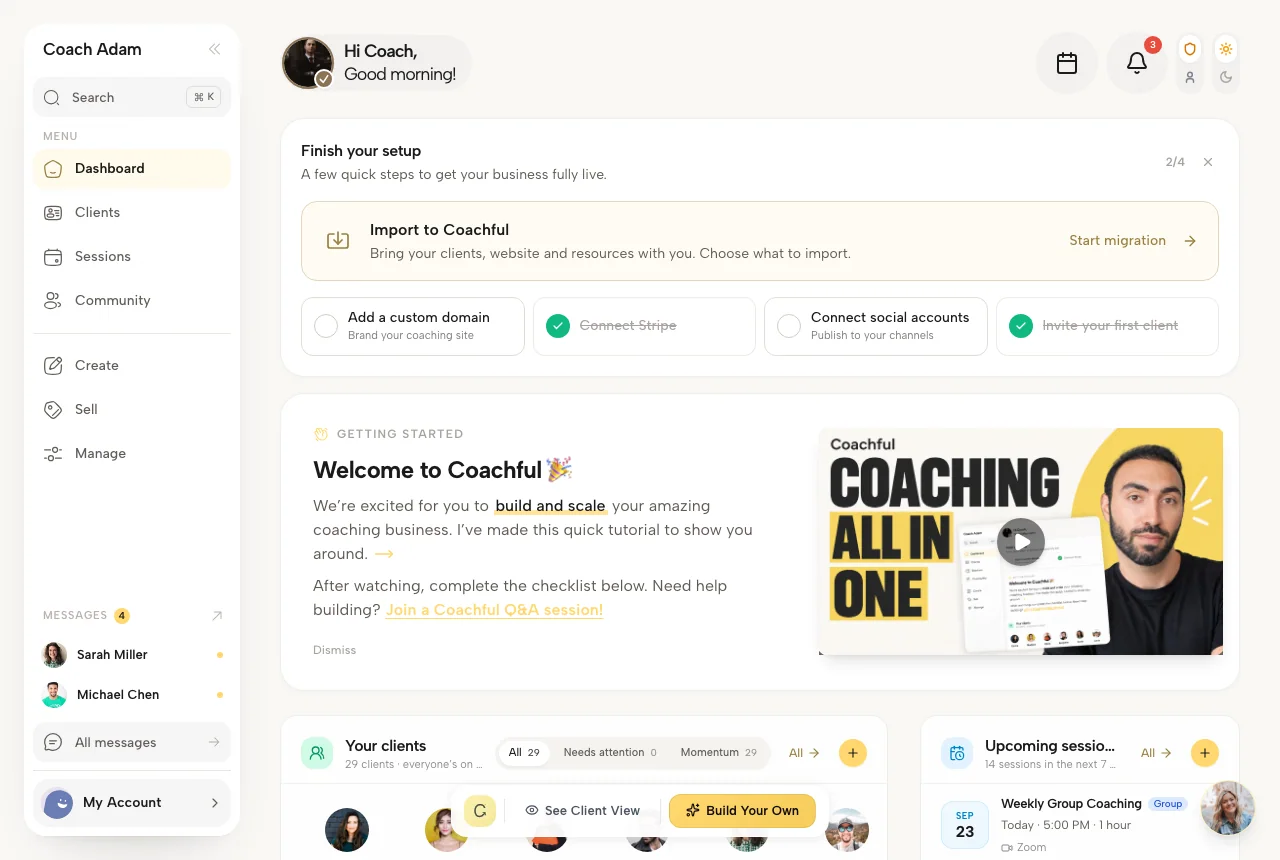
- The review starts from real progress: goals with progress bars and weekly check-ins give you and the client a shared record of what happened.
- Feedback lands on the client record: questionnaires can be sent to clients, with responses kept alongside their history.
- Patterns are visible: client activity and engagement analytics sit next to the written feedback.
- Reconnecting is planned: tags and segments mark alumni, and email sequences can start when a tag is added, with delays between check-ins. Coaching-flow journeys can run a short win-back path.
- Calls are included: the final review and any later catch-up run on built-in video, with no separate video subscription.
Coachful has a 7-day free trial, card required, no charge during the trial, cancel in one click.
Frequently asked questions
When should coaches ask clients for feedback?
In a final review conversation, then with a short written request within about a week of the last session, while the experience is fresh. A later check-in some months on adds perspective on results that showed up after the engagement.
What questions should a coaching feedback form include?
Open, specific questions: what changed, what helped most, what got in the way, what they would change for the next person and anything they did not say. Avoid questions that can only be answered with praise.
Should I ask for feedback and a testimonial at the same time?
No. Asked together, clients read both as a request for praise and you get neither honest feedback nor a strong testimonial. Ask for testimonials separately, only from people who have already said something specific, and with permission.
How do I reconnect with former coaching clients without being salesy?
Plan a few check-ins over the following year, each with a genuine reason: a question about how they are doing, a useful resource or an invitation. Mention offers only when relevant and reply personally when they respond.
Should coaching feedback be anonymous?
It depends on what you need. Anonymous feedback can be more candid; named feedback lets you follow up and fix specific problems. Some coaches offer both options in the same form.
What should I do with negative feedback?
Thank the client, look for whether the same theme appears elsewhere, and change one thing you can test. If appropriate, tell the client what you changed. Negative feedback handled well often builds more trust than praise.