Audit Your Coaching Website So the Right Clients Book a Call

Your website is live. People visit it after a podcast, a referral or a post you shared. And then very little happens. A few book calls that turn out to be the wrong fit, most leave without a word, and you cannot tell whether the problem is the design, the copy, the price or the traffic. So the tempting move is to redesign everything, or to spend money sending more people to a page that is not working yet.
The International Coaching Federation puts the stakes simply: "Your coaching website is often your first introduction to a potential client." It should carry "your background and experience, the types of coaching you offer, and a way to reach you," which is the "information a potential client needs to decide whether to work with you."
The short answer: audit the site as a stranger, in the order a stranger thinks. Can they tell who it is for? Can they tell whether they fit? Do they have a reason to believe you? Is the next step obvious and right for them? Fix the first question that fails before touching the next one, and before spending anything on design, traffic or ads.
Coachful details were checked on 3 October 2026.
The four-question coaching website audit

Each question depends on the one before it. A visitor who cannot tell who the site is for never gets as far as reading your testimonials. A visitor who trusts you but cannot find the next step leaves anyway. That is why the order matters more than any single fix.

1. Can a stranger name your coaching niche from the first screen?
Look only at what shows before anyone scrolls, on a laptop and on a phone. Check that:
- The headline names who you help and what changes for them. "Helping you live your best life" fails. "Coaching for new managers who want their team to stop routing every decision through them" passes.
- The words are your clients' words, not coaching jargon. Clients search for "burned out," not "misaligned with my values."
- The image matches the audience. A photo of you, or of the kind of person you coach, beats a generic sunrise.
- There is one main button, not four competing ones.
Then test it: show the first screen to two or three people outside your field for a few seconds, close it, and ask "who is this for?" If their answers differ, the headline is the first fix. For phrasing ideas, see coaching tagline examples, and if the real issue is that you have not chosen a niche, start with the coaching niches list.
Y Combinator reviews real homepages against a first-impression test. The companies are startups, but the question, "do I understand this in a few seconds?", is the same one a coaching visitor asks. Source: YouTube.

2. Can the right visitor tell they fit, and the wrong one tell they don't?
A site that tries to welcome everyone makes the right people work harder to recognise themselves. Check for:
- The problems you solve, described the way clients describe them, ideally as a short list a visitor can nod along to.
- Who it is for and who it is not for. A line like "This is not therapy, and it is not for people looking for a quick fix" saves you a call that would have gone nowhere.
- The types of coaching you offer, as the ICF advises: format (1:1, group, intensive), length and what is included.
- A price signal. A price, a starting price or "packages are discussed on the call" are all valid choices. Showing a figure filters out people who could never afford it; leaving it out puts the conversation on the call. Pick one deliberately rather than by omission.
- Answers to the questions people ask on every call, in a short FAQ.
For how much detail to give before or after the first conversation, see discovery sessions vs paid first sessions and building a coaching offer page.
3. Is your proof credible enough to act on?
"Background and experience" is the ICF's first essential, and it is where many coaching sites either undersell or overclaim. Check for:
- Relevant background, told as why you understand this client's problem, not a full CV.
- Credentials that matter to the buyer, such as a coaching credential or professional experience in their field, stated plainly.
- Testimonials used with permission, specific about what changed, with a name or role where the client has agreed to it.
- A real photo of you. People are deciding whether to talk to a person.
- Nothing you could not back up. Round numbers like "hundreds of clients transformed" invite doubt unless they are true and you can say how you counted.
For writing the background section itself, see life coach bio examples.

4. Is the next step obvious, and the right one?
Every page should answer "what do I do now?" with one primary action, repeated where a reader would look for it. Then check that the step matches the visitor:
- Ready to talk: a booking link for a discovery call, with a few intake questions so you can prepare and screen. See keeping discovery call bookings safe.
- Not ready yet: a useful free resource or newsletter, so the visit does not end in nothing.
- Prefers to write first: a visible way to reach you, which the ICF lists as an essential.
Click every button yourself, on a phone, and book a test call. Broken links and booking pages that ask for too much are among the quietest ways to lose a ready client.

A coaching website audit checklist you can run today
| Question | Passes when | Common fix |
|---|---|---|
| Who is this for? | Strangers name your audience after a quick look | Rewrite the headline in clients' words |
| Is it for me? | Problems, formats and "not for" are visible | Add a short problem list and a "who this is for" section |
| Why believe them? | Background, credentials and specific testimonials are easy to find | Replace vague claims with specific, permitted proof |
| What do I do now? | One clear action, working on mobile | One primary button, a test booking, a contact option |
What to fix first on a coaching website
- The first failing question in the audit, nothing else.
- Copy before design. Most fixes are words, not layouts.
- Mobile before desktop, because many visitors arrive from a phone.
- Measurement last: once the page is clear, track which sources bring people who book. See tracking which visibility activities bring clients.
Coaching website mistakes the audit usually finds
- A clever headline that describes you, not the client.
- Every service on the homepage with equal weight.
- Testimonials that praise you without saying what changed.
- "Contact me" as the only next step, with no booking link.
- A booking form so long that ready clients give up.
- Redesigning before rewriting.
Fixing the website in Coachful
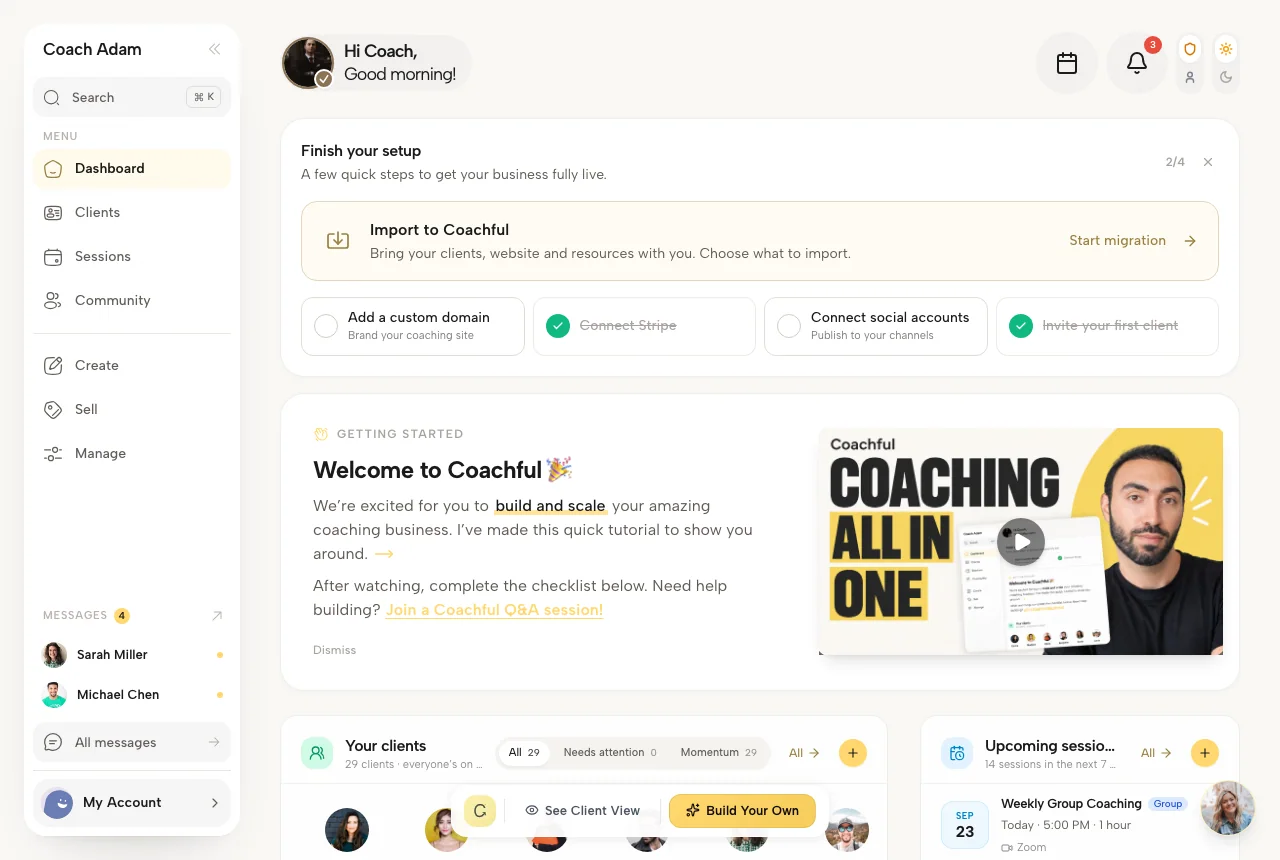
You do not need a new website to run this audit; most fixes are copy you can change wherever your site lives. If you want the website, booking and screening in one place, Coachful includes:
- A section-based website builder with in-place editing of the first screen, including headline, buttons, testimonials and trust logos, plus a blog, custom domain and SEO settings.
- Booking pages with intake questions attached to the client record, and application funnels when you want to screen before a call.
- One source of truth for proof: a profile area holding your background, services, testimonials, niches and credential progress, which Coachful's AI features use when generating website content.
- A mobile link page with your photo, one-line description and a single booking button for social profiles.
- Calls on built-in video, included in the subscription, so a booked discovery call needs no separate video tool.
Comparing builders before you decide? See platforms to build a coaching website. Coachful has a 7-day free trial, card required, no charge during the trial, cancel in one click.
Frequently asked questions
What should a coaching website include?
At minimum, the ICF's essentials: your background and experience, the types of coaching you offer and a way to reach you. In practice that means a headline naming who you help, the problems you solve, your formats, credible proof and one clear next step such as booking a call.
How do I know if my coaching website is the problem?
Run the four-question audit with people outside your field. If they cannot say who it is for, cannot tell whether they fit, see no reason to believe you or cannot find the next step, the site is losing visitors before traffic or price ever matter.
Should I put my prices on my coaching website?
It is a choice with trade-offs. A price or starting price filters out visitors who could never afford you and saves wasted calls; leaving it off keeps the conversation for the call. Decide deliberately and say how pricing works either way.
How many calls to action should a coaching homepage have?
One primary action, repeated, plus a gentler option for visitors who are not ready, such as a free resource. Several competing buttons make visitors choose, and many choose nothing.
What makes coaching testimonials credible?
Specifics. Say what changed for the client, use their words, and include a name or role only with their permission. Avoid numbers or claims you could not back up if asked.
Do I need to redesign my coaching website to fix it?
Usually not. Most audit failures are fixed with clearer headlines, a "who this is for" section, better proof and one working booking link. Redesign only after the words are right.