Facebook Lead Ads for Coaches: 5 Checks Before You Launch

Nour
Founder, Coachful

Facebook lead ads can help coaches invite relevant people into a consultation, but a submitted instant form is not a qualified lead or a booked call. Before launching, check five things: the promise in the ad, the questions in the form, permission to follow up, the handoff into your records, and the outcome you will measure. Optimize for conversations you can responsibly serve, not a dashboard full of cheap contacts.
The familiar annoyance is opening a promising lead list, writing a thoughtful message, and getting “I don't remember signing up.” An easy form can collect a real email without creating much understanding. Your job is to make the next step unmistakable before someone submits it.
This guide is for coaches considering Meta's native instant forms, which collect information without first sending the person to your website. It is not a promise of profitable advertising, a recommendation to buy ads before testing your offer, or an instruction to launch a campaign today.
What are Facebook lead ads, and when do they suit a coach?
A lead ad can open an instant form on Meta's platform. Someone reads your invitation, answers questions, supplies contact information and submits a request. You then need a reliable way to retrieve that request, respond within the permission given and help an appropriate person book a conversation.
That differs from a website campaign, where the visitor reaches your own page before submitting a form. Native forms reduce the journey between seeing the ad and responding. The trade-off is that your ad and form must do more of the expectation-setting that a substantial website page might otherwise handle.
Consider this route when your offer and audience are already understandable, the initial information you need is modest, and you have time to handle enquiries. Prefer a website-first path when a buyer needs detailed scope, evidence, accessibility information or a multi-person purchasing discussion before making a useful request.
If the unresolved question is whether to spend anything at all, start with our guide to paid advertising for new coaches. Here, the narrower decision is whether a native form creates a responsible, workable route into a coaching conversation.

1. Make the ad promise match the conversation you actually offer
A free resource, a free consultation and a paid coaching session are different offers. Do not advertise one and treat the resulting contact as permission for another. Choose the next step first, then write the ad and form around it.
For a hypothetical career coach, that next step might be a 20-minute conversation about interview preparation. The call checks the person's situation, explains the coaching package and lets both parties decide whether to continue. It is not a free interview coaching session and cannot promise an employment outcome.
Example ad copy:
Preparing for an interview after a career break? I offer coaching on choosing examples, practising answers and preparing a realistic plan. Request a 20-minute introductory call to discuss your situation and whether the paid package fits. Submitting this form requests a conversation; it does not book an appointment.
Use only substantiated claims about your credentials, experience and outcomes. Avoid copy that diagnoses the reader, assumes sensitive personal information or promises a result you cannot control. Health, relationship and other sensitive offers need particular care with platform policies and the information requested.
Meta's lead-ad best practices recommend clearly communicating why someone should complete the form and using relevant creative. For a coach, the useful question is simpler: could someone explain what will happen after submitting without speaking to you first?

Decide what the first response will say
Write your acknowledgement before writing the ad. If it sounds like a sales pitch for an unrelated service, the invitation is not coherent yet. A suitable acknowledgement identifies the request, explains who will respond and describes the next step without implying that a slot already exists.
Be honest about response timing. “I review requests on working days and will email you about the next step” is better than promising an instant personal response while you are delivering sessions. Put the same expectation in the form's completion message.
2. Ask enough to establish fit, not enough to run the first session
Use the instant form to establish whether a conversation makes sense. Save confidential coaching material for a more appropriate setting after the person understands the relationship and privacy arrangements. Do not turn a paid lead form into a detailed intake about health history, trauma, finances or intimate relationships.
A practical first version can ask for a name, a contact address and a small number of non-sensitive questions. Each extra field should change a real decision: whether you serve that situation, whether the timing works or which offer the person wants to discuss.
A coaching instant-form example
The following is an educational copy outline, not a Meta interface template. Adapt it to your offer and check the fields allowed in your account.
- Introduction: “Request an introductory conversation about interview-preparation coaching. We will discuss your needs and the paid package. This is not a coaching session or a guaranteed offer of work.”
- Contact: first name and the email address the person wants you to use.
- Relevant situation: “Which service would you like to discuss?” with options matching the services you genuinely offer.
- Timing: “When would you like to begin?” with realistic options, including “I'm exploring.”
- Completion message: “Your request has been submitted. Watch for an email about the next step. You have not booked an appointment yet.”
If you publish a fixed package fee, show it clearly before someone requests a call. If scope determines price, explain that basis honestly. Do not invent a low starting price that almost no suitable buyer can actually purchase.
Meta distinguishes form types including More volume and Higher intent. Its form-type documentation describes an additional review screen for Higher intent. Treat that as a setting worth evaluating, not a guarantee that every submission will remember you, qualify or buy. Availability and placement restrictions can change; inspect the current options in your account.
Keep the first version interpretable. Change one meaningful element at a time, such as the invitation or one qualification question. Rewriting the audience, price, form and follow-up together makes it hard to learn why lead quality changed.
3. Separate the requested follow-up from newsletter permission
A request for a consultation is not automatically permission for indefinite promotional emails. Explain how you will use the submitted information, provide an accessible privacy policy and collect any additional permission your circumstances require. This is operational guidance, not a substitute for jurisdiction-specific legal advice.
Meta's privacy-policy guidance for lead ads says the policy should accurately explain information handling. It also says the policy URL cannot link directly to a PDF, image or direct download. Use a readable public web page that reflects what your practice actually does.
Before publishing the form, check who receives the data, which systems will store it, how long you retain an unconverted enquiry, how someone can contact you about it and whether any additional marketing use is permitted. A copied policy that names tools you do not use is not a shortcut.
A narrowly scoped follow-up message
Hi [first name], you requested information about my interview-preparation coaching through the Facebook form. The introductory call is 20 minutes and helps us decide whether the paid package fits. If you would like to continue, you can choose a time here: [verified booking URL]. If you submitted by mistake or no longer want the call, let me know and I will close the enquiry.
Use a real, working HTTPS booking link in the message you send. The bracketed text above is a writing template, not a functional link. Include the identity and other notices your circumstances require. Do not add someone to a nurture sequence simply because the address transferred successfully.

Choose a restrained follow-up policy in advance. For example, your practice might send the requested information, one reminder and then close an unanswered enquiry. That is an editorial example, not a legal allowance or a proven optimum. Stop when a person declines or asks not to be contacted, and record that decision where future follow-up will see it.
4. Test the handoff from Meta to a real lead record and booking
The form can work while the business process fails. A lead may remain in a platform inbox, transfer without its source, arrive twice or lose the answer that determines whether you can help. Decide who checks new requests and how they become actionable records before any paid traffic starts.
Possible methods include a manual retrieval process or a connector supported by the systems you actually use. Do not assume that seeing a CRM or email editor means native Meta instant-form synchronization is enabled. Verify the exact integration, permissions, destination fields and failure behavior.

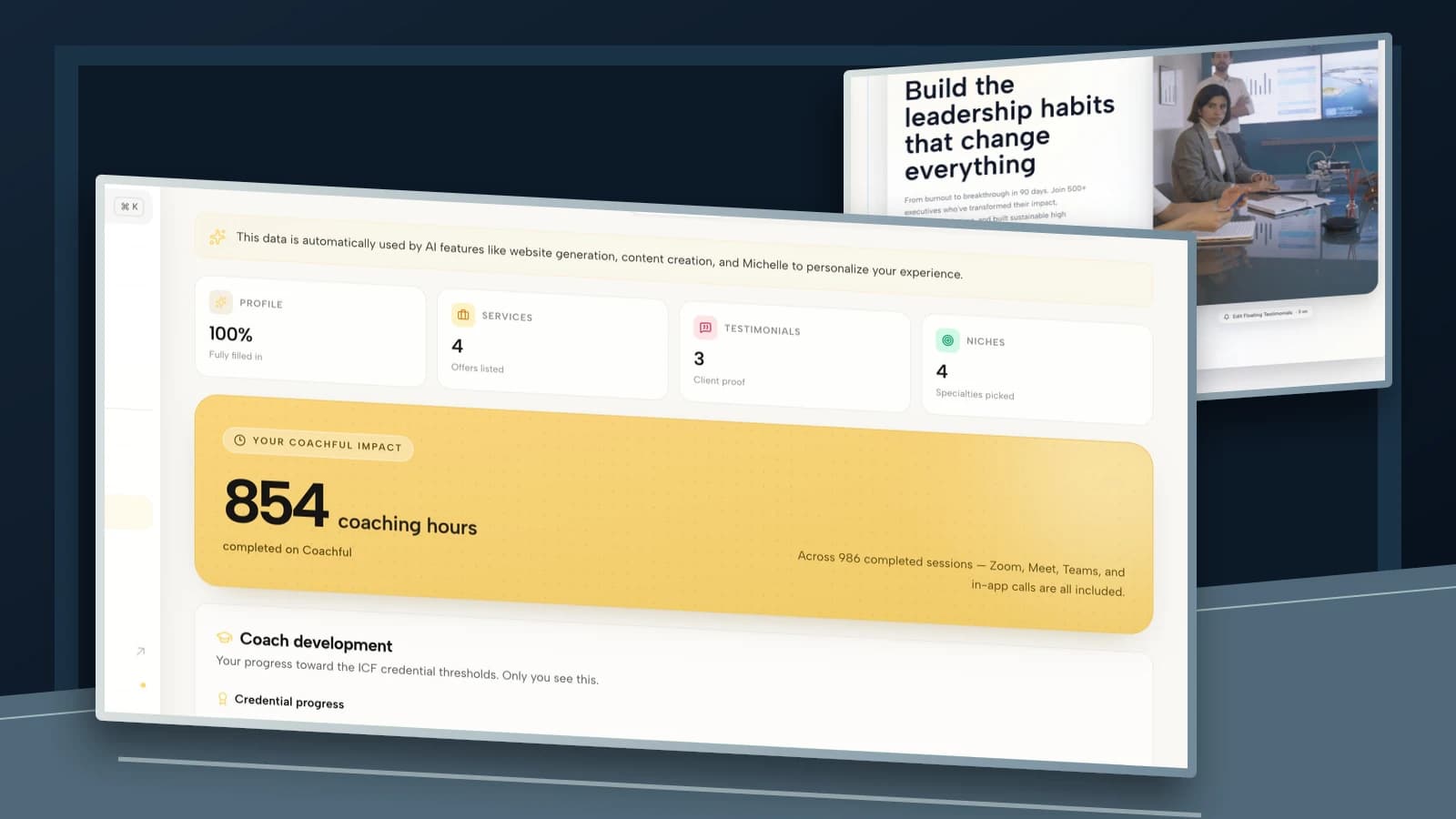
Coachful's lead-management, email and scheduling surfaces can help organize the downstream work. The screenshots here demonstrate those real surfaces, not a verified Meta instant-form import, an account-specific connection or an automatic enrollment rule. If your current system already handles the handoff reliably, use it for the initial test.
Run one end-to-end test with your own details
- Open the correct form through an available preview or testing route, checking that the published version matches your invitation.
- Submit a test request using contact details you control. Do not use a client's information.
- Confirm the request reaches the expected location with the right source, timestamp, answers and permission record.
- Check that the assigned person notices it and can send the intended response without unnecessary access to other client data.
- Follow the booking link on a phone. Check the time zone, available appointments, confirmation and meeting instructions.
- Repeat the transfer or retrieval check to see whether your process creates duplicates. Record the test separately from genuine enquiries.

A submission, a calendar visit and a confirmed booking must remain separate events. If the completion message offers a booking link, do not call everyone who saw it a booked consultation. Confirm a real appointment record exists.
Prepare a failure route too. If the transfer stops, who notices, where can the original enquiry be recovered and how will you avoid sending the same message twice? A modest manual check can be a reasonable early control. An unattended automation that nobody understands is not inherently safer.

5. Measure qualified attended calls before celebrating cheap leads
Write your fit criteria before reviewing the results. For the career-coaching example, those might be a relevant preparation need, a request for support within scope, workable timing and an understanding that the package is paid. Do not redefine “qualified” afterwards to make the campaign look better.
Keep one record for each person and preserve their original submission cohort. Record the form version, campaign, contact outcome, fit decision, booking, attendance and any eventual payment. A reschedule is not a second new lead. An unanswered enquiry is not automatically a poor-fit person.
Hypothetical calculation: a coach spends $300 and receives 30 valid submissions. Ten meet the written qualification criteria, and five attend a consultation. The advertising cost is $10 per submission, $30 per qualified lead and $60 per attended call. None of those numbers establishes a sale or profit.

The arithmetic is ad spend divided by the relevant completed outcome. Keep future appointments pending instead of counting them as no-shows. Report invalid submissions and duplicates separately, using consistent rules. Include sales time and other acquisition expenses when assessing the broader economics.
If you get submissions but few replies, inspect whether people understood the invitation and whether the response actually reached them. If suitable people reply but do not book, test the booking journey and available times. If attended calls are mostly unsuitable, revisit the promise and qualification questions. Each failure suggests a different next investigation.

Set a loss limit you can absorb and a review date that gives people time to respond and attend. Do not expand spend because a tiny early sample looks encouraging. For the wider pricing and acquisition-cost decision, use our paid-ads and CAC guide; this article's job is to make native-form lead quality visible.
Your pre-launch decision
Proceed only when a suitable person can understand the invitation, submit modest relevant information, see what happens next and reach a real conversation. You also need a named owner, a working handoff, an affordable loss limit and a consistent definition of a useful result.
If those conditions are missing, delay the campaign and repair the specific gap. More traffic will not make an unclear consent statement clearer or recover requests nobody checks. A functioning small process is more valuable than an impressive lead count.
To inspect the downstream work before committing to a tool, try the interactive Coachful demo. Look specifically at leads, email and scheduling, then decide how a test request would move between them in your practice. Confirm the Meta capture or transfer method separately before relying on it.
Facebook lead ads for coaches: common questions
Are Facebook lead ads better than sending people to my coaching website?
Not universally. An instant form can make responding easier, while a website gives you more room to explain the offer. Choose according to the information someone needs to make a meaningful request, then compare completed outcomes rather than form counts alone.
Should I choose Higher intent?
Consider testing it when every enquiry requires personal follow-up. Its review step can add deliberation, but it does not replace a clear invitation or your fit criteria. Check the current availability and restrictions in Meta's interface before designing your campaign around it.
Can I automatically add these leads to my coaching newsletter?
Do not assume so. Keep the requested consultation response distinct from ongoing promotional email. Review the notice and permissions collected, your jurisdiction's requirements and your actual email workflow before enrolling anyone.
Does Coachful automatically import Meta instant-form submissions?
This guide does not establish that capability. The screenshots demonstrate downstream lead, email and scheduling surfaces. Verify the exact supported capture or connector route in your account and run an end-to-end test before treating it as operational.
What is a good cost per lead for coaches?
There is no defensible universal target in the sources used here. A cheap submission can be expensive if it produces no suitable conversations. Use your own offer economics, actual completed outcomes and the cash you can afford to lose.
Sources and boundaries
The platform-specific points above draw on Meta's lead-ad best practices, instant-form-type documentation and privacy-policy guidance, linked beside the relevant claims. Platform controls can change. The sample copy, qualification criteria and test process are editorial guidance; the campaign numbers are hypothetical, not Coachful results or industry benchmarks. All product screenshots show demo data.